Second Darkness series:
- Book 1: Shadow in the Sky
- Book 2: Children of the Void
- Book 3: The Armageddon Echo
- Book 4: Endless Night
- Book 5: A Memory of Darkness
- Book 6: Descent into Midnight
- Reconstructing Second Darkness
Like a meteor crashing to earth, I’ve returned for my third series of deep dives into Paizo Adventure Paths. I’ve already tackled the most iconic AP, Rise of the Runelords, and one of the absolute best, Curse of the Crimson Throne. Those articles were great fun and are likely campaigns I’ll run in the foreseeable future. Yet I find myself more excited about this third deconstruction than even those famous adventures. This week, by all accounts, I have my work cut out for me.
So, what am I doing, exactly? These articles take each book of my chosen Adventure Path, breaking it down into what I consider the essential story beats. The result when I’m done is a massively pared-down adventure, ready to be fleshed out with details from the individual characters rather than pre-written bits. From the first post of my first series:
“You see, I absolutely love Paizo’s APs, but I also fully agree with Tarondor when he says (emphasis mine), “Even the best, most complete Adventure Path demands customization for your players and for their player characters. Publishers can’t think of everything your players might like or might do. That’s what you, the GM, are for. Don’t regard an Adventure Path as a straitjacket. Regard it instead as a particularly good set of notes from which you derive your own story. If you pretend it’s supposed to be a complete package that requires no alterations or prep work then your game will be flat and lifeless, no matter how good the writing.”
Indeed, I’ll take this idea further and say that most APs suffer from too many combat encounters, a lack of foreshadowing villains and other major plot hooks, excess and unneeded story beats, and way too many places where the story and character motivations become convoluted. It’s easy for players to pause, a confused look on their faces, and say, “Wait, what are we doing here, again?” Taking out huge sections, NPCs, etc. often improves the AP rather than detracting from it. Doing so also makes room for more PC-driven stories and side quests, which can feel bolted onto the heavy AP plots.”
Effectively, these articles are about me prepping my chosen Adventure Path to run it as a GM, culling what’s written into a coherent set of story beats that excite and make sense to me. With this goal in mind, I’ll return to my evergreen caveats for this series. I’ll repeat these points for each article, because they’re an important foundation for what I’m building here:
First and foremost, these edits are there to make the game that I want to run. What I consider “essential,” you may not, and vice-versa. You would make (or have made) different decisions, which is both natural and part of the fun. Feel free to comment below if you see different opportunities.
Second, I’m going to be making heavy edits. If you’ve run or played in the Second Darkness AP (which, by all accounts, is very few folks), I’m going to be deleting your favorite side quest, or NPC, or completely rewriting villain’s motivations and backstories. When I’m done, it’s likely not going to resemble the story you know.
Third, there will be rampant spoilers—in fact, once I dive in, these posts are essentially spoilers from start to finish. If you are a player in one of these APs or plan to be, these articles aren’t for you. (If you plan on GMing it or have done so, however… welcome!)
Finally, I don’t yet know what game system I’ll be using to run this Adventure Path, but it likely won’t be Pathfinder. Try not to get caught up in how dramatically I’m reducing the possible XP or treasure, or what I’m doing to CR of encounters. These articles are meant to be system agnostic, focused on story beats rather than mechanics.
With the preamble done, let’s jump in!
An Introduction to Second Darkness
Today I dive into Paizo’s third official Adventure Path, Second Darkness, published between August 2008 and February 2009. Second Darkness was initially created for Dungeons & Dragons 3.5, and unlike the first two APs, was never adapted to either edition of Pathfinder or the Pathfinder Adventure Card Game. There were no anniversary editions, no hardback collections, and I don’t know anyone in my network of longtime GMs who has ever run it or played in it. Why didn’t this third AP receive the same treatment as the first two? The answer explains why I’m so excited about this week’s series: Second Darkness is widely considered the worst Adventure Path that Paizo ever made.
Indeed, in Tarandor’s excellent Guide to Pathfinder Adventure Paths, Second Darkness ranks dead last in both his own ranking and his fan poll rankings. By way of explanation, I’ll quote his summary:
“At first glance, this adventure path has everything going for it: ancient secrets the elves are willing to die to protect, a secret war going for thousands of years, infiltrating a noble house in a drow city, a secret drow superweapon that could devastate Golarion. What more could you want from a campaign? Handled more deftly, all the ingredients are there for a classic that would have continued the momentum of Rise of the Runelords and Curse of the Crimson Throne. So what went wrong?
The complaints about this adventure path fall into three categories: 1) the first volume strongly encourages player characters to be focused on making money and discourages ethical characters, then much of the rest of the campaign assumes that the player characters will make ethical and selfless choices; 2) that the tonal shift from volumes 1 and 2 to volumes 3 through 6 is so strong as to be difficult to overcome; and 3) that the people you are supposed to help and sacrifice for are just complete jerks from start to finish (“jerks” isn’t the word reviewers actually used most often…)”
I genuinely knew very little about this AP when I first purchased it in an estate sale, feeling lucky that I was able to buy an entire campaign for so little money. About the only thing I knew is that it is “the drow AP,” focused on dark elves.
Speaking of which, to make matters worse for this reviled AP, when Paizo launched its Remaster project as a response to the OGL controversy, one of its many lore changes to the world of Golarion was to largely remove drow from the Darklands, replacing them with serpentfolk. James Jacobs, Paizo’s Creative Director, explained the reasons for this change in 2023 on the Paizo forums. As a result, most of the lore and characters in Second Darkness no longer exist in Golarion canon. It’s as if a drow superweapon did indeed trigger, wiping them not only from the world but from history.
In a word: Woof.
It would have been easy to skip Second Darkness and continue my series by focusing on beloved APs. Yet if my goal is to edit the source material into something I’m excited to run and I already own all six books, this sort of deconstruction and reconstruction is arguably even better suited to an AP like Second Darkness than its more famous siblings. Can I turn these six books into a fun campaign? Let’s find out!
For now, I’m going to ignore all the OGL Remaster business and take the source material and lore as it’s written in the original books. Drow exist in Golarion, at least in this campaign. There’s a more ambitious rewrite someone could do using the new Darklands and serpentfolk lore as a basis, but that’s not what I’m doing here. Today, I’m seeing if there’s a “drow AP” that I want to run, hewing as closely to the spirit of the Adventure Path as I feel comfortable.
Second Darkness 1: Shadow in the Sky
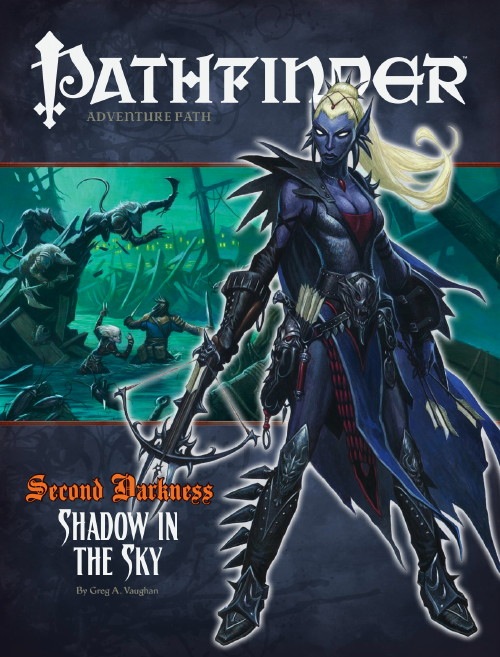
Book 1 of the campaign is entitled Shadow in the Sky, written by Greg A. Vaughan, who also wrote Book 6 of Rise of the Runelords and Book 5 of Curse of the Crimson Throne. The book begins with the origins of Earthfall, the cataclysmic event that destroyed the Azlanti empire and reshaped Golarion ten thousand years ago. Golarion’s elves at the time recognized the threat and most fled through ancient elven portals to their homeworld (yes, in Golarion elves are aliens). Some stayed, however, and one faction fled deep beneath the earth’s surface, into the Darklands. When the swarm of meteors of Earthfall struck, the god of destruction and disaster Rovagug awakened, and his presence corrupted the elves in the Darklands, creating the drow. Millennia later, when the elves returned to Golarion, they eventually discovered the drow and have been at war with them ever since, wishing to purge the world of their shameful brethren. Recently, a powerful drow named Allevrah Azrinae has discovered the magic that caused Earthfall, and she’s determined to bring another star from the heavens down upon the surface elves, wiping them from existence.
I gotta say… I’m totally fine with that lore as the basis for a campaign. Yes, inherently evil races are problematic, made more problematic by the fact that their skin is black. But in fantasy worldbuilding terms, the drow were victims of a corrupting god, so their sadism and cruelty are part of Rovagug’s influence. They are quintessential, apocalypse-spewing Bad Guys in service of an evil god of destruction, at least far as this campaign is concerned. And goodness knows the stakes are high for this campaign setup—the players will be attempting to save the world from another cataclysm!
The campaign itself begins in the city of Riddleport, also known as the City of Cyphers, and is a haven for pirates and thieves. A very important foundational criticism of the Second Darkness AP is that the book encourages player characters to be local thieves, interested in money and greed. The Players Companion (the first Paizo Player’s Guide, something that would become a staple of all future APs, including retroactive ones for the first two) offers some decent hooks into the campaign, but I will be far more explicit about what’s needed to make this campaign successful:
- The Blot is a recent celestial phenomenon above Riddleport, a smudge of darkness hanging in the air that no one can explain. At least one player should be a non-local who has come to town to research the Blot or is somehow drawn by it. These “seekers of the Blot” can be for magical, religious, or naturalist reasons, including something like a prophecy or omen.
- The “non-seeker” PCs can be family, friends, bodyguards hired for the journey, local guides, etc. However the group is organized, though, they are an intact team, and organized around seeking information on the Blot.
- The more elves or half-elves, the better. A natural hook is to have the “seekers of the Blot” of the party plus their bodyguard entourage be from the nearby Mierani Forest, or perhaps distant Kyonin or even the Mwangi Expanse. Being elvish immediately ties the PCs into the lore of the AP and brings with it mutual enmity with the drow.
- At least one of the PCs should have a gambling vice, which is an important hook into the beginning of our story. The ties of the party should be such that when this person gets into trouble, the other party members support the person instead of abandoning them.
- Despite any vices, the party will ultimately be heroes, striving to save Golarion from disaster. They must inherently want to do good.
Those parameters for character creation should set the party up for a fun time in this campaign far more than playing a bunch of sleazeball Riddleport residents. There are other APs for scoundrels (and awesome games like Blades in the Dark). Second Darkness is about heroic adventure and saving the world.
Chapter 1: Cheat the Devil, Take His Gold
I imagine the opening of the campaign being the party’s midday arrival at Riddleport. They will quickly get a sense of the city’s earned reputation—maybe a pickpocket takes some of their gold, and what they see in the streets is shocking to anyone unused to rough cities. Hanging in the sky above them is the Blot.
There is some good information about the Blot provided in the module that the PCs can seek out by talking to locals. I’ll let them meet some NPCs and begin to get their bearings when the gambling-vice PC will hear about an event at the Gold Goblin. The local gambling den is hosting a gathering called “Cheat the Devil and Take His Gold” that evening, which is both a devil-themed costume party and gambling tournament. The Gold Goblin’s owner, Saul Vancaskerkin, has spared no expense, and many locals are buzzing about it.
Assuming the PCs attend the event, it’s a dizzying display of gamblers, waiters and waitresses in alluring costumes, scimitar-wielding bouncers, devil-masked dealers, and even a real cantankerous imp in a cage suspended over the hall. Being Riddleport, there is no ban on weapons or armor, and alcohol flows freely amidst over one hundred participants. Saul appears and gives a speech to kick off the tournament. In short, it’s a spectacle, and a fun scene to set. Depending on the system I’m running, I’ll decide whether the gambling tournament itself involves a single roll or whether there’s some mini game involved. Regardless, my goal is to immerse the players in the festivities enough that they’re invested in winning or losing.
Before the tournament can conclude in the wee hours, however, a gang of four ruffians led by a wizard named Angvar Thestlecrit and his lover Thuvalia make their move to steal the pot for themselves. Angvar casts a distracting spell, Thuvalia makes a scene, and the ruffians burst in to begin taking out the guards. Chaos ensues, and hopefully the PCs swing into action to help. When the spilled chips settle, either the heist has been a success or, more likely, the PCs have saved the day. Unfortunately, enraged guests loudly demand refunds, call foul that the heist was just a ruse to not pay anyone, and Saul does his best to try and quell the crowd. The tournament ends prematurely, grumbling patrons filing out, and Saul seeks out the PCs to thank them. Indeed, he implores them to stay and have a drink with him while the staff clean up.
Saul is a hopeful, endearing, and naïve ex-criminal. Though he’d planned for this tournament to bring the Gold Goblin back from financial ruin, he’s now in trouble. He’ll offer them free lodging at the Gold Goblin in exchange for… ah… helping him deal with the aftermath of the failed tournament—basically he’s worried people will try to kill him, burn the place down, etc., and he has a lot of debt to figure out.
What I’ve written above is how I’ll depict the relationship with Saul and his offer of employment. The PCs are here to research the Blot, so they’ll want to do so, and here is someone in need of what seems to be minor help that won’t distract them too much. Plus, it’s a free place to stay and a local to help them navigate the city. What could go wrong?!
In the module as written, Saul is a dastardly villain in the pocket of the drow who will backstab the PCs by the end of Book 1. His sordid history is oppressively complex (literally, three pages of the module), and he enlists the PCs to run the Gold Goblin for him as his minions and “co-owners” until he tries to get them killed. As written, Saul hired the thugs in the first battle as part of a convoluted plan, and a major part of this book is the day-to-day running of the gambling hall. Since one of the central criticisms of this AP is the number of untrustworthy bastards the party encounters, I’m inclined to make Saul a true benefactor and patron, someone who’s idealism and attempts at a “straight life” never quite pan out in a city like Riddleport. Doing so pushes the Gold Goblin more into the background than foreground, and means I’m culling and changing big sections of the rest of this book. We all knew that was coming, though!
Chapter 2: On The Job
Unbeknownst to the heroes, the Blot is a manifestation of the drow’s experiments to recreate Earthfall. They are gearing up to test their weapon of mass destruction and, as a result, oddities in Riddleport begin to accelerate. The module lists seven occurrences to weave throughout this chapter of the book, from all spells manifesting a strange purple mist to a sudden tidal surge in the harbor to small objects falling from a clear sky. It’s a fun and dare I say… atmospheric addition to the adventure and something I’ll keep.
In the module as written, the PCs become full-time employees of the Gold Goblin, not only protecting it but performing tasks to bring the gambling hall back to profitability. My campaign shifts the focus to researching the Blot, which makes Saul’s employment something more of a side gig. Doing so means beefing up the Gather Information tables at the front of the book and culling the employment story beats. Since the module focuses on Saul, let’s handle the list of Gold Goblin-related beats first, then look at Blot research ones.
Gold Goblin scenes (adapted from the events in this chapter):
- The night after the tournament, four drunken brawlers who attended tournament are back and demanding their money. The PCs can talk them down or fight them. Assuming the scene resolves without the gambling hall being destroyed, Saul will stand on a table and loudly declare that the Gold Goblin is under the PCs’ protection, and to spread the word across the city.
- Some number of days later, Saul asks the PCs to watch a particularly intimidating patron, who he identifies as Clegg Zincher, a local crime lord. If the PCs confront him, he feigns surprise for being singled out and says he’s here only to check out the Gold Goblin and Saul’s “new friends” (i.e. the PCs). His presence is a distraction, which allows a hireling to release a monster into the kitchen (in the module it’s a cindersnake… I’ll have to decide what’s fun), which strikes after Clegg has left. Whether a PC notices the scheme and how it plays out will depend on the PCs’ actions.
- Days later, Saul tells the party that one of his employees has gone missing (one trick in GMing this part of the story will be to make the employees interesting and memorable, so the players care). The employee had gone to pay off a debt, but then never showed up to work. Saul, suspecting foul play, asks the PCs to go to the employee’s residence and to the man Saul owed money to. The residence is ransacked, door hanging open, and the loan shark never received his payment. Someone—maybe Clegg?—is messing with Saul.
- Now rightfully paranoid, Saul asks the PCs to escort some of his men to the docks to pick up a shipment of exotic ale for the gambling hall. When they arrive, a group of Clegg’s men have already bribed the guards and ship’s captain and are loading the crates of ale onto a cart. Fighting ensues, and now Clegg Zincher will see the party as too much trouble to ignore.
- The following night, Clegg sends men to raid the Gold Goblin and kill the PCs. This event is the climax of Chapter 2.
Researching the Blot scenes (adapted from the Gather Information tables in Chapter 1 and Riddleport Gazetteer in the Appendix):
- As the PCs begin interacting with local scholars and wizards, they learn of the Cyphergate Riddle—the long-sought hidden purpose of the stone arch that rises over the harbor. The Order of Cyphers exists to explore and ultimately solve the riddle. A wizard of the Order, Argentus Blakely, postulates that the Blot is some sort of convergence for focusing arcane energies and is running experiments to test his theories. He has little time for the PCs’ questions and rebuffs them.
- Days later, Argentus seeks out the PCs with a wild gleam in his eye. He hopes to capitalize on the PCs’ enthusiasm for researching the Blot and to send one or more of them up to the Blot itself to investigate it directly. How? By granting them the power of flight! With the aid of a staff/potion/wand/other object, he will grant any number of PCs a brief and limited power to soar up to the Blot itself. Sounds fun, right? Unfortunately, what they’ll find is that the Blot is strangely cold, but otherwise indistinguishable from a cloud. Still, Argentus will pepper the party with endless questions and now considers them allies.
- Days later, Argentus sends a message to the Gold Goblin, asking for immediate help and giving them the location of his laboratory. When the PCs arrive, they find him holed up behind a defensive shelter of broken furniture as mephits or some other swarm of summoned creatures destroy his lab. It seems one of his experiments has gotten out of hand. The wizard is quite grateful for the help and gives them some salvaged magic consumables from his laboratory.
- The next day, the PCs are bullied by a group of apprentice wizards, warning them to leave research of the Blot to the Order of Cyphers. It’s clear this is a rogue act and not something sanctioned by the Order. Since harming the apprentices would bring down the Order’s wrath, the resolution of this one is tricky.
- When next the PCs seek out Argentus, he’s gone and has left a note saying that, with his laboratory destroyed, he’s traveled to Magnimar and Korvosa to explore the libraries there for answers. He wishes them luck and perhaps offers another magical boon.
What will make for a fun campaign, of course, is weaving these two lists of events together alongside the growing weird occurrences of the Blot. I imagine a story in which the PCs are slightly off guard, each event from one list pulling their focus between the Blot and the Gold Goblin, with intermittent environmental events interrupting both. Again, though, the raid from Clegg’s men to kill the PCs is the climactic end of this series of events.
Chapter 3: Hidden Enemies and Unexpected Allies
The raid likely destroyed large parts of the Gold Goblin, forcing Saul to keep it closed during cleanup and repairs. Rumors swirl around who was responsible for the failed raid, and if anything, the ordeal seems to have boosted the Gold Goblin’s reputation generally, and the PCs’ reputation specifically. It’s a good opportunity for a level-up downtime beat, at least for a day or two, though I can also imagine doing a level-up sometime in Chapter 2 during a break in the above events.
Saul will eventually report that, by way of his contacts in the city, Overlord Cromarcky ensured that the city watch was nowhere near the Gold Goblin during the raid, which suggests someone important behind the assault. The PCs will of course rightfully believe it’s Clegg.
In the module, Saul sets up the PCs and sends them into an ambush, trying to get rid of them before they get too powerful for him to handle. Since I’ve made Saul a true benefactor, the most obvious reason for the ambush is the simplest: It is indeed the crime lord Clegg, effectively with the same rationale. Instead of Saul tipping them off to a meeting at the Boneyard, which serves as the city’s dump and ship graveyard, it can be the product of their own attempts to gather information. They’ll hear that Clegg is having a meeting with his key lieutenants there on whatever night they find the clue.
The Boneyard is a partially flooded salt marsh full of the husks and skeletons of old ships, smelling of saltwater-soaked clumps of garbage. It’s a fun place for a set piece, and the PCs will find a lantern hanging from a bit of ship’s rigging with several huddled cloaked figures surrounding it in the gloom. The cloaked figures are dummies meant to lure the PCs into the dangerous marsh, when a pack of nasty wererats are meant to ambush them. Whether they sense the trap or fall into it, a tough battle ensues.
Once the battle is over, it will be clear that these aren’t Clegg’s lieutenants. Indeed, they find notes on the leader of the wererat gang in thieves’ cant, which either a rogue PC or an ally can decipher. It will suggest that a different crime lord, the wererat Ziphras, is behind the ambush in the Boneyard, and they were using the PCs’ fixation on Clegg to lure them here. Clegg runs the competing gambling halls and has taken an interest in Saul, so his raid of the Gold Goblin made sense. Why has Ziphras taken an interest, and why has he specifically targeted the PCs? The notes suggest that Ziphras was given a large sum of gold to take out any elven outsiders who had taken an interest in the Blot. When Ziphras heard the PCs were asking about Clegg, he planned the ambush in the Boneyard to kill the fools who had been helping the wizard Argentus. In other words, Clegg is after the party because of the Gold Goblin, but Ziphras is after them because of the Blot (and their elven heritage).
In the module as written, the notes reveal Saul as a villain who hired the wererats, and a Mwangi elf named Kwava helps the PCs in the battle and further explains Saul’s treachery. This sets up a showdown at the Gold Goblin, where Saul and the gambling hall staff all try to kill the PCs. It’s a terrible heel-turn if the GM has done a good job of making Saul and the staff likeable, and I don’t know why any group of players would trust any NPCs for the rest of the campaign. Instead, I’m erasing Kwava, keeping Saul and the Gold Goblin as allies, and making the drow villain in Chapter 4 be the one who has hired Ziphras and his gang to off any elves researching the Blot.
The bridge I need to make is this: As written, after the PCs defeat Saul and his staff, they become owners of the Gold Goblin and discover hidden tunnels beneath the gambling hall that eventually lead to Saul’s benefactor, the drow Depora Azrinae. Instead, I’ve a) made the PCs interested in researching the Blot, with the Gold Goblin’s aid consistently pulling them away from this focus, b) kept Saul as a benefactor, hounded by the crime lord Clegg, who has become a principal enemy of the PCs at this point, and c) now introduced a second crime lord, Ziphras, who is specifically targeting them because of their interest in the Blot, and the drow Depora is Ziphras’ benefactor, not Saul’s. So, how do I get the PCs to Depora’s underground lair?
When the PCs return to the Gold Goblin, Saul hears the story of their ambush, his face pale. He’ll then inform the party, with considerable sadness and reluctance, that he’s discovered that Clegg’s raid on the Gold Goblin was specifically meant to assassinate them, not destroy the gambling hall. Now that a second crime lord wants them dead, he’s sorry, but… he just can’t be associated with them anymore. Their efforts have completely restored the Gold Goblin’s reputation, and he has the money now to hire protection against any further trouble, but he can’t handle two of Riddleport’s crime lords targeting his establishment. He thanks them effusively but effectively kicks them out. Saul will stay an ally, but any meetings with him will have to be secret from now on.
The PCs will then have several leads to pursue: Do they continue their (up to this point, fruitless) pursuit of information on the Blot, track down Clegg, or track down Ziphras? I’ll leave the prioritization of these threads to the players. Eventually, I’ll weave in a second encounter with Ziphras’ gang, one that involves the killing of an elvish NPC they’ve met in their pursuit of info on the Blot. That second encounter will involve giving them information that points them to a secret benefactor beneath Riddleport who is targeting elves. The party won’t know the person’s name but will know their location: smuggler’s tunnels beneath a dock house at the Riddleport Harbor.
Chapter 4: Under the Gold Goblin
Hidden beneath the dock house, the PCs will find long-forgotten smuggler’s tunnels. As so often happens in AP modules, then, the last chapter of this book involves primarily a dungeon crawl. In this case, the dungeon is relatively small—twelve “rooms” in the caverns, including two encounters at the outset that don’t make a lot of sense to me (barracudas and a wight, both of which would prevent Saul and the drow Depora from using the entrance effectively) that I’ll drop. There are guardians that Depora has brought from her Darklands home: darkland sentinels, troglodytes, a fungal crawler, and, eventually, the PCs will find Depora Azrinae and the chamber where she’s been drawing power from beneath Cyphergate for her magical experiments.
There are two things I don’t like about the final encounter in this book. First, there’s a ladder up to a hidden chamber at Cyphergate, an escape that Depora will use if needed. It feels implausible to me that the Order of Cyphers and other people who obsess about Cyphergate’s purpose wouldn’t have discovered it already, and I don’t understand the reason for guardians in the rest of the complex if this is Depora’s primary entrance and exit. Second, Depora is here in Riddleport to both figure out how to take a chunk of Cyphergate’s stone and to select a site for a test of the weapon. She’s somehow left all her accomplices at the testing site (an island called Devil’s Elbow that will feature in the next book) and is here alone with two minor demon guardians. The module says it’s because she fears the destruction of the experiment and is leaving her allies to their fate, which is nonsensical and seems to be based on encounter balance.
As a result, I’m dropping the extra entrance to the caves and giving Depora two trusted, bad-ass drow bodyguards. The demons I’ll place just outside the door, and a fight with them will alert the drow to the party’s presence. If the PCs can somehow sneak into the chamber, they’ll overhear dastardly plans in the language of Undercommon. More likely, Depora and her bodyguards will set an ambush in the excavation chamber and, if the battle goes badly, will try and flee past the PCs. I’ll do my best to make the appearance of drow a shocking turn for the players and make the drow equally shocked that there are elves in their hideout. Remember that the drow are, for all intents and purposes, a boogeyman legend amongst elves, and even less known by non-elves.
Once the party prevails, they’ll have the trope-y research notes (in Undercommon, though, so they may need to be translated in downtime after this module) to tell them all about the study of the unnatural phenomena in Riddleport as “strange and eldritch side effects from the charging of the glyphs on Devil’s Elbow,” along with various portents describing pulling a star from the sky and “the first test” of some arcane weapon.
When the PCs emerge from the caverns, they’ll quickly hear the excited chatter that the Blot has disappeared! Sure enough, as they look up, the shadowy cloud is gone. Moments later, a comet streaks across the sky, over the city and towards a distant island. It hits with all the sound and fury of a nuclear bomb, including blinding light, mushroom cloud, shockwaves, and a tsunami. The party is unexpectedly embroiled in a brief and chaotic series of natural disasters and, in my mind, a cliffhanger scene in which Riddleport scrambles to make sense of what just happened.
If a PC could make sense of the Undercommon notes before, they’ll know that the drow weapon test just occurred. If not, they’ll piece it together during downtime between books 1 and 2. Either way, they’ll know that any legends of the drow are real, and that the threat they represent is severe.
Deconstructed Shadow in the Sky
The trick to running Shadow in the Sky as written, it seems to me, is to somehow get the party excited about running a gambling hall, and then shock them that their employer is a bad guy who they want to kill. Neither of those goals is particularly compelling to me, which I suppose is why so few people love this AP. What I’ve done instead is make the trick to weave the party deeper and deeper into Riddleport’s underbelly, first through the tournament and then through a series of escalating events with crime lord factions, all while not losing sight of their main purpose for being here: the Blot. It’s a harder degree of difficulty job as a GM, but if successful then the players will have, by the end of Book 1, not only answered the question of the Blot but uncovered a secret plan by a race they considered a boogeyman legend: the drow are here, in Riddleport, testing weapons. Not only that, but two different crime lords in the city are gunning for them.
I think we’re onto something fun here, but let’s see if we can keep it going tomorrow with Book 2, Children of the Void.
As always with my articles, please comment below or send me an email at jaycms@yahoo.com. I’m always eager to hear from GMs who have run this AP to know what they think of my edits and different choices they made.



Leave a Reply