Rise of the Runelords series:
- Book 1: Burnt Offerings
- Book 2: The Skinsaw Murders
- Book 3: The Hook Mountain Massacre
- Book 4: Fortress of the Stone Giants
- Book 5: Sins of the Saviors
- Book 6: Spires of Xin-Shalast
- Reconstructing Rise of the Runelords
I’ve started collecting the Paizo Adventure Paths in earnest, and fully plan on running as many as I can before I shed this mortal coil. When I do so, I’ll be running them in a lighter heroic system (for my initial thoughts here, check out this post), and—since I’ll be converting them whole cloth anyway—plan to rewrite them heavily.
You see, I absolutely love Paizo’s APs, but I also fully agree with Tarondor when he says (emphasis mine), “Even the best, most complete Adventure Path demands customization for your players and for their player characters. Publishers can’t think of everything your players might like or might do. That’s what you, the GM, are for. Don’t regard an Adventure Path as a straitjacket. Regard it instead as a particularly good set of notes from which you derive your own story. If you pretend it’s supposed to be a complete package that requires no alterations or prep work and your game will be flat and lifeless, no matter how good the writing.”
Indeed, I’ll take this idea further and say that all APs suffer from too many combat encounters, a lack of foreshadowing villains and other major plot hooks, excess and unneeded story beats, and way too many places where the story and character motivations become convoluted. It’s easy for players to pause, a confused look on their faces, and say, “Wait, what are we doing here, again?” Taking out huge sections, NPCs, etc. often improves the AP rather than detracts from it. Doing so also makes room for more PC-driven stories and side quests, which can feel bolted onto the heavy AP plots.
As a result, welcome to a new project of mine: I’m going to read through each and every AP book I own and pull it into what I consider its essential parts. The result will be a massively pared-down adventure, ready to be fleshed out with details from the individual characters rather than pre-written bits. Essentially, consider these posts a narration of my process to pour over the Adventure Path and prepare to run it. When I’m done in seven days here, I should be essentially ready for Session 0.
But lo, there are caveats!
First and foremost, these edits are to my preference for the game that I want to run. What I consider “essential,” you may not, and vice-versa. You would make (or have made) different decisions, which, as the bold text above emphasizes, is both natural and part of the fun. Feel free to comment below if you see different opportunities.
Second, get ready to clutch your pearls. If you’ve run or played in Rise of the Runelords, I’m going to be deleting your favorite side quest, or NPC, or completely rewriting villain’s motivations and backstories. When I’m done, it’s not going to resemble the story you know.
Third, there will be rampant spoilers—in fact, once I dive in, these posts are essentially spoilers from start to finish. If you are a player in one of these APs or plan to be, these articles aren’t for you. (If you plan on GMing it, however… welcome!)
Finally, as I said from the outset, I don’t yet know what game system I’ll be using to run this Adventure Path, but it likely won’t be Pathfinder. Try not to get caught up in how dramatically I’m reducing the possible XP or treasure, or what I’m doing to CR of encounters.
Cool? Cool. Let’s get started!
Rise of the Runelords 1: Burnt Offerings
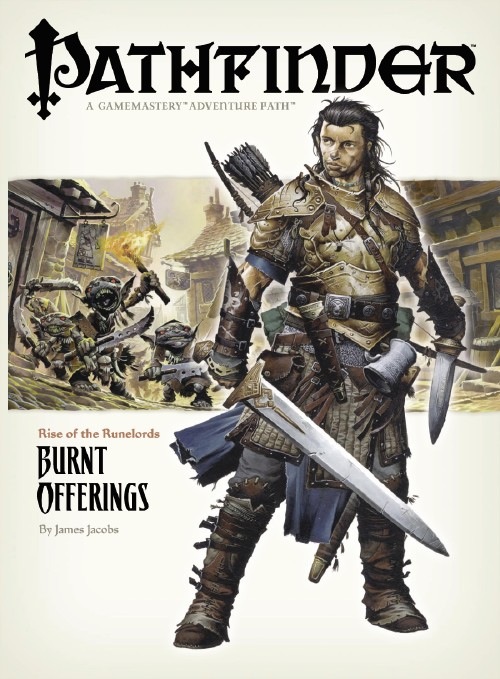
We begin at the beginning! Rise of the Runelords is the very first Adventure Path set in Golarion, originally made for Dungeons and Dragons 3.5 Edition, published in six parts from August 2007 through January of 2008. Paizo also released an Anniversary Edition in 2012 for Pathfinder 1st Edition, which is what I own. In his own excellent Guide to Adventure Paths, Tarandor says, “There’s an anniversary edition, audiobooks, pawns, miniatures, plush dolls, maps, card games and a vast array of fan-made support materials. There is even a Deluxe Collector’s Edition covered in faux leather and fancy hardware. Rise of the Runelords is the quintessential adventure path.”
To deconstruct Book 1, Burnt Offerings (and all subsequent books), originally written by the incomparable James Jacobs, I’m going to be relying on Plottr, a writer’s software made to outline story arcs and beats. At the end of today’s post, I’ll show you what I’m seeing as I map out the adventure. In the meantime, I’ll be narrating my thought process.
Chapter 1: Festival and Fire
Our adventure begins in the town of Sandpoint, in the nation of Varisia. I’ll eventually write my own Player’s Guide when running this AP, but as far as I can tell, all PCs must be:
- Either Sandpoint locals or visitors who will want to get to know the locals. Sandpoint becomes a location the party will return to repeatedly, and the adventure presupposes you care about the town and its people.
- Heroes-in-waiting. Though their adventuring careers have not yet launched, these need to be characters who will, say, leap to defend the town from a goblin invasion instead of flee, hide, or take advantage of the chaos.
Other than that, all choices are on the table. The PCs can know each other or not, and be any sort of adventuring class. The party will be heavily pulled into both urban settings and harsh wilds, so all skills and abilities are welcome. I’d probably steer the party towards the most common ancestries—particularly human, since that’s the primary population of Sandpoint—but anything could work. Anyway, it will be fun, once I decide on a system, to figure out what sort of background hooks at character creation to dangle in front of players to more deeply tie them into the story. The three that scream out after reading the entire AP are:
- If at least one PC can be keenly interested in regional history or Thassilonian history specifically, the payoffs throughout the story will be huge, and it will be easy to motivate the party towards several story beats. The more fascination with history the party has, the more their characters will love what happens.
- Later in the AP, the story tackles the “seven sins and seven virtues” directly, and the story loosely ties to greed as a central sin. If a character is a greedy soul (keeping in mind, all PCs are fundamentally heroes)—or a particularly charitable one and anti-greed, like Robin Hood—there will be truly interesting decisions throughout the story. If a PC showcases a different sin or virtue in their motivations, there will be less consistent spotlights on them throughout the AP, but Book 5 will be a ton of fun.
- If a PC has some sort of enmity or history with goblins, ghouls, ogres, or giants, they’ll have a grand time at various points in the AP. I wouldn’t tip the players off to this idea directly, but if there is an opportunity to nudge or replace (e.g. a PC says their parents were killed by trolls, switch it to ogres), I’d do so.
The first scene involves the party attending the annual Swallowtail Festival. This year’s festival has particular significance because the day ends with the consecration of a new cathedral, which replaces the one that burned down (part of the Late Unpleasantness that plagued Sandpoint five years ago). There are welcome speeches, festival games, the swallowtail release, lunch, and, finally, the consecration. I would keep everything described in the book (except the local nobleman Lonjiku Kaijitsu bowing out of the speeches… more on him in a bit). It all sounds like great fun, and a nice way to introduce the players to the setting and Sandpoint’s cast of characters.
As the consecration begins, the goblins that have been sneakily infiltrating the town… Attack! Egads! Goblin raid! Here the PCs swing into action and help protect the town, fighting off goblins, goblin pyros, more goblins, a goblin warchanter, still more goblins, and a goblin commando riding a goblin dog, all back-to-back-to-back in at least three linked encounters. During the chaos, they save the local nobleman Aldern Foxglove, someone who’s important in Book 2. The goblins flee, and the innkeeper Ameiko Kaijutsu offers the party free rooms at the Rusty Dragon for saving the town.
Here is where I start making changes:
- The specific encounters are going to vary based on what system I choose to run. The important bits are a) play up the chaos of the scene, goblins everywhere, b) keep the “party fights waves of goblins” diverse and interesting so that the combat doesn’t drag, and c) make sure Foxglove gets saved. No problem and check.
- Apparently, the goblins are aided by Tsuto Kaijitsu, son of local Lonjiku Kaitjitsu, and brother to Ameiko, who is an important NPC. The son has bribed Lonjiku to miss the festival and stay home. I’m not sure if either Tsuto or his father’s involvement in the story is necessary, especially given the pages and pages of complex behind-the-scenes activities each has and will do. Couldn’t the goblins have just snuck in and attacked, following Nualia’s (the BBEG of this book) orders? I’m dropping Tsuto’s involvement entirely, especially because I don’t love the only Asian-coded characters (except Ameiko) in the story being bad guys.
- While the raid is happening, Tsuto leads a group of goblins into the cemetery to steal a priest’s corpse, which Nualia is going to use to start transforming into a demon. This detail is a good example of where I think AP plots get unnecessarily dense. Especially with the father-son Kaijutsu evil-doing gone, I’ll drop this bit too.
Chapter 2: Local Heroes
For the next week(s), the PCs are local celebrities. Here there are tons of opportunities to bring Sandpoint to life, make the players connect emotionally with NPCs, and provide downtime. Part of the aftermath in the module is for Sheriff Baylor Hemlock and the PCs to discover the stolen corpse, and encounter skeletons that Tsuto summoned with a magical item to wait for them. Again… I just think all of this is too hard for the PCs to figure out and the whole skeleton thing feels forced to insert an unnecessary combat. I’ll drop it.
I do like many of the other side plots the book dangles in front of the PCs: The first involves Shayliss Vinder trying to get a PC alone to seduce them, only for Shayliss’ protective father and owner of the Sandpoint General Store Vin discovering the encounter and intervening. It’s a great and complicated social situation that could turn out several different ways.
The second side plot involves Aldern Foxglove seeking out the party to thank them for saving him, inviting them to join him on a boar hunt. If they agree, they all ride out to the Tickwood Forest and have a boar hunt! Great way to connect with Foxglove and do some skill checks (or even a non-goblin combat encounter).
I’m more ambivalent about a third suggested plot, in which a goblin from the raids hides in a boy’s closet until it becomes feral and kills the family dog. Then it kills the boy’s father, and the party cleans out the pest. It’s a fine way for there to be a sort of aftermath of the raid, but otherwise it doesn’t really serve a point except being horrible. I think as a GM I’d have this idea in my back pocket, but likely not use it.
Instead, the module encourages the GM to add whatever additional encounters fit the PCs using the detailed Sandpoint overview (and there’s also a Sandpoint campaign supplement available!), in which there are tons of hooks, and I’d dip into these ideas liberally for 1-3 additional downtime happenings. The goal of whatever side quests happen should be to a) provide real flavor to Sandpoint and its people for use throughout the AP, b) further raise (and complicate) the PC’s standing in the town, and c) because of what I’m cutting from Chapter 3, weave in some non-goblin combat. Some example ideas of countless possible additions to this chapter:
- Naffer Vosk, keeper of the Sandpoint Boneyard, is experiencing a minor haunting problem the PCs can handle. A true side quest that can involve battling (or negotiating with) undead.
- Brodert Quink (scholar), Veznutt Parooh (librarian), Ilsoari Gandethus (teacher and ex-adventurer) have a heated disagreement about a point of ancient Thassilonian history as it relates to Sandpoint. Perhaps the PCs can do some investigation and settle the dispute? Good opportunity to reveal some of the complex backstory of the region and explore Sandpoint’s history, along with a combat encounter of some kind.
- The half-orc dungsweeper Gorvi has been drunkenly harassing women along the boardwalk recently. Mayor Kendra Deverin asks the party to speak to him – the town needs his services, but she fears he’s grown both bitter and entitled. An example of the sort of complex social situation that could result in several different outcomes.
- Jargie Quinn invites the party to a night of revelry at her tavern, the Hagfish. There are games aplenty for the party to participate in, and of course the notorious dare to drink water from the hagfish Norah’s tank, all with Sandpoint’s locals egging them on. If your party likes skill challenges, here you go!
- Ameiko keeps a “Help Wanted” board displayed in the Rusty Dragon. Easy place for a one-off side quest that leads to non-goblin combat, particularly using the detailed Sandpoint Hinterlands map from the module.
- Sheriff Hemlock asks the party to check out some shady business going down involving an underground network of scoundrels called the Sczarni (think the Mob). The party heads to the Fatman’s Feedbag and breaks up a bar brawl, then busts up a poison-selling business happening out of Pillbug’s Pantry. The trick here is not to have this side quest spill into something spanning its own long campaign arc, but any Sczarni plots can pick up when the party later visits Magnimar, and with the poison there’s a chance to connect it to Norgorber worship in Book 2.
- The seer Niska Mvashti has had a vision pertaining to the party. Will they brave her decrepit and scary manor house to hear it? Good chance to foreshadow something later in the AP, or to hook a PC’s backstory into Sandpoint.
- Cydrak Drokkus, owner of the Sandpoint Theater, is attracted to the party’s recent celebrity and tries to entice them to star in his next play. (this idea fully stolen from the Legacy of the Ancients podcast)
There’s a point within the module in which a drunken Lonjiku comes into the Rusty Dragon and fights with Ameiko. This encounter is fine if you’re keeping the whole “Kaijitsu men as bad guys” stuff, which I’m not. It’s a heck of a lot easier to portray Ameiko as a bad-ass foreigner who has settled into Sandpoint. Doing so means more changes later, but I’m totally comfortable with those tweaks.
Eventually, the elven bounty hunter Shalelu Andosana (important NPC who will appear again in Book 3) visits the town and provides intelligence to the mayor about activities in the hinterlands. She’s particularly concerned about the increased goblin raids in other neighboring communities. The news is about five goblin tribes working together—which may or may not have been obvious during the Sandpoint raid, but is a good thing to foreshadow—a sign that someone (we’ll later find out it’s Nualia) is organizing them. The Sheriff then heads to the city of Magnimar to see about securing additional soldiers to protect the town and asks Shalelu to keep an eye out on the wilds. He also asks the “Heroes of Sandpoint” to protect the town while he’s gone. Before she heads out, Shalelu invites the PCs to dinner, which is an opportunity to dump a bunch of goblin lore, including foreshadowing goblin “heroes” the PCs will eventually face, one of which is the magic-longsword-wielding Koruvus, which the party will recognize from the raid (more on that detail in a bit). All these scenes are great, from my perspective.
While the Sheriff is out of town, in the module as written the PCs are meant to discover Ameiko missing – she’s been kidnapped by her brother Tsuto after a wild set of activities that happened “off camera” that the PCs will never really discover or understand. Again, I don’t love the foreigners being the evildoers, nor do I love the “damsel in distress” stuff. If I’m dropping Ameiko’s father and brother from the landscape, it’s more straightforward to have the PCs be informed that goblins have been seen at the Sandpoint Glassworks, which sets up the next chapter. The PCs know goblins are menacing the area, so it’s an easy hook. Perhaps the raiding goblins never actually left the town and have been using the Glassworks as a base of operations, healing and plotting the next attack? That idea is cleaner.
Chapter 3: Glass and Wrath
This chapter begins with a lengthy history of the Sandpoint Glassworks, Lonjiku Kaijitsu’s business, and Tsuto’s evil machinations. Again, I’m dropping this entire backstory. It’s a bridge too far for me to see a wealthy businessman’s son becoming infatuated with a monster-worshipping madwoman, and somehow having the skills to act as diplomatic liaison to goblin tribes who hate “longshanks.” In the module as written somehow both men come up with plans to kill each other, and then, after Tsuto wins, the brother and several goblins sneak into the inn and kidnap Ameiko.
In my story, after the raid the goblins simply retreated to the Glassworks to lick their wounds, and the town has been so distracted by the aftermath and the PCs celebrity (and various gossip-worthy side plots) to notice the infestation. I might even drop hints earlier, rumors of goblin-sightings in town that sound like paranoid residents more than reality. Then, an NPC that emerges from Chapter 2 will provide a credible rumor: There’s definitely goblins in the Glassworks, and no one has seen the owner (who can be a new or different NPC than Lonjiku) since the raid. Oddly, though, there’s been smoke billowing from the building’s chimney the whole time!
The rest of the chapter is the infiltration by the PCs into the Glassworks and dealing with the goblins. Paizo APs—as with any D&D-inspired adventures—are littered with dungeon crawls, and here is the first one, a 23-room building infested with baddies. How much of it I keep will largely be determined by a) what system I’m using, as some TTRPG systems make dungeon-crawling more fun than others, and b) my players’ appetites for room-by-room dungeons. Assuming I’m playing a system that supports a “theater of the mind” sort of dungeon crawl, here are the bits I like from this chapter:
- The overall layout is fun, and a glassworking room with a burning furnace is ripe for a cinematic and interesting combat, probably the boss-fight (see below).
- Like the goblin raid, the trick here is to figure out how many goblins populate the Glassworks and find interesting situations—based on the PCs’ approach and plan—to fight them. The book does a splendid job of making Golarion goblins fun and interesting, so there are loads of possibilities to make Gremlins-like encounters. The location also provides fun props: the furnace, broken glass, glass constructs, tools, hot tongs, etc.
What I’m first changing, obviously, is the dungeon boss. Gone is Tsuto Kaijitsu and a kidnapped Ameiko. Instead, the goblins are being led by one of those “heroes” that Shalelu told the party about over dinner: Koruvus, who I’m eliminating from the next section of the story. As a result, I’ll say Koruvus led the earlier raid on Sandpoint. I’ll also add a note to show off Koruvus during the raid, so the PCs will recognize him.
Now, goblins don’t like writing, which is a small issue with the absence of Tsuto. In my story, Nualia has drawn several maps that Koruvus has been trying to follow, which outlines her plans to invade Sandpoint and other surrounding towns. Importantly, it also shows the stronghold where the goblins have been gathering: Thistletop. There’s some opportunity for comedy, since maybe Nualia’s plan was better than what the goblins actually tried. Anyway, here is the first the PCs will learn that someone has indeed been orchestrating the goblins, as Shalelu suspected. They’ll also have a name or symbol to link back to Nualia.
While exploring the Glassworks, the PCs should discover smugglers’ tunnels that have been blockaded. In the module as written, beyond these tunnels are the Catacombs of Wrath, another dungeon. There are a lot of confusing elements to this additional dungeon for me. First, it links directly to ancient Thassilonian ruins from thousands and thousands of years prior, somehow preserved and pristine. There is a “minor runewell,” to be contrasted with a “major runewell” later in the adventure, but the PCs will never really understand these distinctions. Second, the caverns are linked to the Runelord of Wrath (there are seven Runelords, one for each classic sin), Alaznist, whereas the rest of the AP focuses on the Runelord of Greed, Karzoug. Once again, we have a complicated backstory for what this place is and how it’s led by a quasit minion who worked for a double-agent cleric of Lamashtu. There are dozens of interesting-but-weird features to the Catacombs that the PCs will never sort out, including the aforementioned goblin-hero Koruvus, who stumbled into the Catacombs of Wrath, drank corrupted waters from an altar, and became an insane, twisted monster. Like, what!? It’s just bonkers-complex, and I can’t see how it advances the main plot with Nualia or does anything but absolutely bewilder the PCs.
As far as I can tell, there are three main purposes for the wild side-dungeon of the Catacombs of Wrath:
- It introduces ancient Thassilon ruins beneath Sandpoint, as well as the idea of the Runelords (and their connection to the monster goddess Lamashtu).
- The party gets MOAR! dungeon crawling and battles against something other than goblins.
- In Book 5, there is a sinkhole that reveals another level to this dungeon, Lamashtu’s Shrine, which the party will explore.
I’m not at all worried about #3, as for me it’s easier and more believable for a sinkhole to simply reveal ruins on their own (also, spoiler alert: I’ve heavily reworked this part of Book 5). I can keep the smuggler’s tunnels being blockaded, but completely inaccessible until Book 5, keeping some foreshadowing but without the (in my opinion, unnecessary) distraction. I also don’t feel the need to tip the adventure’s hand on ancient Thassilon or Runelords quite yet. The AP is called “Rise of the Runelords,” after all: there will be Runelord-foreshadowing aplenty. In addition, the Caverns push the module into feeling too dungeon-heavy, after what were delightful character-driven plots earlier. Finally, I strongly suspect the party will be depleted after the Glassworks so, what? They go sleep at the inn and then return to same location? I don’t like it at all.
Interestingly, what I’m most concerned about when dropping the Caverns of Wrath is overreliance on goblins as the sole antagonist (and note that I’m not tackling the “goblins as sentient monsters needing to be exterminated” problem, which run throughout the first half of the AP… to run Rise of the Runelord is to accept a Sandpoint-versus-goblins conflict). With cutting the skeletons from the cemetery, Tsuto, and the Caverns, I’m leaving only goblin combats. That could get boring and repetitive, especially given what’s coming in Chapter 4 of this book. As mentioned, I’ll weave non-goblin threats into Chapter 2, but it’s something to watch.
Which brings us to…
Chapter 4: Thistletop
The party should get some time to recover from the Glassworks, sharing the discovery of the coordinated goblin tribes and their stronghold at Thistletop. There’s an opportunity here to continue whatever story beats emerged in Chapter 2 as well. The PCs can wait for Sheriff Hemlock to return or not – basically, the level of urgency is in their hands. That said, I’d probably have the town urge them to deal with it relatively quickly, as the Glassworks revelation shows that Sandpoint is going to be in constant danger until the goblins are dealt with. Thistletop is only six miles from the town!
Eventually, then, the party travels the Lost Coast Road to Thistletop. The way is plagued on the coast by tangles of nettlewood and poisonous plants, so there’s an opportunity to do some overland skill checks and exploration. The module suggests not adding encounters to the journey, but I might insert a wildlife encounter of some kind, again to break up the focus on goblin combat.
Thistletop is “a curiously round island about 60 feet offshore, connected to the mainland by a rope bridge.” There is, again, a fantastically complex backstory to the island, but it amounts to the place being part of the Runelord Karzoug’s territory, and the structure itself is the head of a long-ago toppled sentinel statue. A lot of the complexity is needless and stuff the players will never uncover, but it being a former Karzoug stronghold is cool, and I like the idea that the goblins don’t really understand why they gather here or the ancient ruins they’re sitting on.
The coastal area across the bridge and the primary complex of Thistletop is a large 40-room “outdoor dungeon.” The PCs must decide how they’ll navigate the tangled nettlewood and approach the stronghold – across the bridge, across the water, or through goblin tunnels? I like the tactical strike-team aspect of this setup, though I’d probably discuss the party’s plan, then drop them in media res like a Blades in the Dark heist rather than treat it as a square-by-square crawl.
As you can imagine, there are a lot of goblin encounters around and within Thistletop. Depending on the system I’m using and how the table feels about more gobbos, I’d adjust what’s in the module. Ones I particularly like:
- A goblin druid (and advisor to the goblin chief) Gogmurt and his cougar Tangletooth, who have a lair on the coast.
- The rope bridge is, of course, rigged to topple bigger creatures into the water. And in the water is a prowling bunyip the goblins feed things to. Love it.
- Goblin patrols riding goblin dogs. I love the idea that several tribes are trying to coexist in Thistletop, so I’d amp up the friction and flavorful differences between the goblins (this theme will continue in Books 4 and 6, so it’s good to practice these dynamics here).
- In the stronghold itself, a pen of captured and tortured horses (Golarion goblins hate horses), including a warhorse named Silvermist. The warhorse has already killed several goblins who tried to harass it and is a fun potential ally / mount / animal companion.
- A throne room battle with Warchief Ripnugget, who rides his giant gecko Stickfoot! He also carries a silver holy symbol of the goddess Lamashtu, given to him by Nualia.
- A “harem room” with Ripnugget’s four wives, who are currently entertaining the bugbear Bruthazmus. I like the idea of adding some feral goblin children here or in an adjacent room, which is a more complicated encounter for a moral party.
There are other parts I’d likely cut, such as a big crowd of goblin refugees whose chief died in the Sandpoint raid, a human mercenary named Orik Vancaskerkin and a human spellcaster Lyrie Akenja (again, goblins hate longshanks, and I would want to emphasize Nualia’s monstrous associations, not her human ones… you’ll see me cutting humans loyal to Karzoug a lot in this AP), and a creature called a tentamort that Nualia incongruously allows to prowl in the goblin portion of the stronghold.
Eventually, the heroes will make their way to the lower portions of the stronghold. Here the décor becomes more civilized, better maintained though obviously ancient (a cool detail is that the floors are all slanted in this part of the ruins, since it was destroyed in the cataclysm Earthfall that destroyed the Thassilonian empire), and Lamashtu-themed. Nualia has been residing in this section, keeping some distance from the goblin horde. For me, this is where the payoff of Nualia comes in… and the opponents change as dramatically as the surroundings. No more goblins from here on out… only monstrous awfulness.
That said, I’m not sure if I’d keep the dungeon as-is for Level 2 (where Nualia is). There are traps that feel old-school D&D and I’d have to decide if they fit, plus decidedly too few monsters. Maybe I’d move the tentacular tentamort here, along with another twisted mutant or demon of some kind (the book has a yeth hound, but I’m saving inhabitants of the dimension Leng until Book 6). The point is that Nualia keeps this area for her own monstrous beasties and, eventually, they must face the cleric of Lamashtu herself. Nualia will need to monologue a bit to get across her motivations, but it’s important for her to a) talk up her zealous following of the Mother of Monsters and desire to transform into a half-fiend herself, and b) invoke Karzoug’s name somehow and show herself as tainted by greed. There are also the telltale (and almost trope-y) notes she’ll leave behind, which can further detail her backstory. After Nualia is dead or has fled, there’s a nice half-flooded treasure room with a giant hermit-crab which I’ll keep, especially given how many treasure-worthy encounters I’m cutting from earlier in the book.
Paizo does this thing in APs that I find curious: inserting a deadly encounter either right before or after the Big Boss Battle with a creature that is either as difficult or more than the Big Boss. It’s… peculiar. Here, after finding the room in which Nualia has been performing her awful rituals of transformation and self-mutilation, there is a prison with a greater barghest named Malfeshnekor. This creature has a complicated backstory (again, tied to the Runelord Alaznist, not Karzoug!) and is notoriously one of the deadliest in the AP. So, you know what? I don’t see any reason to keep it at all. Once the party has defeated Nualia and braved the crab-guarding treasure chamber (which I like as a nod towards the sin of greed), the battle is won and the stronghold is conquered.
With Nualia gone, the fragile truce of the various goblin tribes dissolves and the threat to Sandpoint is neutralized. The Heroes of Sandpoint return to fanfare, wrapping up whatever character-driven story beats need wrapping up. It’s time for some well-earned downtime for the party.
I really like this bit from the module itself as a final thought: “Relatively little involving the metaplot of Rise of the Runelords occurs during the course of Burnt Offerings. Although the chapter’s events are closely tied to Karzoug’s awakening, and certain characters in the adventure have ties to characters whom the PCs are destined to meet later in the campaign, the adventure’s primary purpose is to introduce them to their new home of Sandpoint and to instill in them a desire to protect it and its citizens.” I agree wholeheartedly that a lot of the actual Runelord plot can wait, and this book should instead be about becoming embedded in Sandpoint and establishing the party as heroes. If they can transition from goblin hunters to full monster hunters along the way, all the better.
Deconstructed Burnt Offerings
So, when the dust settles on book one of my first AP, here is what I see in Plottr:
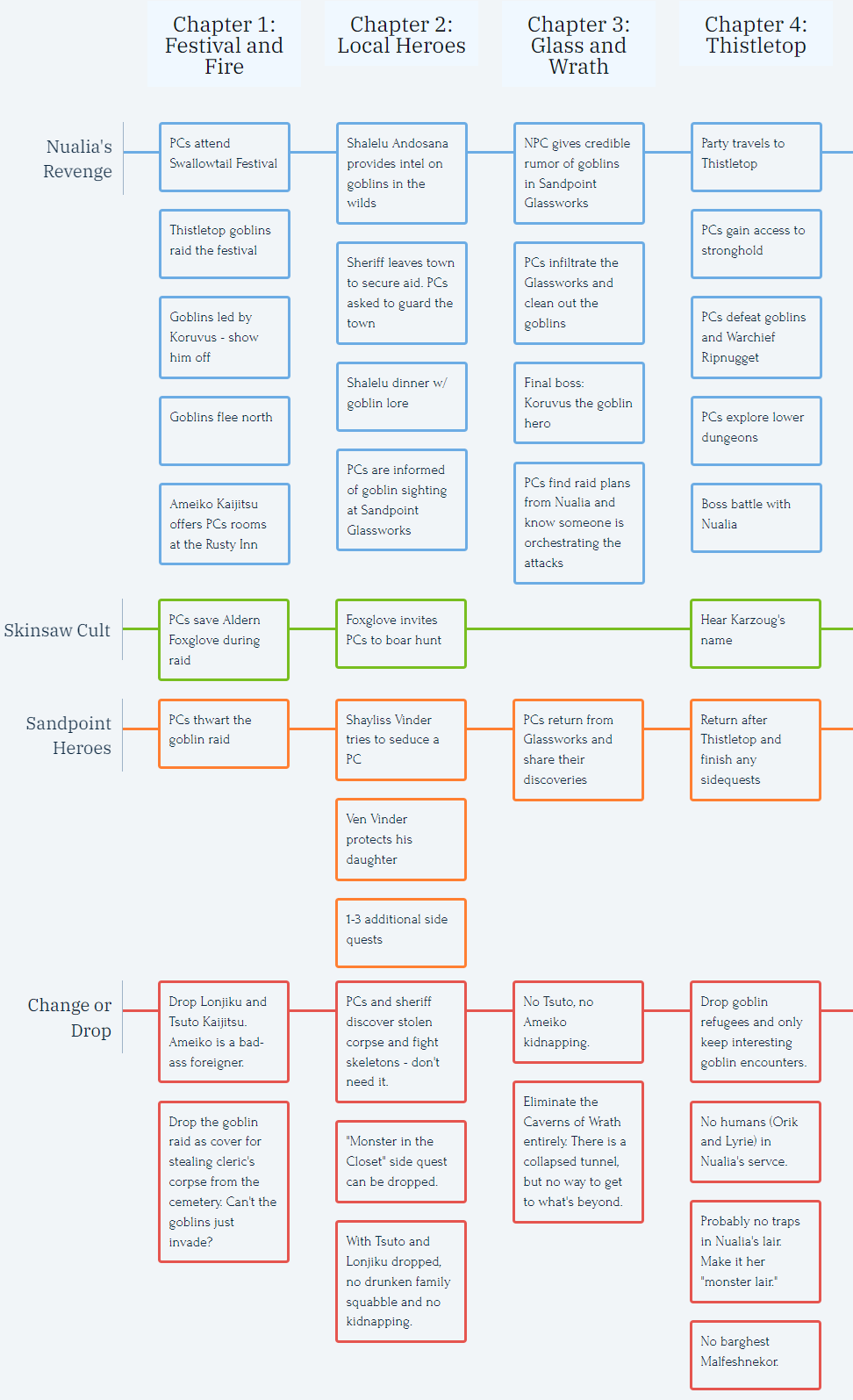
At its most bare bones, it’s basically the tale of a monster-worshipping villain orchestrating goblin tribes to harass the community. The heroes are caught in the initial raid, eventually finding their way to the heart of the threat to eliminate it. Along the way, the party becomes embedded in the community of Sandpoint, learns some of its deep and troubling history, and uncover hints at an ancient evil from ages long past. That brief summary sounds like one of the more classic and fun ways to begin a campaign!
Since we’re just beginning, if you find yourself annoyed by what I’ve cut or changed, I’ll earnestly remind you of the caveats at the top of the article. That said, if you’ve made different choices as GM, I’d love to hear it. Speaking of which, I’m still feeling my way in this series, please do drop a comment or email me at jaycms@yahoo.com with any and all thoughts.


Leave a comment