Another month has passed, and I’m still in search of a heroic tabletop system. As a reminder: I found myself able to purchase a number of complete Paizo Adventure Paths at a big discount, and have subsequently set off on a mission to collect them all. But—although both editions of Pathfinder and all five editions of Dungeons & Dragons are systems I know deeply (well, okay… I never really played D&D 4E, but the rest yes)—I don’t have interest in the intensely-crunchy, prep-heavy work of GMing a complete AP in a classic d20 system. I’ve done it before, but I likely won’t do it again.
Instead, I’m on the hunt for a tabletop game with the following features:
- allows for crazy (super-)heroic stunts without the crunch
- fun to GM and easy to make stuff (like monsters, hazards, etc.)
- suitable for a long campaign (i.e. has some sort of character progression or at least the players won’t get bored with overly simplistic mechanics)
- can’t be tied too deeply into a setting – my intention is to keep the Golarion lore of the APs mostly intact
In other words, I’m looking for a system that is both interesting and complex enough that it can handle long-form storytelling, but light enough that I don’t have to spend hundreds of hours prepping.
Something that both of my earlier articles have prompted is people trying to argue with me why I shouldn’t play Adventure Paths, or how difficult rewriting the stories is. While I appreciate the feedback, I’m dead set on running my version of APs. Even more, the work of streamlining the sprawling Adventure Paths is something I enjoy (and started exploring in a new series… check it out!). Today’s article is about searching for how to run Adventure Paths, not whether to run them.
With that preamble done, I’m diving into a game I’ve seen initial enthusiasm for, yet can find relatively few reviews of: Vagabond, by Land of the Blind. Can a lightweight “pulp fantasy” system satisfy my requirements above? Let’s find out!
Vagabond
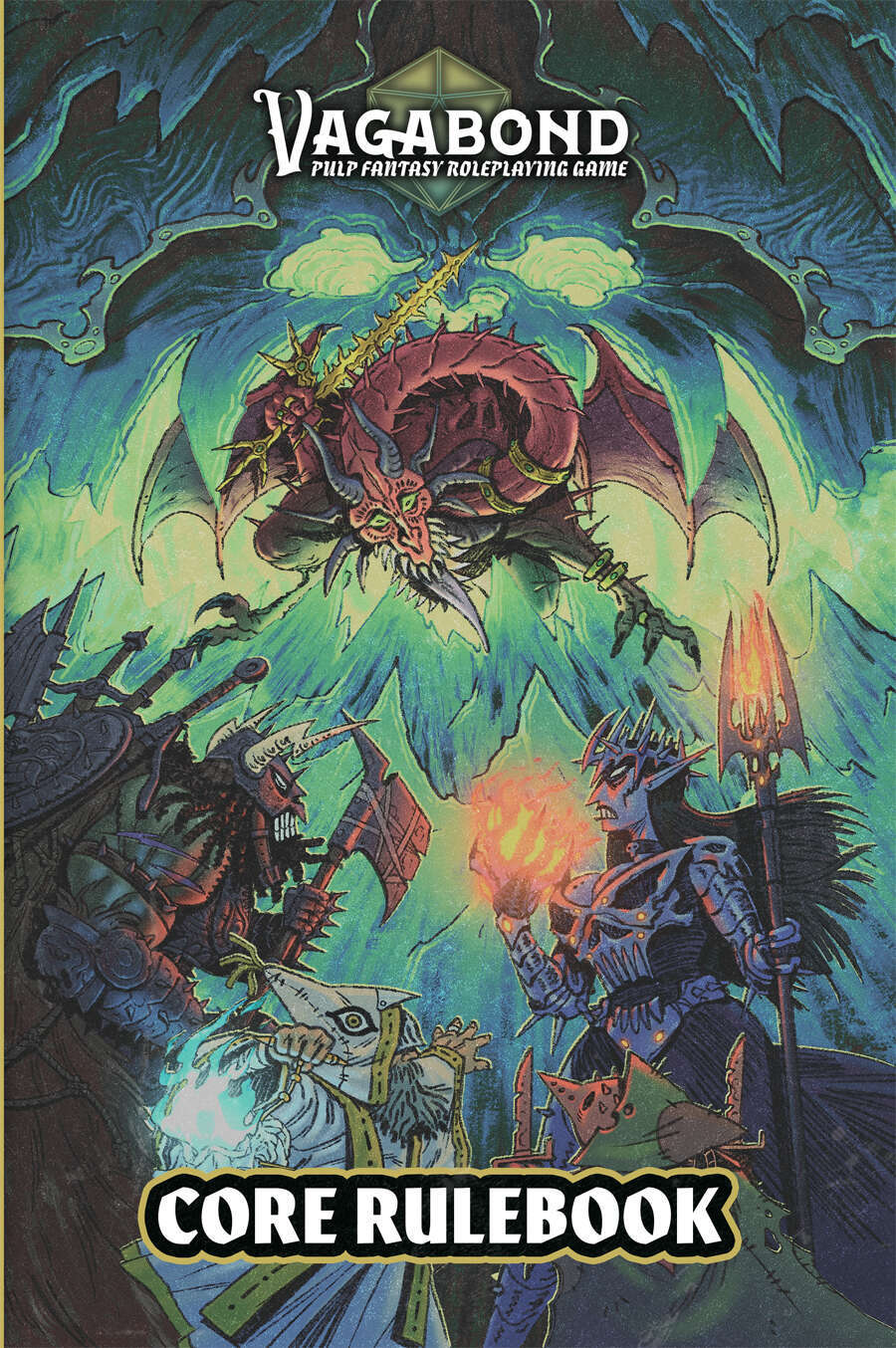
First of all, Vagabond (which debuted in 2024 via a Kickstarter campaign and shipped in 2025), is distinct from other games I’m considering in a meaningful way. Whereas most other games I’m exploring are attempting to speak to D&D 5E audiences—either simplifying those rules or replacing crunchy tactical bits with story-forward mechanics—Vagabond is explicitly meant to build off old-school D&D B/X. The idea, as its creator Taron Pounds has stated, is to be able to run any TSR module in Vagabond with relatively little effort. On first blush, this fact alone seems like it wouldn’t fit my goals for this project, since many OSR-type systems focus on high lethality and less heroic campaigns, filled with fewer MCU-like feats. Reading deeper, though, you get sentiments like this one from the game’s marketing:
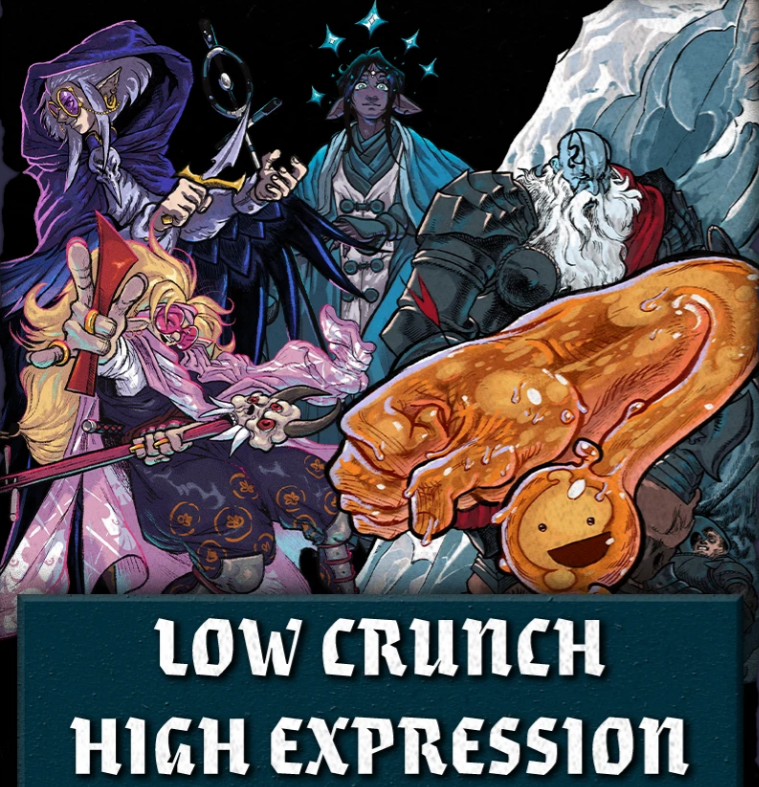
If that image doesn’t scream “you can run a Paizo Adventure Path with this system,” I don’t know what does! So, although it’s a bit different on first blush, I’m intrigued by Vagabond as a potential system.
Mechanics-wise, Vagabond is indeed a d20 system, in which players roll against a Difficulty Class to perform actions like attacking, jumping across a chasm, or picking a lock. Unlike many systems, though, this DC isn’t set by the GM. Instead, characters have stats ranging from 2-7 and doing anything means subtracting that stat from 20, doubling the stat if it’s a trained specialty. So, want to heal someone and you have a Logic of 4? Meet or beat a DC 16 check. Trained in Medicine, a Logic-based skill? Meet or beat a 12 instead. Attacking works the same way, except that the GM rarely (never?) rolls a d20. Instead, monsters are assumed to hit, and PCs must roll to either Block or Dodge each attack, with Armor providing a flat subtraction from damage (you can either roll damage or use a flat number, the system is fine with either option). Straightforward. Easy. So far so good!
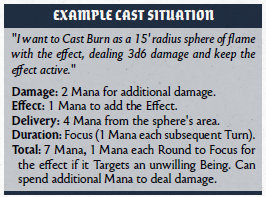
If the above paragraph feels too simplistic, there are also exploding rolls, countdown dice, crits, Favor/Hinder (adding or subtracting d6 to a roll), progress clocks, rules for flanking, grappling, riding mounts, environment hazards, and various conditions (called Statuses). Meanwhile, Spellcasting is a cool and surprisingly deep system of using Mana points and deciding whether to cause damage, an effect, or both, with the ability to scale the spell by spending more Mana to do extra damage, affect a wider area, have a longer duration, etc.—very Lego-block-like:
Speaking of Legos, the game embraces character customization, with 18 classes and 7 ancestries in the core rulebook, with more on the way. On top of these options are a dizzying number of general feats, called Perks. That party image above isn’t wrong – you can pretty much make any sort of PC in Vagabond, and those options will continue to increase the longer the game lives and Taron keeps creating supplements.
As I mentioned, I’ve found very few reviews of the game, despite it being out for a year. My sense—which is reinforced by the modestly-sized communities on Discord, Facebook, and Reddit—is that Vagabond’s player base is currently quite small. Too small, given how fun the game reads. You should check it out!
WhyVagabond Works For Me
The first point in Vagabond’s favor is that reading it is fun. The rules are simply laid out, and the book is compact and easy to navigate. I found myself leaning forward as I consumed it, eager to either try out a solo game or convince my regular crew for a one-shot. Vagabond’s core mechanics are easy to grok, and there are just enough little add-on rules and mechanics that I don’t immediately worry about it being too lightweight to make good stories. I’m fascinated by some of the class options… can you really make a Merchant or Dancer and enjoy a campaign as much as a Barbarian, Sorcerer, or Rogue? I have no idea, but the fact that they exist as standalone classes makes me happy.
Vagabond is explicitly setting-agnostic, so it’s easy to imagine bringing the game to Golarion. Any of the classes work fine, and I can see either tweaking the existing ancestries to hit all the most common ones in the setting. With the Spellbook Zines coming soon to Kickstarter, even Golarion’s most exotic playable ancestries will be pretty much covered. There’s a decent bestiary already in the rulebook, and monsters have small-enough statblocks that creating them from what already exists seems easy once I get used to the system. Likewise, there’s a very light treatment of hazards and environments, but again what’s there seems easy to hack. Which is all to say, Vagabond looks like it checks all the boxes in terms of being easy to GM, light prep, and able to handle the Golarion-specific parts of Paizo’s Adventure Paths. As a cherry on top, its Destiny leveling-up method is exactly the sort of 10-act story structure I’m aiming to simulate.
Finally, the Lego-like magic system is truly clever. In fact, I worry that it’s so much fun as its own minigame that it will be significantly less fun than a non-spellcasting PC (it would be cool, for example, to have a combat maneuvers system as modular as the spell system for combat classes to use).
Which is all to say that I’m tentatively quite excited by Vagabond. There are a few things keeping me from saying my search is done, however…
MyVagabond Concerns
Initially, I said that a system meant to modernize D&D B/X is likely going to be too lethal and un-heroic for my purposes, then I brushed past that concern to focus on the—much deserved!—cool bits. Buuuut… starting hit points for Level 1 characters are 2-7, and likely 2 for any spellcaster who uses Might as a dump stat. Adventure Paths are too combat-heavy to think that 2 hp will be anything but frustrating for players. Right away, then, I’m likely homebrewing something, either using the “Plot Armor” variant use of Luck (spend 1 Luck point to gain d6 hp when reduced to zero) or adding 5-6 hp to all Level 1 PCs, or probably both. That adjustment might be enough (especially because, unlike a lot of OSR systems, Vagabond PCs automatically fully heal when resting), but tweaking the rules right out of the gate makes it feel like I’m trying too hard to make the system work for me.
Then there’s the other end of spectrum—are high level characters essentially superheroes, as Paizo APs expect? Scanning the Level 8 and 10 features of each class, the answer is no. Take the Druid, for example: At 8th level, they gain, Savagery, which means “While you are polymorphed into a Beast, you have a +1 bonus to Armor.” Definitely useful, but taking 1 less damage from every attack means that the world is still a Very Dangerous Place for our shapeshifting keeper of the wilderness. Meanwhile, Fighters gain a second attack at 10th level, something that 5E Fighters enjoy at 5th level, and by 20th level those same Fighters are attacking four times.
Now, all those variations between systems are relative. When you’re playing 5E and a high-level monster has 400 hp, you need four attacks to keep the combat under a fortnight of gameplay. Perhaps when facing off against an Elder Dragon with 90 hp in Vagabond, an extra Armor and attack make all the difference. I won’t know until I play, but the comparison still makes my eyebrow quirk.
When I first read the Vagabond rulebook, I was excited to see something that’s become familiar in modern games: Abstracted distances labeled simply Close, Near, and Far. What I love about this abstraction is that it takes combat away from a tactical grid map and into theater of the mind, which is what I’m intending when I run APs. Upon a closer read, however, the Close/Near/Far labels are merely shorthand, and the game is very much meant to be played on a gridded map. Various Features and Perks increase your movement speed or spell ranges by 5’ increments, and there are rules around things like Difficult Terrain that are difficult to wave away. Once again, then, I’m either succumbing to using tactical grids or homebrewing a fix, neither of which feels great.
Finally, I don’t need a “balanced” system, where there are no opportunities for players to optimize their characters. But until I spend a lot of hours playing, it’s hard to know if any of the Ancestries, Classes, or Perks in Vaganond are so unbalanced as to be unfun for the players. For example, I read one account that in later levels magic-slinging far outpaces melee fighters. I want every player to have choice as they level up, and I want those choices to be exciting and diverse. If there is a certain character-building path that’s OP, certain players will find it. Sometimes I innately “get” a system and feel comfortable adjusting it as I go, but Vagabond isn’t that sort of system for me. Instead, reading the Ancestry, Class, Perks, and Relics sections of the rulebook sends my Spidey-sense tingling, worried that there are decidedly un-fun combos for the players that I’m not yet seeing. My fears might be unfounded, but they’re there.
One Game to Launch My Journey
That’s a pile of concerns, and not light ones. It’s a testament to the rulebook, though, that I still want to give Vagabond a go and see if I can make it work for my purposes. Even if it’s not my Adventure-Path-playing system of choice, I have a feeling that it’s a game I’ll enjoy and want to GM. Heck, I also own a bunch of old-school TSR modules… maybe I’ll have two tables running once I retire in a few years, an OSR one and a heroic fantasy one!
Back to the games I’ve reviewed up to this point, the more I’ve played and read about Daggerheart, the more I realize that a) I’m doing an uncomfortable amount of homebrewing to gloss over some features of the game, and b) while it’s fun to prep, there is a lot of work involved in making (very long!) write-ups for environments and monsters. Put simply, cool game, but not something I’ll use to GM APs.
That decision leaves 13th Age and Vagabond as contenders, and the only way to test if the former is too crunchy and the latter is too OSR is to try them out. I’ll do some playtesting in the coming months, along with considering a small pile of other games collecting on my shelf: Questworlds, Index Card rpg, EZD6, and Nimble. If there are others you think will fit my purposes having read my journey so far, I’m all ears! Please comment below or send an email to jaycms@yahoo.com.
Next: The Quest Continues!




Leave a comment