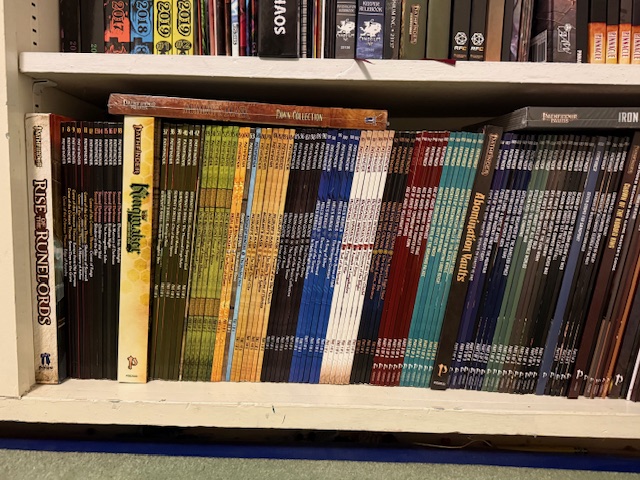
I’m still in search of a heroic tabletop system. As a reminder: I found myself able to purchase a number of complete Paizo Adventure Paths at a big discount, and have subsequently set off on a mission to collect them all. But—although both editions of Pathfinder and all five editions of Dungeons & Dragons are systems I know deeply (well, okay… I never really played D&D 4E, but the rest yes)—I don’t have interest in the intensely-crunchy, prep-heavy work of GMing a complete AP in a classic d20 system. I’ve done it before, but I likely won’t do it again.
Instead, I’m on the hunt for a tabletop game with the following features:
- allows for crazy (super-)heroic stunts without the crunch
- fun to GM and easy to make stuff (like monsters, hazards, etc.)
- suitable for a long campaign (i.e. has some sort of character progression or at least the players won’t get bored with overly simplistic mechanics)
- can’t be tied too deeply into a setting – my intention is to keep the Golarion lore of the APs mostly intact
In other words, I’m looking for a system that is both interesting and complex enough that it can handle long-form heroic fantasy storytelling, but light enough that I don’t have to spend hundreds of hours prepping.
It’s been (checks calendar) a whopping four months since my last article on this topic. I got a new job in April, which is confining my writing and gaming to weekends and certainly slowing me down. Rest assured, though, that my quest for a system to run my now-almost-complete collection of Adventure Paths continues. Rather than dive deeply into a single system today, I’m instead going to circle back on the three systems I’ve already explored now that I’ve had a chance to play them with friends, plus discuss the several systems I’ve been considering to play next.
Circling Back to Daggerheart
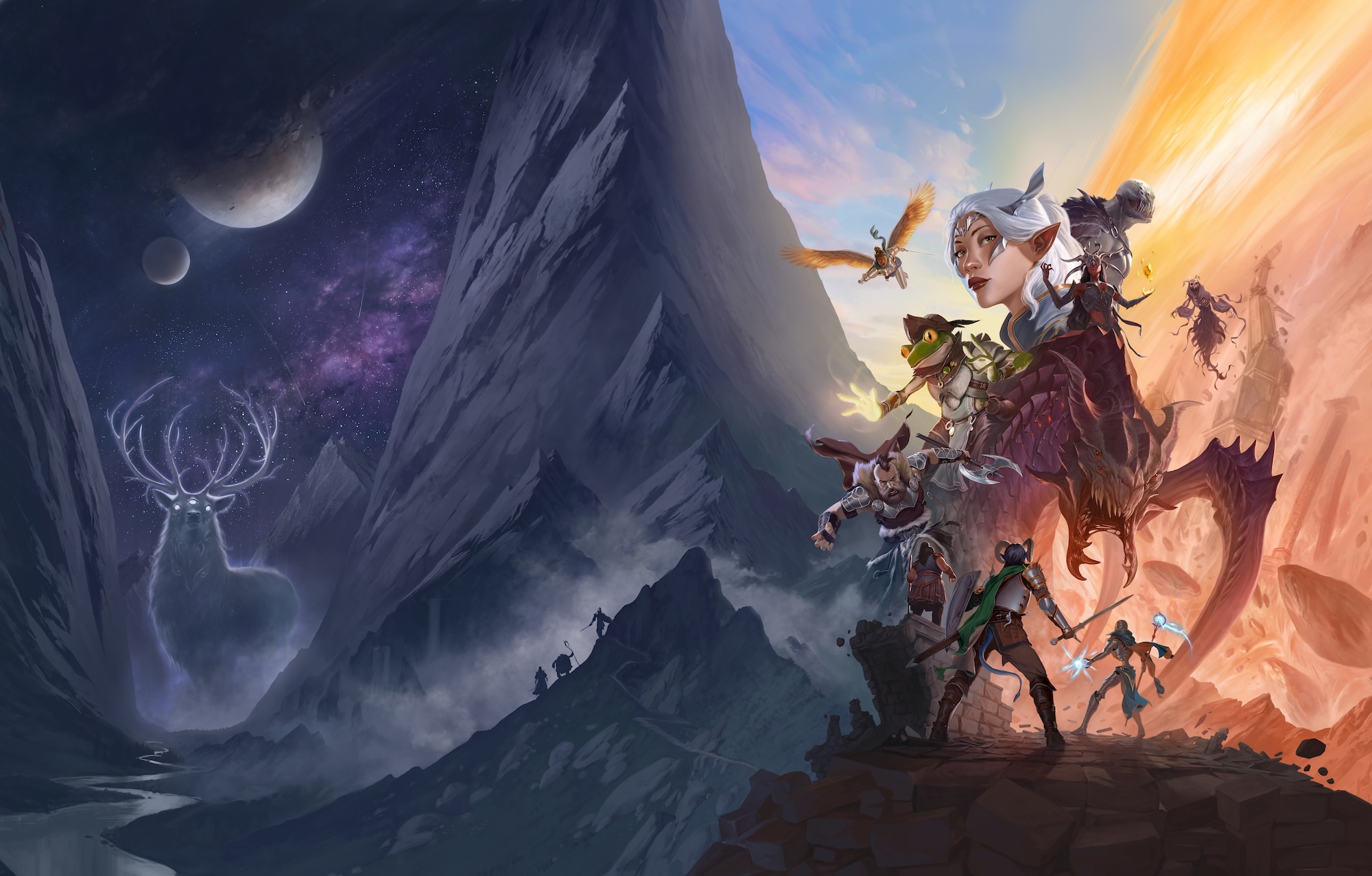
My first game system out of the gate in this quest was Daggerheart. As I said in my initial article, I came to Daggerheart reluctantly but quickly fell in love. My regular gaming buddies had heard enough about it to want to give it a playtest, so I converted the Pathfinder Beginner Box and its introductory adventure (which, cleverly, doubled as a chance to see how well I could adapt Paizo adventures to the system), and off we ran into a few playtest sessions.
I’m still a fan of a lot about what Daggerheart does as a game and, truth be told, my friends had a great time. I’ll say that again: Everyone had fun, including me. I happily bought the Hope and Fear expansion, and can easily see playing or GMing it again in the future. Unfortunately, I’ve also definitively concluded that it’s not a good system for me to run Paizo Adventure Paths in. To understand why, I’ll circle back to my four feature requirements above, though in a different order…
Does it allow for crazy (super-)heroic stunts without the crunch? Yes. The Hope/Fear die mechanics are brilliant and kept us all whooping in delight. I felt the players’ freedom in deciding how to act heroically. Even at level 1, their characters could take on pretty serious threats, including an absolute swarm of giant rats in their first encounter. There is some crunchiness as it relates to distance and spells, but for the most part the action and narrative flowed easily.
In addition, Daggerheart is inherently setting agnostic and thus relatively easy to play in Golarion. The ancestries don’t always work and caused me to homebrew a few elements, but doing so in Foundry was simple to do.
The problem—that surprised me, honestly—is that it may be fun to GM, but it IS NOT easy to make or run stuff. Indeed, I found the GM prep burden heavy, and easily as heavy as traditional d20 systems. As I said in my first article, Daggerheart is still new, so not a lot of core content exists. A metric ton of homebrewed material is out there, but the quality and complexity varies widely. Even if a big library of monsters, hazards, and treasure existed, though, they are surprisingly dense. Monster stat blocks can take up a whole page of text, with half a dozen “if/then” abilities to remember. Environment (where hazards live) write-ups are often even longer. The idea of going through an AP and meticulously building every potential foe, every set piece as an environment, and even the campaign frame… it’s daunting. Once we’re in the game it’s fun, but I don’t feel at all capable of homebrewing cool encounters on the fly. I’d surely get more comfortable with the system, but I found the fiddlyness of making monsters and environments mostly annoying.
Finally, I’m still not sure that the system works for long campaigns, and whether there’s enough variety in character progression to be satisfying to players over dozens and dozens and dozens of sessions. This is a worry that will get settled with years and legions of GMs and players, but I want to get started sooner than that.
Which is all to say that, for very different reasons, I come down to the same conclusion as Sly Flourish in his final review of Daggerheart: A lot of people love this game, and I’m happy about that. For me, though, it’s too burdensome to prep as a GM, there’s too much to remember when running big monster and environment stat blocks, and I’m not yet convinced it can handle long, deep stories. What I really want to see is Daggerheart 2, a game that streamlines and smooths out what’s there now, if that ever happens. I’m also eager to see official adventures from Darrington Press, where the encounter design work is largely done.
Circling Back to 13th Age
Fresh off the success of my Daggerheart playtest, I offered to run a Pathfinder Society scenario (in fact, the very first one, Silent Tide) in 13th Age 2e. Once again, GM prep and conversion took a really long time, but in this case, it was because the Foundry module for the game was a bizarre hybrid of first edition and second edition rules, so I was constantly having to rewrite abilities, add in abilities, and check language/bonuses to ensure that everything matched what I was reading in the rulebook. The whole experience was frustrating and made me wish we were playing in person instead of online (alas, my regular group is scattered across Europe). I hope that Pelgrane Press makes an official Foundry module, because otherwise the existing one is a major deterrent to trying out this new edition.
The only advantage of struggling with the mod is that it forced me to get really comfortable with the rules. Running it was easy. Indeed, here are my notes to the players afterwards:
Pros:
- Once the PCs were built and I understood the basic system, it was dead-easy to prep. The cognitive load on GMs is low… monsters aren’t fancy, everything is theater of the mind, so no battle maps to prep, etc. Converting a PFS scenario was simple, and I could make adjustments on the fly if I needed to, no problem.
- All the narrative flourishes are great. I love Icons and how those relationships work. Backgrounds instead of skills is fun. One Unique Thing added some roleplaying flair that might not have come up otherwise. No gear/equipment except magical items. Magic cantrips being whatever. All of it, to me, improved the game.
- It definitely felt heroic… even at Level 1, your characters could take on armies of undead and a gang of thugs who outnumbered you pretty easily.
- I really, really like thinking of the story in “arcs,” and having some abilities per battle, some per arc (I think the “daily” abilities were from 1st edition and I didn’t catch those to change them). The structure of 3-4 battles is an arc, 3-4 arcs is a level really works for my brain. Rolling new Icon connections at the beginning of each arc is fun.
- I’m a fan of the “Recoveries” system, and I like how it’s a resource-management mini-game to figure out how to pace yourself through an arc.
- Some of the abilities were really cool. I especially like how barbarian rage and the bard song (with a caveat below) worked.
- If I kept playing, I would probably stick to our on-the-fly homebrewed rules of a) adding the escalation die to damage, b) using Icon points in combat, and c) using a Recovery to recharge a power. All helped mitigate the first bullet below.
Cons:
- The battles felt too long. I like how the escalation die wrapped everything up by Round 4 every time, but four rounds with maybe dozens of actors is a lot of “He swings, you take 4 damage.” I guess, like PF2e, combat really is the centerpiece of 13th Age, but they still felt too long for my tastes. Put another way, each time a battle ended I was well past ready for it to end.
- For a GM, the monsters are boring. They do get slightly cooler at higher levels but it’s mostly on me to make them seem cool. It really did feel like all the fun abilities were PC abilities.
- I didn’t love the Recharge system. The fact that Jeroen (without our third homebrewed rule) would have been without a bard song for 2/3 battles seems dumb, and same with our wizard not having Shield randomly (but having his other powers without having to roll? Weird).
- PCs are really, really favored to win. We didn’t see a single PC drop to dying (although we got close a few times!), and even then they’re going to recover quickly. I think that’s sort of fun, but it does take the peril away, which is what makes for exciting battles. I guess you really have to think of it as an MCU movie.
Bottom line: I thought it was fun, and would definitely GM/play it again. That said, I think the Cons probably make it something I wouldn’t use to run Paizo APs. Comparing it to Daggerheart, I thought DH was more fun to play in-session, but way more work to prep before-session.
The players, interestingly, were more negative than me. They thought it was a decidedly “vanilla” d20 experience, and nothing really wowed them (though they did like Icons, One Unique Thing, and how gear worked). They felt the tangible lack of peril, and the combats felt rote – and thus took up too much room in the session. Finally, they didn’t feel as if there was enough variety in what they could do during combat, which was surprising to hear since I felt like their characters sheets were worryingly cluttered with abilities. Which is all to say: Some systems jibe with a group, and some don’t. 13th Age didn’t for my group, alas. Once I collected everyone’s feedback, I came away knowing we wouldn’t play it again. I’ll likely steal the idea of Icons in whatever future fantasy systems I run, though.
Circling Back to Vagabond
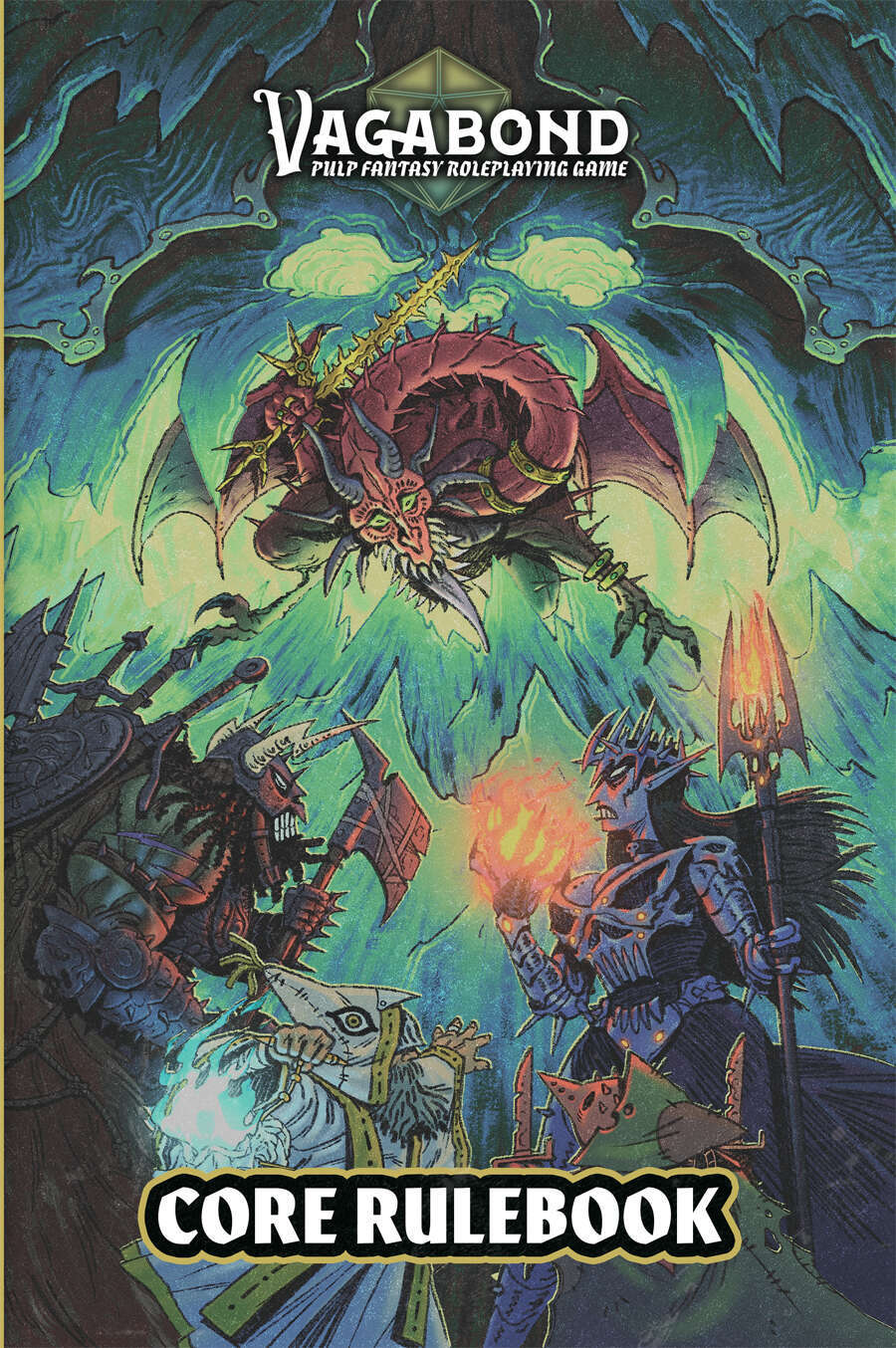
Unlike the previous two systems, my deep dive into Vagabondconvinced me without needing a playtest that it wasn’t going to meet my Paizo Adventure Path needs. Then, much to my surprise, Land of the Blind launched a Kickstarter for a new supplement and used that opportunity for a fairly large clean-up of the core rules. I’m excited by Spellbook and the expanded character options, and even more for tackling a full rules update. When I get my grubby little hands on both, I’ll look to run a playtest with some sort of OSR-type module or one of the adventures in the Kickstarter. I won’t be trying to force a super-heroic AP into it, though.
Three Rules-Light Systems I Read and Discarded
QuestWorlds

Still searching for my third playtest (while I waited until November for my Nimble Kickstarter books to arrive), I spent a good month buying and reading “rules lite” systems that could be used for heroic fantasy. My first foray was QuestWorlds,which has been around for more than twenty-five years as part of Chaosium’s vast gaming library. It was originally called Hero Wars when published in 2000, then Hero Quest, and, finally, in 2025 it was renamed QuestWorlds. Through these iterations, it’s been fundamentally a straightforward game with an “opposed roll” mechanic. Characters in QuestWorlds have abilities with scores between 1-20, which they roll under to push the story forward. The GM, meanwhile, rolls on a Target Number for how difficult the challenge is. Whoever wins the roll-off with the most successes (there are a variety of ways to gain multiple successes with a single roll) determines the outcome. That opposed-d20 rolling is the heart of the game, and everything else is how to factor in bonuses and flaws into the roll-off and how to interpret successes and failures. Abilities are fundamentally open and freeform, which means QuestWorlds is a truly generic system, and throughout the book there are examples of play from fantasy games, sci-fi games, and superhero games equally.
In a lot of ways, QuestWorlds today is almost countercultural in the landscape of TTRPGs. Games today are usually hyper-fixated on creating a very specific gaming experience, from Deathmatch Islandto Girl by Moonlightto Brindlewood Bay to Sentinel Comics. The mechanics bend to create the exact story the GM and players have agreed to play. QuestWorlds, meanwhile, is theoretically the everyman system, able to tell any story, like GURPS without the infinite supplements. For an excellent thought piece on its generic nature, check out this review by Cannibal Halfling. For a great overview of the mechanics from a mega-fan, check out this review on RPG.net. The DriveThruRPG reviews are also quite bullish, with some criticism of the layout (and I admit, the dense blocks of text are difficult to power through… I was also flabbergasted that the book—and print!—is so tiny!).
Back to Cannibal Halfling’s review, he says, “Without any distinct mechanics, QuestWorlds is aiming at one very specific audience: GMs who already have a world and concept in mind and just need a consistent way to adjudicate conflicts when they come up. It is ‘minimum viable RPG’ in every way, and yet that will appeal to some because there aren’t many other games like it on the market.” This precise reason is why I initially ordered a physical copy of QuestWorlds immediately upon reading reviews. That’s me he’s talking about! I have the vast tomes of detail on Golarion as provided by Paizo, plus the structure of epic, heroic scenes via the Adventure Paths… once I have the central conflict-resolution mechanic figured out, I’m set!
My concerns after pouring over the 330-pages of (very small!) print are threefold. First, I have a hard time believing that single mechanic is enough to keep me and a group of players interested for years of AP gameplay. After all, unlike other generic systems, QuestWorlds concerns itself with only adjudicating those story-driven conflicts. The system requires everyone to be comfortable narrating large portions of adventures and only pausing to roll when there is truly a conflict whose outcome will change the story. There are no level-ups, really—or, rather, players receive XP when they fail checks, which they can spend to add or improve abilities (much like Chaosium’s other Basic Roleplaying games). I’m just not convinced that it’s enough meat on the bone, so to speak. Which is made more of a concern because the rulebook is very clear that the roll-off mechanic is to tie up an entire story obstacle, not just a task. Scenes come down to a single roll. There are group conflicts like combat, but even then, it’s one roll per player. There are rules for more complex “Sequences,” or strings of rolls, that I would probably use as a default, but even still it feels like a very condensed way of doing storytelling. We could finish an entire Adventure Path in a handful of months instead of years, I’m guessing. That’s not what I want, though. I want to immerse myself in a story with friends, all of us holding our breath and whooping at the results of the dice. My worry with QuestWorlds is that it’s so focused on shared narrative that the rolls feel less dramatic, not more.
Finally, there is a certain joy that I have in reading rulebooks, and sometimes they absolutely capture my imagination and get me itching to play. It’s what happened with Crusaders and Tales of Argosa, both of which led to lengthy solo games to learn the system (and eventually play with friends, in the case of ToA). QuestWorlds worked in the other direction. Maybe it was the tiny print, or the layout, or the sparse art, or maybe I’m just not that into generic systems. I’m not sure. Whatever the reasons, though, I found it a struggle to get cover to cover in the rulebook and found myself less and less excited to play. I truly don’t think my lack of enthusiasm is linked to the rules themselves (with the two caveats above)—it’s some other indescribable fun in its presentation that was missing for me.
Index Card RPG

Next up was a game that I initially thought was a stripped-down fantasy game and turns out also to be a generic system: Index Card RPG by Runehammer Games. ICRPG (as it tends to be called) is a d20 system, anchored in the standard “6 attributes.” After that, though, it differs pretty dramatically. The core rules are simple, given only ~15 pages in the 400-page Master Edition rulebook. The basics are: a) the entire game runs in turns, each person at the table saying what’s happening round and round the table, b) actions are resolved by rolling to hit a Target Number (TN) using a character’s attribute—there are no skills and very few modifiers, c) every scene (not action) has a TN and Hearts (i.e. hit points) that governs everything in that scene, d) every action has an Effort die (i.e. the effect of the action, like damage from an attack), e) each character can earn a Hero Coin during play to enhance rolls, which can be given to allies, and f) characters don’t have levels, but instead earn milestone rewards as they hit important story beats. In addition, distances and time are abstracted, recovery is done with a die roll, and a few other d20 tweaks that are common to the games I’m considering. Not only are these rules easy to understand for beginners and TTRPG enthusiasts alike, but I give major props to Runehammer for ICRPG’s presentation. The rules are truly easy to digest and understand.
So how can the book be 400 pages, you’re wondering? Fully half of it is GM advice, and I’ve seen people talk about how ICRPG is as much an approach to gaming as a specific system. In addition, because the game differs depending on your world and genre, the Master Edition provides five ready-made worlds to play in: fantasy, sci-fi, weird west, superhero, and prehistoric. There’s a bestiary, a list of spells, lots of random tables, and well… those pages fill up quickly.
For a good overview of the system, check out this review on EN World by Rob Wieland, this one by Benjamin Abbott, and this one on RPG.net. Across the many reviews I found online and the DriveThruRPG reviews on the product page, the consensus seems to be that it’s a really fun game that’s great for beginners, probably lacks depth for long-term play, and is an editing mess since specific information isn’t easy to find across the many sections. It’s also a game that involves making the classes, etc. from whole cloth before you ever get started. After a lot of consideration, then, I decided it wasn’t going to serve my needs.
EZD6

My third and final attempt at a rules-lite system came in the form of EZD6by DM Scotty, which I’d seen several people rave about in various TTRPG forums. It’s a breezy read—44 pages of rules in a 110-page book overall, and in big print with plain-speak ways of explaining everything (though I’ve read in places that its loose wording sometimes causes rules confusion).
Mechanics-wise, it’s easy to get your head around the system. Here is an explanation from a review by Paul Gestwicki: “The core system is clear: roll a d6 and beat a target number, usually 3. Situations may get you a “bane” or a “boon” in a manner similar to D&D 5e’s disadvantage and advantage system. The math and adjudication are much simpler here, and it’s not clear to me that anything is lost in the coarse grain. That is, I don’t think it matters that taking a -2 on a d20 gives a 10% difference in outcome whereas having a +1 target on a d6 is a 16% difference: the human brain is too bad at statistics for this to really matter. The real value here…is the karma system. Players start with three karma, and they earn karma on each failed roll. Karma can be spent to improve any die roll on a point-per-pip basis. This works very well with the d6 system: each failure means, in a sense, you’re banking a 16% chance to succeed at something later. It’s simple, it takes some sting out of failure, and it adds up even in a short adventure. It also feels heroic in the narrative.” Spellcasting has its own separate mechanics and is quite open-ended, bounded only by the “circle of sorcery” you’re using. There are Hero Dice, allowing players to reroll. And… that’s about it. For a clean, clear overview of the rules, check out this review by Tabletop Thoughts.
Look, the reviews of this game are consistent and great. Check out Jeff’s Game Box, Matthew J Constantine, the DMG, or the many, many five-star reviews on DriveThruRPG. Despite the praise, though, I decided after my first read-through of the rulebook that it wasn’t going to serve my needs. Maybe it’s because I’d already concluded that I needed something more medium-crunch, but for me, the decision came down to the fact that a lack of any true progression system is a real downer. Even with simpler mechanics and faster combats, Paizo Adventure Paths are epic and long. I don’t think there’s enough mechanical depth here to entertain a player for, say, a full year or more with a single character without getting bored. The main way that characters get more powerful is better loot, which is cool but for me inherently limiting. I like the fact that there are nine classes, and the five species all fit Golarion well. Multiple circles of sorcery that are distinct (from necromancer to seer to shapeshifter). But… is it enough variety, especially if there isn’t mechanical character progression in the game? Not for me.
That insight helped me set aside any more exploration of lighter systems. I’d be excited to use EZD6 or ICRPG to introduce newer or younger players into the hobby, and they sound like awesome convention games or palate-cleansers after a long campaign in a crunchier system. For running something as narratively deep as an Adventure Path, though, I need something beefier.
Indeed, if I ever wanted to revisit a rules-lite system again for this purpose, I’ve been thinking increasingly that I’d dip into ICONS, a superhero system that has a fantasy supplement and, from my experience, can handle pretty much any scenario. I’d still need to sort out leveling, but it has enough optional rules that I could probably make it work.
Another d20 Playtest Incoming!
I may sound a little contradictory in my quest, because I want something deep and complex, but I don’t want it to be a lot of work for the GM. I want something fun and breezy to play, but I want there to be a lot of character progression options. I want combats to be fun and fast, but interesting and heroic. It may sound like I’m asking too much, or at the very least confused about what I really want. That said, my gut tells me that I’m going to find my perfect Adventure Path system that can do all of the above, and that I’m getting closer.
It’s mid-August as I write this post, which means I’m still at least three months away from my Nimble delivery, and that’s assuming everything runs smoothly with its Kickstarter distribution. I clearly can’t wait that long to play any new systems, nor do I like pinning all my hopes for this quest to a single game. As a result, I’m going to finally dive into two systems that are decidedly more crunchy, but may still have the lighter-prep aspects I’m looking for: Shadow of the Weird Wizard and MythCraft are similar in that both have fantastically deep and complex character-progression trees, with an almost infinite array of paths a character can take as they progress in levels. Upon a first read, I think Shadow of the Weird Wizard has a better chance of handling what I’m after because of its conscious choice to simplify a lot of d20 mechanics and speed up combat. The only way I’ll know if GM prep is burdensome is to try it out. I’m already getting ready to run a Golarion-based game soon!
Please comment below or send an email to jaycms@yahoo.com with any feedback.
Part 5: Shadow of the Weird Wizard




Leave a Reply