Curse of the Crimson Throne series:
- Book 1: Edge of Anarchy
- Book 2: Seven Days to the Grave
- Book 3: Escape From Old Korvosa
- Book 4: A History of Ashes
- Book 5: Skeletons of Scarwall
- Book 6: Crown of Fangs
- Reconstructing Curse of the Crimson Throne

It’s part four of my Curse of the Crimson Throne deconstruction, which is both GM prep for me and, hopefully, GM inspiration for you. If you’re just discovering the series now, check out the Book 1 link above. Otherwise, let’s jump into my evergreen caveats for this series:
First and foremost, these edits are there to make the game that I want to run. What I consider “essential,” you may not, and vice-versa. You would make (or have made) different decisions, which is both natural and part of the fun. Feel free to comment below if you see different opportunities.
Second, I’m going to be making heavy edits. If you’ve run or played in Curse of the Crimson Throne, I’m going to be deleting your favorite side quest, or NPC, or completely rewriting villain’s motivations and backstories. When I’m done, it’s likely not going to resemble the story you know.
Third, there will be rampant spoilers—in fact, once I dive in, these posts are essentially spoilers from start to finish. If you are a player in one of these APs or plan to be, these articles aren’t for you. (If you plan on GMing it or have done so, however… welcome!)
Finally, I don’t yet know what game system I’ll be using to run this Adventure Path, but it likely won’t be Pathfinder. Try not to get caught up in how dramatically I’m reducing the possible XP or treasure, or what I’m doing to CR of encounters. These articles are meant to be system agnostic, focused on story beats rather than mechanics.
Do we still need all that preamble? Those caveats feel so darned important that I’ll keep inserting them. For now, though, let’s turn our attention to arguably the most controversial book in the Curse of the Crimson Throne Adventure Path: A History of Ashes, authored by both Michael Kortes and, in the Hardcover Edition, James Jacobs.
Curse of the Crimson Throne 4: A History of Ashes
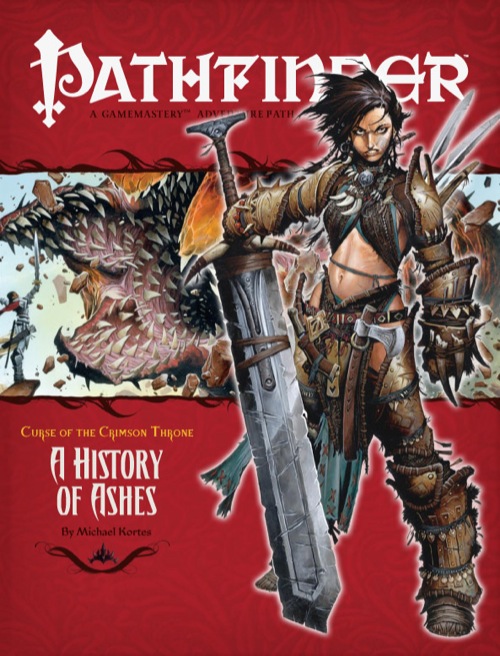
Why do I say that Book 4 is arguably the most controversial of the AP? Because Curse of the Crimson Throne is primarily an urban campaign, set in the vivid city of Korvosa. The PCs begin the Adventure Path with ties into one of the city’s minor villains and, throughout the first half of the campaign, build intimate and important connections throughout the city. Indeed, by the end of Book 3, the party members are likely local folk heroes who the commoners are looking to for protection against the growing evil of Queen Ileosa and her Gray Maidens. Then, sort of unexpectedly… Book 4 sends the party away from Korvosa and into the rugged Cinderlands to the north. In many ways, this part of the AP feels like a glorified side quest, taking away from the central conceit of the campaign.
I read this module knowing its reputation and fully ready to drop this book entirely. Which, if you want to keep the adventuring urban, you can totally do as a GM with minimal impact to the growing confrontation with the queen. That said, I can imagine that a reprieve from urban riots and maniacal nobility in favor of some face-painted tribes of the north might be welcome by a lot of gaming tables. As a result, I’m approaching today’s exercise with a “how do we make this work?” instead of a “do we need this at all?” mentality. Indeed, the only major part I’m dropping is the odd “back in Korvosa” bit added to the Hardcover Edition.
At the conclusion of Book 3, the PCs have rescued Vencarlo Orisini from the Arkonas and discovered the queen’s former seneschal, Neolandus Kalepopolis. They now know without a doubt that the queen is corrupted in some way and must be stopped, and Neolandus is the key to exposing her treachery. They’ve escorted the pair out of the city via an Arkonan boat, north to Harse and Vencarlo’s allies there. I imagine a chance for some relatively brief downtime in Harse while the PCs regroup and level up. At some point in this downtime, the party can have another (now predictable) Harrow reading, which can point to the city’s founding, the dragon Kazavon, whose fang has poisoned Queen Ileosa’s soul, and mysterious Shoanti protectors, all of which foreshadow this part of the AP.
Chapter 1: The Road North
Book 3 commences at Blackbird Ranch in Harse, home of a friend and former adventuring companion of Vencarlo’s. This location is where Vencarlo hid Trinia in Book 1, and she still resides here (which can rekindle any relationship begun with a PC, if appropriate). The PCs, Vencarlo, his friend, and Neolandus are all meeting at night to review the seneschal’s accounts of the castle. It’s a good opportunity to reset what everyone knows about the situation in Korvosa. More importantly, through this conversation the NPCs can help fill in some missing information for the players, especially the existence of something terrible and evil below the castle from Korvosa’s early founding that the queen must have discovered. Perhaps a PC who is a scholar or history buff can help as well.
Somehow, the PCs must decide it’s worth a long journey to the Cinderlands, where the Shoanti resettled after being driven away from Varisia, to discover more about Kazavon’s fangs and how to stop them. That feels to me like an extremely far bridge to cross for any party, especially since they know the queen will continue to batter the city while they’re away. Heck, they spent most of Book 3 in Old Korvosa, so they’ve already been away from their NPC relationships for what probably feels like too long. Most parties, I imagine, will want to immediately get back to the city and figure out a way to expose the queen for what she is. At best, they might send an envoy north to gather information. There simply must be a stronger hook than, “I bet you could spend weeks away traveling to talk to some Shoanti historian about these supposed rumors” to get the party moving north.
The least “blow up the AP” way I can see reaching a better hook is to make Vencarlo’s friend and former member of the Blackbirds adventuring party an old Shoanti shaman rather than a generic Varisian white guy. Handily, I wrote a Shoanti NPC out of Book 1, so I can recycle Thousand Bones for this purpose. In the nighttime conversation, it’s Thousand Bones who can unveil the history of Korvosa, the legend of the dragon Kazavon (which is detailed at the beginning of this book), and who can—instead of suggesting they find rumors of Kazavon’s fangs—provide specific instructions for seeking out the Clan of the Skull, the importance of gaining their respect, and the existence of powerful weapons guarded by the clan that can defeat the evil of the fangs. Basically, my goal is to turn Vencarlo’s friend into a credible quest giver.
Frustratingly, the module gives only vague hand-wavy descriptions of the long road to the Cinderlands, though an appendix provides a couple pages of the Cinderlands flora and fauna. Given that this trip is likely the only major journey of the campaign, it’s something I would want to make more eventful. There’s even a big city on the way, Kaer Maga, which could provide a side quest to the side quest (though I’d probably skirt this idea for fear of lengthening out the campaign too far).
The end of this chapter outlines opposing forces that are hunting the PCs while they journey, including the Red Mantis assassins, a tribe of gargoyles that make the Cinderlands their home, and a white “Shoanti hunter” who roams the area. I like the idea of factions at work in the background, but the leader of the Red Mantis group is named Cinnabar (which either makes me think of Cinnabon or cinnamon gummy bears) and the hunter is named, I kid you not, the Cinderlander. So even if I use these villains I’ll be renaming them.
Chapter 2: Trials of Respect
Once the party reaches the Cinderlands, they’ll begin to encounter Shoanti tribes. The module sets up a “Respect Points” counter to track the PCs’ efforts in the region and suggests making the point counter visible to the players but not how many are needed to earn the Shoanti’s trust enough that they share valuable information (in the book’s scale, the party needs 20 Respect Points to reach this milestone, and at -10 RP they are effectively at war). Since Curse of the Crimson Throne’s publication date, many games have introduced the idea of a “progress clock.” Whatever system I’m using to run this AP, for me it’s more elegant to introduce an eight-segment clock for this chapter, adding or subtracting clock segments as the party earns or loses respect. This revised approach takes away the fiddly “+1 RP for this, -3 RP for that,” and instead lets me weigh the narrative benefits of the party’s actions. I’ve also used clocks enough in various games to know that I’ll make the number of segments clear to the players… I truly don’t see the benefit of hiding the goal they’re trying to achieve.
I’m surprised that there isn’t an Appendix in the hardcover that provides a full, consolidated write-up on the Shoanti, since knowing their beliefs, practices, and the differences between their various tribes is the foundation for this part of the AP being compelling and fun. This information is instead sprinkled across many different locations. To compound my confusion, the module quickly shifts to the Shoanti names of the tribes when describing events (e.g. Sklar-Quah and Skoan-Quah, instead of Sun Clan and Skull Clan). I was so confused by this omission that I went to the original A History of Ashes module and, lo and behold, there is a full Shoanti write-up, with the Cinderlands, that I expected! Anyway, I find myself relying on the Pathfinder Wiki entry on the Shoanti and the original module, both of which to me are better than the Hardcover Edition in this regard.
In my version of the story, Vencarlo’s ally and former adventuring companion Thousand Bones has sent the party into the Cinderlands with clear instructions: Find the Kallow Mounds, the sacred burial site of the three Cinderlands Shoanti clans (Skull, Sun, Moon), and seek out One-Life, the chieftain there. One-Life can help the PCs find a way of stopping the dragon’s fangs, but only if the party gains the Shoanti’s respect.
Dropping Thousand Bones’ name clears any tension from initial encounters with skull-painted patrols, and the party will eventually have an audience with One-Life (as-written, Thousand Bones from Book 1 and One-Life are both present, but they’re redundant figures story-wise so it’s fine to have only one of them throughout the rest of this chapter). Shortly after they meet him, another visitor arrives at Kallow Mounds: Krojun, a hot-headed hero of the Sun Clan (Sklar-Quah), who is incredulous to see outsiders. Tense words ensue, and Krojun challenges one of the PCs to a game of “sredna,” a sort of tug-of-war game. It’s a fun little encounter, and of course refusing, accepting, winning, or losing the challenge affects the progress clock.
That night, the PCs have an audience with One-Life and his Bone Council. He listens to their tale and their request for information, and may fill in some added lore bits about Kazavon in response. One-Life says that the Sun Shamans of the Sun Clan (Sklar-Quah) are the lone preservers of the history of the great evil of Kazavon, but they guard his information closely. To provide that knowledge, the Sun Clan must trust the party to divulge what they know. Given their time constraints, he proposes some possible ways to do so. Some of what’s in the module as written seems to be too disclosing of the Shoanti’s secrets for me to believe them provided so easily here. As a result, here’s an edited list of what One-Life offers:
- Krojun is a hero of his clan. If he proclaims his support for them, it will go a long way. But even if the PCs won the game, it’s sure to be an uphill climb to get his full trust.
- Another individual whose voice carries immense weight is Akram the Truthspeaker, a member of the Moon Clan (Lyrune-Quah). One-Life can direct them to him.
- The Shoanti have many beasts in the Cinderlands who are hostile to them. Hunting these beasts and bringing trophies of their kills is sure to impress the clans.
- The most dangerous of these enemies is Cindermaw, also known as the Clan-Eater, and a creature revered by the Sun Clan (Sklar-Quah). An immense test of bravery is to be swallowed by the beast and emerge alive, and doing so will surely cause the Sun Shaman to see the PCs in a new light.
- An ancient Acropolis exists in the Cinderlands that only the bravest Shoanti will enter because most never return. Those that do bear the sacred mark from its inner sanctum that will impress any Shoanti.
- If all else fails, ask the Sun Shaman to take the Trial of the Totem. He won’t agree without some sign that the PCs are worthy of the trial, but as you become known for other deeds it is surely a way to secure his trust.
Obviously, the PCs can do any of the first five quests they’re drawn to, and in whatever order, and at any point can also request the Trial. I love this sort of adventure structure! In addition, though One-Life trusts Thousand Bones enough to have this audience and provide this advice, he and his Bone Council insist on sending four Skull Clan (Skoan-Quah) warriors with them. These warriors will bear witness to the party’s deeds, and provide support (they, of course, will also report back to One-Life on the PCs’ worthiness). This wrinkle is awesome, because it means a) possible roleplaying social interactions during and between quests, and b) it adds difficulty to the party because they better keep these warriors alive or suffer a loss of respect.
Let’s talk about each of these quests in order:
Krojun’s Trust – If the PCs directly approach the Sun Clan hero, he’ll likely rebuff them and say that one tug-of-war does not mean he trusts them enough to speak for them. That said, the party has piqued his interest, and he’ll continue to follow at a distance, watching the PCs’ trials. There are lots of opportunities to give the PCs glimpses that someone is following them, which can heighten tension during the other quests and lead to a game of cat-and-mouse (which is a path to gaining respect if won). Krojun can also either intervene or complicate any of the other quests, possibly even getting himself into dire trouble. Rescuing him and his small Sun-Clan band is the best way for Krojun to declare his support. Which is all to say, there are loads of ways to bring this NPC to life!
Akram the Truthspeaker – One-Life can direct the party to the House of the Moon, a ruined temple to Desna that predates even ancient Thassilon where Akram is currently camped. The Moon Clan (Lyrune-Quah) are nomadic people, but they return to the House periodically. This time, they’ve encountered a creature called a red reaver that has occupied the ruins and is killing Shoanti clan members. When the PCs arrive, the clan chief asks for help. Assuming the party can kill the red reaver, the Moon Clan—who are less xenophobic than other Shoanti clans—embrace the party. Akram is also there and is happy to both get to know and speak on behalf of the party to the Sun Shamans. The complication is that he is almost seventy years old, with a once-in-a-generation talent for spotting truth that the Shoanti revere. Keeping him safe in any subsequent encounters is hugely important to the PCs’ progress clock.
Hunting Trophies – This quest is the most freeform of the ones provided. Basically, find dangerous creatures the Shoanti would respect you killing, and kill them. There’s a Cinderlands random encounter table in the Appendix which provides some handholds: basilisks, giant scorpions, ashwing gargoyles, ankhegs, rocs, bulettes, chimeras, wyverns, ash giants, and even possibly a red dragon. I would probably only do one or two of these mini-quests, but I can imagine finding a particularly dangerous example of some of these that are plaguing a Shoanti group and making a fun Monster Hunter-type scene. As with many of these quests, there’s also a chance to throw Krojun getting himself into trouble into all these encounters.
Cindermaw – Cindermaw is nasty business—a purple worm infused with elemental fire for Reasons™, and thus one of the deadliest predators in the Cinderlands. Its hunting grounds are known to (and largely avoided by) all Shoanti. Unlike the previous quest, the goal here is not to kill Cindermaw (which would have them lose favor with the Sun Shaman), but instead to show they can be swallowed by him and survive, either by cutting their way out or somehow climbing back out its mouth. Doing so will require a lot of damage- or fire-resistance of some kind. Basically, I see this scene a lot like the Shai-Hulud one from Dune 2, with the Skull Clan (Skoan-Quah) warriors playing up how crazy and brave whatever PC takes on the tasks is.
Acropolis of the Thrallkeepers – This location is a fun wink and love letter to the Rise of the Runelords Adventure Path, as it’s the ruined Acropolis of ancient (like, ten-thousand years ago) sorcerers of Thassilon who served the Runelord Karzoug, the antagonist of that AP. The history of the place is bafflingly complex and something the PCs will never reveal. The point is that it is from a culture they can’t hope to understand, for an equally mysterious purpose. Sihedron Runes, or seven-pointed stars, adorn the black-stoned walls, and it’s an opportunity to show the truly bonkers danger that exists in the ruins and wilds of Golarion.
As written, the module suggests Krojun follows the PCs, possibly getting himself into trouble. It also says that four Red Mantis assassins, guided by the (groan) Cinderlander, are inside the place. I’m fine with the first idea if it makes sense in the flow of the story, but the idea of the Red Mantis knowing about the party’s flight from Korvosa and tracking them so precisely makes me twitchy. The assassins’ appearance certainly puts the PCs more on a clock, and will make them suitably paranoid. On the other hand, the idea that Queen Ileosa knows where the PCs are and what they’re doing makes her too omnipresent as a villain for my tastes. I’m okay with the idea that the Red Mantis are searching for the party, but I’d like their clashes to be a bit more haphazard, where the party must defeat the assassins both to save themselves and keep word from reaching the queen.
Anyway, the Acropolis is an 11-room dungeon whose principal threat is a Cthulhu-inspired tentacled creature and traps galore. It’s filled with esoteric history from Thassilon, and ancient devices that, among other things, brands a Sihedron Rune onto the PCs within its innermost sanctum. It all sounds like a hoot, and something I can dial back or dive into as much as the players are into it.
Trial of the Totem – Once the party is within a stone’s throw of finishing the Progress Clock, they can, if they choose, approach the Sun Shaman early and ask for the Trial of the Totem. Doing so means heading to Flameford, the Sun Clan (Sklar-Quah) camp. The current Sun Shaman is there and will ask for a full account of what the party wants, why, and what they’ve done to prove themselves worthy, prioritizing the accounts of Shoanti (Bone Clan warriors, Akram, and especially Krojun) over the PCs’ own words. Any mention of Kazavon or his fangs will cause the Sun Shaman to become visibly shaken and grave, and he’ll quickly silence the conversation.
The Trial itself is basically a long Survivor challenge in which the PCs, at dawn, must carry 10’ tall totems with rounded bottoms up a hill and attempt to keep them upright until dawn the next day, when they carry them to a higher hill, then must see a third dawn. Fatigue and exhaustion are at play, as well as potential taunts from Sun Clan (Sklar-Quah) members, attacks from hungry predators in the wilds, etc. There’s even an opportunity for heat-induced religious visions from the PCs’ gods. If the PCs succeed, they are officially friends of the clan (the module says they’re full members, but that seems silly), and the Sun Shaman agrees to share his wisdom.
If the PCs have already completed the progress clock without the Trial, the above can play out similarly without the three days of the Trial of the Totem. Regardless, once the Sun Shaman agrees to share his knowledge, he’ll gather the PCs in a private yurt to talk.
Before he can do so, though… Flameford is assaulted! Here the Red Mantis have finally discovered the PCs’ whereabouts (making me even more sure they’re not needed in the Acropolis), and they’ve allied themselves with a tribe of ashwing gargoyles. It’s a large-scale battle—and the big climactic fight of this book—since the local Shoanti will swing into action. Assuming the PCs prevail and repel the assault and keep the Sun Shaman alive, there’s a proper victory party and, finally, the Sun Shaman will spill his secrets in a private audience.
What are those secrets? Bizarrely, the module waits until Chapter 4, so I’m going to switch up the order here to continue the story (more explanation below in the intro to Chapter 3).
Chapter 4: Conclusion
Finally, the Sun Shaman shares everything he knows through lore about the origins of the fang of the dragon Kazavon that was buried deep below Korvosa Castle and is now corrupting Queen Ileosa. He then says that he can perform a ritual with the PCs to uncover a solution to fighting the evil of the ancient relic. The shaman likely begins by singling out the PC with Zellara’s Harrow deck and asks for a reading, or he singles out another PC who can provide some sort of prophecy of the battles ahead. Then he begins chanting and, when the hours-long ritual is done, each PC gains:
- One of their weapons, armor, or shield is infused with spiritual power, allowing each PC to have a unique relic of their own. I’ll work with each player to make each item feel exciting and epic.
- An ability to thwart death once (whose mechanics will depend on the system I’m using), or some other cool one-use power.
The ritual done and the blessings given, the PCs are free to return to Korvosa with all haste, providing some downtime on the journey and likely level-ups for everyone. They have what they came for—something to put them on more even footing with Queen Ileosa—but what’s happened at home in their absence?
Chapter 3: Mantis and Maiden
I’m truly confused by the insertion of this chapter into the AP. The upshot is that an ally in Korvosa reaches out to the PCs to tell them that an opportunity has presented itself to strike at the Red Mantis and Gray Maidens, wiping them out in one fell swoop. But wait… aren’t the PCs in the Cinderlands? Yep! The module says this chapter can occur anytime the PCs are back in Korvosa, from the end of Book 4 all the way into the first parts of Book 5. Why place it here, then? Why not resolve the Cinderlands arc and then offer this chapter as a possible postscript or way to enter the next book? It’s so weird that I went hunting up the original A History of Ashes module, and, sure enough, the story doesn’t jump around like this version. Indeed, it’s interesting to me that Michael Kortes is the sole author listed on the original book, so I assume James Jacobs came in with the Hardcover Edition to add this chapter. It also looks like there was a whole “Shoanti marshalling their forces to go to war with Korvosa” subplot that was dropped from the original for the Hardcover, which seems like a good edit to me.
Setting all of that aside, let’s look at this chapter and puzzle out its reasons for being here. The campaign seems to presuppose that the PCs at this level will have access to teleportation magic or some powerful way to cross distances easily, and that they may be taking breaks from their Cinderlands adventures to return to Korvosa to check in on things or resupply. As I’ve said in my Rise of the Runelords write-up, I truly dislike this assumption of fantasy campaigns, as it negates any fun/peril of travel and throws a lot of the integrity of unique cultures across Golarion into question for me. Basically, I like my fantasy stories where the characters are bound to their region, with the wider world a more mysterious place. Local stories are, to me, inherently more interesting. I feel the allergic reaction to resurrection magic, long-distance scrying or communication, and probably a few other D&D mainstays that take away peril or mystery from adventuring, and I almost always add a steep cost to anything that feels overly danger-breaking. Which is to say that, in my campaign, once the PCs are in the Cinderlands they’re unlikely to return to Korvosa until they’ve either succeeded or failed at their quest.
To make matters worse, this chapter feels utterly unnecessary. As written, the PCs receive a message from a Pharasman priest and meet with a variety of NPCs to uncover a back entrance to the Red Mantis’ and Gray Maidens’ base of operations, through a place called Deathbed Vault. The backstory on the place is overly complex, and the location itself is a 21-room classic dungeon, full of a menagerie of monsters and traps that only loosely make sense to be there. The prize for surviving these threats is an extraplanar monster called the Mother of Thorns, a creature that provides the final ritual (i.e. torture) that transforms women into Gray Maidens, Zenobia, the Gray Maidens’ “indoctrinator,” and Kordaitra, the Gray Maidens’ second in command.
While I appreciate the insertion of a dungeon crawl (which Paizo seems to think is required as a regular beat in any campaign) and a chance to attack the Gray Maidens in their stronghold, there is a lot about this whole situation I don’t like. How did Ileosa create the first Gray Maidens? Was it always with the Mother of Thorns? How long have they been operating here, and why are all these NPCs suddenly so powerful (and if they were around before, why aren’t they people the PCs have encountered yet?). I also don’t like the buddy-buddy nature of the Red Mantis and Gray Maidens, and prefer if their alliance is more fraught, held only together by the queen’s mad ambition and power.
Unfortunately, then, I’m dropping this entire chapter. The Red Mantis’ attack upon Flameford, the Sun Shaman’s knowledge, and the blessings to aid the party in fighting the dragon’s fang all feel like an appropriate wrap-up of this arc, including downtime. The return from the Cinderlands and discovery of what Queen Ileosa has been up while they were away set up Book 6 (wait, what about Book 5? Stay tuned tomorrow!). If at some point back in Korvosa the party wants to make an assault on the Gray Maidens before taking on the queen directly, I’ll have this chapter in my back pocket but will likely only loosely use it and instead homebrew what that encounter entails.
Deconstructed A History of Ashes
On that weird and anticlimactic note, then, we’ve finished Book 4! When all is said and done, it’s a fairly straightforward structure: Go to Cinderlands to discover a way to fight the queen, do Shoanti quests to earn the right for that information, gain power and come home. Though I initially approach this book dubiously, this whole part of the campaign not only sounds fun, but a nice way to vary the setting briefly before continuing the adventure in Korvosa. That said, Book 4 is, fundamentally, a long side quest. The party can tackle Queen Ileosa and her forces without the Shoanti-fueled weapons and abilities from the Cinderlands and can obtain the information about the Fangs of Kazavon in other ways. If you’re not into it and want to keep the action in the city, it’s an easy section of story to remove.
As always with my articles, please comment below or send me an email at jaycms@yahoo.com. I’m always eager to hear from GMs who have run this AP to know what they think of my edits and different choices they made.
 My Hero Brain
Leave a comment