Curse of the Crimson Throne series:
- Book 1: Edge of Anarchy
- Book 2: Seven Days to the Grave
- Book 3: Escape From Old Korvosa
- Book 4: A History of Ashes
- Book 5: Skeletons of Scarwall
- Book 6: Crown of Fangs
- Reconstructing Curse of the Crimson Throne

I’m back! I have a new job that is giving me a lot less writing and gaming time, but I’m still back! Strap in, folks, because today is a doozy.
After a series of posts deconstructing and then reconstructing Paizo’s first Adventure Path set in Golarion, Rise of the Runelords, into the AP that I want to run, I faced a choice: Go deeper on RotR and fully convert it into a new system (probably Nimble), ready for me to jump in as GM, or flip to the next AP in my collection. It wasn’t an easy choice, and I waffled for about a month. Ultimately, I decided to stick with the idea that originally spawned my first series: At this point, I’ve collected nearly every Paizo AP, and gosh darnit… I want to read and run them! These articles are a nice forcing function for me to do both—taking the time to really pour over the story beats of these epic campaigns not only familiarizes me with the campaign structure, but it’s the first (and most labor intensive) step to running them.
So, what am I doing, exactly? These articles take each book of my chosen Adventure Path, breaking it down into what I consider the essential story beats. The result when I’m done is a massively pared-down adventure, ready to be fleshed out with details from the individual characters rather than pre-written bits. From the first post of my last series:
“You see, I absolutely love Paizo’s APs, but I also fully agree with Tarondor when he says (emphasis mine), “Even the best, most complete Adventure Path demands customization for your players and for their player characters. Publishers can’t think of everything your players might like or might do. That’s what you, the GM, are for. Don’t regard an Adventure Path as a straitjacket. Regard it instead as a particularly good set of notes from which you derive your own story. If you pretend it’s supposed to be a complete package that requires no alterations or prep work then your game will be flat and lifeless, no matter how good the writing.”
Indeed, I’ll take this idea further and say that most APs suffer from too many combat encounters, a lack of foreshadowing villains and other major plot hooks, excess and unneeded story beats, and way too many places where the story and character motivations become convoluted. It’s easy for players to pause, a confused look on their faces, and say, “Wait, what are we doing here, again?” Taking out huge sections, NPCs, etc. often improves the AP rather than detracting from it. Doing so also makes room for more PC-driven stories and side quests, which can feel bolted onto the heavy AP plots.”
Feedback from my Rise of the Runelords series was terrific and much appreciated. A consistent comment was a surprise at how much content I removed from this beloved AP. A few people hated me doing so, which is understandable—if you want to run these campaigns as written, then deleting side quests, changing NPCs, etc. feels like an anathema. Most readers, however, took these changes in the spirit I intended: As a particular GM getting ready to run his own campaign. When viewed with this lens, my hope is that, whether you like my choices or not, you find inspiration to fully embrace making these stories your own.
With this point in mind, I’ll return to my evergreen caveats for this series. I’ll repeat these points for each article, because they’re an important foundation for what I’m building here:
First and foremost, these edits are there to make the game that I want to run. What I consider “essential,” you may not, and vice-versa. You would make (or have made) different decisions, which is both natural and part of the fun. Feel free to comment below if you see different opportunities.
Second, I’m going to be making heavy edits. If you’ve run or played in Curse of the Crimson Throne, I’m going to be deleting your favorite side quest, or NPC, or completely rewriting villain’s motivations and backstories. When I’m done, it’s likely not going to resemble the story you know.
Third, there will be rampant spoilers—in fact, once I dive in, these posts are essentially spoilers from start to finish. If you are a player in one of these APs or plan to be, these articles aren’t for you. (If you plan on GMing it or have done so, however… welcome!)
Finally, I don’t yet know what game system I’ll be using to run this Adventure Path, but it likely won’t be Pathfinder. Try not to get caught up in how dramatically I’m reducing the possible XP or treasure, or what I’m doing to CR of encounters. These articles are meant to be system agnostic, focused on story beats rather than mechanics.
With the preamble done, let’s jump in!
Curse of the Crimson Throne 1: Edge of Anarchy
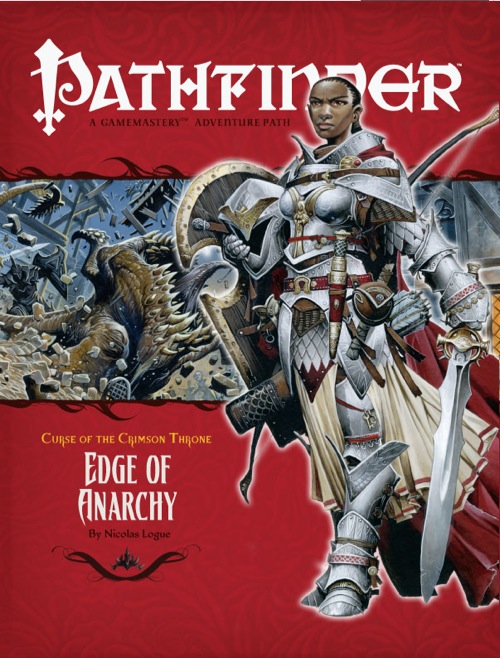
I’m not getting clever with the order of these series, which means that I turn my attention to the second Adventure Path set in Golarion: Curse of the Crimson Throne. Paizo released the original six books for Dungeons and Dragons 3.5 Edition, published from March to August 2008. They then released a beefy 480-page compiled Hardcover Edition for Pathfinder 1st Edition in October 2016. In 2019, the Curse of the Crimson Throne expansion appeared for the Pathfinder Adventure Card Game. Most recently, in 2023 Pinnacle Entertainment Group released the boxed set for their Savage Pathfinder game. I apparently have a TTRPG fanatic’s problem, because I own all these versions except the card game. For the purposes of this series, I’ll be focused mostly on the PF1e Hardcover Edition, which is the most complete in terms of content (though I’m critical of some of the changes, as you’ll see when we wade in).
If you hate me changing things in classic Paizo APs, this series is likely the best you can hope for (at least until the second half). As Tarondor says in his excellent Guide to Pathfinder Adventure Paths: “Curse of the Crimson Throne is a masterpiece. The NPCs and the setting are carefully crafted, especially in the first half of the game, which all takes place in the same setting. The second half is also very good, but doesn’t dwell in one place and so the PCs are bound to feel less connected to the people and places. What sets Curse of the Crimson Throne apart from other campaigns and adventure paths that also feature excellent settings is the way the PCs are woven into the life of the city. Your PCs will almost certainly care about the city and its fate, which is critical to making the adventure feel personal.” All in all, CotCT ranked second in both Tarandor’s ranking of all Paizo APs up to 2025 (out of 44!), the same ranking as his reader poll. Indeed, one of my diehard PF1e GM friends says it’s his favorite campaign that Paizo has released for any edition.
Which is all to say, if you want to play the most iconic AP, play Rise of the Runelords. But if you want to play the best of the classic ones, play Curse of the Crimson Throne. Given how good the reviews are, maybe I won’t change anything! Er… well, mostly anything.
Chapter 1: Haunted Fortunes
Right from the outset, the campaign looks to tie the PCs into the story. First and most obviously, the players should make characters who live in the city of Korvosa, the largest city in Varisia and the location of most of the campaign. But the AP does something that I wish every campaign did: It provides background hooks to tie every PC directly to the story, called “campaign traits.” These hooks center around a man named Gaedren Lamm, who is “a despicable wretch who missed his chance at being somebody big in Korvosa’s murky underworld. Well past his prime, the decrepit thief abducts orphans and forces them to support his parasitic lifestyle with petty crime. Many members of Korvosa’s lower class have had dealings with Lamm, and even a few of the city’s middle class and nobility have had their lives complicated by this foul old man. Yet no matter what he does, he always seems to slip away from the guards and avoid answering for his crimes.”
Each PC, then, can choose one of a whopping twelve different ways their past is tied to Lamm in some way. Perhaps a PC was betrayed by him in a business dealing and is hungry for revenge, or Lamm framed a family member, or murdered a lover, or abducted a sibling, or even tortured the PC and left them for dead. Each campaign trait is flavorful and compelling, immediately giving the character a reason for hating Lamm. The campaign traits also have minor mechanical benefits and XP boosts to various milestones, which would depend on the system I run. Even without the mechanics, though, these hooks are a splendid way of weaving a party together with a common cause.
Two other minor points about character creation: First, Curse of the Crimson Throne’s setting is a sprawling urban adventure, from the ghettos to the throne room. If a PC is a wanderlusting naturalist who wishes to make a pilgrimage to some distant land, it’s not going to fit this AP (unless that land is the Cinderlands, but even then probably not). Second, the Player’s Guide oversells how easy it is to play someone out for vigilante justice, since the campaign assumes you will accept joining the Korvosan Guard and be peacekeeping officers for a while. These APs, with rare exceptions, are about playing heroes, more Justice League than Punisher.
With character creation out of the way, let’s turn our attention to Book 1, Edge of Anarchy, by Nicolas Logue (also author of RotR’s third book!). As with many epic campaigns, the book begins with a dizzyingly complex set of events that have taken place before the adventure begins. The important bits are:
- Korvosa was founded 300 years ago by an invading force from the south into Varisia, pushing the native Shoanti away.
- Though few know the truth, these Shoanti were guardians of a terrible relic: the magical fangs of the great dragon named Kazavon, which now lie beneath Castle Korvosa.
- Korvosa’s current king, Eodred Arabasti II, has no heir to the throne and a beautiful young wife, Queen Ileosa.
- Ileosa recently discovered the Fangs of Kazavon, and exposure to them has corrupted her, making her cruel and ambitious.
- In her ambition, Ileosa has been slowly poisoning Eodred, who is now at death’s door, and attempting to murder anyone who stands in her way to the throne. She’s enlisted the aid of a religious cult and an assassin’s guild, the first of many dubious allies.
These royal machinations are all in the background and unbeknownst to the PCs, as is the other detailed backstory they don’t know: That a fortuneteller named Zellara Esmeranda was wronged by Gaedren Lamm and attempted to kill him. He murdered her instead and now keeps her head in a box within his lair. Somehow Zellara’s anguished spirit remains, however, and her [waves hands around] fortuneteller magic somehow locates the PCs. She also, the book says, somehow can cast illusions into the PCs’ minds. With these powers, she sends each PC a Harrow card (Golarion’s tarot deck analogue is a Harrow deck, and it’s very cool… I own two physical copies!), drawing them to her home, and then illusorily appears once they’re gathered to give them a quest.
I admit, I don’t love this opening. Why did killing Zellara give (or enhance) her powers? Of all the many people wronged by Lamm, why are the PCs her chosen champions (the book says that she senses they have “the greatest strength, the greatest potential, and the greatest anger,” which is flimsy given how awful Lamm is)? Isn’t it simpler just to have her be a fortune teller with a beef against Lamm instead of all the unexplainable magic-and-illusions stuff?
As much as I hate changing the very first scene of a beloved AP, I’d rather have Zellara be a living quest-giver, a desperate woman who sees finding people capable of taking on the man who murdered her son as her only opportunity for revenge. It’s more work as a GM to make individual connections with each PC instead of “you are mysteriously drawn to a place,” but for me more satisfying. Zellara has sold everything she owns to discover Lamm’s location, and the Korvosan Guard ignored this information. Will the PCs act on her behalf? Will Gaedren Lamm finally be made to pay for his crimes, she pleads?
Assuming the PCs agree to face Lamm, Zellara will then perform a Harrow reading for each PC, something that’s outlined in the book and a way to foreshadow later story beats. I love this idea, and again, something I like even better when Zellara is a real person instead of an illusion.
With the PCs united and Lamm’s whereabouts known, the adventure is off and running! There’s no true urgency to make their way to an old fishery on Westpier 17 except the PCs’ individual needs for closure, so there is a chance to do some scouting and/or planning if the players want to do so. Indeed, taking an extra day or two helps set up the ways I’m tweaking Zellara’s appearance later.
The old fishery is a creaking, decrepit building with boarded-up windows, as its owner died some time ago. Gaedren Lamm has been squatting here with his workforce of enslaved orphans (called “Lamm’s Lambs”) and thug companions. The module provides good descriptions of its features and location as well as how its inhabitants differ during day or night, so any plan the PCs make for how they approach is fair game. There’s a nice section of how the orphans will respond to the PCs, and when they’ll aid them or Lamm. All in all, it’s a complicated set piece as the first combat encounter for a new party, but the campaign hooks give it weight and purpose.
The fishery has fourteen locations over two floors as a “dungeon,” which I won’t detail here. Suffice it to say, there are anywhere from 9 to 26 orphans present depending on time of day, and the PCs must defeat 3 thugs (Yargin, Hookshanks, and Giggles), a foul-tempered dog named Bloo, and of course Gaedren Lamm himself. Because it’s fun, Lamm has a pet alligator named Gobblegut, which should be part of the final encounter. If anyone jumps into the river during the infiltration, there’s a shark waiting for them. The only encounter that feels extraneous to me is a nest of large “drain spiders,” so I’ll drop this one.
The trick is to make the final encounter with Lamm exciting and monumental, since it is in many ways the end of a story arc that just began when the players made their PCs. There’s little chance of Lamm escaping, since he’s an old man and the party have personal vendettas against him. Indeed, I’m faintly surprised (and I suspect the players will be too) that the whole conceit of why they’re together as a party—a common enemy who wronged them—is so easily dealt with at the very outset of the adventure. It’s a jarring bit of closure based on the campaign traits, and hopefully leads to good roleplay moments. Regardless, there are campaign ideas if Lamm escapes in the book, but the expectation is that he’s brought to justice or, more likely, killed by a vengeful PC or his own abused alligator. Any of these outcomes makes for an interesting end to the scene.
If the party took 1-2 days to set up their invasion of the fishery, there was plenty of time for Lamm to hear about Zellara asking questions about him. In his den, then, is her newly severed head and Harrow deck. I like this resolution to Zellara as an NPC much better than her being already dead and having unexplainable powers, and think it will likely have a bigger impact upon discovering her head. If instead the party rushed straight to the fishery, they can find Zellara dead in her home, slain by thugs sent by Lamm, when they report back. Either way, this tweak satisfies any changes I made to the opening scene of the AP.
Treasure-wise, Lamm has a crudely coded ledger detailing his various criminal enterprises. This book, once deciphered, can further hook into PC’s backstories, and is something the Korvosan Guard will happily pay to solve unclosed cases. In a lockbox, there are various valuable items (including a) his prized possession: a valuable brooch stolen from Queen Ileosa herself, and b) the dagger of Lamm’s murderous son Rolfe (who appears later in the AP) that Lamm has kept over the years, plus a few magic items. Finally, Zellara’s Harrow deck sits either within the box or on her corpse at home, and it is its own intelligent relic – super cool, and adds weight to their earlier readings!
Chapter 2: A City Gone Mad
So, the adventure is finished, right? The party was brought together by a common enemy and now that enemy is vanquished. We did it!
Not so fast. As the PCs leave the fishery, it quickly becomes clear that chaos has broken out across Korvosa. Parts of the city are burning, alarm bells ring frantically, people scream, hippogriff patrols streak overhead, and on and on. “The king is dead! Long live the queen!” some shout, only to be countered by ragged cries of “Hang the queen!” or “The usurper must die!”
It seems that most Korvosans viewed Ileosa as “a petulant gold-digger at best.” Once the outrage began at the proclamation, it quickly spread into full riot across the city. As it states in the module: “In the space of a dozen hours, all of Korvosa’s oppression and anger explode into chaos. The city perches on the edge of anarchy.”
The rest of this chapter details a series of events and encounters that can occur in whatever order makes sense based on how the PCs react to a) the chaos in the streets, b) their discoveries in Lamm’s hideout, and c) whatever individual plots exist in their backstories and with each other, though they roughly happen in numbered order. The campaign assumes that these events take place over the span of a month, but it can be significantly shorter or longer depending on what the party does. I’m generally in favor of more time passing than less in Adventure Paths, so I won’t be in any hurry to get through this module. The point here is to provide the PCs a broad canvas, and to emphasize that the city remains in protracted turmoil.
What’s interesting (and confusing upon first reading) about the structure of Edge of Anarchy is that three of the events in Chapter 2 send the party into detailed events in Chapter 3. So, as a GM, there is some flipping back and forth within the book that’s needed to run the adventure. Regardless, there are some prerequisite story beats to hit before some other events “unlock,” but for the most part the idea is that Chapters 2 & 3 of the module are all there for the PCs to accomplish however it makes sense to them, with Event 14 in Chapter 2 the trigger for the actual end of Book 1, which is its own section at the end but somehow not Chapter 4. Like I said: Confusing!
There are, in all, fourteen events listed in this chapter. I’ll color-code them into events that I like as written and see little reason to change (black), events that I like with some tweaks (purple), and events that I see as optional or would drop all together (red).
Event 1: Return to Zellara’s Home
If the PCs rushed to the fishery, they’ll likely want to return to check on their quest-giver, especially with the city rioting. It’s here that they can find her place ransacked and Zellara murdered by Lamm’s thugs, plus retrieve her magical Harrow deck. If they already found her head and deck in Lamm’s possession, her home can act as a “home base” if they don’t have one, and perhaps the Harrow deck can respond to the house in some ways, revealing some of its powers.
Event 2: The Mysterious Brooch
The PCs will likely either try to investigate the expensive brooch they found in Lamm’s hideout or sell it. Either way, an experienced merchant tells them that it not only belongs to Queen Ileosa, but that it’s been reported stolen and can be returned to Castle Korvosa for a reward. I suppose truly lawful PCs might have wanted to hand over Lamm’s loot to the Korvosan Guard but will find doing so more challenging given the riots. Still, if they’re persistent, I’m sure someone from the Guard can provide this information as well as a merchant. The point is to point them towards returning the brooch at some point, which leads to Event 8.
Event 3: Mad Prophet
A rabid doomsayer singles out a PC and says some sort of doom-y prophecy that can either foreshadow something later in the AP or just be random raving. Still, he carries disease and tries to grapple with the PC. Simple. Thematic.
Event 4: Imps and Dragons
I debated on considering this encounter optional, because it doesn’t serve the primary plot. That said, it’s a flavorful flourish of Korvosa – that imps and house dragons are both as common as alley cats, and occasionally wage war in the skies. The city’s turmoil has triggered new gang wars between the two, and the PCs can quickly stumble into such a conflict. Indeed, the module suggests it can happen multiple times, which sounds repetitive to me. But having this conflict occasionally flavor the background of scenes either before or after the party has more directly involved themselves is fun.
Event 5: Meet the Mob
Obviously, in a city rioting it’s easy to encounter a rabid mob. Especially if one of the PCs is of higher birth or wealth, they can become a target of angry commoners. They can also break up, as the module suggests, a mob attacking a hapless nobleman. In the book, they provide an NPC named Amin Jalento, who offers a reward if aided. I’d prefer to find an NPC that will more dramatically matter later, though. Maybe it’s Ambassador Aleito from Event 10?
Event 6: Drunken Guard
This encounter involves a strangely complex backstory of a guy named Grau Soldado who has become a Korvosan Guard and is an alcoholic. In a drunken stupor, he accuses one of the PCs of the reason for his misfortune and challenges them to a duel. It’s a weird side quest that neither adds flavor to the city nor furthers the main plot, especially since the PCs are later asked to hunt down Guard deserters. I’ll likely drop this event, even though there’s a minor link to Vencarlo Orisini in Chapter 3 and another minor link in Book 2. These links are easy to change.
Event 7: Otyugh Uprising
Korvosa apparently uses otyughs (classic D&D monsters) to keep the sewers clean and flowing, and, in this event, one is attracted to the noise of the city streets and breaks to the surface, immediately attacking the PCs. It’s a fun random encounter for nostalgia purposes, but I have lots of questions – how often does this happen in a normal/noisy bustling city (i.e. is this a known hazard of Korvosa life)? Who is responsible normally for dealing with the otyughs? Was this creature a lone renegade or is it happening everywhere and the PCs feel pulled to head into the sewers? The whole thing just feels… extra, and ultimately unnecessary.
Event 8: Long Live the Queen!
Whenever the PCs decide to return the brooch to the castle, they find Castle Korvosa heavily defended with tense soldiers. In a surprise twist, however, once they know the reason for approaching, the guards escort the PCs all the way to the throne room to speak to the queen herself! I was initially skeptical of the credulity of this story beat, but I love meeting the campaign’s antagonist this early, and as written Ileosa is searching for mercenary companies to add to her forces. The PCs meet the queen’s impressive handmaiden Sabina Merrin, then have an audience with Ileosa herself. The only tweak I’ll likely make here is to show the queen as just slightly off, planting a seed of doubt about whether she’s in her right mind or not. Otherwise, she thanks them graciously for the brooch and asks if they’d be interested in helping defend the realm. If the PCs agree, it’s off to Event 9.
Event 9: Welcome to the Guard
If the PCs accept Queen Ileosa’s offer to join her Guard from Event 8, they find themselves in Citadel Volshyenek. There, they meet Field Marshall Cressida Kroft, who is exhausted and explains the trouble they’ve had keeping peace in the city. Indeed, a Guardsman named Verik has not only abandoned his post but rallied a troop of Guard deserters to actively speak out against the queen. Cressida would like to pay for the PCs to track down Verik, find out why he’s doing what he’s doing, and bring him back for questioning (though there is also a small bounty in it for them if he’s dead). This event leads to the “All The World’s Meat” (it will make sense later) section in Chapter 3.
It’s a fine set-up for a quest, but the ease with which the PCs are suddenly part of the Guard is odd to me. I’ll likely change this event in two ways: 1) if the queen is hiring mercenaries, let’s make the Guard feel seedy. There will be evidence of Ileosa’s questionable judgment, with people the PCs see as criminals training in the citadel, who are likely to cause more harm than they prevent. Basically, Ileosa got lucky with the PCs, but the whole “You brought back my brooch? You’re clearly trustworthy!” in a city like Korvosa should have some negative repercussions. 2) I’m a big believer in giving the PCs downtime when it’s time to level up. If possible, I’ll have the PCs level up here as they get forced into several days of training. The idea that the Field Marshall will just look them over and then immediately send them on a mission speaks to her desperation, but like Event 8 seems a little too trusting for how a city under siege should feel. I like the idea instead that Cressida is disgusted by what’s been forced on her by the queen, but is doing the best she can. She initially dismisses the PCs as thugs or charlatans or fools or whatever, but they win her over in these downtime days, and that’s why she decides to send them out to find Verik.
Event 10: The Ambassador’s Secret
Back from All The World’s Meet in Chapter 3 (see below), the PCs return to Citadel Volshyenek. Sometime later, they are summoned to Field Marshal Cressida Kroft’s office, this time with a handsome man named Vencarlo Orisini with her. Vencarlo is a renowned swordsman and fencing teacher in the city, and has brought information to Cressida about an ambassador from Cheliax (a neighboring nation) who is trying to take advantage of Korvosa’s chaos. The actual plan of the ambassador, whose name is Darvayne Gios Amprei, is far too detailed in the book, so I’ll likely stick to a “this guy’s buying up land from desperate landholders, which can’t be good. He’s also a sleazeball, and hangs out in a vice den called Eel’s End. Find him and see what you can find out.” She also gives the party a bag of gold for bribes if needed. Which is all to say, I’ll keep this event mostly intact except for a) providing the PCs some minor downtime after All The World’s Meat, and b) dramatically reducing the exposition. Otherwise, it sets up the “Eel’s End” mission in Chapter 3 (see below) in the same way.
Event 11: The Queen’s Scapegoat
When the PCs return from Eel’s End in Chapter 3, they’ll start to hear rumors in the street that Queen Ileosa has named the king’s murderer: An artist named Trinia Sabor who painted King Eodred II’s portrait shortly before his death. It’s not true, of course, and when the PCs next interact with Field Marshall Cressida, she’s troubled by these rumors and unsure about their credibility. Queen Ileosa is also openly criticizing the Korvosan Guard for failing to both identify Trinia as the true villain and bring her to justice and is beginning to spin up her own personal guard (which will be known as the Gray Maidens) to handle it. Conflicted, Cressida asks the PCs if they’d be willing to go find Trinia Sabor before any of the queen’s rabid followers do and bring her in to be questioned. If I’ve played the growing trust of Cressida and the ongoing chaos of the city’s rumors well, it sounds like a great scene to start the next quest.
Event 12: Into the Shingles
Trinia Sabor, the queen’s scapegoat for the king’s murder, lives in the Shingles, a slum in the central part of the city. The young artist has never been good with money, and lives in a tenement with other artisans, artists, singers, and students who believe her innocence. From the book: “Above, jury-rigged catwalks, overhanging roofs, lines of laundry, and homemade bridges of rope and boards create a cluttered tangle, a multi-level mess of gutters, upper floors, and rooftops.” It’s a fantastic set piece for… a chase! Trinia and her neighbors have set up alarms to warn them of pursuers, and when the PCs get close to her apartment she flees to the rooftops. The description in the book is great, and there’s a whole mini game around pursuing Trinia. Not only is the chase fun, but it can turn out any number of ways. If the party catches Trinia, she pleads her innocence. Do the PCs turn her over to the queen? Cressida? Help her escape? Set her up in a safe house? Or does she simply get away, diminishing Cressida’s confidence in them? It’s all great.
Event 13: A Missing Body
It took a long time—almost to the end of the book!—for me to remove a major story beat from this campaign. As written, the PCs have returned from chasing (and possibly capturing) Trinia, the queen’s scapegoat when… they get a totally random side quest that would take many sessions to complete. More than that, it’s a side quest dealing with Korvosa’s racist views towards the Shoanti, the native people who lived on this land before Korvosa was founded. The grandson of the Shoanti ambassador is murdered, and Field Marshall Cressida sends the party to return the boy’s body from the necromancer who took it. I won’t go into the complex details, but suffice it to say that the PCs must enter chambers beneath the graveyards, find the body, and bring it back.
So, what’s the problem? First, this quest steals any momentum from the primary plot involving the queen. Second, it serves no purpose with Cressida—she already trusts the PCs, and their success or failure bears no weight on their relationship with her or their standing within the Korvosan Guard. Third, though the Shoanti will play a big role later in the AP (the focus of Book 4), there are far more graceful ways to introduce them. Finally, if you’re going to tackle issues of racism against indigenous people, tread cautiously… some of the sound bites and descriptions sent my teeth on edge as written. Which is all to say, there is only one reason I can see to keep an even small version of this side quest (see Chapter 3), and I don’t think that reason is compelling enough to spend time here.
Event 14: A Lovely Day for an Execution
After a beat of downtime or so, Queen Ileosa announces that the king’s assassin (either Trinia if the PCs captured her, or another scapegoat if Trinia escaped) is to be executed at sunset in front of a large gathering. Field Marshall Cressida, now sharing the PCs’ concerns about the credibility of the queen’s motives, wants the party to be there on behalf of the Korvosan Guard. The actual execution is the scene of Book 1’s conclusion below.
Chapter 3: Blood and Bones
Like the module itself, it’s a little odd to write my summary and response of this chapter after Chapter 2, which contains the full arc of Book 1. As mentioned, this chapter is essentially a “double-click” on three events from the previous one, namely Event 9, Event 10, and Event 13 above.
All The World’s Meat
Event 9 results in the PCs joining the Korvosan Guard, proving themselves to Field Marshall Cressida Kroft, and then Kroft sending the party to deal with a renegade sergeant named Verik Vancaskerkin who is inciting rebellion against the queen. The Field Marshall has heard that Verik has made a butcher shop named All The World’s Meat as his base of operations, but she doesn’t have the manpower to deal with him.
Okay, it’s here that the story trips into one of those detailed, twisty-turny backstories that are common in Paizo Adventure Paths and exactly the sort of thing that, from my experience, confuses players and removes them from why their characters are adventuring in the first place. According to the module, Verik has been placed within the guard by a lover from one of Korvosa’s oldest noble families, the Arkonas. But wait… she’s really a shapeshifting rakshasa! She and her rakshasa family are plotting to topple Ileosa and install a puppet prince, and they’ve used the manipulation of Verik (essentially a “middle manager” in the Guard) as their first move. Why is Verik so easily manipulated and willing to oppose the queen? Because there was a scandal involving his older brother back in Riddleport, and… well… yeah, I don’t know. About the only thing that I like about the provided backstory is that Verik and his accomplices have taken to calling themselves the Cow Hammer Boys and are doling out meat during the time of unrest to keep families from going hungry.
The Arkonas are a faction in the city that will play a more central role in Book 3, so their inclusion doesn’t bother me. However, this plot of theirs involving Verik is buried too deep for the players to reasonably discover it and so serves as a poor introduction to them. Instead, let’s step back and consider the rationale for this mission: Why enlist the PCs into the Korvosan Guard and send them to deal with deserters? First, it’s a way for them to get more enmeshed into Korvosan machinations. Second, it demonstrates the deep fissures happening within the city. Third, it’s a way of building credibility and trust within the Guard. We can accomplish all these goals without the complicated “manipulated by a shapeshifting noble we don’t meet” backstory.
Instead, let’s consider Verik for what he appears to be: A “middle manager” within the Guard, sure, and one frustrated with how little they’re helping Korvosa’s people. Having come from humble roots, he finds himself sympathetic to the commoners’ rhetoric, that Queen Ileosa has somehow taken the throne wrongfully and doesn’t have their interests at heart. Rather than quell the riots, he joins them and takes a Robin Hood-like role in bringing food to those who need it. He’s a zealot now, and willing to oppose the queen’s forces with violence when needed. To me, this motivation and backstory enrich the scene, because it’s unclear whether the PCs should be killing the Cow Hammer Boys, bringing them to justice, or ultimately helping them. Either way, the implications of their choices are more interesting.
Whether you keep the original backstory or not, the mission is essentially the same as Gaedren Lamm’s Old Fishery: Scope out the butcher shop (which is crowded with commoners in the morning and has the Cow Hammer Boys butchering livestock at night) and decide how to infiltrate it. All The World’s Meat has 8 total rooms, including a believable livestock-to-butcher-shop setup, with 4 Cow Hammer Boys (Baldrago, Malder, Parns, and Karralo, all of whom are less idealistic than Verik and more thuggish, though I wouldn’t make them full-on murderers as the module suggests) and Verik.
I envision the inevitable confrontation with Verik and his men to involve him spouting a lot of anti-corruption rhetoric and bashing the queen—suggesting that she was the one who had King Eodred II killed. I’d be surprised if a group of PCs decide to kill him for essentially being an idealistic vigilante, and maybe there’s even a diplomatic solution that can involve getting Verik to surrender. The only finger on the scales here is that I wouldn’t let Verik agree to escape and stop his activities if the PCs look the other way—either he’s fueling unrest or he’s in prison. As a result, the PCs should ultimately bring Verik back to Field Marshall Cressida in chains or in a coffin. Doing so solidifies Cressida’s trust in them, and hopefully also plants another seed of doubt in the PCs. Again, I don’t see the need to bring the Arkonas into the story now, as the party doesn’t yet have the reputation to matter to the forces vying for the throne.
Eel’s End
Event 10 has Field Marshall Cassida sending the party on another mission on behalf of the Korvosan Guard, this time to act on information gained from Vencarlo Orisini. Vencarlo is a recurring NPC, and has a double life as the vigilante and folk hero Blackjack, basically Korvosa’s Batman or Daredevil or whatever. He’s a fun character, and the goal early is to make him likeable. He offers to escort the party to Eel’s End, flirting with female characters charmingly and zeroing in on any capable sword wielders. He eventually wants to pass the mantle of Blackjack to that PC, so if any PC even vaguely seems like they might be an heir, that’s the one to charm on the walk. Once in Old Korvosa, Vencarlo points out the way to Eel’s End and departs.
The vice den Eel’s End is a warship at the end of a pier, with four smaller vessels moored to it. It’s a terrific location for a scene and detailed well in the module. It’s run by a sleazy guy named Devargo Barvasi, aka the King of Spiders. I can’t help seeing the Penguin’s club The Iceberg Lounge in The Batman here, and will likely use it as inspiration (the other obvious comparison is Jabba the Hutt). Devargo, like the Penguin in the movie, is fairly immune to the law and master of this domain. He’s open to meet with the PCs and either be bribed, convinced, or (less likely) intimidated, and there’s a good table in the book on various ways he can react to the party’s diplomacy efforts. There’s even an imprisoned house drake named Majenko that, depending on how this scene plays out, can become a PC’s familiar, animal companion, or ally.
Recall that the PCs’ mission is to dig up dirt on the Cheliax ambassador Darvayne Gios Amprei. Ambassador Amprei frequents Eel’s End, and so his plans to take advantage of Korvosa’s misfortune for Cheliax’s gain is fairly easy to tease out. What’s less obvious is that he’s been having an affair with the wife of an important Chelaxian noble, and Devargo had scandalous letters stolen from the ambassador’s home that he’s been selling back to Amprei. These letters are in a locked chest in Devargo’s private quarters, which the PCs can gain by successfully wooing Devargo, buying them, sneaking into his inner sanctum, or through violence. The letters, however, are the keys to undermining the ambassador’s efforts, as he will be disgraced if his affair is made public.
To be honest, it’s an odd plot point. Knowing Ambassador Amprei is trying to undermine Korvosa and that he frequents a place known for prostitution and drugs isn’t a problem for him, but his affair—which can only be revealed by these secret letters—will cripple his career? I’m also surprised that Amprei isn’t anywhere in Eel’s End, so I’m afraid that enterprising PCs will try and scour the city for him to dissuade him more directly. I suppose the trick here is for Devargo to hint that he definitely has dirt on the ambassador, and to focus on that dirt. I don’t have another obvious way to resolve this quest unless it’s to add Amprei (who, surprisingly, makes no future appearance in the AP) directly into Eel’s End. As mentioned earlier, I’ll likely add an appearance in Event 5, and then send him out of town.
There’s a whole bit in the module about monstrous spiders beneath Eel’s End that the party could stumble upon. I’ll decide at the time whether to keep this aspect around, but likely drop it.
The Dead Warrens
As I mentioned in Chapter 2 when discussing Event 13, I am dropping this entire side quest from the campaign. It’s a (quite lengthy!) distraction from the main plot involving Queen Ileosa and her scapegoat for the king’s murder, and any introduction to the Shoanti is better handled later in the AP. There are only two reasons to keep even a smaller version of this mission intact, and only one of these two reasons gives me pause. First, it’s the only opportunity in the first book of the AP for an actual dungeon-delve, something around which many D&D and adjacent games revolve. Second, the Dead Warrens pits the PCs against a legion of undead and a necromancer, which may be a welcome respite from the urban adventures throughout the rest of the book.
I’m unconvinced that fantasy campaigns need dungeons to be satisfying, but your mileage may vary based on your own tastes or gaming group. The issue of non-human, monstrous opponents, though, is worth some reflection. In all, the Dead Warrens is a thirteen-room classic dungeon chalk full of monsters. There’s an owlbear skeleton, human skeletons and zombies (including the zombie of Gaedren Lamm!), derros (many of them, including the villainous necromancer mini-boss), an otyugh, stirges, necrophidiuses, acid-spraying skulls, a carrion golem, and even an ogrekin named Cabbagehead. Though I almost guarantee the players will forget at some point why they’re there or how this dungeon fits into the wider plot, they will probably have a blast fighting (largely undead) monsters. That said, there will be time enough in the AP for fighting non-human baddies, and the weight of this elaborate side quest (plus the reasons I outlined in Chapter 2) ultimately make me comfortable dropping it.
Chapter… 4? The Conclusion
I’m confused why this scene isn’t considered “Chapter 4,” since it’s the final scene of the book and separate from the other chapters. I suppose it’s because of short length of this section (two pages) relative to the other chapters. Regardless, once Event 14 in Chapter 2 has triggered, it’s time for the execution of the queen’s innocent scapegoat before a large gathering, with the PCs in attendance on behalf of the Korvosan Guard.
The book does a nice job describing the scene—more like a grand ball than an execution, with the city’s who’s who there like a flock of peacocks. Queen Ileosa enters with a flourish and sits atop a high throne overseeing the public courtyard, makes a speech, and then ominous drumbeats herald the scapegoat’s (probably Trinia) arrival. It’s time to behead an innocent person.
What do the PCs do? I’ll do as much to amp up the tension of the scene as possible. If the PCs want to save Trinia, they’ll set their plan into motion. If they’ve decided to simply bear witness, I’ll ensure it’s gut-wrenching and give them front-row views. Either way, just as either the PCs are about to expose themselves or the executioner’s blow is about to land, a black-clad vigilante—the folk hero Blackjack—unexpectedly swings into the courtyard and saves Trinia. The crowd explodes into chaos, and the PCs must decide if they help Blackjack, oppose him, or simply exit stage left. However it all shakes out, a beloved figure like Blackjack directly opposing the queen will change the mood of the city, sending Queen Ileosa into hiding for several weeks and giving the PCs their first significant downtime before Book 2.
Deconstructed Edge of Anarchy
Whew! This book is by far more complex and involved than anything in Paizo’s first AP, Rise of the Runelords. Surprisingly, I’ve left it mostly intact, with the only significant omissions Event 13 and the corresponding Dead Warrens dungeon-delve. Overall, Book 1 sounds like a ton of fun, especially for a group wanting urban adventure and palace intrigue. What begins as a revenge tale against a common enemy quickly turns into a series of missions as newly deputized Korvosan Guards, confronting the queen’s treachery. I love how the Adventure Path’s big villain is front and center from the very first book!
As always with my articles, please comment below or send me an email at jaycms@yahoo.com. I’m always eager to hear from GMs who have run this AP to know what they think of my edits and different choices they made.

 My Hero Brain
Leave a comment