Rise of the Runelords series:
- Book 1: Burnt Offerings
- Book 2: The Skinsaw Murders
- Book 3: The Hook Mountain Massacre
- Book 4: Fortress of the Stone Giants
- Book 5: Sins of the Saviors
- Book 6: Spires of Xin-Shalast
- Reconstructing Rise of the Runelords
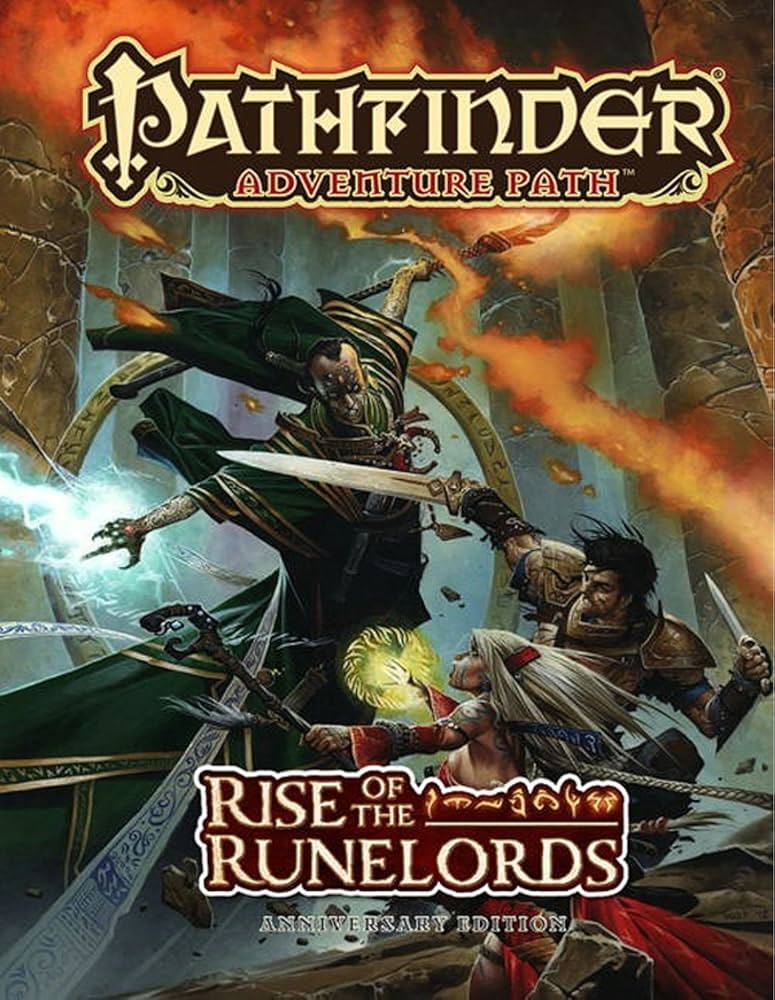
It’s the epic climax of the Rise of the Runelords Adventure Path from Paizo! Can you believe it? We made it to Book 6! As you know by now (I mean, my gosh… this is your sixth time reading it this week!), my goal is to break each book down into its essential story beats, freeing up room for more character-driven bits and overall simplifying and focusing the campaign. Today, as always, there will be changes aplenty, so it’s good to review my evergreen caveats:
First and foremost, these edits are to my preference for the game that I want to run. What I consider “essential,” you may not, and vice-versa. You would make (or have made) different decisions, which is both natural and part of the fun. Feel free to comment below if you see different opportunities.
Second, get ready to clutch your pearls. If you’ve run or played in Rise of the Runelords, I’m going to be deleting your favorite side quest, or NPC, or completely rewriting villain’s motivations and backstories. When I’m done, it’s not going to resemble the story you know.
Third, there will be rampant spoilers—in fact, once I dive in, these posts are essentially spoilers from start to finish. If you are a player in one of these APs or plan to be, these articles aren’t for you. (If you plan on GMing it, however… welcome!)
Finally, I don’t yet know what game system I’ll be using to run this Adventure Path, but it likely won’t be Pathfinder. Try not to get caught up in how dramatically I’m reducing the possible XP or treasure, or what I’m doing to CR of encounters. For a peek inside my thoughts on systems, you can start here.
Onto the epic climax of the Adventure Path, Book 6!
Rise of the Runelords 6: Spires of Xin-Shalast
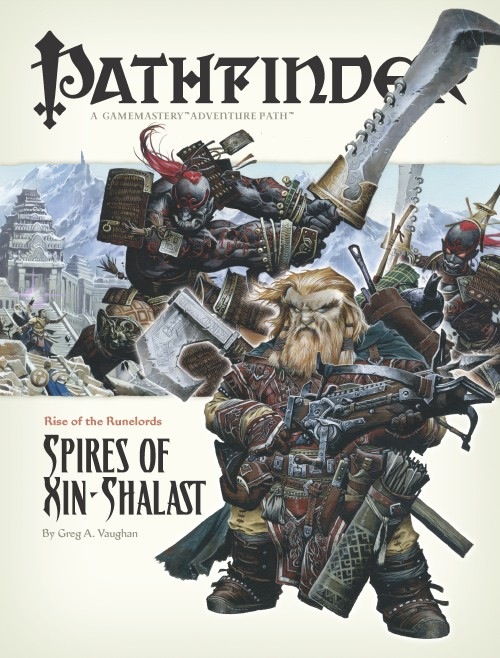
Greg A. Vaughan has written a ton of Adventure Path modules, so I’m genuinely excited to dive into Book 6, Spires of Xin-Shalast. The guy, like James Jacobs who wrote Book 1, is an AP legend.
Unfortunately, there are two details from the initial pages of backstory that I don’t like: First, the setup of this book assumes (based on backstory from Book 4) that the stone giant Mokmurian hid the location of Xin-Shalast, the former capital of Runelord Karzoug’s empire, and thus the module begins with the PCs discovering that two dwarves found the way the fabled city. Xin-Shalast, as written, is somehow in another reality, accessible only through secret and forgotten ways. The problem is that Xin-Shalast was the most ostentatious city in Thassilon, and the PCs now have an entire Thassilonian library at their fingertips, plus the ruins beneath Sandpoint. There really aren’t any maps of the world from back then still available to help travelers find it? An empire based on greed isn’t splashing its location into every tome possible? Besides, in the AP as written, in Book 4 Mokmurian is manufacturing weapons for the army amassing at Xin-Shalast, but somehow no one knows how to get them there? I find this omission difficult to justify and will tackle it below in Chapter 1.
The second problem will occur once they reach the fabled city: Mokmurian was Karzoug’s principal lieutenant in Golarion while he slowly awakened, and it was his role to raise an army in the Runelord’s name. The PCs have already defeated the goblins, ghouls, lamias, ogres, and giants that would make up the bulk of this army, plus Mokmurian himself. Yet when the party reaches Xin-Shalast, there is another army waiting for them, significantly more powerful than what Mokmurian had assembled. That seems odd, unless lots of time has passed since the events of Book 4 and Karzoug found a different mortal ally. I think that I have a way to puzzle out this inconsistency, but it’s something to tackle as a GM to keep the internal logic of the adventure intact.
Those speedbumps aside, the setup here is clear: The PCs now possess legendary Runeforged items and know that they must defeat Karzoug. It’s time to take the fight to Xin-Shalast and end this threat once and for all.
Chapter 1: Seeking Xin-Shalast
In my story, the idea of Xin-Shalast’s location being known but the route to get there still unknown was seeded at the outset of Book 5. When the party returns to Sandpoint after Runeforge, then, it’s a chance for the “research team” of Brodert Quink, Veznutt Parooh, Ilsoari Gandethus, and any Magnimarian scholars to have puzzled out the way. The PCs can sort out any lingering complications with Sandpoint locals during some downtime, but they know that Karzoug is awakening and they must get to Xin-Shalast to stop him. So, while I have generally allowed long downtime beats between each book in the AP until now, this last bit of downtime should primarily be focused on readying themselves for the journey ahead.
As I mentioned above, in the book as written, Xin-Shalast is somehow hidden from reality, but I’m brushing away this idea. In my Rise of the Runelords, it’s simply a once-magnificent capital that has long been shrouded from human contact because of its location: Amidst the Kodar Mountains, one of Golarion’s most intimidating and massive mountain ranges, known to local Shoanti tribes as the “World’s Roof.” This detail also makes it difficult to, for example, bring a Varisian army from Magnimar to Xin-Shalast (though if the players wanted to do so I’d welcome it… I’m a big believer that high-level play means large-scale solutions).
What happens next is likely another travel montage. The party was able to brave the Rimeskull, and these mountains are even more intimidating. Rugged foothills turn to towering peaks, and I’d throw in as many details to showcase how treacherous and inhospitable the environment is. This sort of montage is aided by limiting teleportation magic (something I talked about in Book 5) to make tasks like this one easy.
Chapter 2: Whispers in the Wind
The two aforementioned dwarven brothers are the focus of this chapter, complete with a complex backstory about them finding the way to Xin-Shalast, then the expedition starving and turning to cannibalism and eventually being killed by a wendigo. In the module as written, the party finds the Vekkers brothers’ cabin and the ghosts who haunt it. The PCs fight an undead treant, dwarven ghosts (including the brothers) and several haunts, a frost worm, and, eventually, the wendigo. It’s a fascinating place to insert a side quest, and hugely distracting from the focus on Karzoug. I just can’t imagine giving the PCs these legendary artifacts at the end of Book 5, gearing them up to face the Runelord, and then plunging them into a side plot with characters the party has no connection to whatsoever. Not surprisingly, then, I’d drop this chapter altogether. If I’m feeling the need to extend the travel sequence and delay the climax of the AP, I might throw in an abandoned Shoanti cabin and a wendigo as an homage, but it would be brief and not tied to the central plot.
Chapter 3: On the World’s Roof
The adventure as written has Xin-Shalast disconnected from regular reality because of its association with Leng (a demiplane full of nightmares within the Dreamlands). Leng is a Cthulhu-inspired location, which is cool to include for Adventure Paths like Strange Aeons, but feels bolted on here. There is so much going on with Thassilon and its millennia-old history, the Runelords’ empires, and Karzoug specifically, that I’ve largely culled parts from the Adventure Path that, to me, add confusion for players without a ton of payoff. I think there’s a way to honor the idea that there are denizens of Leng in Xin-Shalast without the complicated backstory, but we’ll get to that in a bit.
Because of Xin-Shalast’s otherworldly phasing between planes, however, in the module as written it makes sense that the journey to get there involves some fairly esoteric story beats. As written, the PCs travel the River Avah to the Fen of the Icemists, and must wait for a night with a full moon and meditate (but only if starving!), whereupon the remainder of the route is made clear to them. I’m not a huge fan of making a part of, at this point, superheroes starve themselves for a vision, but I can imagine this scene being epic in the hands of the right GM.
I’m replacing all the “vision quest” beats to say that the way to Xin-Shalast is simply about as inhospitable as journeys get. It’s freezing cold, windy, and at severely high altitude. This story is meant to be heroic, so I wouldn’t beat the party down and turn the campaign into a survival game, but rather impose some environmental conditions on them, make some difficult skill checks, and narrate the sort of monster encounters they experience. The point will be to show how “regular” adventurers would never be able to survive this path into the hidden mountain valley at the top of the world.
What I do like in the module is that the Fen of the Icemists is guarded by an ice nymph named Svevenka. Assuming the party is able to make a connection with her, she’s able to a) detail the nearby whereabouts of Xin-Shalast and the path to get there, b) offer some handholds about what they’re likely to encounter there and what’s been happening in recent months, and c) provide the Fen as a safe harbor and place to rest if and when the PCs need it. I’ll lean into making the Fen a sort of “fairy-touched” location, somewhat of an oasis within the otherwise harsh surroundings.
As the party leaves the Fen and nears the fabled city, the flat, frozen stones begin to have a faint sheen of gold to them. A wide road appears, taking them to the gates of Xin-Shalast. Those gates are patrolled by cloud giants and a frost-giant sergeant (which seems odd… I’d make them all the same type of giant since here, like Mokmurian’s stronghold, the various factions bicker amongst themselves). After that, Xin-Shalast is open to them.
Chapter 4: Xin-Shalast
The party finally arrives in Xin-Shalast, once capital of Runelord Karzoug’s empire nation of Shalast. This chapter is by far the beefiest of the module, with as many pages dedicated to it as Chapter 1-3 combined, and acts as a partial gazetteer to the city along with a full appendix detailing its history and districts. The point is that Xin-Shalast is a ruined C-I-T-Y, large and sprawling and once the most ostentatious in Golarion.
Chapter 4 concerns itself with the Lower City, where most of Xin-Shalast’s population once resided. Now, as we know, a city over 10,000 years in arctic and volcanic conditions would be unrecognizable and nothing but small bits of rubble. The logic of why Xin-Shalast is recognizable and standing after so many millennia is put simply to the fact that a) it’s sharing reality with Leng, and b) there were powerful spells put upon it back in Karzoug’s day to protect it from its harsh environs. Since I’ve rewritten the first reason, I’m okay with the second one. I also like the idea that, since Karzoug first began simmering into consciousness, he began gathering forces here. Those forces have been steadily restoring the city over the number of months (or, if I have my way, years) since the party first began this AP. Either way, I’d make the Lower City ruined but recognizable, and the closer to Karzoug you get, the more pristine the city becomes.
This massive (literally, made to accommodate giants) city is largely uninhabited when the party arrives, with cold winds howling through streets and empty promenades. I’ll populate the city with a) creatures that have made the ruins their home over the millennia since Shalast fell, and b) new arrivals summoned by Karzoug’s will.
The Lower City has seven districts, and there is no ticking clock pushing the PCs to rush through it. The whole place sits in a steep mountain valley, so they will have little choice but to move south to north, with access to the spires and Karzoug accessed through the northern portions. As the party explores, there are several possible events that could occur. I’ll change what’s in the module based on my revised history and populace above to include:
- Much like the camps outside of Mokmurian’s fortress, the Lower City contained various monstrous factions united under Karzoug’s banner who do not trust one another. Unlike in Book 4, they have the space to spread out throughout the city and can be tackled individually. The module offers many possible locations that could make good set pieces, and I would include in the factions at least a few tribes of giants (the ones primarily involved in rebuilding the Lower City), a family of harpies, a tribe of yetis, an ice devil freed from some magical imprisonment by the city’s recent occupation, and a powerful blue dragon named Ghlorofaex.
- One faction is a group of stone giants led by a mage named Gyukak. He can either seek the PCs out once they start making trouble in the city, or the PCs can find Gyukak and another faction fighting. Whatever the case, the point is that he has heard how the PCs liberated the giants of the Iron Peaks and Gyukak is seeking to escape Xin-Shalast. He can detail the forces in the Lower City (particularly the presence of Ghlorofaex and the ice devil), a bit about what awaits in the spires (maybe the presence of rune giants and the otherworldly forces of Leng, or at least hints and rumors), and how to get there. His hope is to escape the city while the PCs are distracting Karzoug—probably while they’re fighting the dragon. Unlike Conna the Wise in Book 4, Gyukak has no special relationship with the boss—an ally, but one with less reliable information and a desire to escape.
- With the coming of the cataclysm, many of the slaves of Xin-Shalast retreated belowground to survive. Hundreds of generations later, they’ve become creatures called skulks and refer to themselves as the Spared (though I’ll have to think about how the PCs and the Spared would be able to communicate with each other). A skulk named Morgiv approaches the party after they’ve fought things in the Lower City and are resting. They have a whole primitive society in the catacombs beneath the city, and if the PCs can ingratiate themselves with the Spared they will have access to these passageways and the creatures will warn them of danger as they traverse the city. The module has a monster called the Hidden Beast enslave the skulks, but I will probably just say that some cool, solitary, darkness-loving creature has answered Karzoug’s call, and the skulks ask for the party’s help to get rid of it.
- There is a section of the city, once the Entertainment District, that has become known as the Tangle and is avoided by the diverse factions. It’s basically a huge, parasitic, corrupt plant-thing that can possess its victims (I picture it like Starro, but all connected to each other by vines). Depending on where the PCs go early in their exploration of the city, they can stumble into the Tangle or devoutly avoid it.
Fighting the dragon Ghlorofaex likely happens on the northern edge of the Lower City, where his lair resides, and it’s hard to imagine this battle being anything but loud and epic. If he hasn’t noticed the PCs yet, Karzoug will certainly take notice of this battle and prepare his defense. Regardless, once the blue dragon is defeated and Karzoug’s new army is in disarray within the Lower City, it’s time to take on Runelord Karzoug himself.
Chapter 5: Scaling Mhar Massif
The way to the spires of Xin-Shalast are open to the PCs. To get there, they must scale the mighty peak of Mhar Massif (which has a cool backstory that I’ll keep… basically an entity trying to enter Golarion who failed and became trapped in the stone, only its head visible and protruding from the mountain, which each Runelord of Greed reshaped to their own visage). The most straightforward way to travel up the mountain is the Golden Road, a steep and broken path to the spires. I’m a little confused about how this whole setup worked when it was a thriving metropolis back in Thassilonian times, especially as the module goes out of its way to detail how the increased altitude negatively affects the PCs. I’ll tone a lot of the “treacherous mountain-climbing” stuff down a lot, and instead make the hazards about the forces guarding the spires.
In the module as written, as I’ve said repeatedly, the reality of Xin-Shalast and that of Leng are blended, so there are otherworldly creatures combing over the place. There’s a complex plot that some of the denizens try to embroil the party in during this chapter, involving something called the Leng Device. Finally, there’s a big anti-magic zone called the Occluding Field, which is the sort of thing you need to include when teleportation and scrying magic is easy. It’s… a lot.
I would instead say that Karzoug found himself in a situation where the bulk of his assembling forces were defeated by the PCs at the end of Book 4, yet his power was growing and he found himself closer and closer to reawakening within Golarion. As a result, he used forbidden magical rituals to reach into Leng and summon NEW armies to help him conquer the region, while simultaneously calling out to those greedy creatures who might join his cause within the Kodar Mountains. Those “local” forces have been dwelling in the Lower City. As the PCs scale Mhar Massif, they begin to encounter the things from another plane that Karzoug has unleashed. The first of these forces are Leng spiders, creatures the size of mammoths. I would go out of my way after this encounter to clue the PCs into how “wrong” these creatures are, worse even than any devils or demons they’ve encountered to date.
Eventually, the party arrives at the Spires of Xin-Shalast, a sort of city-overlooking-the-city and where the Runelord Karzoug made his palace and fortress, called the Pinnacle of Avarice. It’s a little unclear to me how these hundred-foot towers survived the cataclysm and subsequent millennia (if so much of the city survived the cataclysm of Earthfall, why did the Runelords put themselves in suspended animation?!), but for once I’ll handwave this detail and say they’ve been the focus of Karzoug’s attention since reawakening, to rebuild his one-time sanctuary.
The actual city surrounding the Pinnacle of Avarice is only passingly described in the book and is largely unoccupied. I’ll focus on the creepiness of its emptiness, then, and set off any magical or otherworldly senses the PCs have as blaring. They are drawn to the Pinnacle as the obvious and terrible source of power within this area, and it’s here that they will finally confront Karzoug.
Chapter 6: Pinnacle of Avarice
Again, I’m challenged by the logic of the Pinnacle of Avarice’s description, with its 2,200-foot tower, delicate and precise architecture, cavernous spaces, and details like the “floor is of highly polished gold and onyx in a checkerboard pattern. Doors are made of solid stone, plated in gold and silver and studded with gemstones.” Again I’ll say: if such a place could survive the cataclysm of Earthfall, why did Karzoug and the other Runelords put themselves in stasis? Even the hand-wavy “it shares dimensional space with Leng” and “magic preservation spells” don’t make sense to me, when Earthfall utterly destroyed the empire of Thassilon. Don’t get me wrong: the descriptions are cool and epic …but still bother me.
Instead, I envision a partially collapsed structure under construction. The opulence of the Pinnacle of Avarice is evident to anyone, but so is the destruction of Thassilon 10,000 years ago. Karzoug has sent his minions to restore what had been the epicenter of his nation, but the project is not yet complete. I will keep the descriptions in the module as true for some of the more used and important rooms, yet others will be a mix of grandeur and decay. To me, this is a more compelling vision of what befell the domain of greed’s avatar.
In the module, Karzoug went into stasis with three dozen rune giants (magically enhanced giants) and his right-hand man Khalib. This, too, stretches my understanding of the powerful magic involved in keeping Karzoug safe. Instead, I like the idea that Karzoug, desperate after Book 4’s destruction of his budding army, turned to his magical training. Before he was a Runelord, Karzoug was the apprentice of a summoner (his full backstory is detailed in the AP). And so, the remaining forces available to him are weird, powerful entities from Leng, as well as Karzoug’s most trusted lieutenants. Either way, I’ll keep this bit in mind from the book: “exploration of this complex shouldn’t feel like a dungeon crawl as much as it does a long, drawn-out battle that spans multiple rooms and opponents.”
Karzoug’s forces are ready for the PCs, and know their strengths, weaknesses, and tactics. I’m always a bit challenged when the enemies are meant to be militaristically smart and capable, because I’m… not. Still, I would do my best to lay an ambush for the party either at the entrance of the Pinnacle of Avarice or soon after, and ensure that these fights are tough. As per the module, opponents will come in waves at the PCs.
As always, my tendency is to massively simplify a large complex with dozens of rooms and encounters. For me, the forces within the Pinnacle are:
- Otherworldly creatures of Leng, including elephant-sized bat creatures called shantak, elephant-sized spider creatures called scarlet walkers, an aberration called a moon beast, and a Leng ghast with a troupe of Leng ghouls (which is a nice callback to Book 2).
- A pair of rune giants, which are scary-cool black giants with runes carved into them (that’s one on the cover of the module!).
- A lamia named Most High Ceoptra, which I’ll say was Xanesha and Lucretia’s mother for maximum revenge factor. As a result, I will make her more crone-like (though her image in the module is awesome).
- Viorian, Karzoug’s favored champion and wielding the Sword of Greed. In the module she’s a human, but it makes more sense to me that she’s either a cloud or storm giant.
What I would excise from the place are a) the hordes of cloud and storm giants, which clog up the encounters and make more sense in the Lower City, b) more lamias than Most High Ceoptra, because in too great a number they feel less special, c) gross bloated creatures called hungerers that feel much more like minions of gluttony than greed, d) Karzoug’s human apprentice Khalib, because his whole backstory doesn’t add much to the story, and e) various other extraplanar entities in the module that aren’t tied to Leng.
In the module, because of the dimensional overlap between the Material Plane and Leng, Karzoug can manifest at various parts of the map. It’s a fun way to taunt the players and set up the final encounter, but since I’ve gotten rid of the Leng-overlap bits, I would instead say his presence permeates the Pinnacle as he gets closer to rising, and instead of manifesting it’s his mocking voice that appears throughout the PC’s flight to him—which matches the echoing laughter at the end of the Book 4. This tweak keeps the foreshadowing and buildup without actually fighting him yet.
There are two major story beats in the module within this chapter that I’m either skipping or changing: The first is a magical artifact known as the “anima focus,” which is linked to a “soul lens” that fuels the “runewell” of Greed. I find the workings of these magical mechanisms overly complex and, again, something the players are unlikely to puzzle out or understand. The central idea is that activating these items opens a portal to the Eye of Avarice, where Karzoug is held in stasis, so the PCs can fight him. I’ve erased the idea of a “minor runewell” from Sandpoint in the first half of the AP, so I’m fine brushing aside these artifacts as well. I don’t see the PCs as needing to enter another pocket dimension to fight Karzoug… let all these beings wearing the Sihedron Runes dying finally reach a tipping point that sets him free, which is the whole plot he set up from the beginning of the AP. Let Karzoug’s eruption into the world create the effects from the next chapter, destroying much of the surrounding structures. I find this setup of the final battle a lot more climactic and satisfying. “Oh no! He’s here! We’re all that stands between him and his terrible rule of Varisia!” I would signal this arrival throughout the Lower City and this chapter—each time a creature wearing a Sihedron Rune dies, perhaps there’s a slight rumble of earth, or flash of light from atop the spires. The point is that all the deaths—from Book 1 through the end—have added up to Karzoug breaking free.
The second story beat, which occurs prior to the anima focus within the module, is the Leng Device, a portal to Leng that its denizens are guarding. In the module as written, a Cthulhu-inspired tentacled creature begins crawling out of the portal for the PCs to defeat. It’s a cool idea and reminds me very much of the first episode of Marvel’s What If…? animated series. I’m keeping the basic idea here—that impossible Old Ones of Leng want to be set free in our world—but moving it to the final chapter.
Whew, that’s a lot to absorb. If I’ve done my work correctly, the PCs have fought their way to the center of the Pinnacle of Avarice through Karzoug’s remaining minions, which are dominated by creatures from Leng that are utterly alien to Golarion. Finally, with the defeat of these forces, the energy from the many Sihedron Runes has fueled Runelord Karzoug’s escape. He arrives, ironically, just as the forces working to release him are gone, but he arrives in his full power. And he’s still relying on the creatures of Leng to aid him… much to his folly.
Chapter 7: The Eye of Avarice
Clever to have the final book be seven chapters, a nod to the seven sins.
In some ways, I’ve set up the final confrontation quite a bit differently than what’s in the AP as written: In the module, the Eye of Avarice is the pocket dimension housing Karzoug, and the party has entered this dimension via the magical artifacts guarded by Most High Ceoptra. In my version, the PCs can fight Karzoug’s remaining forces in any order and in whatever rooms of the Pinnacle, but when depleted Karzoug erupts from his stasis, ready to battle the PCs. Yet despite these different paths to get there, I would preserve a lot of the environmental factors as written in Book 6: molten gold flows throughout whatever chamber the party finds themselves in, creating platforms and hazards for the battle. Runelord Karzoug, sometimes called Karzoug the Claimer, attacks the party—triumphant from having been freed but furious at his army’s destruction.
The module has a round-by-round set of tactics from Karzoug that are quite good. Where I will add to the difficulty of this encounter to make it truly epic is to add a swirling summoning vortex to one side, where Karzoug pulls forces from Leng to serve him. Monstrous, impossible aberrations lumber out of the portal to fight the PCs, replacing what’s in the module (another blue dragon, a rune giant, and two storm giants). With crazed eyes, Karzoug taunts the PCs, telling them that they’ve only beaten his most mundane forces, that he has made pacts with Leng that will endlessly fuel his power and soon remake Shalast. He will rule this land forever, he boasts, exterminating Varisia and its meek populace and ensuring that Xin-Shalast is again the wealthiest city in the world.
If possible, I’d showcase the Runeforged items in the party’s possession as tipping the scales of the battle. Make those items particularly effective against the denizens of Leng and/or Karzoug, or have Karzoug be afraid of them once he recognizes them for what they are. As always with climactic boss-battles, the trick here is to make a truly challenging fight with opponents that, at first, feel impossibly daunting. The party is likely to be depleted after the many fights in the Pinnacle of Avarice, though, and the whole point of these Adventure Paths is heroic fantasy. The party, then, should have a good shot at prevailing against the mighty Runelord, even if at first it doesn’t seem possible.
The revised set-up of this battle allows for some GM control of the ultimate climax of the story. If the party defeats Karzoug with relative ease, something world-eating begins to crawl out of the portal to Leng and the PCs must somehow defeat it and close the portal. If Karzoug is thrashing the PCs, that same world-eating Old One can begin emerging, much to the Runelord’s consternation. In this latter case, perhaps the battle becomes a brief alliance with Karzoug to defeat the tentacled creature, only for it to pull Karzoug into Leng at the end. Whatever the case, I’ll use the portal to Leng and the unholy/unhealthy/dangerous alliance between it and Karzoug to make the most batshit-crazy, over-the-top ending to the campaign as possible.
In a blinding flash of light and destruction, the portal closes and Karzoug is defeated. Perhaps the Pinnacle of Avarice and its surrounding city are destroyed. Perhaps there’s a whiteout and the PCs awaken in the rubble.
What now? There’s an excellent appendix entitled “Continuing the Campaign” that covers possible implications of the party’s actions. I love this bit: “Although the PCs have averted a terrible threat to Varisia, it seems likely that most of the region’s inhabitants won’t even notice. To most locals, stopping the very real threat of an invasion by giants made the PCs as much heroes as they’ll ever be. Nonetheless, there are some who know the true extent of what the PCs have accomplished, from poor Brodert Quink (whose claims that the PCs saved Varisia from the End of the World merely become the latest in a long line of unbelievable tales) all the way up to organizations like the Pathfinder Society.”
As I hope I’ve demonstrated throughout this blog series, the idea behind these campaigns is to make them your own. Perhaps Xin-Shalast wasn’t destroyed, and becomes a new destination for adventurers and scholars to unlock understanding of a civilization thought lost to history. Perhaps Karzoug was defeated, but the invasion from Leng is still a very real threat. Perhaps Karzoug escaped or was pulled into the collapsing portal, so the promise of his vengeful return lingers. Perhaps, in a disaster ending, Karzoug won, and the players must think through the implications for Varisia. Whatever the case, I’m a big believer in a) allowing each PC a long, narrative epilogue to conclude their tale however they want (even if the PC died in the final battle, let them talk about their legacy or loved ones they left behind), and b) collaborating in the final session to decide how the world is forever altered by the party’s actions. These endings are such amazing and feel-good experiences… milk it, baby! The next campaign in this new version of Golarion awaits! Heck, the next campaign hook might be dangling right there from the end of this one!
Deconstructed Spires of Xin-Shalast
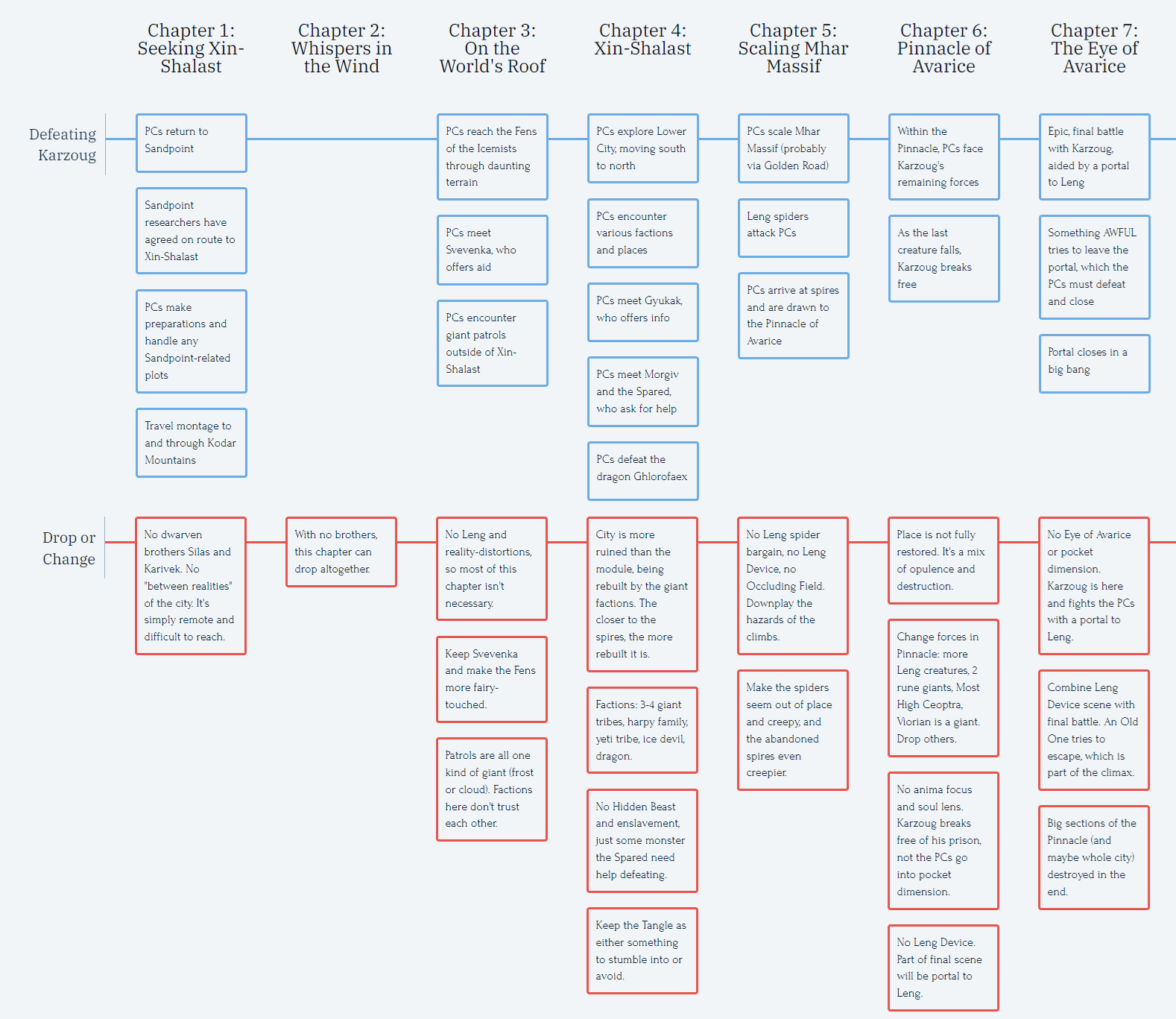
As always, I’ve used creative license to change a lot about the book as written, but I hope that I’ve kept the spirit of the Adventure Path intact.
Here is Plottr’s visualization, showing the full extent of changes, additions, and subtractions:
Oooo baby! Are we done? Almost! Tomorrow, in my final installment of this series, is a “Reconstructing” post to see what I’ve wrought and the full outline of my version of Rise of the Runelords. See you then!
As always, I hope this long and winding journey has been fun for you. Please do drop a comment or email me at jaycms@yahoo.com!
 My Hero Brain
Leave a reply to Reconstructing Rise of the Runelords – My Hero Brain Cancel reply