Last month, I wrote about a new project that’s been niggling at my brain.
A brief recap: I found myself able to purchase a number of complete Paizo Adventure Paths at a big discount. But—although Pathfinder 2e is a system I know deeply—I don’t have interest in the intensely-crunchy, prep-heavy work of GMing a complete AP in PF2e (which I’ve done before). Instead, I’m on the hunt for a tabletop game with the following features:
- allows for crazy (super-)heroic stunts without the crunch
- fun to GM and easy to make stuff (like monsters, hazards, etc.)
- suitable for a long campaign (i.e. has some sort of character progression or at least the players won’t get bored with overly simplistic mechanics)
- can’t be tied too deeply into a setting – my intention is to keep the Golarion lore of the APs mostly intact
In other words, I’m looking for a system that is both interesting and complex enough that it can handle long-form storytelling, but light enough that I don’t have to spend hundreds of hours prepping.
Last month’s article explored Daggerheart, a game that I like far more than I expected to. In fact, after one of my weekly groups finished playing through the Sky King’s Tomb AP in PF2e, they were kind enough to let me run a test session of Daggerheart, with me converting the intro adventure in Paizo’s Beginner Box, called Menace Under Otari. This experiment was both a test of how fun the game is to GM and play, but also how easy it is to convert from PF2e to Daggerheart. It was a great success, and the group asked for a second session to keep going. So, as I mentioned in the previous post, I may have already discovered my system of choice on the first try.
That said, I’ve purchased four additional games to explore, so explore them I shall. If I’m going to dedicate years of my life leaning into a game playing the expansive Paizo APs, I want to feel good about my due diligence. What’s funny is that, because of inventory shortages and shipping delays, I am receiving each game staggered over months. These delays have made my ability to sit down and really absorb each book easy, without the others staring at me from The Stack (games I’ve bought but haven’t read yet).
The second game to appear on my doorstep is… 13th Age, 2e!
13th Age, Second Edition
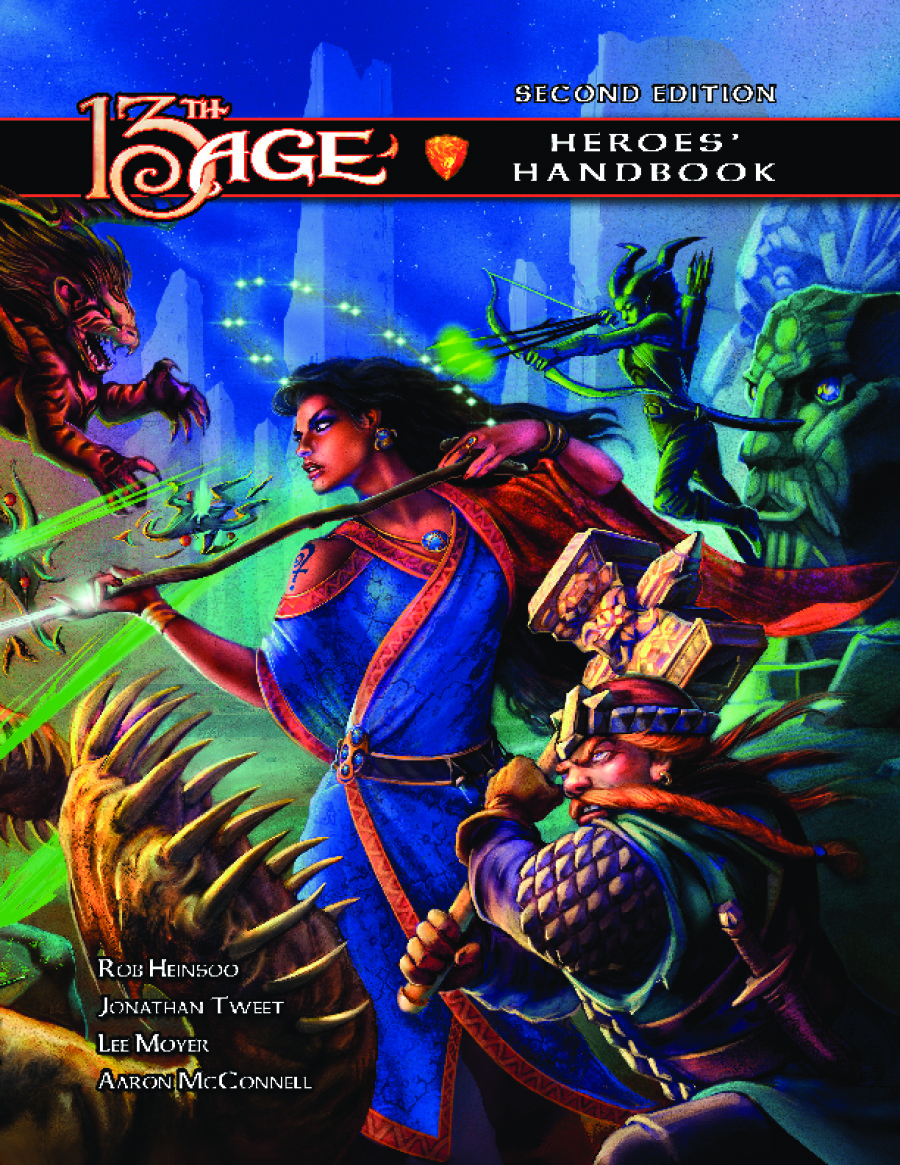
13th Age, unlike Daggerheart, is not at all a new game. Pelgrane Press (also known for the Gumshoe system) first released it in 2013, but somehow the game completely eluded my radar until it released its second edition last year. Apparently, this second edition is compatible with everything from 1e, which means there are literally dozens of supplement books to expand upon the new Heroes’ Handbook and Gamemaster’s Guide. I’m not literate enough in the differences to know how easy it is to convert content between the two editions, but it’s cool and impressive that you can do so.
13th Age is a d20 system, and so the base mechanics will be familiar to pretty much any TTRPG enthusiast. I’m surprised at how few reviews I found of the second edition, but check out this excellent overview from Scroll for Initiative and this one from TTRPG Thoughts. Both give you a sense of where 13th Age veers away from D&D 5e, simplifying the mechanics to make it less about tactical, grid-based combat and more of a story game. I’ve been hooked on Sly Flourish’s podcast recently, and he’s said that 13th Age 1e is one of his absolute favorite games to run and GM, and keeps teasing a review of 2e. When he delivers the review, I’ll link it here.
When I initially posted my quest for a new system on Reddit, 13th Age was one of the most-suggested systems for me to explore. As I mentioned the game to friends, my buddy Rob got excited, as it’s also a system he’s wanted to check out. I had the same dizzying feeling diving into 13th Age as I did when I first discovered Dungeon Crawl Classics – I consume SO much TTRPG media, how had I not known about this game until now!? Our hobby is so relatively small, and yet bafflingly vast.
Why 13th Age Works For Me
Anyway, 13th Age 2e turns out to be a game that is very, very cool. Like the reviews I linked above, I’m going to spotlight some of the mechanics I think are particularly great, and how they work with my Adventure Path dreams.
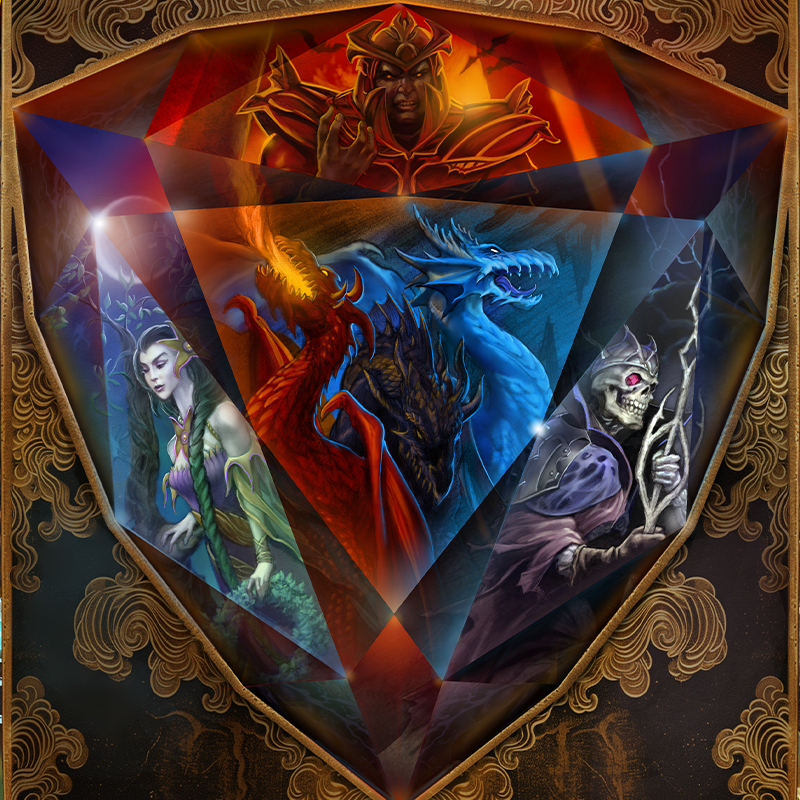
Icons – In 13th Age, the GM defines the powerful entities shaping the world in which the PCs are adventuring. These can be everything from the Queen of the Elves, the High Priest of Abador, the local thieves’ guild head, or even the devil-god Asmodeus. It’s an acknowledgement that every fantasy story has these near-mythical figures in the background, shaping the world. In 13th Age, however, each PC is explicitly linked to at least one of these Icons, and this connection has mechanical impact on the story and game.
The entire conceit of Icons is so cool, I’m bewildered when I read 13th Age forums that many GMs don’t bother with them. For my purposes, it sounds like an absolute blast to define the Icons for a given Adventure Path, and to include them in whatever Player’s Guide I create. Indeed, even if I don’t end up using 13th Age for my campaigns, I’m probably stealing this idea.
Simplified… Most Things – Any game I choose for this project is going to do things like abstract ranges during combat, allow players to roll for checks based on their general background instead of tied to explicit skills, and hand-wave crunchy mechanics. 13th Age, however, really tries to lean away from the stuff that slows games down. Gear is massively simplified, and distinction between most weapons and armor is mostly flavor. Damage is flat instead of rolled, which occurs to me is a huge speed boost. Monster stat blocks are shorter, easy to hack, and focused on interesting, unique abilities. There are “mooks,” which can get mowed down in large numbers. All these features, to me, take away the crunchy bits that bog down many d20 game experiences, especially higher-level combat. The game still has a big spotlight on combat encounters, but it does its best to not make every session dominated by them.
The Escalation Die – Relatedly, a small mechanic that demonstrates the underlying goals of 13th Age’s design is the Escalation Die. On Turn 2, all PCs get a +1 to attack rolls. The next turn it’s +2. Etc. etc. The result is both a) shorter combats, and b) increasing dramatic action in the later rounds of combat, all tilted towards the heroic characters. I love how it encourages players to hold onto big one-shot abilities instead of blowing them all on Turn 1. This is the sort of feature that makes OSR-lover’s heads explode but works perfectly for a game meant to be more like the Marvel Cinematic Universe.
Narrative Arcs and Recoveries – Something a lot of more modern games do is make healing and recovery its own minigame. In 13th Age, PCs begin with 8-9 “recoveries,” which are essentially an auto-heal, and often let you reset lost powers. As a result, 13th Age parties don’t need a dedicated healer like in most d20 games, and this mechanic avoids unnatural rest-stops in the action, keeping characters pressing forward through dramatic arcs. Then, when a party finishes an “arc” (which is story-based, usually containing 3-4 encounters), everyone receives a Full Heal-Up. The focus, then, is on the momentum of the story, not resource-depletion or nights at an inn. As a GM, the game asks you to set up each PC level-up based on a number of arcs (which can be one-arc-per-level for short campaigns or multiple-arcs-per-level for longer ones), which fits perfectly within the structure of an Adventure Path. Like Daggerheart, 13th Age only has 10 total levels available to PCs, which I’m realizing is another common feature of modern games and something I like.
One Unique Thing – Finally, something many people highlight in 13th Age discussions in the “One Unique Thing” during character creation – something about each PC that is utterly distinct in the campaign and explicitly agreed upon between the player and GM. Maybe they’re the only surviving prince of a lost nation, or have a twin separated at birth, or are destined to wield the Blade of Dreams… whatever. It’s a firm statement that these PCs are different from the other inhabitants of the land in which they live. They’re special. They’re heroes. Unlike Icons, the One Unique Thing aspect of a character doesn’t have mechanical impact on the game per se, but it’s a flavorful and fun way to encourage players to think big, and gives GMs loads of potential hooks for the story. Oh, and I should say that Level 1 characters in 13th Age are bad-ass… this is not a d20 game where you need to wait until Level 3-4 for your character to feel powerful.
All these features add up to a game that looks like a d20 game at first blush, but which pushes players and GMs to embrace the over-the-top-ness of heroic fantasy, all while speeding up the combat bits so they don’t dominate each session. That all sounds perfect for running Paizo APs, honestly.
My 13th Age Concerns
By far the biggest concern as I gleefully read the new books is that 13th Age, while focusing on speeding up the game, is still by far the crunchiest game of the ones I’m considering. Or, put another way, I’m convinced that 13th Age plays faster than other d20 games, but is it simpler to run for the GM?
Take the sample character, Alyssa the human paladin, that becomes the focus of the tutorial front matter of the Heroes’ Handbook: It’s a busy character sheet, with three Talents, two Backgrounds, and five Features/Powers/Spells, on top of six Ability Scores, three Defense scores, two Icon relationships, weapons, Recoveries, Hit Points, etc. That’s a level ONE character, and already a lot for any player to track, much less for a GM across a party of 3-5 PCs, plus monsters, hazards, etc. In combat, there are free actions, move actions, standard actions, and interrupt actions, there’s delaying and readying actions, there are opportunity attacks, and there are “special action” combat maneuvers like rallying and combat assists. Add a whole bunch of supplemental material from 1e and more 2e books on the way, and I worry about substituting one prep-heavy system for a slightly-less-but-still-burdensome one. Maybe it’s just because I’m new to the system and haven’t taken 13th Age for a test run, but the cognitive load on running the game seems high, which is the opposite of what I want.
The monsters give me a little hope in this regard. Flipping through the Gamemaster’s Guide, the entries aren’t overwhelming to consume: Even demons, dragons, giants, and other high-level critters have relatively few things to remember. And though there are additional “Nastier” abilities available to spring on a party, nothing I saw felt like the page-long entries of D&D 5e and Pathfinder. When I was running a 1-20 campaign in PF2e, it got to a place where I dreaded high-level battles because of the sheer number of things I had to remember to make the combat interesting. The complexity feels high in 13th Age on the PC side of the equation, but not so much on the monster side. Indeed, the monster entries for 13th Age, I’m suddenly realizing, are probably simpler to run than in Daggerheart.
My second concern is that on forums I’ve seen a handful of 13th Age GMs say that, at some point in the campaign, the PCs basically became unkillable, and it’s a struggle to properly challenge them. I’m all for a heroic—even superheroic—game, but epic stories come from peril and stakes. If the party can shrug off the BBEG and their vast hordes without breaking a sweat, the game ultimately isn’t fun for anyone. What’s more problematic about this issue is that it only rears its head after dozens of game sessions, at which point there’s a sunk cost in the system.
Ultimately, the only way I’ll really figure out my comfort with 13th Age’s complexity and power creep is to both play and GM it. I think that I’ll do what I did for Daggerheart—try converting part of the Pathfinder Beginner Box’s intro adventure, Menace Under Otari, and run a one-shot. Doing so will large skirt the Icon and One Unique Thing features, but will at least give me a sense of how prepping a game feels, how crunchy combat is, and how satisfying non-combat scenes are. I’m cautiously optimistic!
One Game to Launch My Journey
Despite my earlier bravado, in the darkest shadows of my soul I have a suspicion that I haven’t found my lighter heroic system yet. Daggerheart is super fun, but there are idiosyncrasies when running it that puzzle me (check out this awesome review that came out since my last post, which does a nice job explaining some of my head-scratching), and 13th Age feels like an awesome medium-crunch game, not necessarily as light as I want it to be. If I were going to put my bet on a system, it’s going to be Nimble, but that’s the fifth and last game to hit my physical mailbox. In the meantime, this is a puzzle that I will continue to ponder. As problems go, this system challenge is a delightful one. I’ll check back in a month or so with a new system to explore.
Please comment below or send an email to jaycms@yahoo.com with any feedback.


 My Hero Brain
Leave a comment