
It has been great fun over the past six months playing Dungeon Crawl Classics solo, documenting my sessions as both a game log and fantasy fiction (if somehow this sentence is news to you, start the dozens of installments here!). I’ve learned a ton from this experience, not only about DCC and solo play, but how I might relaunch a similar series using a superhero TTRPG (which, as I’ve said, is my first love) in an entirely weird homebrewed setting, operating without the safety net of published material. That’s right: Today I officially switch gears.
I’m not done with DCC, not by a long shot. But I’ve had a story idea niggling in my head since before the pandemic, and the past year’s posts have provided clarity on how I might explore it. What I had originally conceived as a series of science-fantasy/superhero mash-up novellas works better, I think, as serial fiction, and solo play keeps the project energizing for me. So, at least for now, I’m planning to move my DCC love into GMing an online campaign for a group of players while simultaneously turning my solo-play/fiction energy towards my brain-worm of an idea.
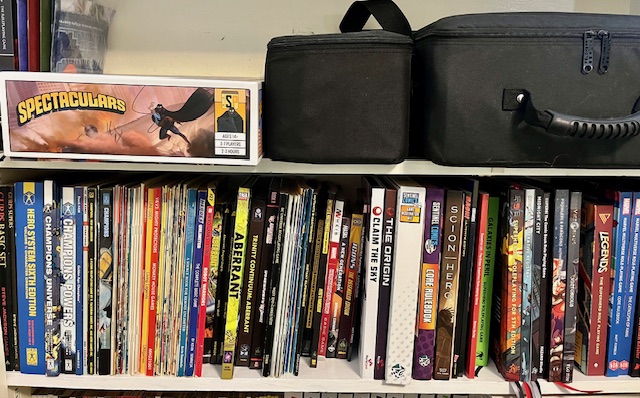
I, uh… own a lot of games, superhero and otherwise. Indeed, collecting superhero TTRPGs has been a hobby of mine, and I’ve even tried to document every superhero game ever published (this list is neither current nor comprehensive… I get bursts of energy to update it a couple of times a year). For me, then, one of the most profound questions to answer is: What the heck game system do I use for my solo play?!
This decision is a weighty one. At any point in time, of course, I can switch game systems in the background without messing up the story (and might even want to do so from time to time). What I believe deeply, though, is that the underlying system fuels the narrative, and will either work with or against me when I’m writing. Besides, I’m choosing which game I’m going to dedicate months, if not years, of my life to playing. Do I pick something already familiar to me or something brand new? Do I go rules heavy or rules light? Do I reskin a game built with a strong setting or choose a system that’s inherently setting agnostic? Etc. etc. etc. These questions feel almost overwhelming. Scanning my bookshelves and PDF libraries, I’m paralyzed by choice.
As a result, I’m going to dedicate multiple posts to sorting out my thinking on this topic. Settle in, boys and girls, because the next several weeks are going to entail a lot of TTRPG navel-gazing. By the end of this first series, though, I’ll have selected a game system and be ready to dive into the setting and character creation.
First, a note about the story I want to tell: It’s a post-apocalyptic Earth that has become, with the fall of modern civilization, a feudal, fantasy-like setting where humans face off against monsters. No one remembers the world as it was. Suddenly a set of superpowered people—think comic book powers layered onto fantasy archetypes—emerge. What is the origin of these strange abilities? What do these powerful beings herald for the world? Can they save humanity? You get the idea.
My oddball requirements for this project are:
- A superhero game that can be played in a fantasy setting, plus allow for anachronistic weapons and technology. Basically, the superpowers and fantasy elements need to be satisfying, but allow for other genre shenanigans.
- Is neither too crunchy (if I’m consulting forums or rulebooks more often than writing, that’s bad) nor too lightweight (I need to feel like the dice are guiding the story and enhancing the narrative). I want to feel like the mechanics support the story.
- Level-up jumps in power. My idea is that the PCs start as “street level” heroes and become demigods as the story progresses. Something will be pushing them closer to godhood, which is a core part of the story. The game should not only allow for those different levels but be fun to play at all of them.
- No hard-wired comics tropes (like secret identities, costumes, etc.). The story will be a genre mash-up, so I can’t hew too closely to any overly specific formulas.
To help bring my unique story to life, today let’s talk about the systems that I am not considering, even though this list represents many of the most popular games in the superhero TTRPG genre, past and present. Heck, a lot of these games are true favorites of mine, and some represent literal years of memories. For one reason or another, however, each doesn’t sound quite right for this specific project.
The OGs
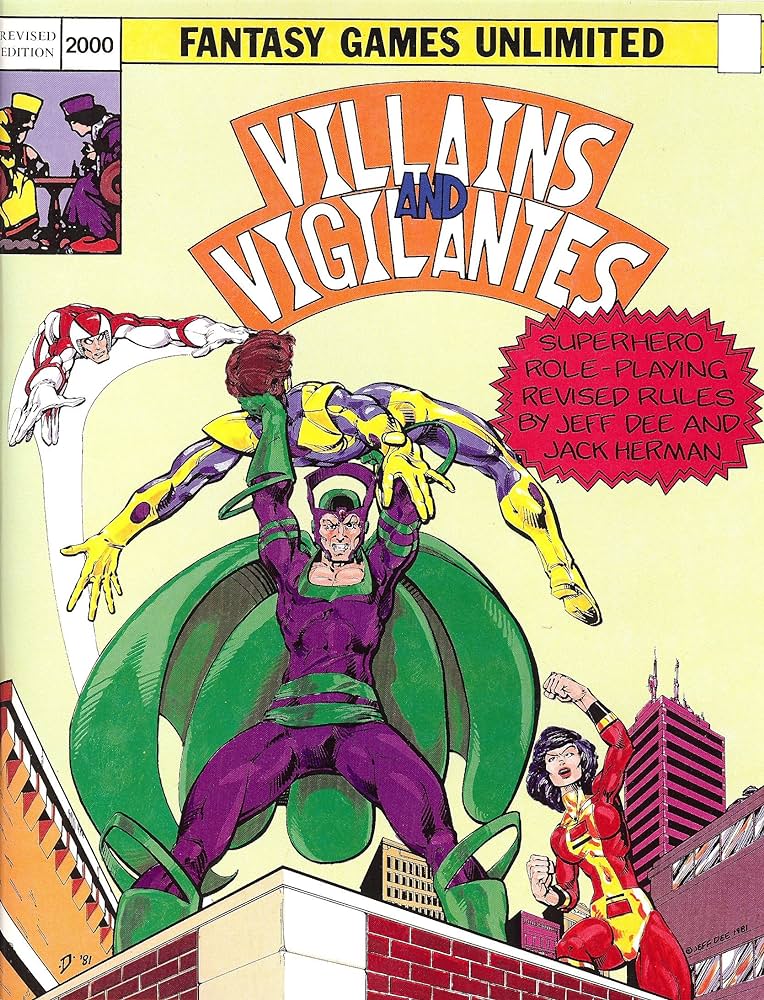
Villains & Vigilantes was my first superhero game, and something I played through middle school and high school. I was immediately enthralled by the art of Jeff Dee and Bill Willingham, which would become constant inspirations for my own drawing. My first time playing in a long campaign of any kind was a wild V&V series of adventures GMed by dear friend Ted. At one point in that campaign, our group of heroes entered an alternate dimension, and, upon exiting, each PC’s power set and appearance completely changed, permanently altering our heroic identities. It blew my mind how satisfying sticking with the same character over long story arcs could be, and how gonzo wild superhero tales can become.
Why not take V&V for a nostalgic spin, then? The revised edition of the original rules, which is what I played during those years, is a product of the early 1980’s and, truly, does not hold up well in terms of creating satisfying characters, simulating comics action, or telling deeply narrative stories. On the other hand, after a lengthy legal battle, Jeff Dee and Jack Herman finally released a more modern, updated game in 2017, called Mighty Protectors. This third-edition of the game, which I own but have never played, has an old-school vibe but seems to, based on many positive reviews, hold up well under today’s modern scrutiny. Which is all to say that I’m tempted. For this project, however, I worry about all three of my requirements above. It seems like work to make the system into a fantasy world, character creation is gradual and incremental, and some Disadvantages are hardwired into tropes. As a result, I’ll save Mighty Protectors for a future project.
A special, side-note shout-out to Longshot City, a delightful superhero hack of the very-weird Troika! system. Longshot City, to me, has an even better V&V vibe than Mighty Protectors, and is something I would immediately be comfortable playing solo. It also, however, suffers from all the same issues in terms of fit for this project. Making characters is a hoot, though. I recommend checking out this game.
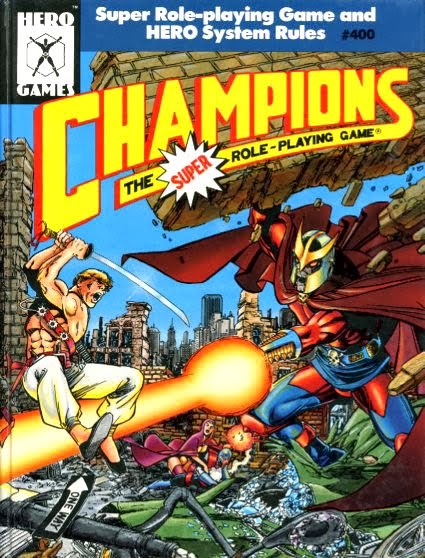
The single superhero game I played for the most years of my life, the one that unseated V&V and became my obsession through college, graduate school, and beyond, was Champions. Indeed, the first long campaign I ever GMed was with Champions 4th edition, with the sweet George Perez cover. I also still own the 3rd, 5th, and 6th editions of the game, the latter of which is the current edition and has its own fantasy supplements. Champions introduced “point buy” systems for superhero character creation. The rulebook is an absolute tome, with a mathematical, balanced answer to creating any superpower or character concept possible, and it’s a system I know back to front. In addition, because it’s all based on points budget, my “level up requirement” is easy to handle in Champions; if I want a jump in power, I just need to, for example, add 50 points at story milestones.
It is equally tempting to dip back into the nostalgia lake of Champions. But, and I say this with great affection, the HERO System is work, man. Creating characters—heroes or NPCs—can take hours of tinkering, and combat can be equally persnickety. I’d like the system to be in the background for this project, not the primary time commitment. I’ve loved putting in the math-miles in the past, but not this time. For all of these same reasons, I am also not considering GURPS Supers, which is a point-buy generic system that I’m sure at least one person thinks I’m stupid for not using. GURPS is really, really, really flexible as a system, but if I wanted to use something generic here that’s based on balanced, simulationist math, it would be the HERO System, which I know far better.
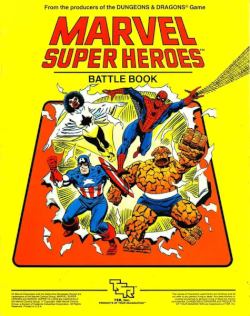
One of the original superhero games that still has a surprisingly cult-like following is the original Marvel Superheroes, which pioneered the famous FASERIP system. I own the original yellow boxed set in 1984, and the advanced set released a year later. Marvel Superheroes has a terrifically narrative approach (especially for its time) and can be a lot of fun to play. The game never really captured my imagination for creating new heroes, though, and I find it’s better suited to a “I want to play Wolverine and fight Deadpool” sort of game experience than a homebrewed world with novel characters. It’s important to nod my cap at FASERIP, but it’s not my system of choice.
I’m more tempted by the most recent Marvel game, the Marvel Multiverse RPG. I like that it’s actively supported by Marvel and still pumping out sourcebooks. I also know that the Glass Cannon Podcast crew love it. The more I’ve read about Marvel Multiverse, though, the more detractors I find, suggesting it has some real balance issues, that some character concepts are currently impossible to realize, and that there is less of a focus on character advancement. Even more, the game and setting are deeply interwoven, so it seems difficult to use for a non-Marvel game, and, especially, a fantasy setting. I’ll also not be delving into the other Marvel (or DC, for that matter) games from over the years.
Another nostalgic favorite of mine that is oh-so-tempting is Golden Heroes. I’ve written a deep dive look at Golden Heroes, so I won’t rehash it here. Suffice it to say, I’ve spent a long time thumbing through my copy of Squadron UK (its more modern successor), wondering if this project might be the time to bust it out. Good sense tells me, though, that the fun of Golden Heroes has always been rolling up characters, not so much the gameplay.

The People’s Favorites
The game many, many people consider the granddaddy of superhero TTRPGs is Mutants & Masterminds. With over twenty years of updates, supplements, and support, the M&M community and resources are vast. At its core, Mutants & Masterminds is a d20 system recognizable to fans of Dungeons & Dragons, but it is a game uniquely its own, and specifically designed to tell superhero stories. For years and years, I had a Hero Lab account for the sole purpose of making M&M characters in my spare time, even when I never had a group with which to play them. Character creation here is also a point-buy system, and it has so many options that pretty much any idea is possible.
Although making characters (PCs or NPCs) in M&M is not quite as time-consuming and intense as in Champions, it’s still significant, tinkering work. It also has d20 baggage from D&D 3E that I don’t love, including the restrictive action economy that doesn’t, in my opinion, simulate the cinematic, superpowered battles that are the stuff of my daydreams. For all these reasons, I enjoy making characters in M&M more than playing it. The staying power and popularity are nothing to sneeze at, though. Mutants & Masterminds deserves its flowers and would be easy, because of its adjacency to D&D, to use in my homebrewed setting.
The only game I hear talked about more than M&M is Masks, a Powered by the Apocalypse game meant to simulate and capture the spirit of teen superhero drama. Gone are the fiddly, crunchy bits in all the games above in favor of pure, thematic, storytelling gusto. Masks was somewhat of a revelation for many people, able to tell stories that superhero games to that point had struggled to tell. Unfortunately, like most PbtA games, Masks fits a very specific niche in terms of genre and is thus mostly unable to tell stories other than teen superhero drama. Since I want my tale to be broader than that, I’m skipping this system.
A quick sidenote that Worlds in Peril attempts to broaden PbtA into more general superhero tales, but I haven’t been super interested in that game. The creators eventually adapted it into a game I really like, though. Speaking of which…


Close, But No Cigar
So, Worlds of Peril begat a really intriguing game in a different system, Galaxies in Peril. I absolutely love Blades in the Dark’s mechanics, but (and I know these are both controversial statements) the setting of Doskvol turns me off, and I have zero interest in playing scoundrels. As a result, I often keep an eye on Forged in the Dark games that have different settings or flavor. The idea of a supers FotD game was immediately appealing, and I’ve devoured the Galaxies in Peril book cover to cover twice. There is a procedural element to the mechanics that would make for excellent serial storytelling, and it’s fundamentally a system that focuses on the meatiest part of adventure tales, with a fun narrative way of interpreting die rolls. For a long time, when I envisioned playing games in my homebrewed setting, I assumed that I would use Galaxies in Peril.
Unfortunately, the more I’ve considered the reality of using this game, the more I realize that the city that replaced Doskvol in Galaxies in Peril is highly specific, and not at all conducive to classic fantasy. To make it work, I would essentially have to create my own city, with my own factions. I ultimately might end up doing exactly that, but having to do it all as prework is daunting. I’d still love to play Galaxies in a longform campaign, but like many games in today’s post, I get the sense that it’s most fun right out of the box, embracing the baked-in setting.
When people ask me for my favorite superhero game, my current answer is Sentinel Comics RPG. Sentinel Comics does so many cool things that other games don’t that it blew my mind when I first played it. Character creation is semi-random and yet creates wholly satisfying PCs. Combat, with its innovative, timed Green-Yellow-Red mechanic, is epic and fast-paced. The environment is an actual NPC in combat, with its own moves that change any scene cinematically. Game sessions are called “Issues,” and there are story milestones once you’ve created a “Trade Paperback” worth. So cool! Running it as a GM is a joy. Everything about Sentinel Comics is just so fun. And yes, the game takes place in its own “Sentinel Comics” universe, which is four-color, bright-and-shiny in theme. But there’s nothing about the setting that is hardwired into the mechanics, and it’s an easy system to reskin.
The fatal flaw of Sentinel Comics, at least for my purposes, is that it has basically no level-up advancement at all. This omission makes some sense, since comic book characters over time rarely get more powerful… they just change. Sentinel Comics assumes that the fun is seeing those changes in characters without obvious jumps in power, sort of like my high school game with Ted. It’s a system that very much mimics the experience of comic books at every turn.
I’ve thought long and hard about whether I could make Sentinel Comics RPG work for this project, and I just don’t think it’s fit for this particular purpose. Alas. If you haven’t heard of the game and love superhero stories, though, I can’t recommend buying it highly enough.
Another modern system that has sorely tempted me is City of Mist. The basic conceit of City of Mist is that each PC is an avatar of mythos that sits just beyond human perception. PCs can be embodiments of Thor, or Little Red Riding Hood, or the Stay-Puft Marshmallow Man, or whatever. Pretty much anything goes in City of Mist, both in terms of character concept and powers. Thanks to its Fate-like system, playing the game is less about measurable stats and more about thematic “tags,” qualitative descriptions attached to characters. If you can argue for why a tag works in a situation, you get a bonus to your 2d6 roll (and, like PbtA, every roll is a 2d6 roll and considered a “move”).
Thematically, there is a lot about the game that works well with my homebrewed concept. If I replace the modern city with a fantasy world, the same toggling between “Logos” and “Mythos” is not only possible, but something that I want to actively explore in my story. The lack of crunchy mechanics means that fighting with swords or eyebeams is irrelevant, and though City of Mist, like Sentinel Comics RPG, doesn’t have an “advancement” mechanic per se, changing the thematic tags does fundamentally shift characters in ways that can feel like growth. A lot fits here.
I’ve consumed a ton of City of Mist reviews, listened to interviews of the creator and actual-play podcasts, and read the books cover-to-cover. What I’ve come to understand is that a) the system is extremely narrative, open-ended, and feels unlike most other TTRPGs, and b) the quality of gameplay is highly dependent upon (as with many narrative games) the skill of the GM and trust of the players. What I cannot for the life of me figure out is whether City of Mist would be terrible for solo play. It seems like much of the richness of the game lies in the collaborative storytelling mojo between people, so my fear is that during solo play it would feel sort of, I don’t know… rule-less. Which is all to say that City of Mist intrigues the heck out of me, but I want to play it with a group before committing to it solo. Champions is too much crunch. City of Mist, I’m afraid, might be too little.
Speaking of too little crunch, I like that we have so many “rules light” superhero games like Tiny Supers and BASH, but I likely need more heft. I’ll be trying out some light-rules systems in upcoming installments, but these feel a bit too light.
A game that I originally placed into Part 2 of this exploration is Scion. On the surface, Scion has a ton of features that feel exactly like what I need for this project: Like City of Mist, it’s a game about humans becoming inhabited by myths. There are clear jumps in power levels that are both story-driven and tied to mechanics, and each power level has its own book associated with it: Origin, Hero, Demigod, and God. The Storypath System seems cool and a huge improvement on the first edition of the game, with the right balance of dice-rolling and narrative focus. From everything I’ve read, combat is fast-paced and fun.
I ultimately decided to shelve Scion for two reasons. First, like City of Mist, the idea of urban fantasy feels hardwired into the game. The specific gods in Scion are tweak-able, but the game expects that you’re playing off the major pantheons and mythos, whereas I’m planning to create my own divine forces. Would it be possible to replace their detailed explanation of cosmology with something homebrewed, and replace the modern aspects of the setting with traditional fantasy? Maybe, but I feel a little lost at the full scope of implications. Which leads me to my second reason for not using Scion: I don’t know if it’s the way Onyx Path writes its books, but I’ve read through Scion: Origin a handful of times, and I just don’t “get” it. I’ve read tons of TTRPG rulesets and supplements, and there is something oddly impenetrable to me about the way the game is showcased. It’s a beautiful book and I absolutely love the concept (American Gods is one of my all-time favorite novels), but my eyes glaze over every time. If I’m not grokking the rules the first several reads, tweaking it right out of the box feels nigh impossible. Like City of Mist, I need to play Scion with a group before going solo.


Finally, it’s worth briefly touching on other popular systems that I’m not considering for this project:
- There isn’t another game like Spectaculars, and I would looooove to play with a regular in-person group. At its heart, Spectaculars is a journaling game that invites a group to spontaneously and organically create the world as you go. Innovative. Cool. I really hope they release digital journals at some point so I can drag my online group into trying it out someday. For this project, however, the assumptions the game makes about embracing superhero tropes doesn’t fit my goals.
- I’ve written a deep dive into Aberrant, but wow does it seem like a lot of work to fit into a custom, fantasy setting. The world of Aberrant, and by extension the whole Trinity Continuum, feels fundamental to the game design. Could I force-fit something like Trinity: Aegis to make my concept work? Like Scion and City of Mist, with a system I don’t know well, it’s too much effort.
- Savage Worlds Super Powers Companion takes the very cool SWADE system into the world of superheroes. I like Savage Worlds, in general, and find it fun to play. It can also easily toggle between fantasy and superpowers. From everything I know about it, though, and everything I’ve read, it is far better for “pulp” stories than epic ones involving demigods. I’m going to start small in my tale, but eventually want to get big.
- I’m intrigued by Claim the Sky, the superpowers expansion for the Cypher System. However, in reading through reviews of the Cypher System, it seems to not so much have fans and detractors as a lot of… middling. It’s a solid generic system that some people think is slightly too fiddly and others think is slightly too narrative. It’s unclear how the vastly different role the system expects GMs to take versus players would work in a solo game. Basically, I don’t have any good reason to break the seal on these books and pilot them through such a complex project as this one.
- Just for the sake of completeness, I don’t have any interest in dusting off my old copies of Superworld, Heroes Unlimited, or Silver Age Sentinels. I didn’t really love these games when they were new (okay, I had some fun with HU), so they’re not really in the running here.
Alright, alright, enough about the pile of games that I won’t consider for this project. Next time, let’s begin a much deeper look at the SEVEN (yes, really) games that I’m currently exploring as my game system of choice. I truly don’t know which one I’ll choose at the end, but fingers crossed that all this navel gazing will help clarify my muddled thoughts.
If you have thoughts about any of the games above—including any you think I’ve prematurely ejected—please comment below. You can also feel free to guess as to what systems I am considering, if you’re a superhero game afficionado.
Until then!



 My Hero Brain

