
Happy New Year! I love that my first official post on my new project goes live on the first day of 2025.
New project, you say?
Today was supposed to be my umpteenth deep-dive exploration of superhero games, in search of a system that I wanted to run as my next solo game. Then I discovered Crusaders, a book that had been sitting on my shelf unread for months. I’m too distracted by my excitement, so I’ve abandoned my pile of games to be explored. It’s my blog, right? My muse cannot be tamed.
Deep breath. Let’s get started.
My Setting: The Age of Wonders
I’m a big believer that worldbuilding is a trap meant to paralyze GMs from starting homebrewed campaigns. I have a vague sense of what I want to do in this next solo game, based on an idea for a novel I had years ago. But I’m going to discover the world as I play rather than go deep into its history, deities, warring factions, and bestiary.
Here are the elements that are grounding me:
This is a traditional fantasy setting, with faux-medieval technology and cultures loosely inspired by fables and Appendix N-like literature. Taverns and inns have fun names, beware the dark woods, and all that.
At the launch of the game, humans are the only ancestry, living in fortified settlements scattered across the land under a distant monarch’s banner. I don’t yet know who the monarch is or much about the nation, but it’s a relative time of peace.
That said, I envision a town or city where the people are diverse, and many cultures coexist. Too much fantasy, in my opinion, is dominated by the analogue of medieval Anglo-Saxons or Vikings. They’ll likely exist here (because knights and horned helms are cool) alongside African and Latin America-inspired cultures, in a continent that is somewhat a crossroads of the world.
Monsters roam the wilderness, making travel between settlements dangerous and a need for fortified defenses. I need to flesh out what these monsters are, but they’re generally mythical beasts more than nonhuman ancestries. In other words, there aren’t Societies of Scary Things, just hungry predators who want to eat you.
The gods disappeared long ago and took magic with them. Humans are just humans, doing what they can to survive in a harsh world full of creatures mightier than them. Oh sure, people claim that they can cast spells and speak with the divine, because there are all sorts of stories of ages past where these things did exist. But, as far as anyone knows, magic died when the gods abandoned the world long, long ago. As a result, the people in this setting are generally more humanist than religious.
But ho, our heroes are manifesting superpowers! I haven’t decided if the beginning of the story will be the unleashing of wild magic into the world or if we’ll start sometime shortly afterwards. Either way, an event known as The Wyrding will grant some people amazing powers, animate long-forgotten constructs, give some animals sentience, and on and on. The Age of Wonders has begun. Is it random or is there a reason behind the changes? That’s part of the story.
Tone-wise, I’m aiming for something akin to the Marvel Cinematic Universe (phases 1-3, let’s look away from the multiverse stuff) meets traditional fantasy, set in an untraditional cultural setting. This story is meant to be fun, snappy, and action-packed (which is a big part of why I wanted a supers game), character centric, and with emotions that span the spectrum but fall on the more hopeful side of things. In my mind’s eye, it’s a story that starts Grimbright and moves to Noblebright as the characters grow in power. We’re beginning in a decidedly Grimbright story, though… a fantasy town with random people struggling to survive despite the titanic threats surrounding them.

That’s it. The details on any of the above and all the texture I’ll discover first by making the starting town, then the main protagonists, then through playing the game. Unlike a novel, I don’t have a story arc in mind, either. I want to find the central antagonists and tensions alongside the characters. It’s an emergent tale, one uniquely possible thanks to TTRPGs and serial fiction.
Recrafting Crusaders Tables and Variant Rules
With these broad brushstrokes in mind, let’s circle back to my game of choice.
As I mentioned last time, I’ll need to do some work on Crusaders to both fit the setting above and combine its core rulebook random tables with the excellent Crusaders Companion. As I suspected, this work was both fun and rewarding, resulting in a set of tables and rules I’m excited to implement.
Origins
Literally the first page of the rules in Crusaders, the first of several random tables, is the Origin of your hero and how you came to be a PC. It is often the most central question to any superhero TTRPG and is the place where I most needed to think through how my setting and Crusaders interact. In some ways, as well, the Origin here substitutes for “character class” in D&D or Pathfinder, helping shape what abilities the character manifests as they grow in power.
Here is where I ended up:

There’s a lot to absorb on a table like this, especially without knowing the game system intimately and with my own homebrew-setting biases littered throughout. One way of understanding this table is that, when making a new character, I have a roughly 50% chance of making someone transformed directly by The Wyrding, 15% chance of someone who’s the companion of a transformed or awakened nonhuman entity, 15% chance of a “fantasy adventurer” who wasn’t transformed but is along for the ride anyway (think Sokka in Avatar: the Last Airbender), 10% chance of someone who is wielding a newly-magical item, and 10% chance to either choose one of these options or create something new/niche. I’ll use this table for both heroes, major NPCs, and important antagonists, since they’re all created using the same process. Speaking of which, expect any PC to also begin with the ICONS Origins Background generator, which I can use mostly unaltered.
Powers
Next up are the retooled Powers tables, which is less about my homebrewed setting and more about a) combining the core rulebook and Companion lists, while also b) curating the lists to the archetypes and powers I most enjoy playing. As you’ll recall from my brief “let’s roll up a PC” foray last post, each percentile roll on a table also gives you the “flip-flop” option (so a 25 is also a 52) across all four tables, giving you a lot of say over what sort of character you’re building. The one place where a fantasy setting crept in is on the Super Skills list, but even here I was surprisingly able to use most skills unaltered.
Here are the lists:

I won’t detail my many, many tweaks from the original lists to these. Suffice it to say, I used the same “what percentage would I want each to occur in the world?” rationale as when making the Origins list. I also added a few items cross-category, so, for example, Acrobat is both a Super Skill but now also a Physical Power, matching things like Super Strength and Vigor. I was tempted to break the Physical Powers list into two lists—either offensive/defensive or separating out travel powers—to make the lists roughly equal in options, but I wasn’t sure such an endeavor gained me anything in character creation. I also didn’t do a deep dive into the flip-flop options, making sure that any number combination on each table provided vibrantly different choices. I’m going to trust that there is both enough variety and randomness in these tables to stimulate my creativity.
Motivations
Motivations are oddly anticlimactic in Crusaders. They get a relatively substantial treatment: a full two-page spread in the character creation section (by comparison, the same length as Origins and twice the length of Character Growth), yet with no real mechanical impact on the game. Motivations are there to flesh out a character and provide roleplaying depth for players, and potential plot hooks for GMs.
I’d like to make Motivations matter more in my game, either by adding Victory Points (the Crusaders equivalent of xp) or Hero Points (the metacurrency that allows PCs to flip-flop die rolls) when characters are acting in direct accordance with their motivation or achieve some story milestone. Possibly both, though I’m leaning towards Hero Points. It’s something I’ll watch once I’m playing and getting a better feel for the system.
In the meantime, long ago I created a handy Motivations list for my various characters, both in TTRPGs and writing fiction. The inspiration for this list originally came from an excellent list in the first edition of the Aberrant rpg, and I slowly added to it over time. My thought is that any character, protagonist or antagonist, can have one of these motivations.

Note that the list is technically a table I can roll on to determine a character’s motivation randomly (good use for those Dungeon Crawl Classics d30s!), though I’m likely going to choose the main PCs’ goals.
Rank and Advancement
As I’ve been saying constantly, I want to create a game with clear jumps in power, taking the PCs from “street level heroes” to godhood. When I made my sample Crusaders character in the last post, I tried using 3 Power rolls instead of 5, and 15 Attribute points instead of 18. I’ve since revised my thinking here, with the following structure for starting values and progression:
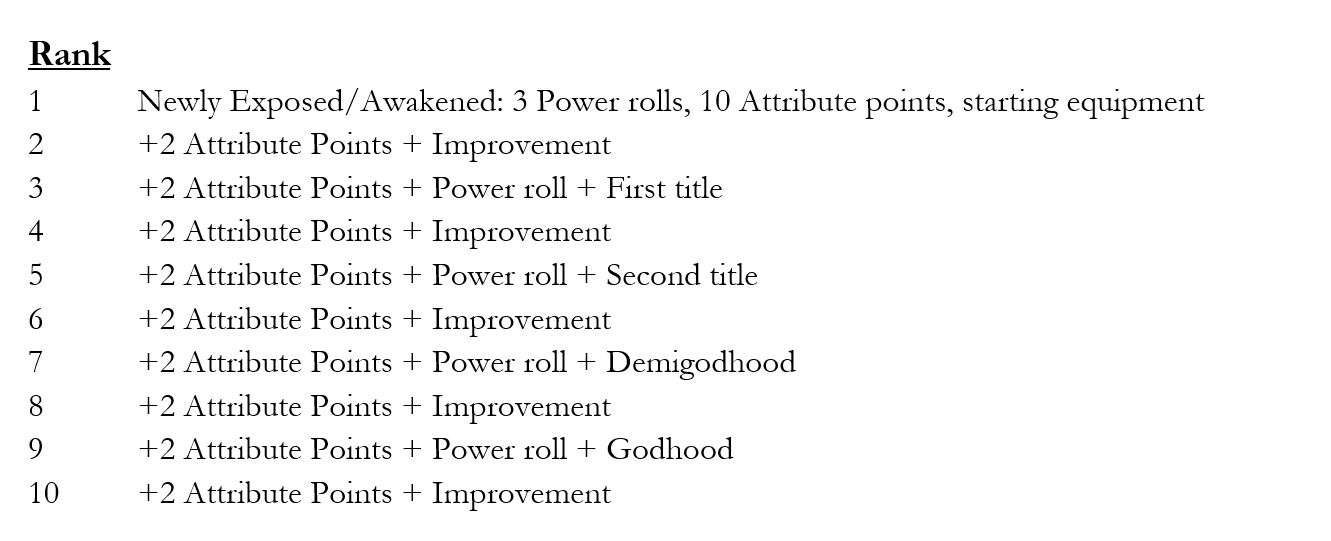
Rank in Crusaders is more a symbol of fame and accomplishment than power, so in some ways this is the place where I’m most radically altering the game. Here, Rank 5 is equivalent to what a starting PC in the base Crusaders game would be (5 Powers rolls, 18 Attribute points), which is targeted as a comic book level superhero. To get there, a Rank 1 character is relatively weak, and a Rank 10 character is relatively overpowered. Thankfully, because Crusaders isn’t a game with a defined bestiary and cast of villains, I’m going to be creating all the NPCs and antagonists from scratch anyway, so it’s not like my Rank 1 characters are going to be any more vulnerable if I don’t want them to be.
What are titles, you may be asking? And what does “Godhood” mean? I’m not sure, honestly, except to say that I like the idea of there being a “fame” element to Ranks in addition to power, and I’ve always loved earned titles in fantasy games and literature.
Critical Hits and Critical Failures
Finally, I love that Hero Points in Crusaders are so straightforward and tied to Rank. You get 1 HP per Rank at the start of each Issue, and you can cash one in to flip-flop any d100 roll. Neat. Easy. Cool.
The more I’ve played around with the system, though, the more that double-digits (11, 22, 33, etc.) feel special. The game treats them as special for character creation rolls, in which you’re meant to flip-flop; on the tables above, doubles allow you to choose your own result or invent something new. So, it’s odd to me that the same doesn’t hold true during gameplay.
I’m going to play around with doubles meaning either critical hits (if the roll is under the chance of success for a given roll) or critical failure (if the roll is over). I like this system because it means that if you’re particularly good at something—say, with an 80% chance of success—you get more chances to critically succeed and fewer to critically fail. If you’re facing a particularly tough challenge, the opposite is true. That’s elegant and fits the Crusaders ethos.
The question is: What does a critical success or failure mean when you’ve rolled it? Here I’m going to feel my way and decide depending on the situation. Eventually, I might come up with a more coherent, hard-and-fast rule for how to handle these rolls. For now, I just want them to have juice, either helping or hurting the PCs in some meaningful way.
Let me reiterate that I’m super excited about Crusaders as a game to play. My many tweaks above are a testament to that excitement rather than a criticism. So many of the game books I read had me making puzzled, hesitant notes about rules interactions that I didn’t understand or that felt odd to me. In Crusaders, however, I felt like I immediately “got” the game, and so instead found myself saying, “Aha! That means I could…” All the energy I spent crafting the above tables and rules felt like good energy, generating more enthusiasm for me to jump in and play.
Speaking of which, enough of this table-setting nonsense for one New Year’s Day. Next time we’ll begin diving into the town in which our adventure will begin, and then crafting our player characters. Fun fun! As always, hit me up with any questions or comments below.
Joyfully yours,
-jms






 My Hero Brain