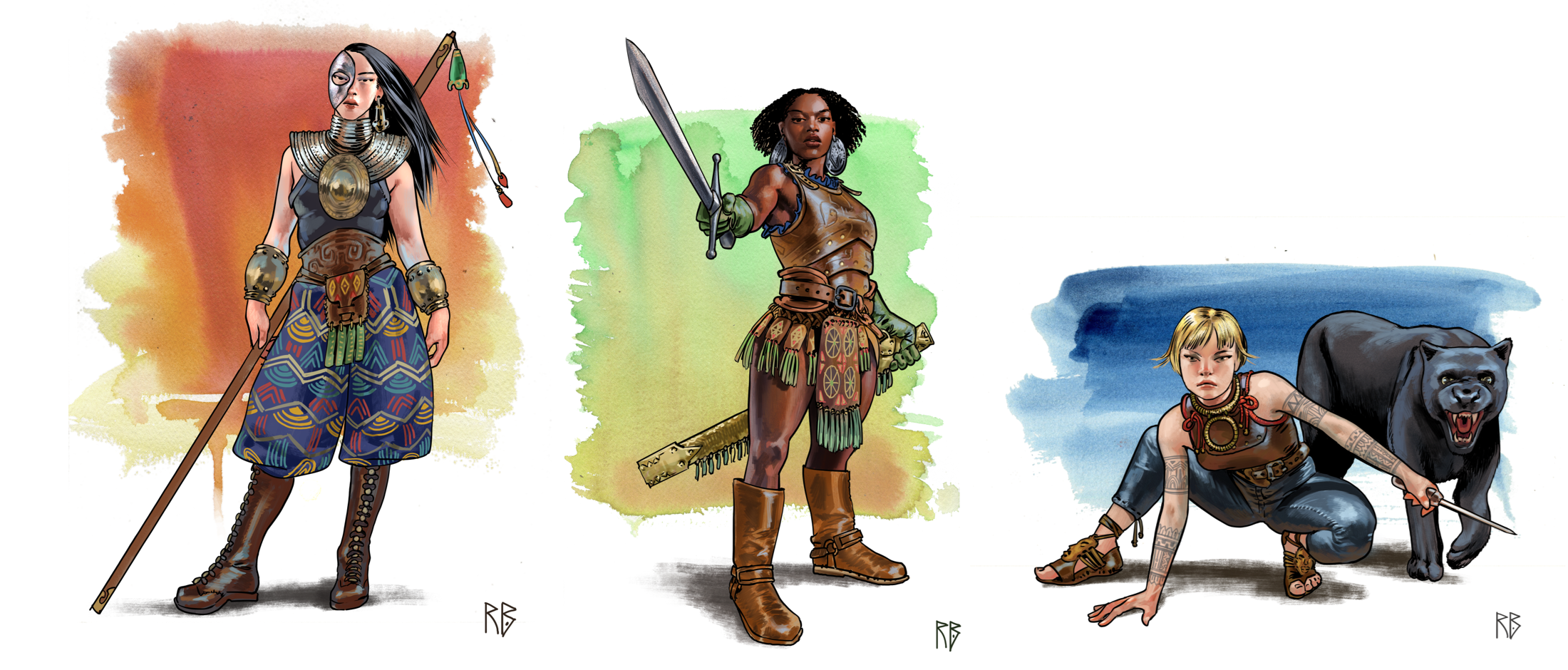
Age of Wonders, Issue 5 Reflections

art by Roland Brown (drawhaus.com)

We’re heading into the climactic Issue 6! Let’s avoid the preamble and just jump right in, shall we?

Deconstructing Prepared Adventures

Issue 5 really opened my eyes to the glory of solo roleplaying. Recall that I’d recently started falling back on published material to give me some structure for my storytelling. No sooner had I done so, however, than the plot sort of led from one thing to another… Maly made a heroic theft of the bejeweled box (which, at the time, I had no idea what it was or why the ratfolk wanted it), giving rise to an underground chase, then a showdown with new villains, one of them Kami’s brother, and then the re-theft of box by the ratfolk ringleader. None of that was in my head when I started looking at Rats of Ilthmar for inspiration.

But then I hit a wall; there was no “next logical step” for where to take the story, and I’d strayed so far from the published material that I didn’t see how to find my way back there. Enter Mythic GM Emulator to the rescue last installment, and in a few quick rolls I not only had my answer (summoned filth demons, baby!) but felt reinvigorated for Issue 6. Maybe it’s silly to type this sentence after so much time solo roleplaying, but I felt like Mythic’s unlock of the next part of the story made me finally “get” why solo-play is fun. I still don’t like having absolutely no material as a foundation for my games, but it was easy to see how I could continue this story for months, if not years, and never run out of exciting twists and turns.

Indeed, I’ve been expanding my consumption of media on solo roleplaying and recently listened to an interview with Tana Pigeon, author of Mythic, on the Solo RolePlayers Podcast. The topic of the interview was playing published adventures solo, and it’s a great listen. Though neither Tana nor the podcaster PJ really understand the glory of published material (or, in PJ’s case, an appreciation for the magic of group games), Tana has a few super interesting tactics for how solo play can use published material as a source of emergent storytelling, some of which are detailed in the Mythic second edition book. A new and intriguing approach, however, comes from Tana’s article in Issue 50 her own self-published Mythic Magazine called “Deconstructing Prepared Adventures.” Buy the issue if you can, but, in summary, the idea is to completely abandon the structure or plot of published adventures and instead roll dice to randomly select sections of the adventure as tables to answer Fate questions and generate random events. This approach keeps the adventure feel and themes but creates something entirely new.

Now, as I said, what was missing for me in the interview was a true appreciation of published material. I like the structure of an adventure with story beats, plot milestones, and overarching quests or themes. I enjoy the prep of GMing a group game or a solo one equally. Just look at my playthrough of two full Dungeon Crawl Classics adventures – that experience was great fun for me. I’m excited about having the dice determine the protagonists’ fates without me worrying about what comes next. As a forever-GM in my group games, it’s an opportunity to dive deep into an adventure that either I’ll never get to play with a group or as preparation for doing so. Moreover, that experience feels like it mimics the vibe of a group game (with the obvious differences that I’m piloting both the PCs and NPCs and I’m not with friends). I don’t get bothered by knowing what’s behind the next door, because I get the same thrill out of the anticipatory “Ooo! How will they handle the next challenge?!” excitement as I do GMing group games, plus I find it a narrative challenge to follow the dice and still navigate the published material. On the other side of the coin, I never really wanted to play truly emergent games. Somehow not having any structure destroyed my motivation. If anything could happen and I was making it all up, why did the events matter at all? The idea of playing solo like Tana or PJ seem to enjoy felt, I don’t know… lonely.

Maybe it’s having invested more time in solo play, or perhaps it’s just all the new media I’m consuming on the topic. Whatever the case, I’m becoming more open to what I’m now realizing is the norm for solo roleplaying and am increasingly ready to embrace wherever the heck my mind will lead me. Will this dawning revelation lead to more interesting stories? I guess we’ll find out. File it away for the next adventure, though… I want to try that “Deconstructing” method at some point.

Speaking of the next adventure…

We’ve Made It: Issue 6!

I don’t know how explicit I’ve been throughout this experiment, but once I settled on the “six Issues form a Trade Paperback (TPB)” idea, the commitment I made to myself was to see one six-Issue arc all the way through. It’s been an experiment on so many different dimensions: Homebrewing a world, mashing up superheroes and fantasy, playing a new game system, more emergent play, different POV narratives, six-Issue arcs… the list goes on and on. Given the pace of my writing, I was essentially giving myself six months to settle into this story and then assess. All along, I’ve meant to decide after Issue 6 whether to keep going as-is, make a significant change (for example, swapping Crusaders for another game system), or pause the story and start a new project. Right now, I’m not at all sure which path I’ll take in a month’s time.

Whatever I decide, I’m hoping to end this TPB with a bang. We’re entering a battle where the odds are stacked against our protagonists: Without Destiny, there are three Rank 1 PCs against three Rank 2 villains. Moreover, it feels to me like the demons’ powers are more wide-ranging and complementary to each other than Kami, Emah, and Maly’s are. They will need some luck and good tactics to survive, much less to defeat the demons. As I said at the end of the last installment, I’m officially worried about the party.

So, either the PCs will get wiped out, the heroes will triumph against all odds, or somewhere in between. Either way, I’m excited to see what happens. I feel a little bad about killing Tatter “off screen,” but my choices were to do that, have her be part of the battle, or escape again. My sense is that she would have tipped the scales for either side if she’d joined them, and her escape just leaves me in the same “how do I resolve the ratfolk plot?” predicament I was feeling before. I’m glad the dice decided to take her off the game board, despite the ignominious end.

Finally, let’s also pour one out for Anos Wosu, the cat-man sidekick of Kami’s brother who never even got a name in the narrative, much less a chance for backstory. Peace out, karate cat-man.
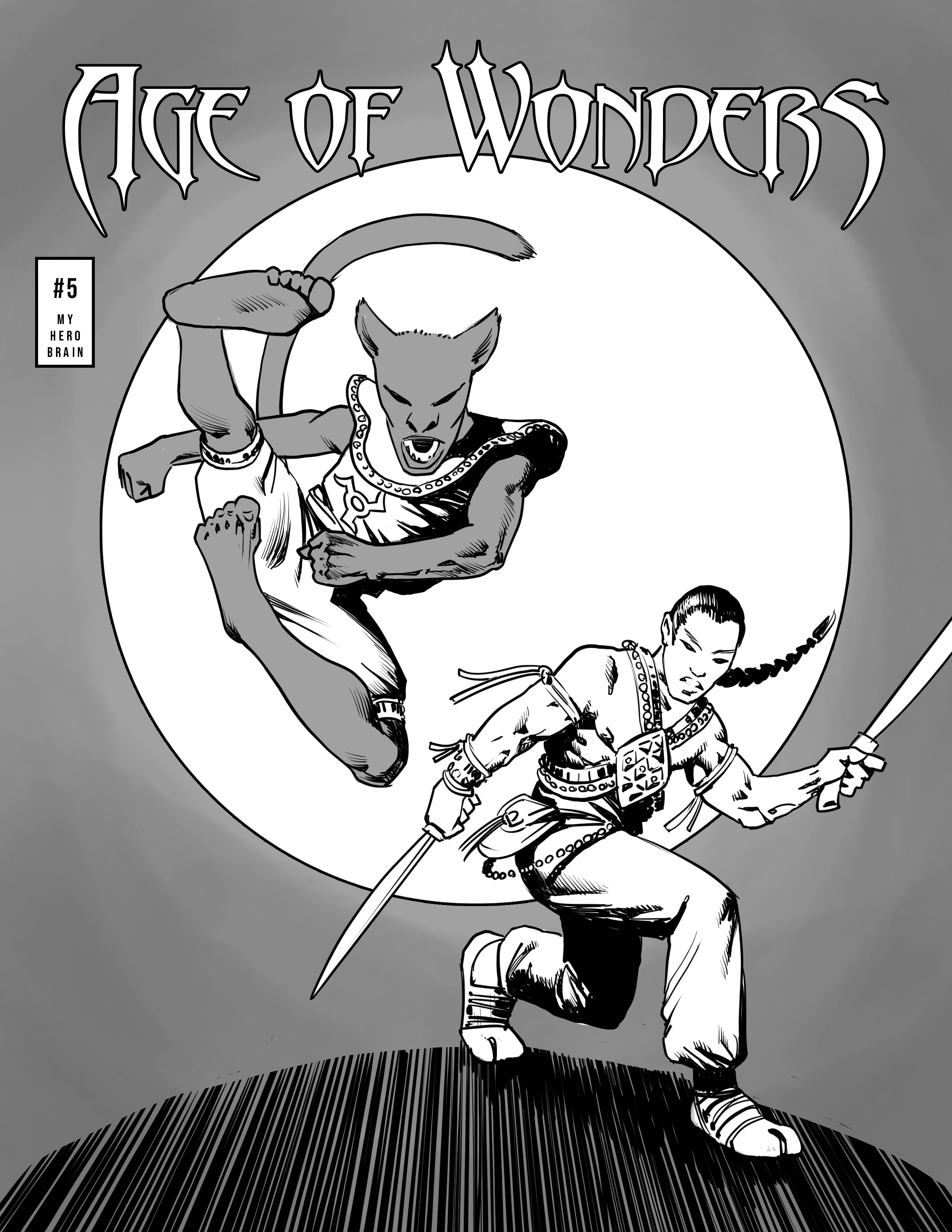
art by Roland Brown (drawhaus.com)

I like that Issues 3, 4, and 5 all feature the main antagonist(s) of that Issue, and of course all credit goes to Roland Brown for his creative eye and drawing prowess. That said, wait until you get a look at Issue 6’s cover! I gave Roland some really weird beasties to manifest, and he delivered in spades. Get ready for some gross demons next week.

As always, if you’re enjoying the story or have suggestions, drop me a comment below or feel free to email me at jaycms@yahoo.com.

Next: Heroes versus demons! [with game notes]

Choosing a Supers System, Part 5: Cortex Prime

Game number four of my deep-dive exploration of superhero games that can be played in a fantasy setting. Sometimes I wonder what’s wrong with me, that this is how my brain works.

By now you’re aware that I’m envisioning a new solo-play venture, one that involves a genre mash-up and thus a particular set of requirements for choosing my next game. These by-now-familiar requirements are:

  • A superhero game that can be played in a fantasy setting, plus allow for anachronistic weapons and technology. Basically, the superpowers and fantasy elements need to be satisfying, but allow for other genre shenanigans.
  • Is neither too crunchy (if I’m consulting forums or rulebooks more often than writing, that’s bad) nor too lightweight (I need to feel like the dice are guiding the story and enhancing the narrative). I want to feel like the mechanics support the story.
  • Level-up jumps in power. My idea is that the PCs start as “street level” heroes and become demigods as the story progresses. Something will be pushing them closer to godhood, which is a core part of the story. The game should not only allow for those different levels, but be fun to play at all of them.
  • No hard-wired comics tropes (like secret identities, costumes, etc.). The story will be a genre mash-up, so I can’t hew too closely to any overly specific formulas.

After three narrative-light systems in a row, it’s time to turn to something different. Today is my first (and only, at least for this series) dive into a true “setting agnostic” game, not built for any one genre, but meant for games in any of them.

Cortex Prime

Truth be told, I didn’t know that Cortex Prime existed until recently. Instead, I knew Marvel Heroic Roleplaying, a 2012 game by Margaret Weiss Productions and by far my favorite (out of five!) TTRPGs made under the Marvel banner. Marvel Heroic Roleplaying received rave reviews and introduced several innovative mechanics well-suited to the superhero genre. Sadly, the company lost its Marvel license within a year of launching the game and thus disappeared as quickly as it appeared. My sense is that if Margaret Weiss had retained the license, MHR would be talked about today as much as FASERIP, and likely would have spawned Cortex Prime—a generic system using the same engine as MHR—sooner. Instead, designer Cam Banks took the guts of that original game to a 2017 Kickstarter, and Cortex Prime released three years later. It may have sat dimly in my awareness the past few years alongside systems like Genesys and Cypher, but I had mostly steered away from generic systems towards more specific and unique game experiences. At some point this year, I made the connection between Cortex Prime and Marvel Heroic Roleplaying, rubbed by eyes in disbelief, and promptly ordered the core rulebook.

The first thing to say about Cortex Prime is that it is beautifully produced. The cover, the interior art, the graphics used to explain game concepts, the layout… it’s all stunning. If the Supers! RED rulebook sits on one end of a sensory-stimulation spectrum, Cortex Prime is on the other.

It’s also a relatively unique rulebook in two ways: First, it reads like a “Game Design 101” textbook as much as a game instruction manual. Everything beyond the core mechanics in Cortex Prime is modular, and optional rules (called, in fact, “mods”) take up more room than the base rules, each painstakingly considered and guiding when you might use or not use that option. Because it’s a generic system, everything has a specific and technical term abstracted away from any one genre, and it’s a game that requires you to think beyond those technical terms to their application. Second, and relatedly, the book is targeted at Game Masters, not players. Because of its modular, design-the-game-to-your-world nature, Cam writes the book to bring GMs into the game design tent, letting them choose what sort of game they want to play. Cortex Prime is the single most earnest attempt I’ve seen to allow GMs to run the very specific game they want to play.

A number of great reviews of the system exist, and I’ll link to a few here by Mephit James, Gnome Stew, and Jeff’s Game Box. The best summary of the core mechanics are from a terrifically-written review by Cannibal Halfling, which I’ll quote here:

“Cortex is at its core a ‘roll and keep’ dice mechanic. For any challenge the player assembles a dice pool of around three dice, rolls them, and keeps the highest two results. Depending on which of your character’s traits are relevant to the roll, you could be rolling d4s, d6s, d8s, d10s, or d12s, with d6 being average, larger dice being better, and d4 being much less good, especially considering the high probability of rolling a 1. All dice rolls are opposed rolls; the base dice pool that the GM rolls is two dice whose size vary depending on the difficulty of the task.

There are two other mechanics which depend on the die results. First is the Effect Die. Once a player chooses the two dice they wish to keep, they choose the largest remaining die to be an Effect Die. The Effect Die determines the impact of certain dice rolls, and is dependent on the size (rather than result) of the chosen die. This does mean that it might sometimes be advantageous to choose a lower absolute result (provided it still meets the threshold for success) if it produces a larger Effect Die. Second result-based mechanic is the Hitch. A Hitch occurs when a player rolls a 1 on one of their dice. A die showing a one cannot be chosen for results or for the Effect Die. While there are no direct consequences beyond that for rolling a one (only rolling all 1s is considered a critical failure and is called a Botch), the GM may choose to spend that 1 on the roll to create a Complication. Complications, and their positive counterparts Assets, represent circumstances or items that exist in a scene, much like Aspects in Fate. A GM can add the die value of a relevant Complication to the dice pool that opposes a character’s roll, while the player can do the opposite with a relevant Asset. When a character creates an Asset, they may use the Effect Die to determine its die size and therefore its impact on the scene. The other core mechanic of note is the Plot Point System. Each player starts play with a Plot Point, and when the GM activates a Complication from a player rolling a 1, they also give that player a Plot Point. Plot Points can be spent on activating abilities, counting more dice in rolls, and preventing a character from being Taken Out of a Conflict. As more options are defined, so too are more ways to earn and spend Plot Points.”

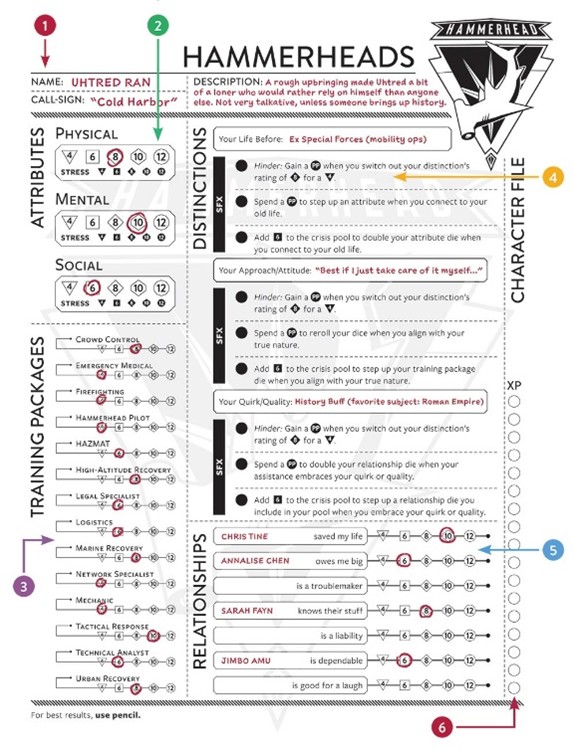
For the previous games, I made a sample character to test out the system. I can’t do that here, because to make a character in Cortex Prime means first making a dizzying number of choices about what mods exist in a particular world. Are we defining characters by Attributes, Skills, Roles, Powers, Relationships, Affiliations, Values, or something else? What do the superpowers do in this world? What factions exist that characters can join? Etcetera etcetera etcetera. Every character sheet in Cortex Prime is unique to that GM’s vision for the world. Take, for example, the same character sheet on the game’s website, for their sample Hammerheads (sci-fi) setting:

Everything on the sheet above—the three Attributes, the Training Packages, how Relationships work, what Distinctions matter—it’s all a setting-driven choice that the GM made before a player ever got involved. The possibilities are dizzying, and means that, once a GM has done the work of designing the world, everything in it bends towards the specific setting and stories in that setting.

Why Cortex Prme Works For Me

In a lot of ways, Cortex Prime is my wildest dream come true. It is a system designed for genre mashups, to allow GMs to feel unconstrained by any pre-existing setting. This is exactly what I’ve been searching for in this exploration. Reading through my criteria at the top of this post, it’s hard to see how any of the next game systems are ever going to address my criteria better than Cortex Prime. I get the strong sense that I could spend months worldbuilding and turning all the modular knobs to create exactly, EXACTLY what I want to do. Heck, once I’d done this work, I would have a game sourcebook in my hands that I could use far beyond my own solo play adventures. I would be tempted to consider writing adventures for my world and publishing them, surely reaching out to my regular game group to start a campaign. It’s kind of like a dream come true for homebrew worldbuilders.

What about jumps in character leveling, something that I’ve been using as a primary screen against other systems? You guessed it: There are mods for that too. Character advancement is its own section in the Cortex Prime rulebook, and I could make leveling up as milestone-driven or dramatic as I want.

Finally, once the world and game are built and all that knob-fiddling is done, the game has exactly the balance between crunch and narrative that I’ve been seeking. The mechanics are clear and easy to execute, and the decisions lead to exciting story moments. Even though the book often reads like a dense technical manual, it’s obvious that the density of mechanics is meant to allow the GM to make choices before players get involved, but that gameplay is meant to be fluid and fun. Look back to the game that launched the system in the first place, Marvel Heroic Roleplaying. In a lot of ways, MHR is an example of what Cortex Prime looks like once the GM choices are done.

The cherry on top: Because it’s a new game with such a wide scope and elegant presentation, the community around Cortex Prime is still vibrant. Unlike some other games I’m considering, I have no doubt that there would be plenty of people with which to bounce ideas or to lend inspiration. Moreover, I expect more and more setting books will be released over time, providing a whole ecosystem of Cortex Prime ideas to mine.

So, am I done? Did I find my perfect system? It sounds like it, right?

My Cortex Prime Hesitations

On average, I think each page of the ~250-page Cortex Prime rulebook took me more time to consume than any other game book I own. I had to reread sections multiple times to grok it and connect what I was learning with other sections, taking breaks between sections to allow my mind to breathe. It’s the only rpg book in memory that I’ve brought on an international business trip so that I could have the long plane rides to read it without distraction. To be clear: I’m not criticizing the book’s presentation or layout. For me, learning Cortex Prime is akin to learning a new language. Cam Banks has invited me to become a game designer and given me tools to do so. It’s as if I started the process of finding the perfect car for myself and stumbled upon a custom-kit dealership, where I can have any unique car I want if I’m willing to learn how to build it.

What I’ve come to realize, though, is that I’m not fundamentally a game designer. At best, I’m a competent GM who is comfortable homebrewing certain rules and tweaking settings to my taste. I’m a writer first, game player second. I don’t aspire to publish my own game system. Jumping back to my analogy, I’m a car enthusiast, not a mechanic—I want to buy a car and have someone give me the keys, complete with a maintenance plan if I run into trouble later. It’s clear to me that Cortex Prime offers the exact game experience I want for my project, as long as I’m willing to put in the significant work to assemble it from parts. Is that the work I want to do? I don’t think so. Everything about Cortex Prime feels tantalizingly full of possibilities but frustratingly far away.

I have two additional quibbles, but they are minor compared to the daunting, steep learning curve of building the system to my homebrewed world. First, as I’ve said throughout this series, Dungeon Crawl Classics titillated me with the story possibilities inherent in random tables. The more randomness I can insert into my process, the more that I surprise myself in my storytelling. Unless I want to build the tables myself, nothing about character creation in Cortex Prime is random. I’m sure that Cam Banks would encourage me to build those tables, but it’s just another step to a long process before I get to play and write. Woof.

Second, it sounds like there is some collective handwringing in the Cortex Prime community about how licensing works with the system (another article on this topic is here). In other words, once I’d put in the months of fiddling with the system to have it exactly represent my homebrewed, mashup setting, how public could I be with the choices I’d made? If I wanted to start releasing bits on this blog that became my own specific character sheets, powers lists, etc. – who owns those? It makes sense that there are legal questions there, because as I said, the Cortex Prime book feels uniquely like a game design toolbox more than a typical game rulebook. I don’t have specific goals or an endpoint in mind for this project (and honestly am not particularly ambitious about it), but I’d hate to regret choosing it as a system without fully educating myself on how licensing works. Add this step to the long lists of things I’d have to understand before beginning to play, which just all makes me want to sigh heavily.

One Game to Rule Them All

If it’s not obvious, I’m incredibly impressed by Cortex Prime as a system. It’s brilliant and unlike anything else I have on my TTRPG shelves. Kudos all around to Cam Banks and anyone else who created it.

It’s also a sobering game to explore. On the one hand, Cortex Prime delivers exactly what I want, as long as I’m willing to put in upfront work to create it. My resistance to doing that work is palpable, however, and makes me realize that I want a game that satisfies my requirements without needing to design the game myself. Back to my car analogy, I’d rather spend more time test-driving cars, finding the best one of the options available that I can drive right off the lot, than learning the skills necessary to build my own from a kit. There’s a reason that I spend time playing games and writing fiction and don’t spend that same time designing games. I hadn’t been forced to confront my missing game-designer gene until Cortex Prime.

As a result, I’ll keep it as an option, but distantly behind the others. If I truly can’t find something that works for me—or if I find myself with tons of free time and a willingness to crack my designer knuckles—it’s cool to know that Cortex Prime is there waiting for me.

Top Contender: ICONS

Second: Supers! RED

Third: Cortex Prime

Not currently in consideration:

Choosing a Supers System, Part 6

Choosing a Supers System, Part 4: ICONS

Another post, another quest for my soulmate game.

By now you’re aware that I’m envisioning a new solo-play venture, one that involves a genre mash-up and thus a particular set of requirements for choosing my next game. These requirements are:

  • A superhero game that can be played in a fantasy setting, plus allow for anachronistic weapons and technology. Basically, the superpowers and fantasy elements need to be satisfying, but allow for other genre shenanigans.
  • Is neither too crunchy (if I’m consulting forums or rulebooks more often than writing, that’s bad) nor too lightweight (I need to feel like the dice are guiding the story and enhancing the narrative). I want to feel like the mechanics support the story.
  • Level-up jumps in power. My idea is that the PCs start as “street level” heroes and become demigods as the story progresses. Something will be pushing them closer to godhood, which is a core part of the story. The game should not only allow for those different levels, but be fun to play at all of them.
  • No hard-wired comics tropes (like secret identities, costumes, etc.). The story will be a genre mash-up, so I can’t hew too closely to any overly specific formulas.

I have another “lighter weight” game system on my pile, so I figured it would make sense to tackle it next in direct comparison to Supers! RED andProwlers & Paragons. It’s also the most popular of the three systems: It’s time for ICONS!

ICONS

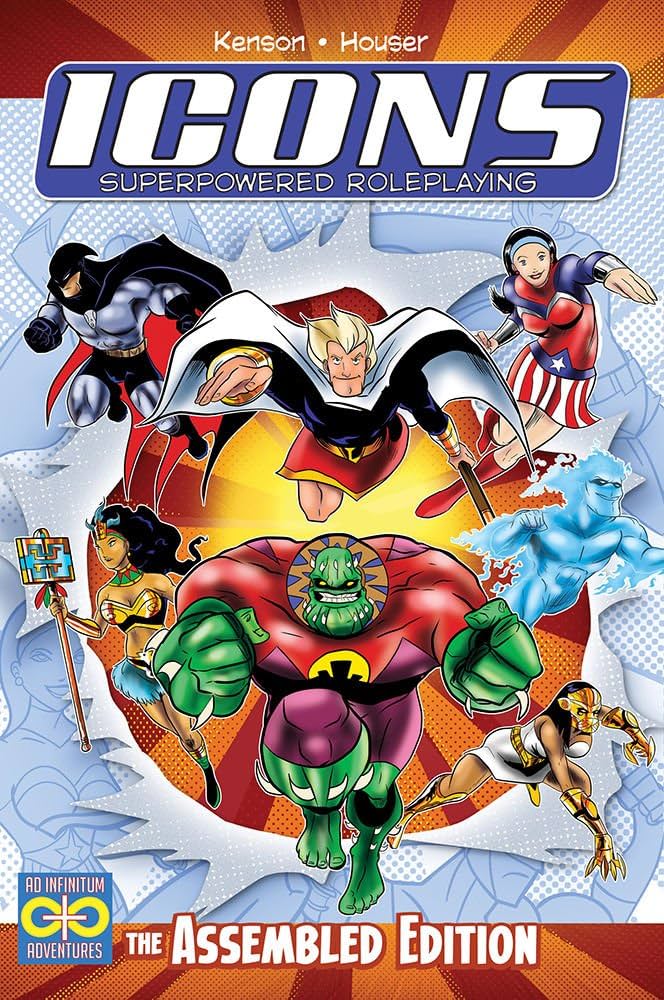
ICONS (yes, it seems to be always capitalized, though it’s not an acronym… yell it with me now) is the brainchild of Steve Kenson, longtime TTRPG veteran and original designer of Mutants & Masterminds, probably the most popular and played superhero game of all time. In listening to interviews with Steve, it sounds like he was trying, with ICONS, to create a more accessible game than M&M, something that gamers of all ages could jump into with minimal start-up costs. This goal is further emphasized by the presentation of the core book (the “Assembled Edition” is the 2014 revised book, and seems to be the definitive ruleset), which features Saturday Morning Cartoon-like artwork from Dan Houser and is pocket-sized. Everything about ICONS is non-threatening and kiddie, which I’ll admit for me at first was a turn-off.

The bones of the game are steeped in Fate Core, a rules-light, narrative-focused system. Every opposed test includes rolling a single d6, adding the value of the Attribute or Power you’re using (always on a scale of 1 to 10), and comparing the result to another single d6 plus the opposing ability. Dead easy. Results of these tests have a narrative range (seven possible outcomes, from “Massive Success” to “Massive Failure”). Each character also has descriptive, non-numerical Qualities (e.g. “I can do this all day” or “All-American hero” might be on Captain America’s sheet), and players or the GM can invoke (using Determination points, the game’s metacurrency) these Qualities either for or against the PC. Stamina is the “hit points” stat, a combination of a character’s Strength and Willpower. Range and time in combat are both abstracted. All these points are like the previous two games I’ve explored and seem characteristic of many narrative games. I’ve read some reviews annoyed that ICONS uses many of the same mechanics as Fate Core but changes the terms unnecessarily. Since I’ve not played any Fate proper games, I’m blissfully unaware of these issues.

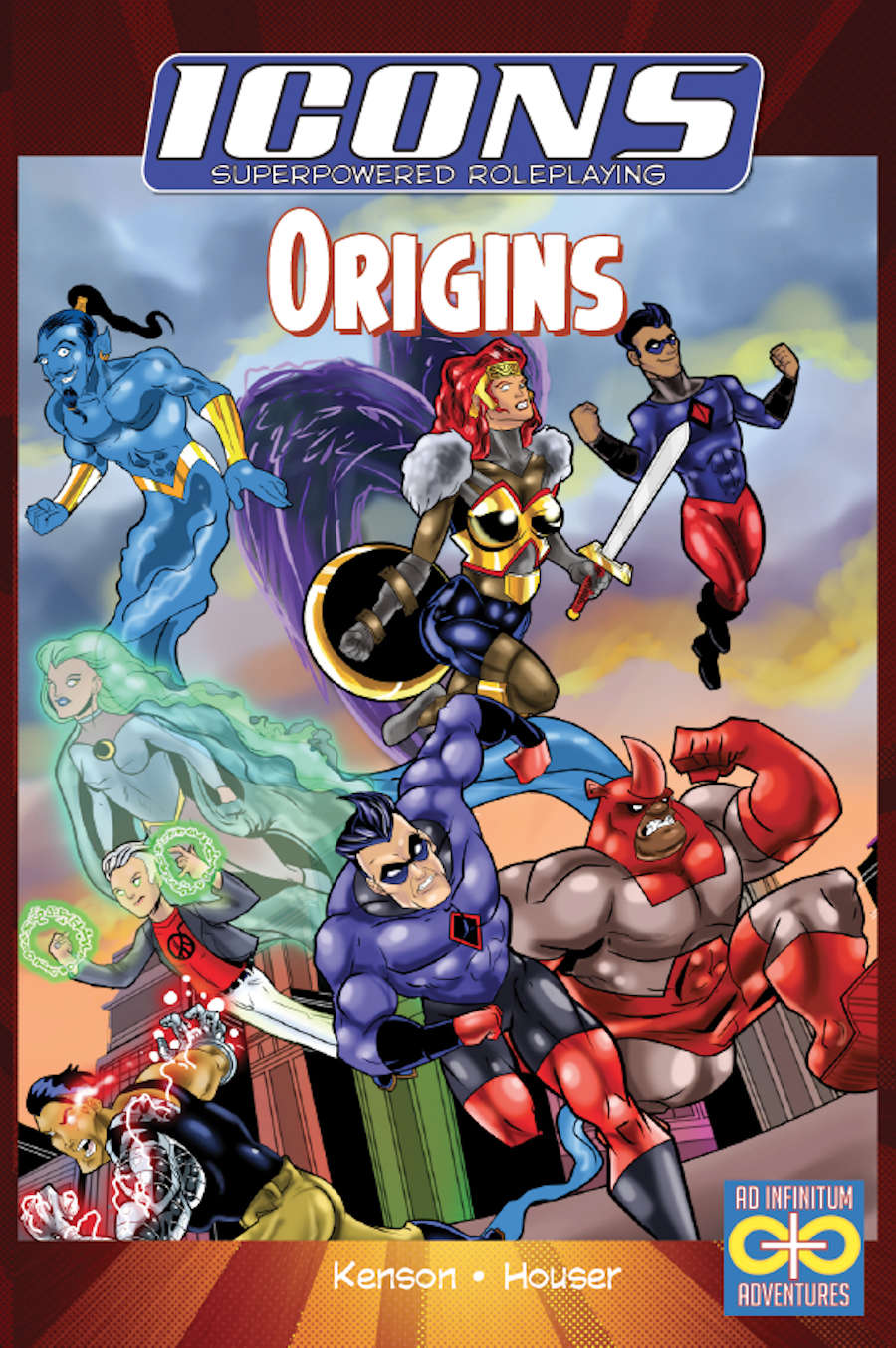
Sitting on top of these relatively basic mechanics are a metric ton of wrinkles and optional rules that make ICONS deceptively deep. Characters can combine effort to overcome otherwise-impossible opposing numbers, or the GM can set up “pyramid tests,” which are multistep challenges that simulate things like stopping trains from colliding. Players can retcon the fiction and use their powers for creative stunts. The game’s lethality is a choice, as are things like sustaining injuries. The list goes on and on, and that’s just from the 2014 rulebook. Over the past ten years, a metric ton of splatbooks, supplements, and additions have piled up, much like my bae Dungeon Crawl Classics. Unlike DCC, Steve Kenson has managed to collect many supplements into a few “greatest hits” books. For me, the best are Great Power, which adds a bunch of new powers to the base game, Origins, which expands the character creation process and introduces Knacks and Specialties, and ICONS Presents!, a 2019 summary of all sorts of variant rules and additions to the game. Included in this last book is a whole section on playing ICONS in a fantasy setting!

Character creation in ICONS is meant to be random (though there’s an optional point-buy way of making characters, the reverse situation from the last two games I explored) and is supposed to go quickly. So… let’s try it out!

To simulate what I want to do in my game, I’m dipping into ICONS Presents! for the alternate “fantasy hero” tables. I’m also going to roll on the very fun Background tables in Origins to flesh out the character. And, to fully stretch all the supplements I own, I’ll also use the expanded Powers tables in Great Power.

My first table is Origin, and I roll a 1 on a d6: My character is Arcane, with an innate gift for magical power. I also receive an additional arcane Knack.

I next roll on Archetype, a get a 5 on a d6: Stealth, adding +2 to my Coordination and Awareness. Cool. It’s an arcane trickster or thief of some kind.

Now it’s time to roll up my Attributes on 2d6, consulting a slightly modified table for Fantasy. Here is what I roll:

Prowess (ability to fight): 3 (Average)

Coordination: 6+2 from my Origin: 8 (Amazing)

Strength: 6 (Great)

Intellect: 6 (Great)

Awareness: 5+2: 7 (Incredible)

Willpower: 2 (Poor)

I then get to swap two Attributes, and I’ll swap Strength and Willpower. Whoever this person is, they’ll be a slight, agile, headstrong person, but not particularly musclebound.

Next I would roll for powers, but the Fantasy rules say to pick a few Knacks instead. I’m actually going to do a bit of both, selecting 2 each of Knacks and Specialties (their “fantasy” profession and skills), then rolling for a single Power.

For our magician-thief, I’ll pick Vanish and Escape Artist as Knacks, plus Stealth and Occult as Specialties. My character was, I’ve decided (at least until rolling up the background information), an Indiana Jones-like relic hunter before acquiring otherworldly abilities.

What was that Power? I roll “Offensive” and then “Dazzle.” My character can overwhelm an opponent’s senses somehow. Cool, and mighty handy given a PC who wants to mostly get out of combat instead of fight.

Now I turn to rolling up my character’s Background. After a whole bunch of rolls, I come up with a female, pale-skinned, seventeen-year-old who is a fun-loving and playful person. She values a mentor/teacher and yearns for love. She believes that people need leadership and guidance. She grew up in a rural community and was well-treated, at least until her entire family was betrayed by a loved one and lost everything. She then found a mentor and a windfall. Excellent stuff, random tables! I’ve got her in my mind, and as such writing her origin and Qualities is simple.

Here’s where I ended up:

The character creation process took me quite a bit longer than, say, Prowlers & Paragons, but that’s partly because I was flipping through four separate books. I have no doubt that it would become a fast process with practice. More importantly, it was fun, and generated a character that I could immediately drop into the story I’m wanting to tell.

Why ICONS Works For Me

It’s clear that Steve Kenson has put a lot of love over the past dozen years into ICONS, and it’s built on a Fate Core system that’s tried and true. As a result, ICONS is an intuitive system that is not only easy to understand but easy to tweak. I made a judgment call on what to use between standard superhero random character generation and the fantasy alternate tables without feeling self-conscious about the decision, even though Meri was my first character. Because the game always comes down to a single d6 role plus a single value, there’s not a lot to bog down speed of play. I love that the timekeeping system out of combat is divided into chapters, issues, and series, which sounds perfect for serial fiction. Which is all to say that ICONS’ core mechanics are easy to digest, easy to use, and I can easily see it working in my homebrewed world. With the four books I already own, I’m ready to play.

Although I didn’t think of it as a requirement when I began this process, I’m finding that random character generation is foundational to me being interested in the character creation process. Recall that I’m coming off six full months of Dungeon Crawl Classics, which is likely the most random-table heavy game in any genre. So much of solo play is combating my paranoia about overly railroading the story, and the randomness of rolls is what generates my surprise and delight. I’m already more interested in the character I made above than either of the Evlyn Towers I made with point-buy systems.

The level of support for ICONS is also heartening. There are tons of books, from both Ad Infinitum Adventures (Steve’s company) and third parties. I found no less than a dozen form-fillable PDF character sheets online, for example. There are Wiki and Facebook pages and a Discord server. The community feels dormant, but there’s still a faint heartbeat there. And hey… there’s even VTT support! I haven’t used Fantasy Grounds VTT before and have heard that it’s an expensive endeavor, but it’s nice to know that it’s there if I need it.

My ICONS Hesitations

My two hesitations on ICONS are related. First, because everything in the game is based on a 10-point power scale and every roll is a single d6, the power spread in the game doesn’t feel huge. As a result, I’ve read some forum comments that it might be a better game for low- and mid-level play instead of cosmic-threat level. It’s not a game that has particular rules for “street level” or “superheroic” play, because I don’t think those distinctions really exist in ICONS.

…Which means that it’s difficult to envision what “leveling up” looks like, when what I’m seeking are clear jumps in power once the character hit story milestones. There’s a section in the rulebook that discusses how to give Minor, Moderate, and Major Achievements, and Major Achievements (increasing Determination, adding Powers, etc.) might be enough, especially if I ignore the other two. It’s an open question, though, and one I probably wouldn’t sort out until I was already deeply invested timewise into my campaign. It would be a shame to get six months into a solo campaign, only to realize that I’m going to have to switch systems to fully realize the higher levels of play I had intended when I began.

I also don’t love juggling so many books to play, which is the same complaint I had with DCC. But I can’t really ding other systems for not having enough supplemental material and then complain that ICONS has too much material that I want to use. Consider this a minor irritant, not a reason to play another system.

One Game to Rule Them All

Of the three lightweight systems I’ve explored these past few weeks, it’s clear to me that ICONS is the best fit for what I want to do. The question is: Does moving it into first position on my list mean that I absolutely won’t come back to Supers! RED? For now, no. Yes, ICONS has the better character creation system, and far better support and materials. Supers! RED is different enough mechanically, though, that I may end up deciding that I want its narrative flexibility (particularly how it handles multiple Resistances) and the clear ladder of power levels. Heck, I could even see using the random tables in ICONS to generate the concepts for Supers! RED. So for now, I’ll keep both on the list:

Top Contender: ICONS

Second: Supers! RED

Not currently in consideration:

Choosing a Supers System, Part 5

Choosing a Supers System, Part 3: Prowlers & Paragons

It’s my second of many superhero TTRPG deep dives (links at the end of each installment to the others)!

Why am I suddenly diving into so many games? I’m planning to continue my solo gaming experience, but this time using a homebrewed world, story, and characters. The setting I’m envisioning is a genre mash-up, basically superpowers layered onto traditional fantasy, with a sprinkling of technology. Could I have started with something simpler? Heck yes, and maybe I should have done so. But I’m enjoying the specific requirements for a project like this one, and using it as an excuse to pour over some games on my shelf that I’ve either never read or have wanted to take for a test spin. Choosing the system has become a time-consuming tangle, but it’s been fun so far.

Speaking of requirements, I’ve articulated them as:

  • A superhero game that can be played in a fantasy setting, plus allow for anachronistic weapons and technology. Basically, the superpowers and fantasy elements need to be satisfying, but allow for other genre shenanigans.
  • Is neither too crunchy (if I’m consulting forums or rulebooks more often than writing, that’s bad) nor too lightweight (I need to feel like the dice are guiding the story and enhancing the narrative). I want to feel like the mechanics support the story.
  • Level-up jumps in power. My idea is that the PCs start as “street level” heroes and become demigods as the story progresses. Something will be pushing them closer to godhood, which is a core part of the story. The game should not only allow for those different levels, but be fun to play at all of them.
  • No hard-wired comics tropes (like secret identities, costumes, etc.). The story will be a genre mash-up, so I can’t hew too closely to any overly specific formulas.

My previous exploration tackled Supers! RED, a game that I’d bought after reading its glowing reviews but that I’d never sat down to read cover to cover. The other game in this vein is Prowlers & Paragons, also bought when I was in a superhero TTRPG buying frenzy because of how many people said they love it. What’s different about P&P is how many folks declare loudly that it’s their favorite supers system. When I added it to my “to be explored” pile, it was in large part to give me an excuse to understand what everyone was raving about. Let’s jump in!

Prowlers & Paragons

Prowlers & Paragons was first released in 2013, with the “Ultimate Edition” launched via a 2019 Kickstarter. Before I sit down to read a rulebook for the first time, I often search through easy-to-find game reviews to orient my brain. What’s fascinating (and exciting) about P&P is how many old-school lovers of Champions swear by it, and it seems to be a haven for people who, for whatever reason, bounced off Mutants & Masterminds. Hey, I’m a lover of Champions! I bounced off M&M (at least gameplay… I still love making characters)!

Check out this comment, from Richard in the above DMs Guild forum: “I would recommend this game for players of games like Champions or Mutants & Masterminds who find the math oriented nature of combat to feel very clunky and not very comic book like. Likewise I feel that fans of other narrative games, such as Cortex Prime, could look at this and have a good alternative game to use if their players want more crunch in the character creation. Alternatively I could see this game being used to create a really good fantasy game as well. I have often used super hero rpgs to run Dungeons & Dragons games. I feel character creation is much more fun in such situations and combat tends to work better.”

Squeee!!

In terms of how the core mechanics work, I’m going to use another quotation, this time from a 2022 review from Timothy S. Brannan: “The game mechanic is very basic and very easy to use. Every trait, ability, power, or what have you has a score. Figure out what you want to do, find the right combination, add those numbers up, minus any negative modifiers, and then roll that number of d6s.  “2s” and “4s” are one success, “6s” are two successes.  Compare that to the Thresholds table and you will know by how much you succeed, or fail.”

In a lot of ways, then, Prowlers & Paragaons shares its base DNA with Supers! RED. Everything has a d6 value, and gameplay involves rolling pools of dice. The difference here is that you aren’t adding the dice values in a pool, but instead counting the number of successes. As a result, dice pools in P&P can get large, since the game doesn’t care about your ability to do much math. The book routinely uses pools of 12d6 or more. If you like fistfuls of dice, this is a great game for you.

Combat is the crunchiest part of P&P, with specific terms like “active and passive defense” and “subdual damage,” but everything is theater of the mind and based on the basic mechanics from the review quoted above. Range and movement are abstracted to provide narrative flexibility, and a GM can decide how much things like size and cover matter to combat (or not). There are multiple pages of combat maneuvers, including rules for grappling, stunts, ambushes, defending others, etc. My general sense in reading the rulebook is that the non-combat parts of P&P are about who the narrator is, with a lot of open space to describe what’s happening. Combat, on the other hand, becomes more scripted, with clear initiative order and Health tracking. I’m not sure how I feel about the balance here without playing it.

Also like Supers! RED, character creation in P&P is a point-buy system with an optional random generator if you need a launching pad for ideas. The main differences between the two are a) the overall pool of points is larger (for street-level heroes, I used 12 for Supers! RED and 75 for P&P), b) P&P has more Attributes and Talents, which is what soaks up a lot of those extra points, and c) Flaws serve a different purpose. In Supers! RED, the equivalent of Flaws give you extra points to spend. In Prowlers & Paragons, though, Flaws create roleplaying situations in which you can receive Resolve points, the metacurrency that allows players to add dice, reroll dice, or add narrative features to a scene.

Because there are so many parallels between the two, I thought it might be fun to try and recreate my character Evlyn from the last post to see how it might differ here:

Comparing the two Evlyns from Supers! RED and P&P, you can see that, even with a street level hero, there is more detail here. Indeed, I’ve heard new players sometimes feel intimidated by the sheer number of Attributes, Talents, and Powers, especially if they’ve entered expecting a “light mechanics” system. That said, most of that sheet is fluff (though I like the many ways to add flavor), and since everything is expressed in a simple Xd format, once you’ve stared at a few characters sheets it’s all easy to grasp. Making my first PC took a little more time than Supers! RED, but not much. Like any points-buy system, the biggest trick was the “add one point here, take away two there” fiddling at the end to make sure I used exactly 75 points. Overall, I felt that I had plenty of points and options to make the character from my mind’s eye.

Why Prowlers & Paragons Works For Me

I worry that Supers! RED is too light mechanically, and Prowlers & Paragons is a definite step up in complexity. Combats can get crunchy, and things like chases and hazards are handled in “goals,” or multiple steps to resolve the situation. Because the “who gets to narrate” question is a core focus of the game, it’s a little odd to think about it in solo play. Thankfully there’s a “traditional results” variant rule that creates a table reminiscent of Blades in the Dark, changing the narrate-and-respond structure of resolving actions into “failure,” “success,” or “failure/success with a twist” which the GM can dictate. I love those mechanics, and it’s something I often find myself weaving into other TTRPGs. Also, like Supers! RED, we have tiering of enemies into Villains (full stats), Foes (same stats, half health), and Minions (one xd6 value), which creates encounters where PCs can feel especially super. Which is all to say, Prowlers & Paragons seems to have a lot of things I want out of my next game.

The system also has easy, clear jumps in power level built into the system since everything is based on point-buy character creation. Check out this glorious table from the core rulebook:

Perfect! I can easily see, instead of allowing PCs to spend the incremental Hero Points they receive at the end of each successful adventure, forcing them to save up until reaching a certain threshold. This sort of sudden jump in ability is, mechanically, what I’m hoping to create, and P&P makes this part of the storytelling easy and straightforward.

Finally, I want to say it’s a minor thing, but the more superhero game books I read, the more it matters to me: The Prowlers & Paragons book is gorgeous. Some of the art makes me wish it was a full comic book, and the layout is clean and easy to follow. Bouncing around chapters to find information is easy. The writing is clever and often delivered with a wink. After half a year with Dungeon Crawls Classics’ absolute monster of a rulebook and its scattered supplements, it’s delightful to have such a well-assembled book.

My Prowlers & Paragons Hesitations

Despite the quotation earlier in this exploration, I think the base P&P game requires some work to make it fit cleanly into a fantasy setting. Several of the Talents–Professional, Science, Technology, and Vehicles–are aimed at a decidedly modern comic book experience, and missing are things like Lore and Magic/Arcana. Similarly, several of the descriptions for Motivations, Flaws, etc. lean heavily into modern comic book tropes. None of these problems are crippling to my ability to play it in a fantasy setting, but it’s not out-of-the-box ready. As I’ve said before, I’m leery of homebrewing a system before I’ve even had a chance to play it as intended, and though the core game here is simple to grasp, it’s unlike most other TTRPGs I’ve played.

The biggest stumbling block for a fantasy setting is Gear. For me, equipment in P&P is caught in a weird limbo between narrative and crunchy. Characters can basically have whatever mundane gear they want, but these items often have mechanical boosts or effects. At some point, equipment is good enough to justify becoming its own Power, but that point isn’t obvious to me. Armor and weapons have tags that have defined mechanical impacts as well, some of which mimic Perks or Flaws that would normally cost or give you Hero Points. When thinking about a fantasy world where the PCs have superpowers but others don’t, the whole thing feels like a mess to sort through. I wish there was a P&P supplement that fully explored alternate settings like sword-and-sorcery or cyberpunk, which would help me feel more confident in how to navigate the many issues I see ahead.

I have a few other minor gripes about the system that already make me want to fiddle with it. For example, why doesn’t a character’s Motivation, which is given more than a full page in the book, somehow provide ways to generate Resolve? Another example: when making Evlyn, the only distinction between Blink and Teleport seems to be about combat, and so buying both felt overly taxing on my points build. I read in some reviews that P&P is easy to “break” from a balance perspective, and I’m just beginning to sniff at the edges of this problem even from a single read through the book. There is a way that a highly crunchy system like GURPS Supers or a highly abstracted system like Supers! RED works better for me, which is a surprise to discover.

Finally, I’m bummed to see that Prowlers & Paragons neither has a vibrant, active community nor even a creator website where I can find discussions, alternate rules, sample builds, etc. for inspiration (though I do believe a small Discord server exists). There’s no VTT support that I can find. These absences aren’t an enormous barrier, but they are discouraging to my confidence for committing to it for more than a one-shot foray.

One Game to Rule Them All

When I began my exploration into Prowlers & Paragons and reading reviews, I was sure that it would rank ahead of Supers! RED. Much to my surprise, I can more easily see committing to Supers! RED, and, while writing this post, often found myself thinking “this would be easier to figure out in Supers! RED than here.” My worries about Supers! RED being too lightweight and thus not keeping my interest remain, but P&P simply didn’t pull me in, despite its flashy presentation. In fact, if Supers! RED had the same art and layout, I’m pretty sure that the decision would have been ridiculously easy to make.

To be clear: I don’t want to yuck anyone’s yum; if P&P is your favorite supers system, that’s great. Feel free to argue with me in the comments. For me and for this particular project, however, I see too many ways it doesn’t quite match my hopes for it, despite the ridiculously-lovely rulebook.

As a result, our top contender hasn’t changed…

Top Contender: Supers! RED

Not currently in consideration:

Choosing a Supers System, Part 4