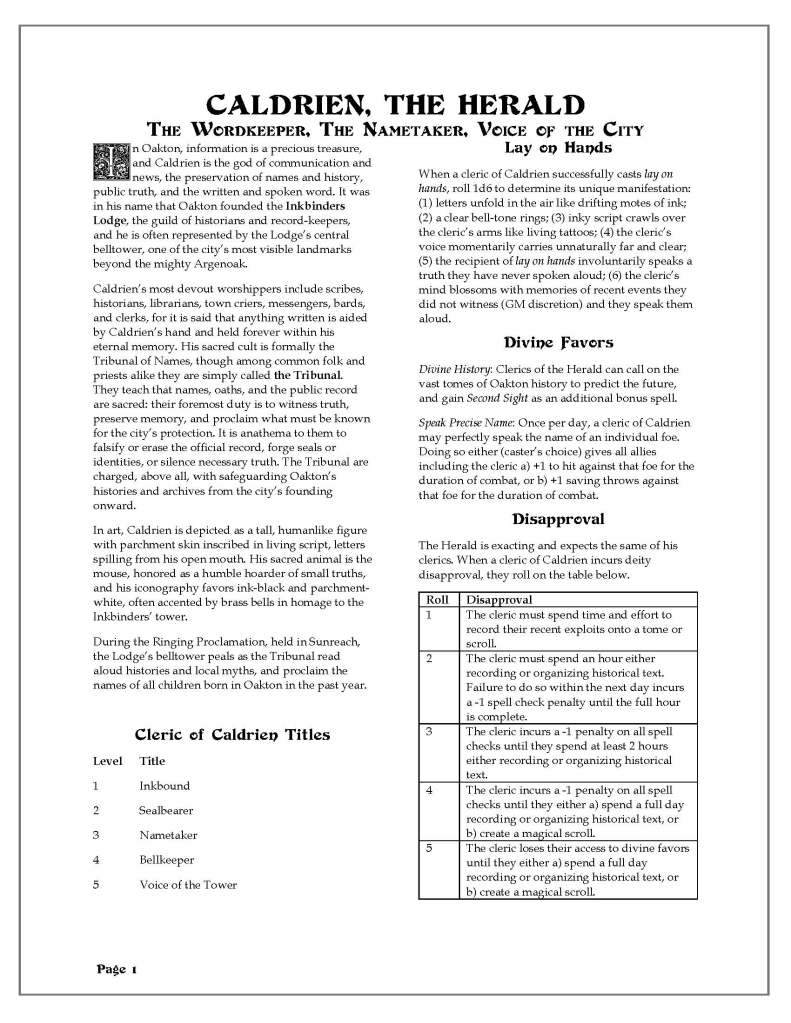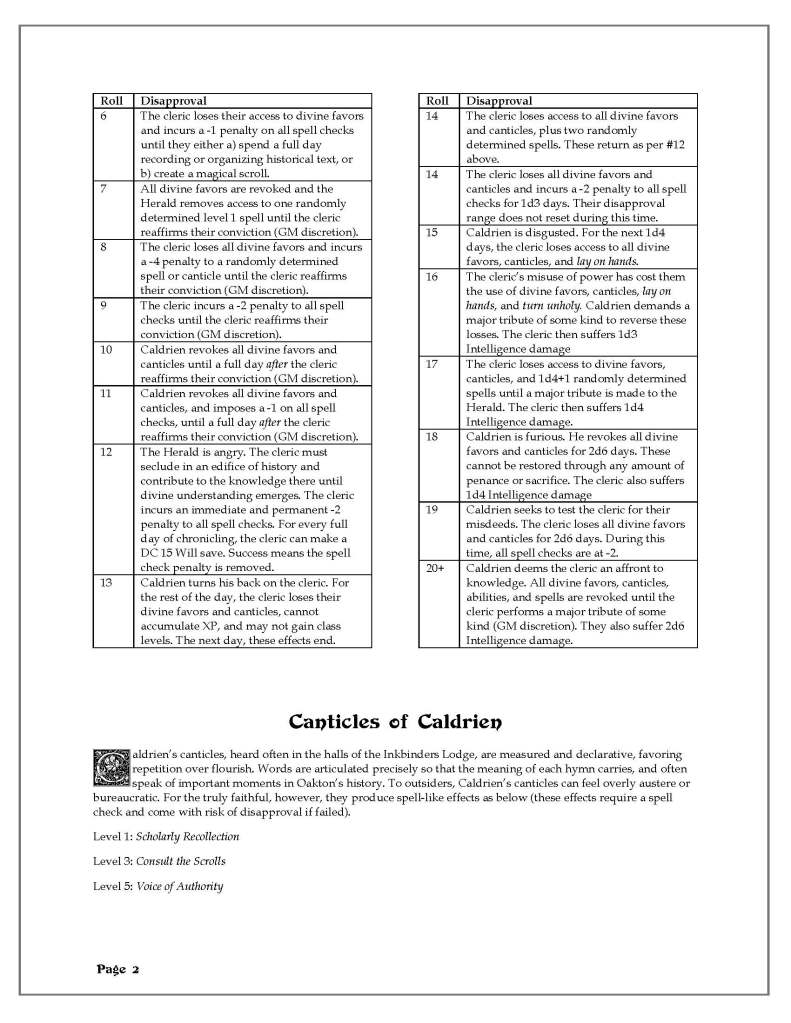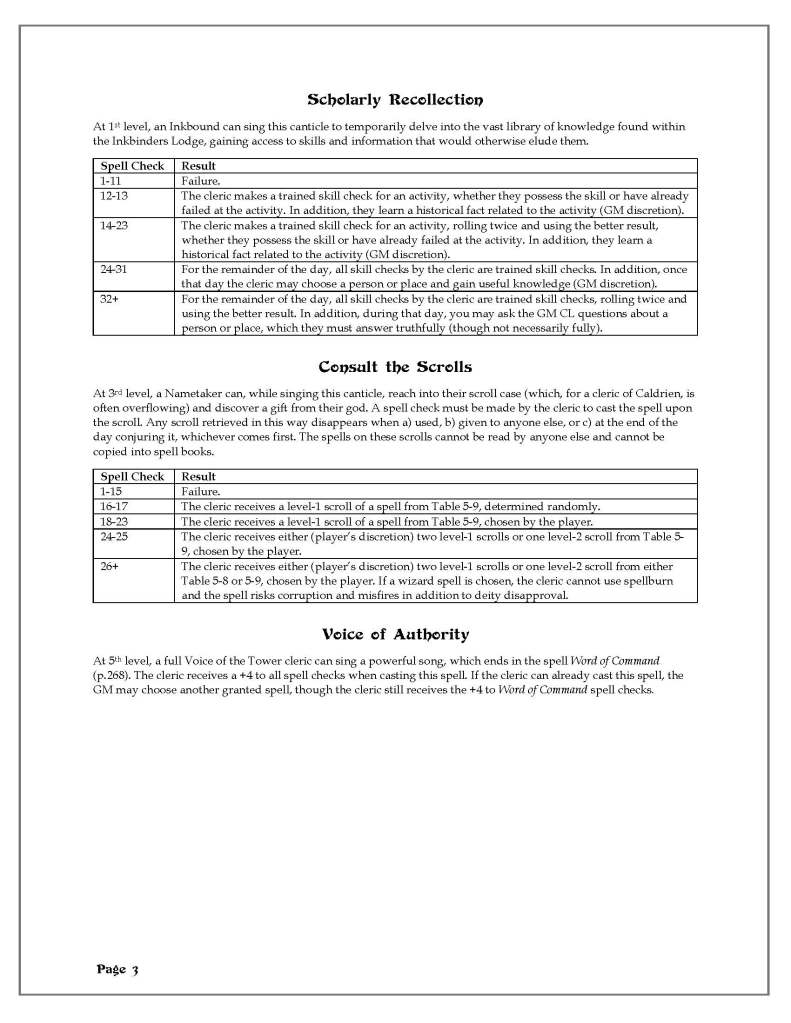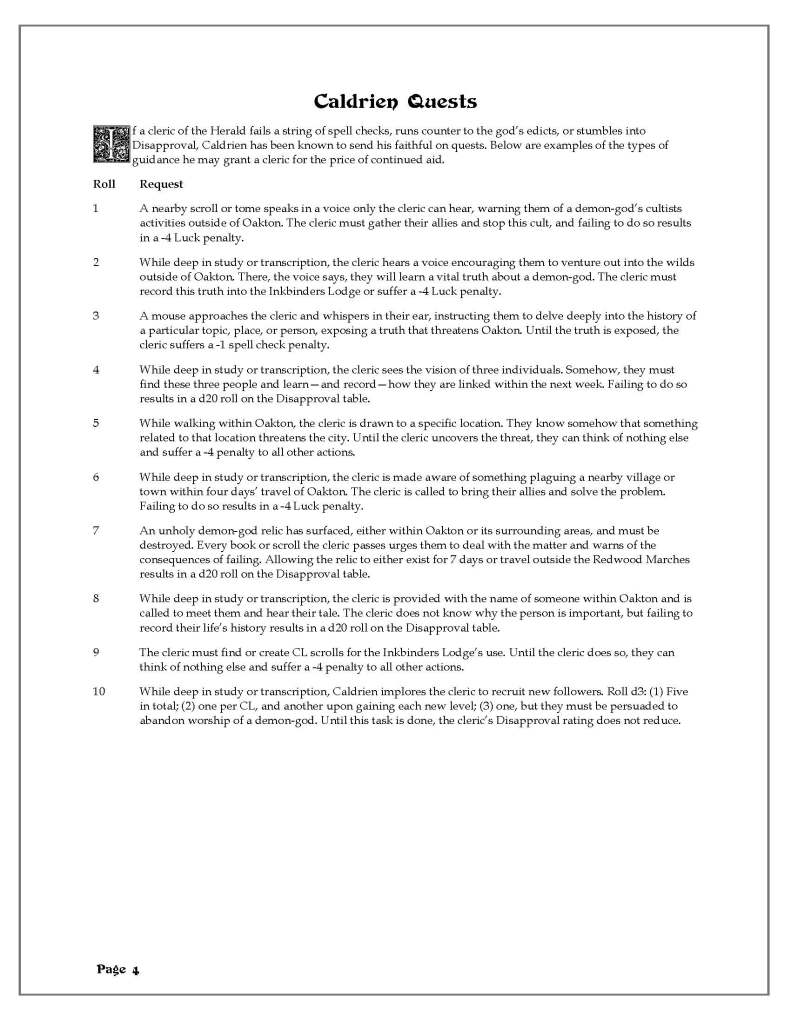
DCC Patron 01 – Quenvara, the Rootmother

If you’re confused about why I’m throwing Dungeon Crawl Classics content on a Wednesday into my blog, you must have missed last week’s post where I introduced this little (and by “little,” I mean “gargantuan”) side project to translate my Oakton gods and demons into DCC-usable content. Ostensibly I’m doing this work so that I can GM a home game sometime in the future, but mostly I’m doing it because it’s fun.

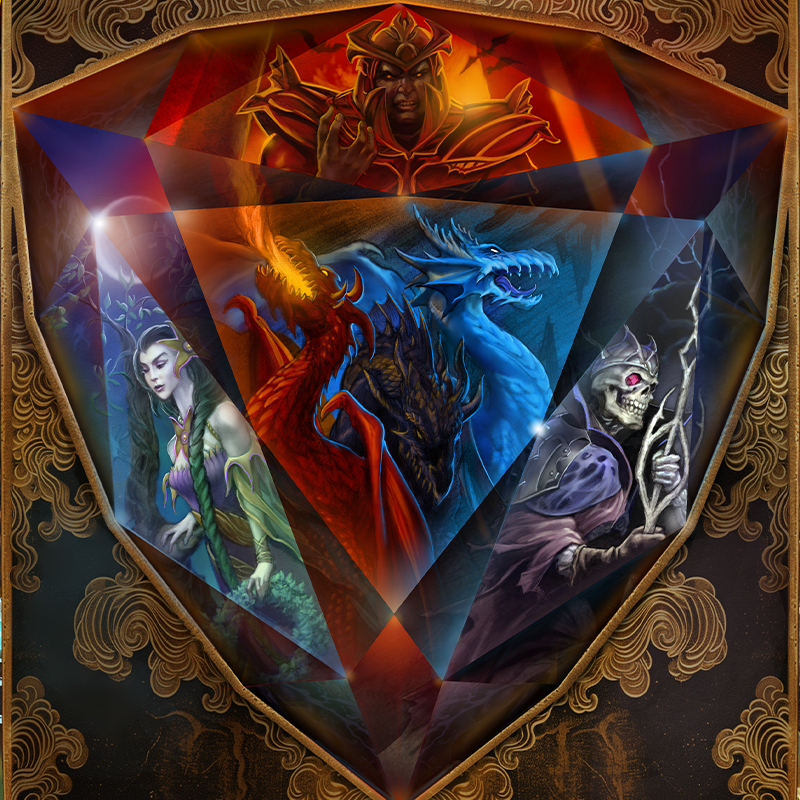
Last week, I asserted that any of my Law-promoting city-gods of Oakton and any of my Chaos-promoting demon-gods of the wilds could be either deities (i.e. provide clerics power) or patrons (i.e. provide wizards power), depending on the goals and aims of the human in relationship with them. To demonstrate how this relationship differs, I’ll look at the Rootmother as a patron. She’s so protective and human-loving… she wouldn’t corrupt a poor wizard, would she? By golly, she would!

It’s fun to think about a cleric of Quenvara and wizard of Quenvara both leveling up and evolving over the course of a long campaign. The cleric would be continually steered towards the Rootmother’s edicts, sent on quests to promote her ideals and working to maintain her favor. In doing so, the cleric would have tons of healing and protection magic at their disposal. The wizard, meanwhile, would be slowly twisting and mutating over time, becoming something like an Ent from Tolkien or treant from Dungeons & Dragons, a living embodiment of Quenvara’s wishes without the strict need to uphold her ideals. Both paths are brimming with story potential, which is one of the reasons I love DCC so much.

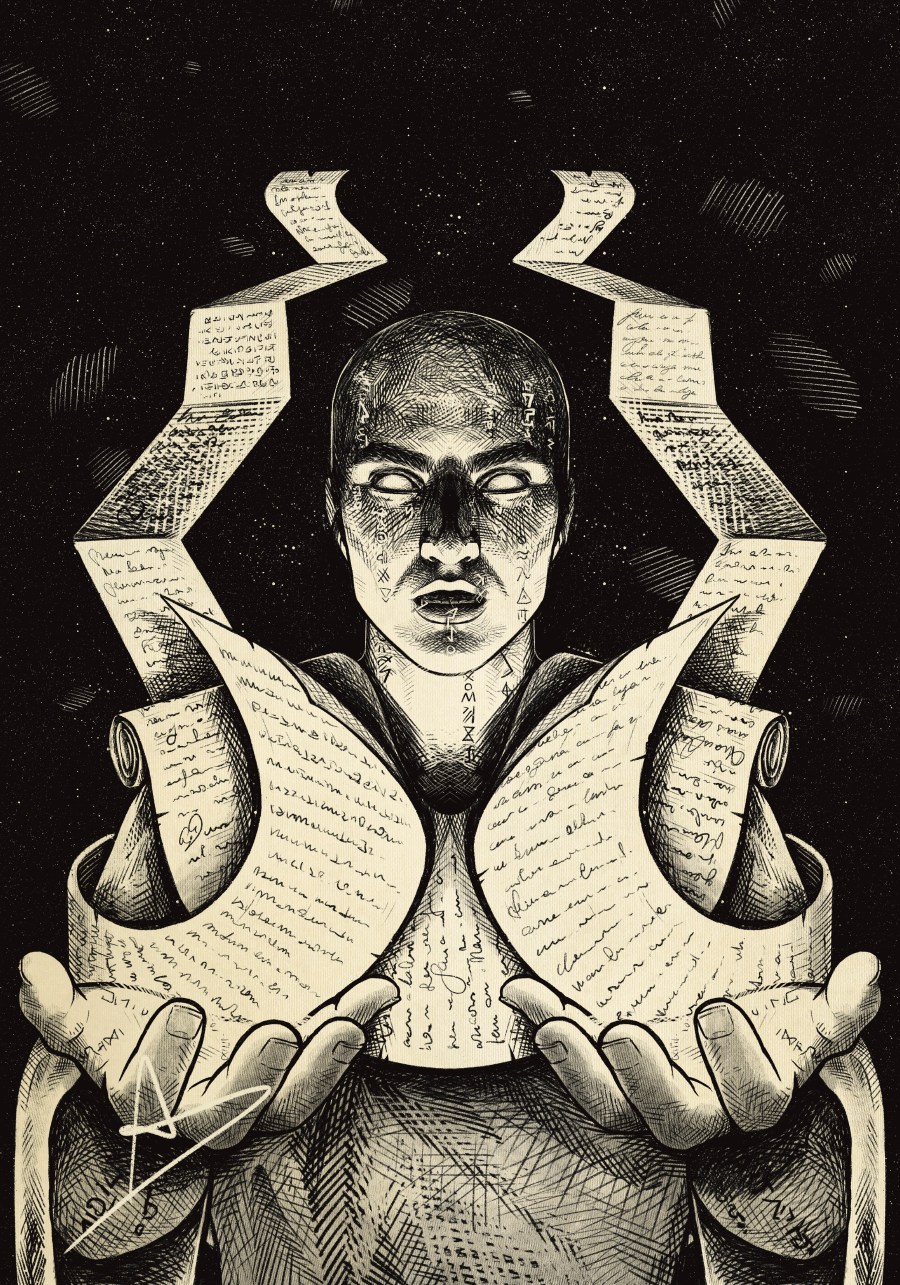
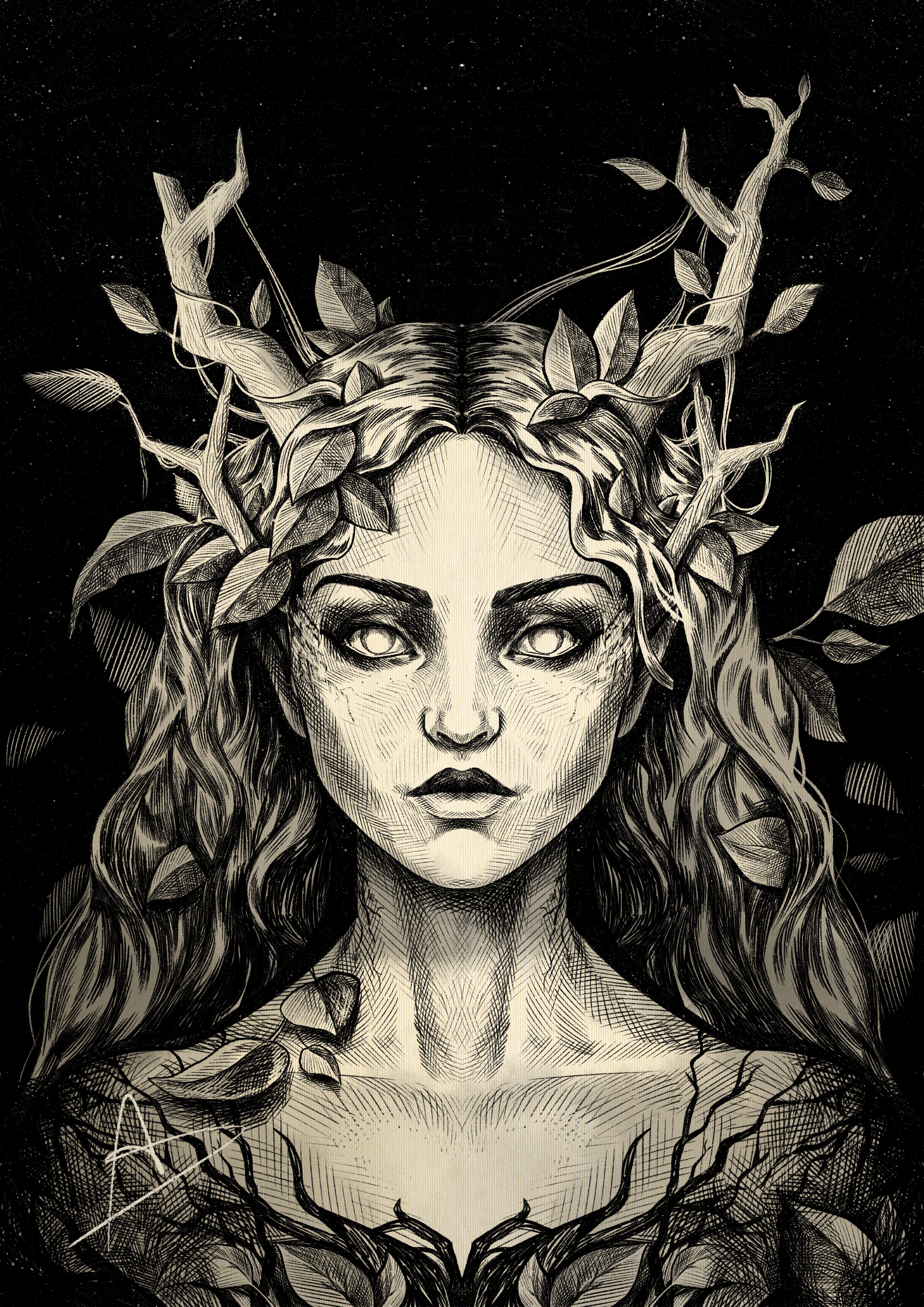
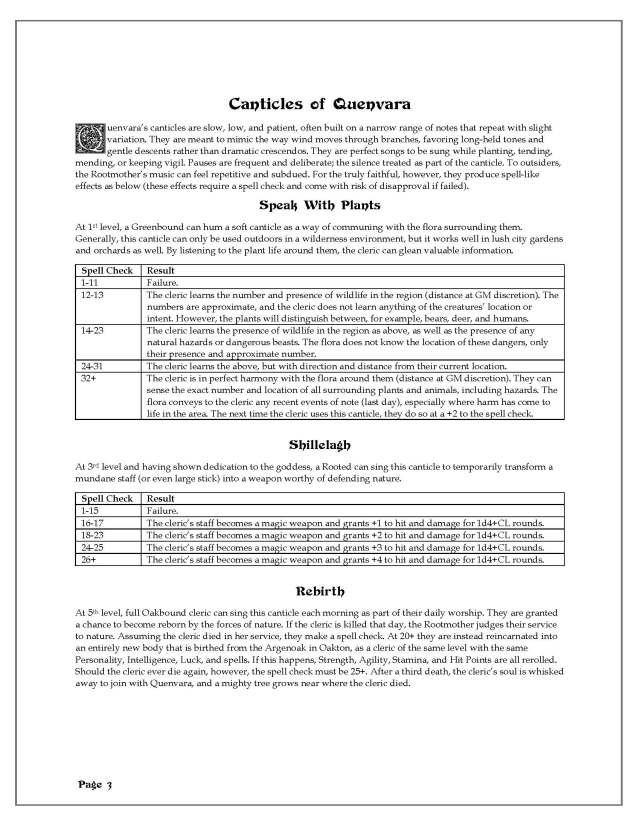
The Patron Quenvara the Rootmother

Artwork by © anaislalovi. All rights reserved

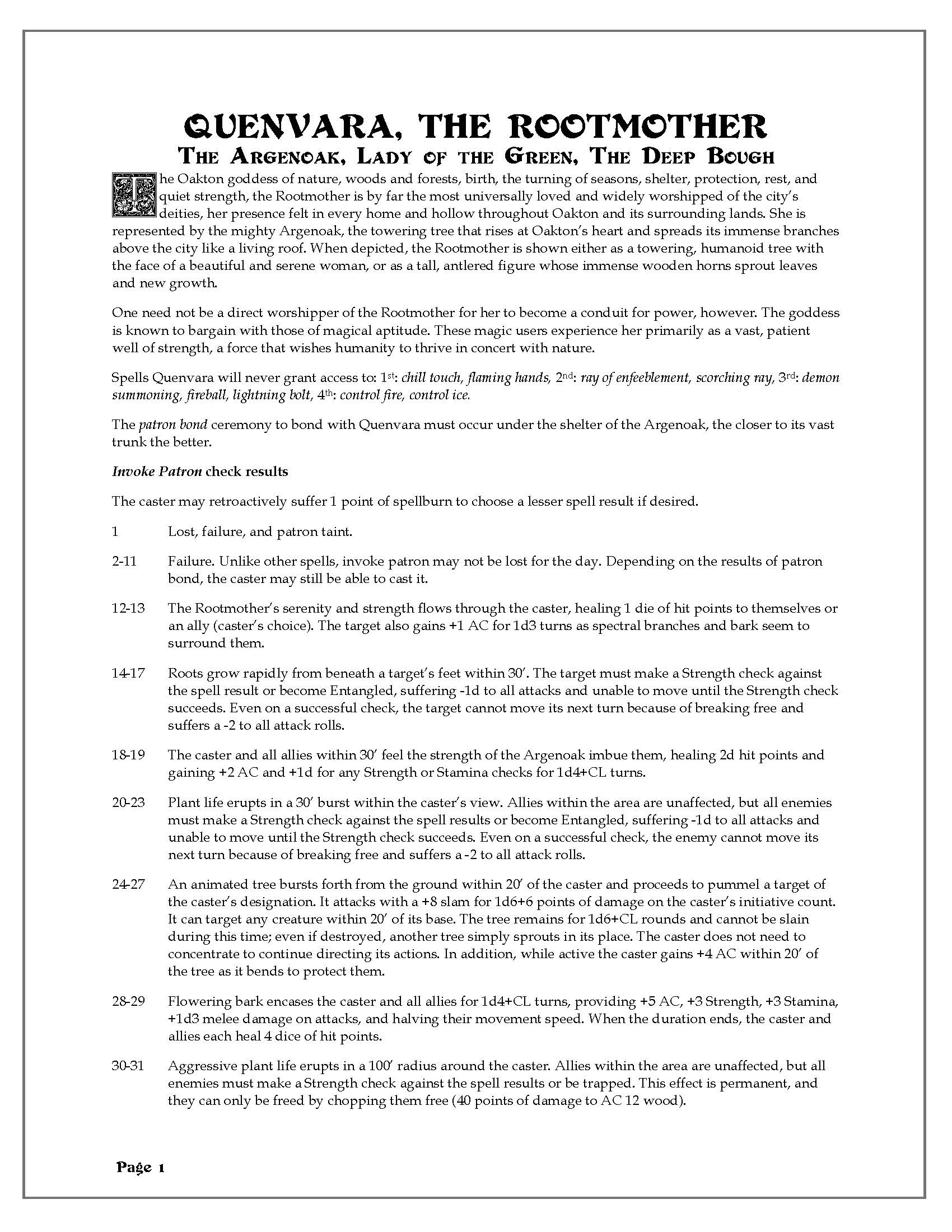
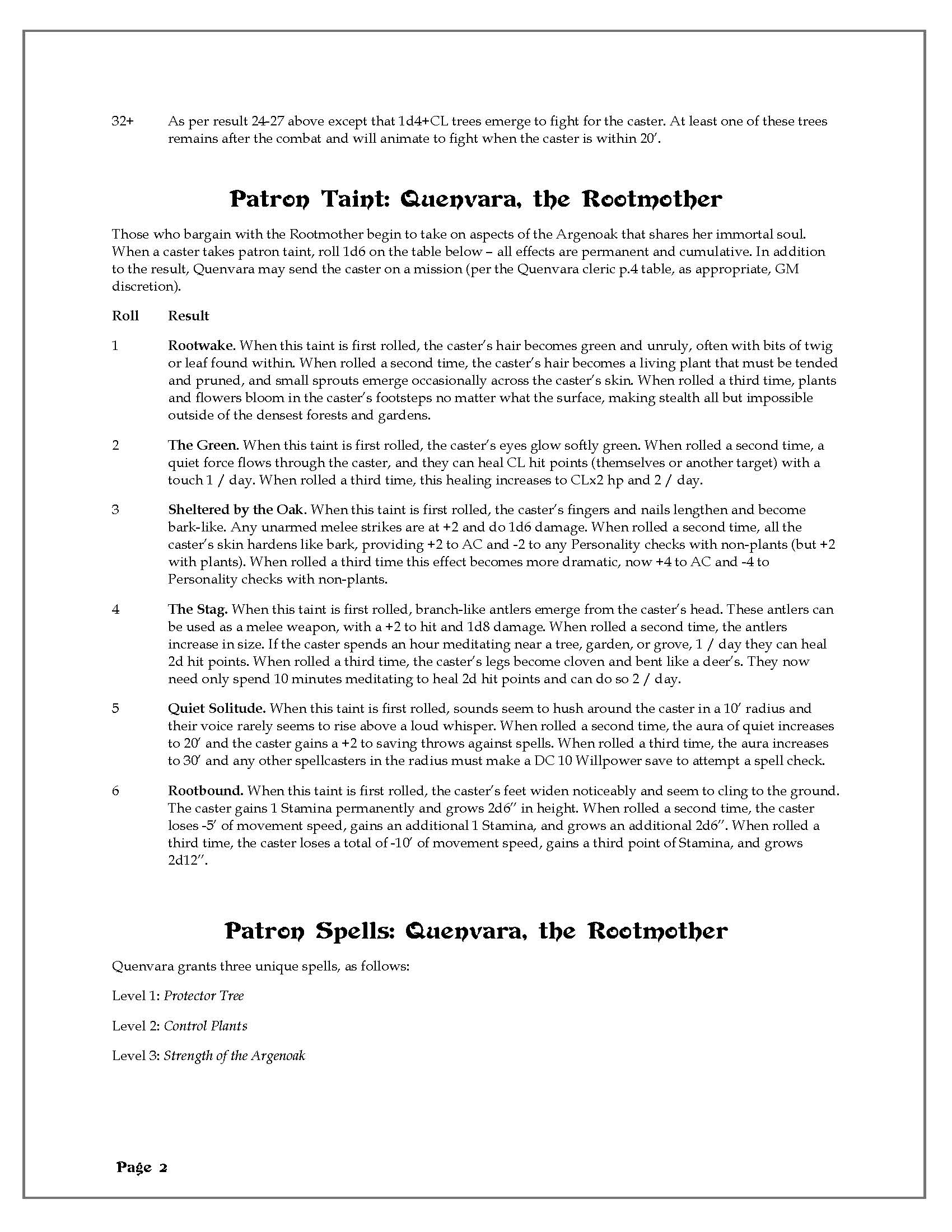
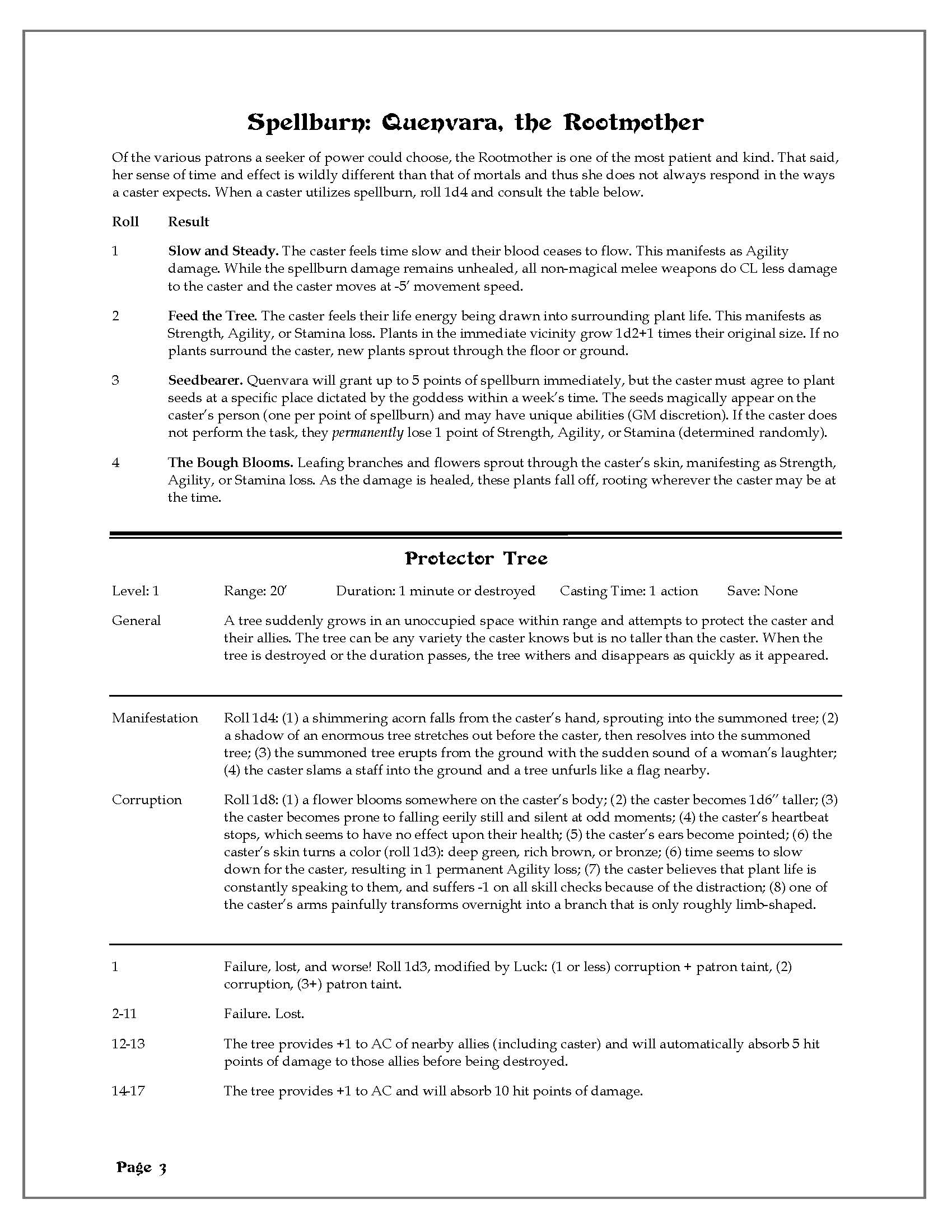
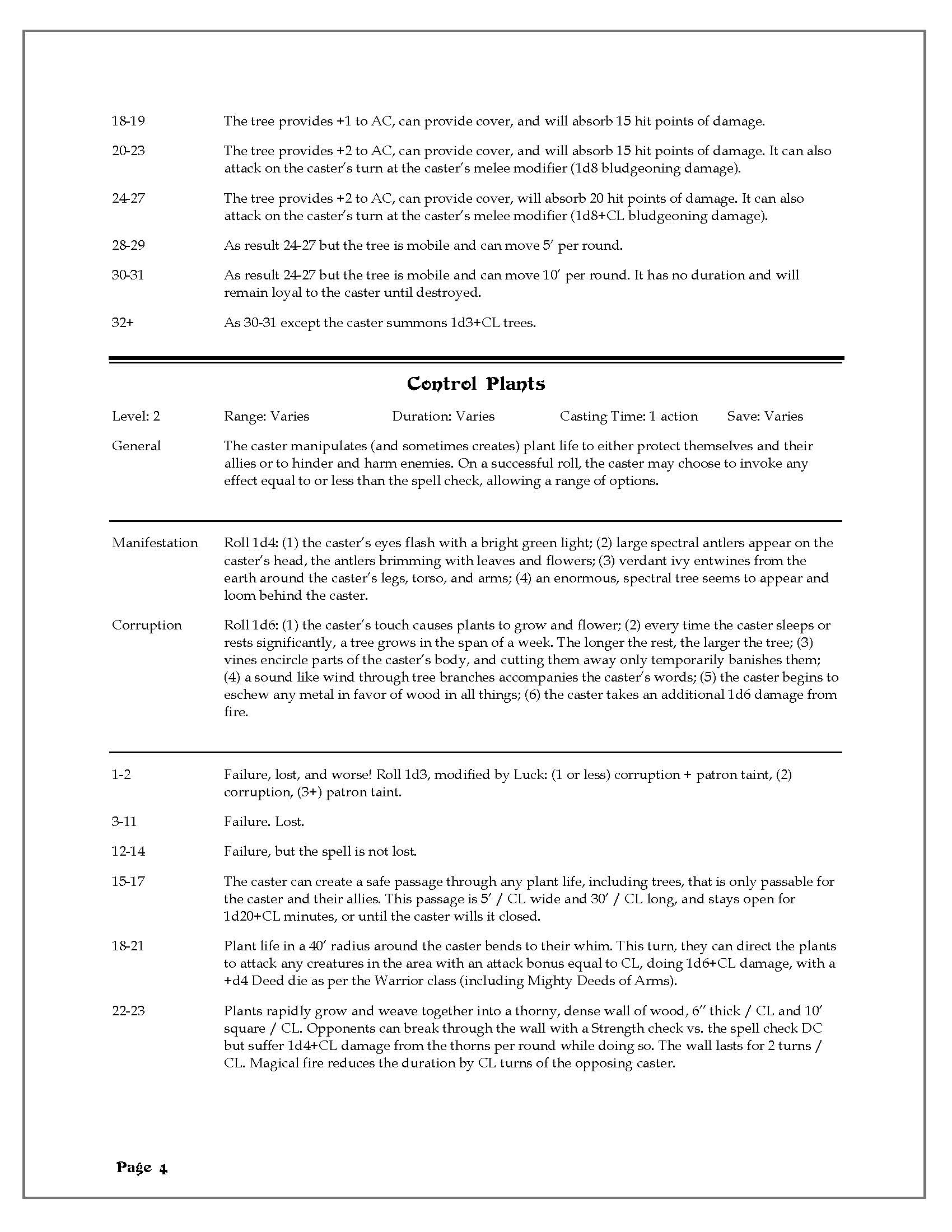
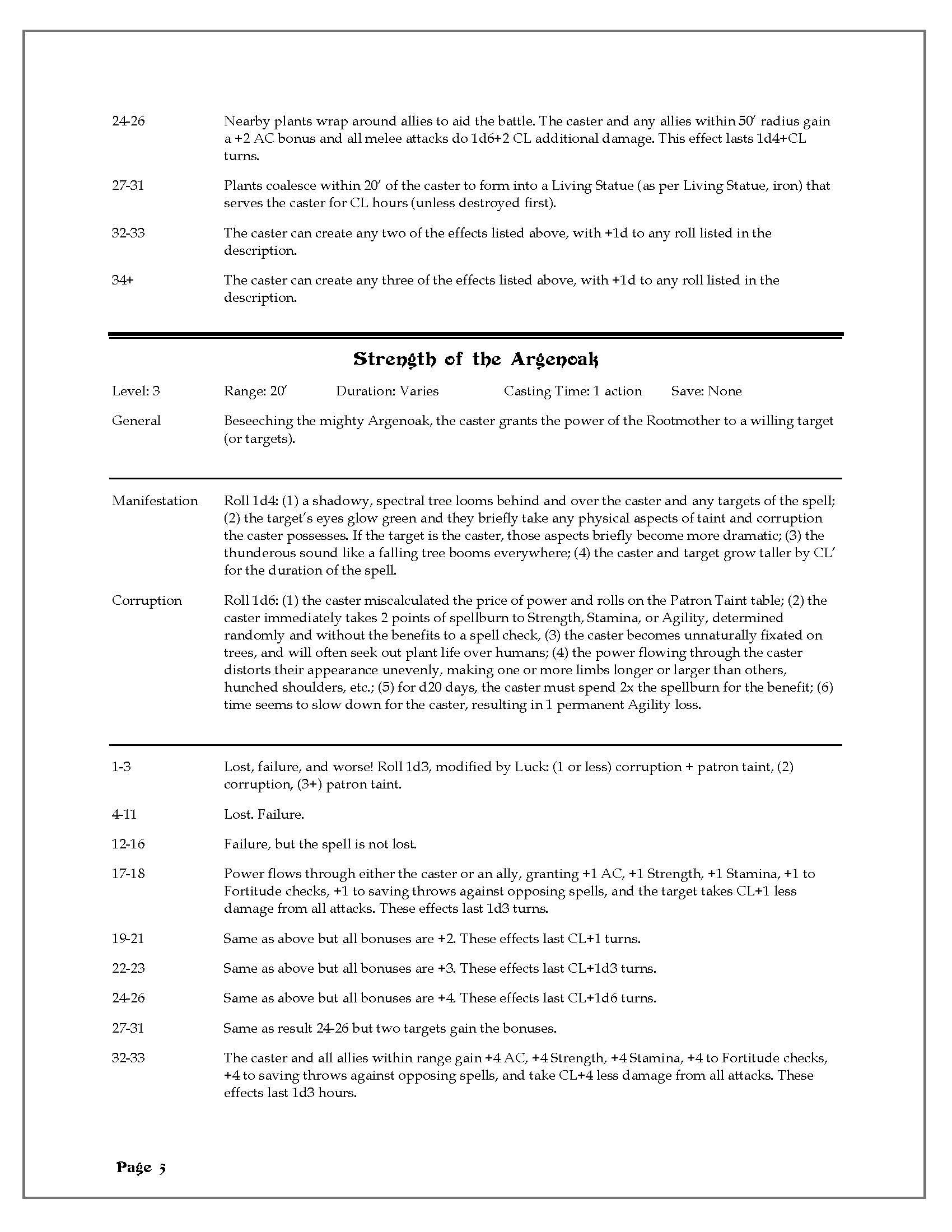
In my write-up for the Rootmother as a patron, I’ve relied heavily on Daniel J. Bishop’s Yddgrrl, the World Root expansion of the Invoke Patron spell in the DCC rulebook. I admit, I’m totally enamored with the Patron Taint and Corruption results for Quenvara, but I suspect that’s going to be true for every patron I write.

The hardest bits, at least for me, were the patron-specific spells, since DCC spells can get absolutely bonkers at higher spell check results. The “Control Plants” spell was the trickiest, and I stared at Control Fire and Control Cold for a long time to try and puzzle out its effects. You’ll also note that I expanded the “Failure, lost, and worse!” ranges for the spells, as one of my homebrew tweaks to DCC rules is saying that any spell check result in that spell’s level (i.e. 1-3 for a third-level spell) can result in patron taint and/or corruption. Otherwise, in my experience, both patron taint and corruption are too rare, and I don’t know a single wizard player who doesn’t revel in these tables.

Anyway… Enjoy!

You can also view the full PDF of Quenvara here.

Next week, by request from one Stephen Grodzicki—awesome author of the Tales of Argosa rpg I’m playing in my solo-play… check out all his work at Pickpocket Press!—I’m turning my attention to the primary antagonist of my Tales of Argosa story so far: Orthuun, the Blind Sovereign. I hope you enjoyed the safety and peace of the Rootmother these past two weeks, because things are about to get… dark.

Please let me know what you think below or via email at jaycms@yahoo.com!

DCC Deity 01 – Quenvara, the Rootmother

Wednesday, what? New Year’s Eve, what? What’s happening here?

Well, see… Two related but distinct things have been occurring in my life, and they’ve led me to this Wednesday post (and possible future Wednesday posts… read on!). First, I’ve been unemployed since July. I don’t like the word “unemployed,” honestly, because it sounds so negative. Better to say that I’ve been happily unemployed since July, taking a large severance package from my employer instead of moving to Amsterdam. The unexpected windfall has allowed me to, for the first in years, slow down, travel, and enjoy time with loved ones. Over the last six months, I’ve reconnected with friends that I haven’t seen in over a decade, spent quality time with my adult kids, soaked up experiences with my awesome wife of thirty years (including getting an awesome new puppy), and—most profoundly—supported my mother through her husband’s unexpected death. It’s been a blessing to have this time and freedom, truly, and I’m not a religious guy so don’t use that word lightly.

Second, I’ve been spending many, many hours with my TTRPG books. They’ve long sat there, the collection growing each year, waiting patiently for me to have some downtime. Now that I have that time, it’s been a joy to both dive into nostalgic books from my gaming past and introduce myself to new games I’ve picked up but never absorbed. My brain has been swimming in dozens of game systems and mechanics, and piles and piles of nerdy lore. It’s been fabulous.

I’m not quite ready to retire from my day job, but one of the things I’ve long envisioned when I do is to host an in-person Dungeon Crawl Classics campaign at my house (right now all of my weekly games continue to be online). DCC remains my favorite fantasy TTRPG, exploding with random tables and emergent storytelling (it’s a testament to Tales of Argosa that when I promote it to people, I describe it as “DCC’s more elegant, sword-and-sorcery cousin”). When I’ve allowed myself to dream, I always assumed that I and my players would co-create a campaign world from whole cloth. But—thanks entirely to my weekly Tales of Calvenor game—I now realize that any fantasy game I run for a long time, maybe forever, will be in my own homebrewed world of Calvenor.

DCC and Calvenor Cosmology

One of the things that’s often bothered me about DCC’s cosmology is the fuzzy line between deities (where clerics receive their magic) and patrons (where wizards do). Both deities and patrons are supernatural, immortal, otherworldly entities influencing the world through mortals, but deities do so without corruption, keeping clerics on a leash of approval/disapproval. Patrons, meanwhile, corrupt the literal hell out of their poor wizards, constantly entering into dangerous bargains. Yet, as far as I can tell, there’s no particular difference as to why one supernatural entity is a deity versus a patron except it’s whatever the author wanted to write.

The Princehold of Calvenor is the nation in which my current story takes place, a small part of a much larger world. Within Calvenor are disparate cities, and each city—like Oakton, my current story’s epicenter—is protected from the wilds by a pantheon unique to that city. Outside, in the wilds, are demon-gods who rampage and scheme to take down those cities. The entire conceit of my fantasy world is that the gods of Law support human civilization and the demon-gods of Chaos oppose them.

So, in my world, I justify the distinction thusly: ANY deity of Law OR demon of Chaos can be a deity for a cleric OR a patron for a wizard (if I ever decide what Neutral entities are in my world, the same goes for them). The difference is that a cleric is in harmony with an entity’s goals and belief system whereas a wizard only wants power, and thus the entity is steering a wizard against their will towards their belief system.

Take two characters from my story: Alric Mistsong and Hadren Kelthorn. Both are in relationship with Orthuun the Blind Sovereign. Hadren, in the above terms, would be a cleric of Orthuun, promoting the demon-god’s nihilistic goals and gaining power as a result. Alric, meanwhile, uses Orthuun as a patron, channeling power from the demon-god via his corrupted spellbook but actively working against the destruction of his own world. Both clerics and wizards are dangerous gigs (especially as it relates to Orthuun), but in very different ways.

As I mentioned, one of the key aspects of DCC that makes the game so flavorful, exciting, and awesome is the mountain of custom, random tables. Each spell, each deity, each patron, each major magic item, each demon or dragon… they’re all—ALL OF THEM!—multiple pages long and full of bespoke tables that send your games into madcap directions.

But do you see the problem? To do my homebrewed world justice, I’ll need to make both deity and patron entries for every supernatural entity in my world. To begin with, that means tackling the twenty-two Oakton gods and twenty-ish demon-gods. That’s, oh… almost ninety pieces of work? And each piece includes a multi-page entry with multiple random tables? Let’s not forget, too, that’s only one city in a vast nation, nestled within an even vaster planet. 

I mean, that’s just a bonkers amount of work.

And yet…

I have time right now! My brain is alight with ideas!

Let’s just…

Oh, I don’t know…

At least start?

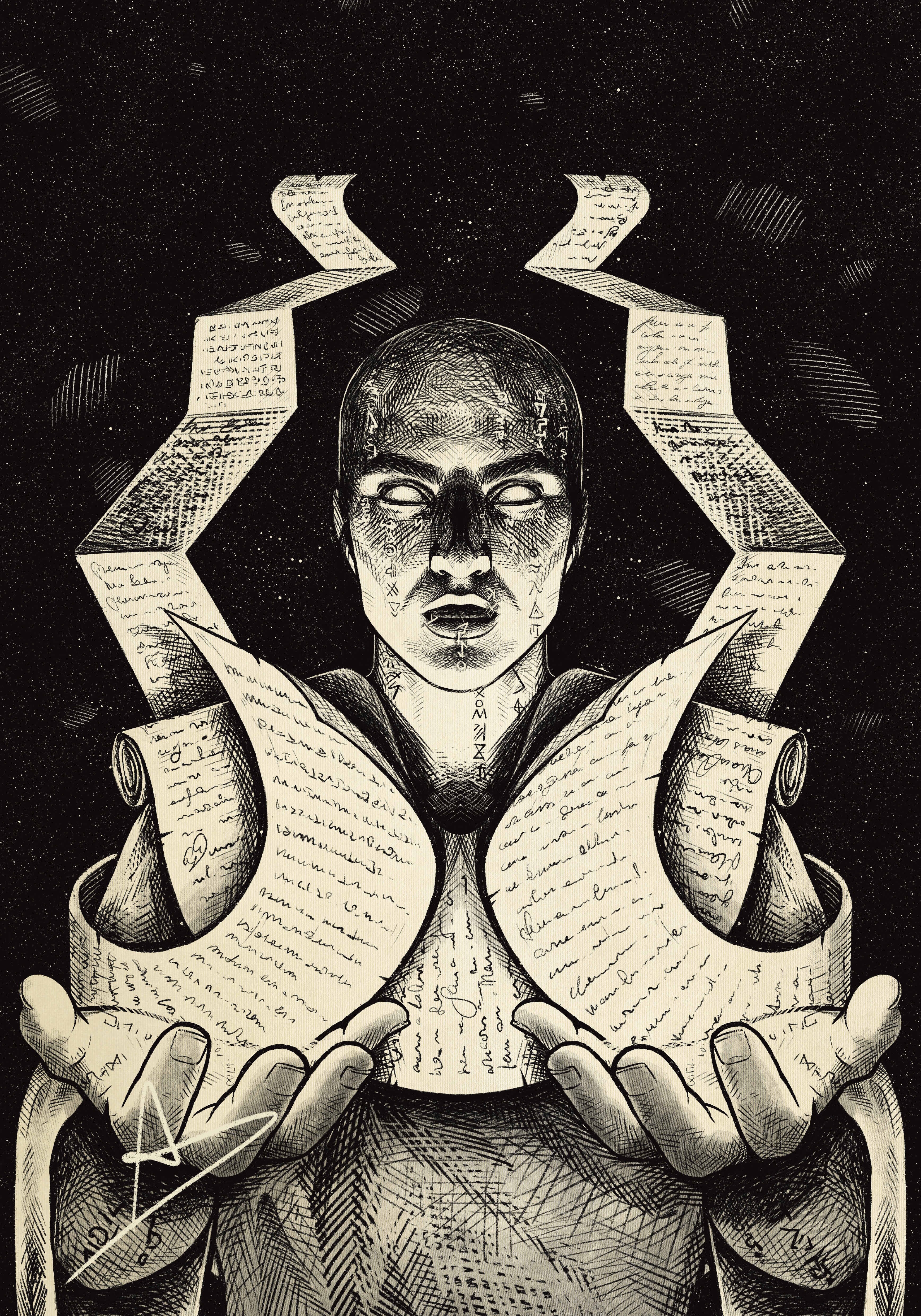
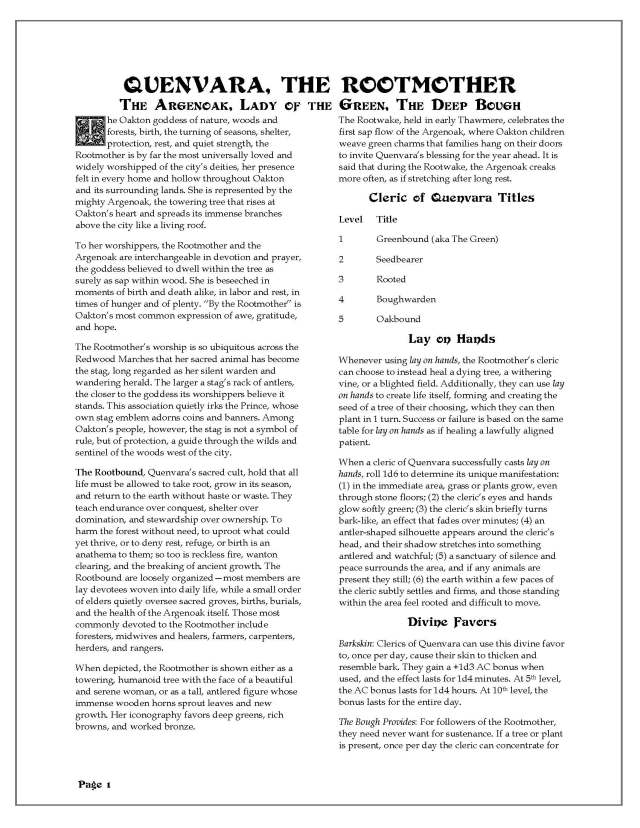
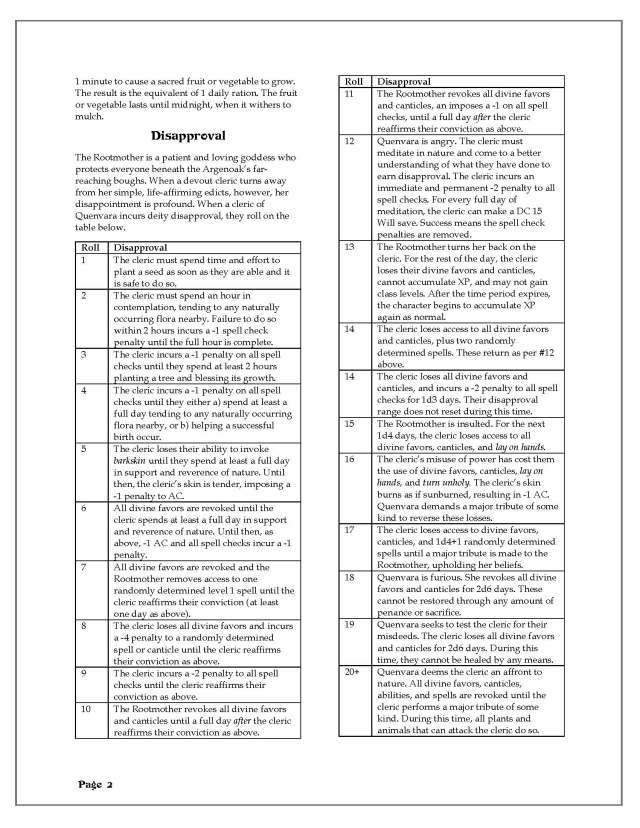
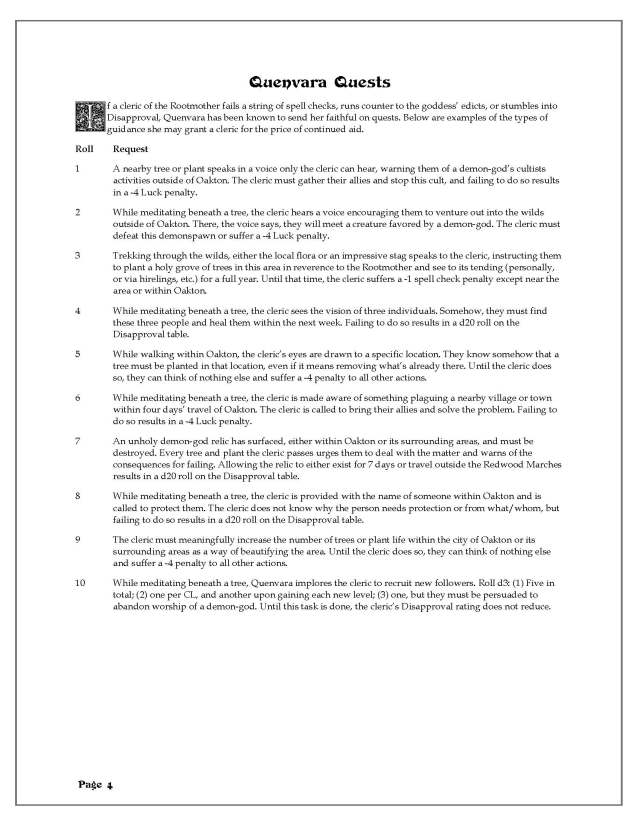
The Goddess Quenvara the Rootmother

Artwork by © anaislalovi. All rights reserved

To stretch my creative muscles, it only makes sense to start with the most central deity in the Oakton pantheon, the goddess that is the focus of declarations and exclamations almost every single week: The Rootmother, known by her sacred name Quenvara to clerics and power-hungry wizards alike (note that none of the current story’s protagonists know or use this name for her).

Below I’ve created a full DCC-style deity entry for her, much of which is either inspired by or taken directly from the excellent (free!) Ildavir write-up in Clerics of the Known Realms by Sean of Realm 15. Because I’m not at all worried about selling these write-ups, I’m perfectly happy to steal good work and give credit where it’s due.

You can also view the full PDF of Quenvara here.

Enjoy!

Next week I’ll provide the very different Patron write-up of Quenvara the Rootmother. I absolutely do not promise to keep these entries going every week on Wednesday, but I’ll do so as my time and passion allow. The priority is the Saturday story, but this project is a wonderful outlet of energy and time, and each entry only gets me closer to my DCC retirement dream…

Today’s post is a curveball bonus, so please let me know what you think below or via email at jaycms@yahoo.com!

Age of Wonders, Issue 6a: Filth Demons

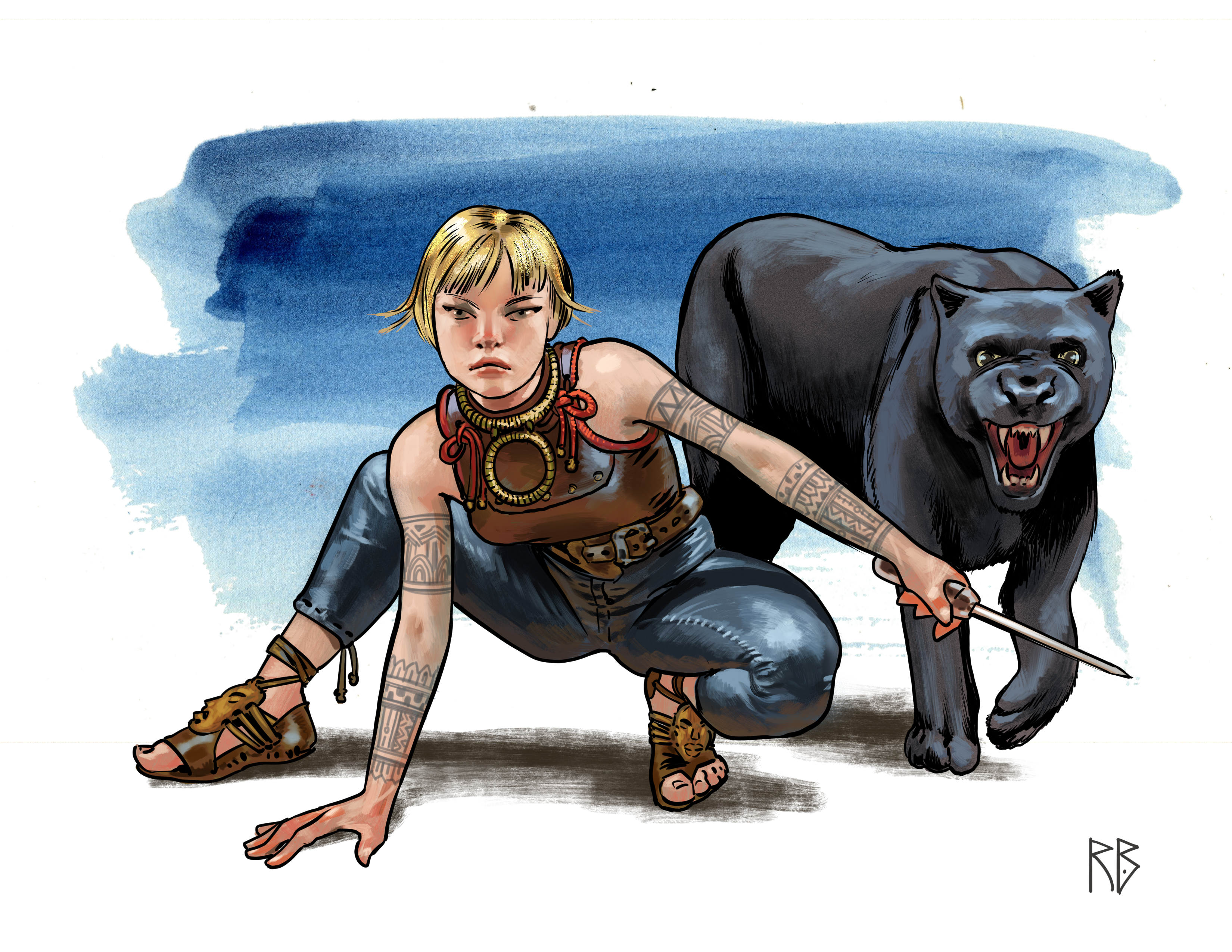
art by Roland Brown (drawhaus.com)

For several heartbeats, Maly stood stunned upon the stairs, unsure of what she was seeing. The only light illuminating the space was from the open door above, making everything here gray gloom. Yet the shadows did little to protect her from the horrors within the room below.

On some primitive level, she recognized that much of the basement was the same: a low-ceilinged square with unpainted stone walls, dirt floor, and a few bare wooden shelves. Pale mushrooms sprouted in one corner and, near those mushrooms where there had once been a ragged hole in one wall, there was now a section of new stones and mortar that did not match the rest.

Yet her eyes were fixed on the three figures regarding her, each an impossibility. The most human was a naked, pale figure, yet his skin was rotting and missing chunks, like a corpse that had been picked over by scavengers. Where his almost bone-white skin was intact, the light glinted off what appeared to be fish scales, which only made sense because, instead of a human head, the figure had the gaping-mouth, wide-eyed head of a large fish.

Standing at the fish-man’s hip was an intact, upright skeleton of what appeared to be a child. It turned its skull to look up at the fish-man, then back at Maly, staring at her with empty, black sockets. The dirt around the skeleton’s feet swirled and moved like mist, giving the stunted figure’s lower half an almost dream-like appearance.

Two strides away from the pair was the most disturbing of the trio. Its back half was that of an enormous worm, or perhaps—Maly realized with disgust—a maggot, undulating as it shifted its weight. The top half of the creature was that of an enormous cat, though not a great majestic animal like Destiny the panther. Instead, an emaciated body with scrawny arms and patchwork fur pulled the worm-thing forward. And the entire monstrosity, from notched alley-cat ears to maggot stump, was covered in long, thin, protruding spines.

Between the cat-maggot and skeleton lay a robed ratfolk body, which Maly recognized as the priest from the underground temple. Twin spines protruded from her chest. Maly couldn’t be sure, but she looked dead, hands curled up defensively and eyes wide. The bejeweled box, the only thing of any beauty in the basement, lay toppled on its side, lid open and mummified hand discarded upon the dirt floor.

A voice echoed in Maly’s mind. It was Destiny, but far quieter and more distant than she’d heard him before. He spoke as if doing so was a great effort. Demons… the panther hissed. Minor, but… even lesser… demons are… deadly. Beware, child.

As if on cue, the child-like figure raised its bony arms, skeletal fingers outstretched towards Maly. The dirt at its feet, which had been moving lazily, suddenly rushed out like an ocean wave. The choking cloud blasted Maly, dirt scouring her exposed skin, and she coughed and stumbled half blind down the remaining stairs.

Kavac… Destiny wheezed in her ear. Demon of dirt… and grime.

“No kidding!”Maly sputtered aloud, then reached out with her mind. Any tips for defeating these things? Or sending them back where they came from? But the panther was ominously silent. It was a terrible time to get timid, she thought. Maly did not want to be fighting demons in a basement when there was a member of the East Bay Dragons upstairs who might be the key to getting her inheritance back. Well, to be fair: She never really wanted to fight demons.

And yet, demon-fighting was upon her. Spitting sand from her mouth, Maly pulled her twin daggers from their sheaths and struck at the small skeleton. It surprised her with its dexterity, leaping up and over her blades with jaw-dropping ease.

As it landed, however, Emah was there, yelling and slashing down with her sword. There was a crunch of bone. The skeleton cried out, shrill and terrifying, for its voice was also that of a young child.

The rotting hulk stood over Emah, raising its arms overhead and looking to smash fists down upon her friend. Before Maly could shout a warning, however, twin fists the size of dinner plates bashed into the fish-headed thing. It flew sideways into a stone wall with a crunching impact.

The third creature yowled like a drowning cat as it launched spines from its body. Kami’s misshapen torso flowed like a ribbon, avoiding the arrow-like quills. But one thunked into Emah’s shoulder, which she acknowledged with a grunt.

Xapha… the panther’s voice whispered. Demon of… infected rot. Its… touch is… ruin.

“Not helpful, Destiny!” Maly shouted into the melee.

The small skeleton wailed like a distraught child and launched itself at Emah. She cursed and slashed with her ancestral sword, however, and cleaved the creature midair. A clatter of bones hit the floor, and the dirt swirling all around them abruptly ceased.

Maly didn’t relish getting close to the spiny cat-maggot that Destiny said could kill her, so instead turned her attention to the rotting fish-headed man. It was staggering to its feet after the impact, the stone cracked all around it like a spiderweb. The scaled hulk was slow, halting, and unsteady, so she was shocked when it caught her arm as she stabbed down with a dagger. It lifted her, struggling and feet kicking air, in its grip so that Maly’s face hung near its lidless fisheyes. It reeked of spoiled meat and dead fish, making her gag.

Vakal… Destiny’s voice breathed weakly. Demon… of slow… decay. Unstoppable…

Maly opened her mouth to comment on that little nugget when the thing swung her hard against the cracked wall. Her teeth clattered together, and all the air left her chest. She collapsed to the dirt floor, gasping.

Stars danced in front of her eyes, but she looked up to track her opponent’s movements. Thankfully, it had turned away from her, towards Kami, whose oversized fists pounded down again and again on the spiny maggot body of the third demon. The sounds were grotesque, like boots squelching in mud. Kami didn’t see the fish-thing lumbering towards her, and Maly had no breath to shout a warning.

Instead, Maly hurled a dagger at the thing’s back. It sunk into the demon’s rotting flesh with a satisfying thunk but didn’t slow its advance on Kami. She willed strength into her legs and worked to unsteadily regain her feet, still gasping for air.

Thankfully, Emah shouted a wordless challenge and stepped to the demon Vakal’s side. She sliced her blade horizontally across its ribs and a great slab of scaled flesh tore free, falling to the dirt with a wet slap.

Though it showed no sign that the strike had hurt it, Vakal turned ponderously to regard Emah. She raised her blade to parry but it simply backhanded her, much as the animated bronze armor had done upstairs days before. The demon was not nearly as strong as the armor, however. Rather than fly across the room, she simply staggered to one knee. Emah spit a glob of blood onto the floor and stood, fury in her eyes.

Before she could attack again, Emah winced and looked down on her shoulder. The demon Xaphal’s spine still protruded from her skin. She pulled it free and tossed it aside, regripping her sword with two hands.

Back on her feet, Maly hurled herself upon the demon’s back, stabbing again and again with her second dagger. The blade squelched into scaled, stinking meat. She couldn’t think about that, though. A panic had begun to rise within her, born out of Destiny’s silence and Emah’s wince. The panther had said that Xaphal’s touch was ruin… what did that mean for her friend? The only way to know for sure was to kill this last monstrosity and get her to a medic.

Vakal slumped forward and Maly yelped as the tip of a sword thrust from the thing’s back, near her arm. The metal was coated in a gray sludge instead of blood. As the body toppled, she kept stabbing and stabbing, riding it down to the dirt floor. Maly found herself yelling incoherently, now with both daggers back in hand. She attacked like an Oakton drummer hammering on her instrument, and continued long after the demon ceased moving. It took Emah’s sweat-slicked arms pulling her off to regain her senses.

The two women stood together, panting. Maly stank of corpse and fish and was sure she would be plagued by nightmares for the rest of her life.

“Shh, shh,” Emah said desperately. “It’s over, Maly.”

Destiny’s voice, weaker than she’d ever heard it, whispered a single word.

Unstoppable…

To her horror, the demon Vakal began to rise, even as the remains of the two other demons quivered.

Next: How do they stop it?!

Portal Under the Stars, Chapter 2

Introduction: Portal Under the Stars Playthrough

Portal Under the Stars, Chapter 1

Art by Antal Keninger

Councilwoman Leda Astford stared through the open door in wonder. She could feel the other Graymoor residents pressed beside and behind her in the cramped corridor, but her full attention was fixed ahead.

Old Bert Teahill had claimed that beyond the magical portal lay “jewels and fine steel spears.” There were crystals on the now-open door, dotting the wooden surface in star-like patterns, which she supposed could be mistaken for jewels. And spears?

Yes, there were certainly spears.

In a rectangular room, perhaps ten feet from the open doorway, straight ahead, was another stout, wooden door banded in iron, no crystals upon its surface. Four armored iron statues, two on each side, flanked that door. Each statue depicted a person–human men and women, judging by the physiques, ears, and roughly carved faces–in enameled armor holding a black spear, arm cocked back as if ready to throw. All four deadly spear-tips aimed directly at the open doorway in which Leda stood.

It was Bern Erswood, the herbalist, who pulled her aside forcefully.

“Leda! If those things loose those spears, you’re as dead as Mythey, that’s for sure,” he whispered fiercely, admonishing.

“If it were a trap,” sniffed Egerth Mayhurst, the unpleasant jeweler, panting, flattened himself on the opposite side of the hallway as Leda and Bern. His bald pate gleamed with sweat in the pale blue light. “It would have triggered, yes? Perhaps it was meant for someone who forced the door open before it was unlocked.”

“Well then, by alla’ means,” the dwarf, Umur Pearlhammer, grumbled from behind them. “Go on in and try the next door, yeah?”

“Absolutely not!” Egert blanched.

“I’ll- I’ll do it,” stammered Little Gyles, Bert’s grandson. He planted his pitchfork and pushed forward.

“No, son,” Umur and Bern said almost simultaneously, then chuckled at one another.

“Bravest one here is the wee lad,” Umur shook his head. “Step aside, step aside. We’re here. Might as well see what’s behind that next door since we’ve come alla’ this way.”

“I’ll join you, Master Pearlhammer,” Bern smiled, and the two men stepped into the room, shoulder to shoulder. Undaunted, Little Gyles was right on their heels.

Nothing happened.

Leda exhaled loudly at the same time as several others, not realizing she had been holding her breath.

The adventure text says that the statues “wait for an opportune moment, then suddenly hurl their spears at the characters.” Since I’m controlling the actions of both the traps and the PCs, it seems unfair to choose when that moment occurs. Instead, I’ll leave it up to chance.

I’ll roll a d4 to see how many cohorts of three individuals enter the room before the spears fly. I already have their marching order down on a piece of paper.

I roll a 1. Dang. I like all three of those characters in the lead!

Each statue attacks with a +2 against the PC’s Armor Class of 10 (12 for Bern, who is wearing Mythey’s leather armor), but poor Gyles is in the doorway, so any that target him get a whopping +4. They do 1d8 damage each. I’ll say one spear flies at each PCs, and two at Gyles unless the first one kills him. If so, the fourth spear will fly through the doorway at either Leda or Egerth at a +2 (what? You thought the point-of-view character Leda had plot armor? The dice decide the story, and everyone here is as fragile as a… well, as a villager thrown into a magical, alien portal.). Here goes…

The first spear flies at Umur: (19+2) 21, and hits for 2 damage. Umur has 3 hp… whew!

The next at Bern: (6+2) 8, sails wide of Bern. Whew again!

Now at Gyles: (8+4) 12, which hits for 3 damage. The boy only has 1 hp, sadly. Brutal.

That means the fourth spear targets either Leda (1-3 on a d6) or Egerth (4-6): A 4 is Egerth. It rolls a (7+2) 9 and barely misses.

Suddenly, with a coordinated, metallic THUNK! and a quick whirring noise, the four statues released their spears in unison. Before Leda and the others could even gasp, one had buried itself in Umur’s broad shoulder, another had clattered against the wall behind Bern, and a third had sailed through the doorway, narrowly missing Egerth’s leg and skittering across the stone floor amidst the others. The dwarf cried out in pain and stagged just as the jeweler clawed at the wall backwards, into the pressed crowd.

“No!” Bern yelled, much to Leda’s confusion. And then Little Gyles Teahill, the boy with the strength of a grown man, asked specifically to be there by his grandfather, fell back into her arms. A spear shaft protruded from the middle of his chest.

Gyles didn’t mutter last words or even make a single sound. The sleek, black spear must have killed him instantly. A bright bloom of red blossomed on the front of his homespun shirt, his eyes wide, surprised, and glassy. The pitchfork the boy had been clutching clattered to the floor.

For a long while, there was screaming, crying, consoling, and grief. Leda herself carried Gyles’ body to the end of the corridor and outside, placing him gently on the open ground in the nighttime air. She closed his eyes and said a prayer that Justicia, goddess of justice and mercy, watch over him. She had promised Bert that she would keep the boy safe and had utterly failed. The weight of that failure threatened to crush her into a ball on the cold dirt. Instead, she stood and planted fists on hips, staring at Little Gyles to memorize his every feature. Something cold and hard formed along her spine, keeping the tears at bay.

Bern, meanwhile, tried his best to tend to Umur’s shoulder wound, and managed at least to get the bleeding staunched. The dwarf looked pale and weak now, his voice strained. The others tried to convince the dwarf to turn back and head back to Graymoor, but he set his jaw stubbornly.

“You say me, but we should alla’ go back,” he grumbled. “We’ve found only death here.”

“We keep on,” Leda said decisively, joining them after her time outside. “They’ve taken Little Gyles, these bastards. We go in, we take what we can, and we ensure his death was not in vain.”

The group quickly realized that the black, sleek spears were better weapons than any of them wielded. Bern and Egerth were the first to take theirs, and after some discussion the Haffoot siblings, Ethys and Giliam, gripped the other two. The halfling pair, who made their living trading tea leaves in a small boat up and down the Teawood River, looked particularly small carrying the long, wicked weapons. When offered one, Finasaer Doladris explained that, as an elf, he could not touch the iron of the spears for long, but he did pick up Little Gyles’ wood-shafted pitchfork. Even the scholar, it seemed, had recognized the danger of their situation.

It was Erin Wywood, the sharp-witted minstrel and councilman’s granddaughter, who recognized that the armor on each statue was not part of the sculptures and could be removed. It took what felt like ages, but together they puzzled out how to unstrap the pieces from the unmoving iron and help others don them. Umur looked the most natural in the black metal, even though his dwarven physique forced him to exclude some of the original pieces. Hilda Breadon, the stocky baker, followed Umur’s lead and made hers fit in much the same way. Erin donned a full, scaled suit, which the others thought only fair since she had discovered it in the first place. And, thanks to the particular urging of Umur and Bern, Leda took the final suit of armor herself. She was unaccustomed to wearing anything but simple cloth, though she found the weight somehow comforting.

When everything was sorted, only the haberdasher Veric Cayfield found himself armor- and weapon-less. He smiled brightly and said that he didn’t mind… it was fun to help get the others fitted into armor, and he would feel ridiculous holding a spear.

“I have my scissors if it comes to fighting,” the halfling announced with cheer, patting a pouch at his hip. “But I don’t think it will. This strange place beyond the portal is full of traps, not monsters. What do you think the traps are protecting, do you figure?”

“And who was the principal architect of this demesne?” Finasaer wondered aloud, tapping his lip. “Fascinating.”

At that, the group grew quiet and looked warily at the closed, iron-banded door. After the experience of the last two doors and the talk of traps and mysterious builders, no one seemed especially eager to go first.

Filled with visions of Little Gyles’ glassy-eyed stare, Leda sighed and told the others to stand aside. “From now on, I’ll go first,” she announced. “Everyone keep sharp and have your eyes open. If you see something, speak up.” The others murmured assent, even bitter-faced Egerth. The smell of sour, nervous sweat filled the room. Leda’s gauntleted hand reached out to the door, she exhaled sharply, and tried the latch.

It clicked and the door swung open. Leda winced, expecting pain. Nothing happened.

Beyond the door was a large, square room with marble flooring and polished walls. At the far end of the space was a towering granite statue of a man. It was a detailed work of artistry Leda could hardly fathom, and must have been thirty feet tall. The statue’s eyes looked somehow intelligent, and his barrel-chested body was carved to show him wearing animal hides and necklaces from which dangled numerous amulets and charms. A heavy, stone sword was carved to hang at the man’s hip. Leda thought he looked both like a barbarian warrior and shaman, though from where or when she could not begin to guess.

One arm of the statue was outstretched, its index finger pointed accusingly at the doorway in which Leda stood. After the room with the spear-throwing statues, it was a nerve-wracking pose. She quickly stepped into the spacious room and aside.

“Come on,” she said to the others. “There are more doors here.”

Indeed, the square room had three additional doors, all identical to the one she’d just opened, at each wall’s midpoint. Four sides, four doors, one enormous statue. Otherwise, the room was empty.

Time to see if anyone notices some other features of the room with an Intelligence check, at DC 12. I’ll give the three high-Int PCs and Leda, as the first one in, a chance.

Erin for once misses an Intelligence check at (2+1) 3.  Ethys also rolls a (2+1) 3. Leda rolls a (12-1) 11. Thankfully Umur rolls a (15+1) 16, which makes sense since he’s the stonemason of the town.

As everyone slowly filed in, boots echoing on the marble floor, Umur peered up and around, studying the statue and room’s construction.

“Careful,” he growled. “See those scorch marks on the floor and walls? And look here, this statue weighs tons but there’s grease here on the base where it meets the foundation.”

“What does that mean, master stonemason?” Bern asked nervously.

“It means, methinks, that the statue rotates and shoots fire, is my guess,” he rubbed thick fingers in his beard, frowning. “Though the masonry involved in such a thing, well… it boggles the mind.”

“Traps, not monsters,” Veric said from the back of the group.

At that, everyone froze and looked wide-eyed up at the enormous barbarian shaman, its finger outstretched accusingly at the empty, open doorway.

“What– what do you think activates it?” Erin Wywood whispered. Still no one moved.

Umur continued rubbing at his beard, eyes searching. “Could be pressure plates on the floor, s’pose, but I donna’ see any. Could be openin’ the doors, but it didn’t scorch us when we came in, did it?”

“Eyes open, everyone,” Leda tried to keep her voice from trembling as she called out. This enameled black armor would not help her at all when engulfed in flame. “And let’s not clump together.”

For the next several minutes, the ten Graymoor residents carefully, carefully spread out and searched the room. Other than discovering more evidence of fire to support Umur’s theory, they found nothing.

“Maybe… it’s broken?” Giliam Haffoot, the brother, asked, rubbing sweat from his brow with a sleeve. It was well known that his sister Ethys was the brains of their boating operation and he was there for the labor. “Been here for years, innit?”

“We have no idea how long,” Bern mused. “We could be standing in another plane of existence, outside of time, even on the surface of that distant Empty Star. That statue could be of the god who created everything, ever, all the stars and worlds. Who knows? This place is a wonder.”

“A miracle,” Erin the minstrel breathed, eyes wide.

“Let’s assume,” Umur murmured through teeth still clenched in pain. “That it will roast anyone who tries to open a door. What do we do?”

They all contemplated.

“We could open all three doors at the same time,” Ethys Haffoot tried, planting the tall spear on the stone to lean on it. “Maybe the statue will get confused, then.”

“Or only cooks one of you, at the least, while the others escape,” Egerth mused. Leda frowned that he said “you” and not “us.”

“And then what? The rest of us run to a door where it ain’t pointin’?” Giliam asked, his scrubby face scrunched in thought. “Sort of a shit plan, though, innit?”

“Do you have a better one, Master Haffoot?” Bern asked. The halfling seemed surprised to be asked and looked absolutely dumbfounded how to respond. Neither he nor the others could come up with an alternate suggestion on how to proceed.

With much apprehension, then, they assembled themselves. Leda would open the western door (none of them knew if it were truly west, but it helped to have a description, so they pretended that the door from which they’d come was south), Umur the northern one, and Giliam surprisingly volunteered for the eastern door. The others of them stood near one of the doors, Bern and Finasaer with Leda, Erin and Hilda with Umur, and finally Egerth and the two other halflings joining Giliam.

“Ready?” Leda called out, placing her hand on the handle of the western door. As she did so, a whirring noise began building within the room. “Now!”

I tried to puzzle out who would go with whom here. Bern the herbalist has been protective of Leda, and the elf Finasaer has seemed to gravitate to her side as well. Erin, one of the smartest of the group, will follow one of the other smarties in Umur, and Hilda is a fellow craftsperson (as much as bakers and stonemasons are similar) so would feel some kinship with the dwarf. Ethys would clearly stick near her brother, and it makes sense that Veric would want to be near the other halflings. Egerth, meanwhile, calculates that a group of four means he is less likely to be targeted by the statue than if he were in a group of three.

Egerth’s logic, it turns out, dooms his group. The statue targets the largest group first, and whoever is opening the door. It shoots out a gout of flame, and rolls a whopping (19+6) 25, for 5 damage. Giliam only has 2 hp, so he’s dead.

Into combat initiative we go… The PCs are lucky and most rolled higher than the barbarian-shaman statue.

In surprising synchronicity, the three figures at the door clasped the latches and opened their respective doors. As Umur had predicted, the immense stone figure rotated on its base with a sound of grinding rock so deep that they all felt it in their bellies more than heard it. Ethys and Veric shouted warnings, but too late. A fountain of fire erupted from the statue’s fingertip, engulfing poor Giliam Haffoot. The man shrieked and rolled on the stone as he died.

Veric, the haberdasher with neither weapon nor armor, did not pause. Quicker than Leda knew the man could move, he sprinted on short legs away from the flaming Giliam and towards Umur, diving through the open northern door. Umur, wide-eyed, followed the halfling, with Hilda right on his heels.

“In! In!” Bern shouted over the screams, and he pushed himself and Leda through the western doorway.

Egerth Mayhust, Graymoor’s jeweler, stumbled past the burning, shrieking Giliam Haffoot and into the eastern opening. Then, much to Ethys Haffoot’s utter astonishment, slammed the door closed behind him, right in her face.

There are now three villagers remaining when it is the statue’s turn: Finasaer the elf at the west, Erin Wywood the minstrel at the north, and Ethys Haffoot (facing a closed door) to the east. Since there is no group larger than the rest, we’ll roll randomly who the statue targets next. I’ll roll a d6 (1-2, 3-4, 5-6) and get a 2.

The statue rolls a (14+6) 20, which easily hits the elf. He takes 3 fire damage, leaving him with 1 hp. He is also burning, though, and will take an additional 1d6 of damage, killing him, unless he can succeed at a DC10 Reflex save. I’ll roll that now: Finasaer gets a 6.

The room seemed to shudder as the thirty-foot stone figure pivoted in its base, finger swiveling to the sage Finasaer Doladris, the only elf in Graymoor’s memory.

“No, wait!” he held up his hands, dropping Little Gyles’ pitchfork, before the WHOOSH! of fire jetted from the fingertip to surround him.

Through the open doorway, Leda could see the elf rolling around in his once-sparkling robes, frantically trying to extinguish the flames. Yet within moments he was nothing more than a burning pile, like Giliam Haffoot across the room.

A Haffoot family trait, the siblings had long told the Graymoor residents, was a single club foot. Both Giliam and Ethys had one, lending credence to the claim. Across the wide room, Leda and Ethys locked eyes and the councilwoman could almost feel her mind working out whether she could, on one lame foot, make the distance between them. The quick-witted halfling apparently decided she couldn’t, and ran in a galloping trot to the north using the spear as a makeshift crutch, out of Leda’s view.

“Miss Astford!” a small voice called out clearly from the direction in which Ethys had run. It was Veric, the haberdasher.

“Yes! I’m here! Me and Bern!”

“Quick! Run to us! So we’re not split!”

She turned to Bern at her side and the two shared a quick nod. As one they threw themselves out, leaping over the charred, flaming lump of Finasaer and towards the north. The room shuddered and rumbled as the statue began tracking their movement. She did not even pause to take in the surroundings behind the western door before exiting it.

Damn this armor! Leda thought wildly. Bern, in Mythey’s leathers, sprinted past her, around the statue’s base and into the northern opening. Leda stumbled, feeling clumsy with the weight of the enameled, black metal strapped everywhere. Ahead she could see a group of huddled faces, urging her on. Veric and Umur and Erin, all reaching out to her from the doorway as she panted towards them, each step heavy.

The scale mail that Leda (and Umur, Erin, and Hilda) is wearing decreases her movement by 5’ per round. So while Bern can dash from the eastern hallway to the northern in one turn, Leda cannot. She gets right to the north entrance, and the statue gets to make a strike against her. The only hope is that Leda’s AC is higher than everyone else’s, +4 for the armor and +2 for her high Agility. So her AC is 16, meaning the statue has just over a 50% chance of hitting. Oh boy.

The statue rolls a (13+6) 19, hitting. I literally winced when I rolled the damage, but it’s only 2! That’s half of Leda’s hit points, and now she needs to pass a DC 10 Reflex save. Now, scale mail also provides a “Check Penalty” for a variety of activities involving dexterity. I can’t find in the rulebook if this pertains to Reflex saves, though. A quick web search tells me that, while slightly disputed, no. Leda’s +2 Reflex save bonus is intact. So she has to only roll an 8 or better…

She rolls a 12. Yes! Whew.

Joseph Goodman, author of Dungeon Crawl Classics and the adventure The Portal Under the Stars has said that the statue room is incredibly deadly, able to wipe out whole parties of Level-0 characters if they aren’t careful. He’s not kidding.

“Come on!” Umur growled from mere feet away. “Run, lass!”

The others dove for cover as the sound of the flames fountained from behind her. Her back and legs seared with heat and she jumped with her last bit of strength towards the now-empty doorway. Leda landed painfully, with a clatter of armor, and suddenly multiple hands were all over her, rolling her and helping to extinguish the flames. Someone slammed the door shut, leaving only the sound of several people panting and the smell of burnt hair hanging in the air.

 For several moments, Leda gasped for breath and lay her cheek on the stone floor beneath her. Her father’s longsword, never used once in her life, jammed painfully beneath her hip. Indeed, everything hurt, especially her back and legs. But she was alive, thank the gods. She squeezed both eyes shut and thought of Little Gyles.

Eventually, she rolled to her knees and, grimacing, stood. Umur sat gasping, his back against the door. She could see the dwarf’s bandaged shoulder through the gaps in his armor and it was soaked in fresh blood. Bern, Erin, Hilda, Ethys, and Veric all sat or stood nearby, looking stunned and out of breath. Seven of them, where they had once been twelve.

It was only in glancing at her companions that she first became aware of the shimmering, ethereal light in the room. She gasped as she looked beyond their group.

“What– what is this place?” she whispered.

Portal Under the Stars, Chapter 3

Introduction: “Portal Under the Stars” Playthrough

As I mentioned in my last entry, I have recently been pouring over the Dungeon Crawl Classics rulebook by Goodman Games. Each of its 500+ pages is a delight. DCC is a game that a) I really, desperately want to try out, and b) for a variety of reasons (time, number of games already in the queue, my group’s interests, etc.) is unlikely something I can play soon with my weekly online group of players. I also mentioned solo play, and not-coincidentally received the Mythic GM Emulator as a Christmas gift (thanks mom!) last year. So, although superhero games are my first love, right now, in this moment in time, I’m going to try my hand at playing my way through an introductory DCC adventure.

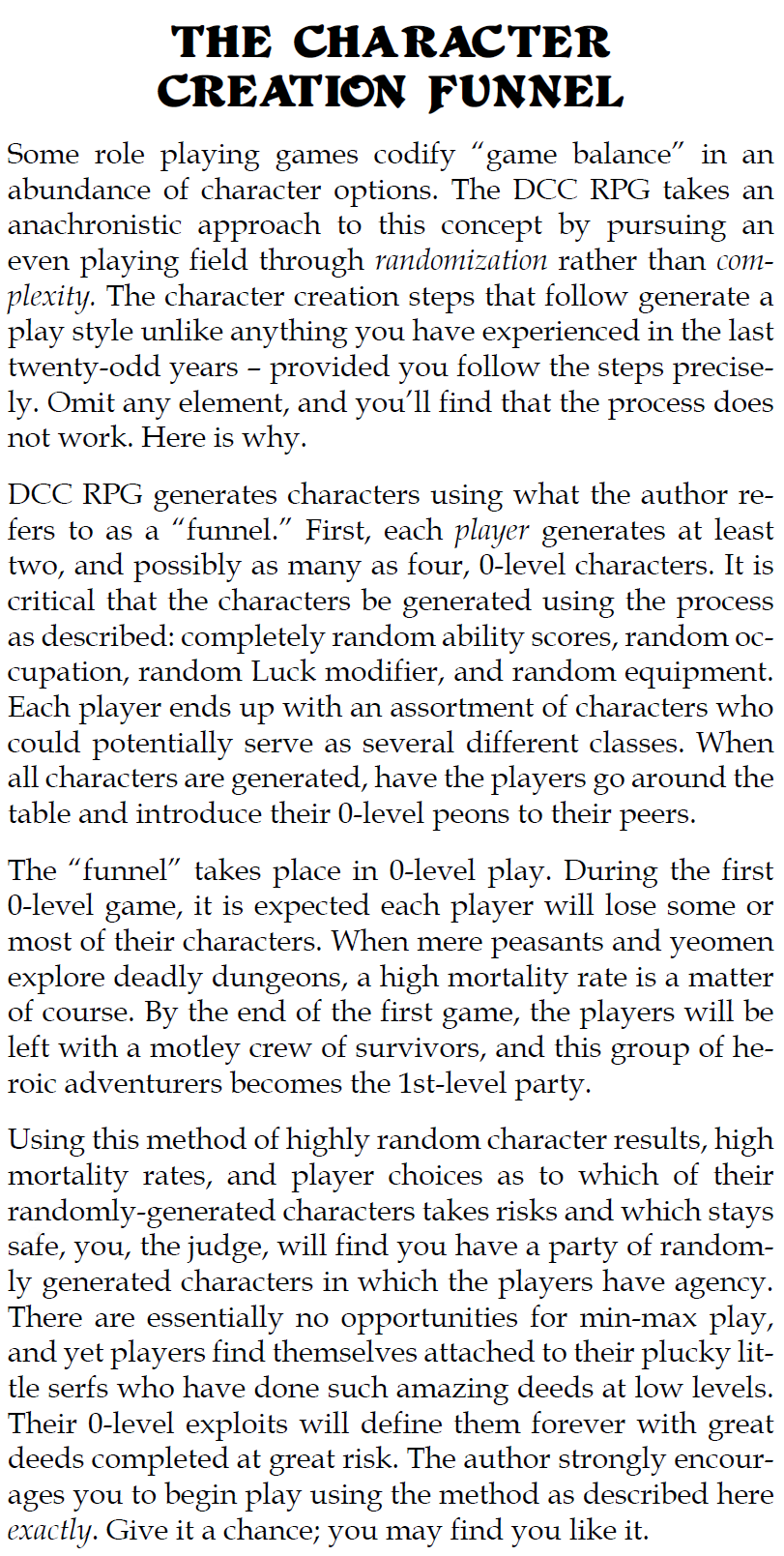
One of the quirks of DCC as a system is “The Funnel,” which is a way of describing how players form new adventuring parties. The basic idea is this: Each player rolls up multiple pre-adventurers, called Level 0 characters. These are normal townsfolk living in a dangerous and mysterious world, ready to defend their livelihood but without the equipment or skills to do so effectively. Then, The Funnel puts these poor 10-15 souls in a brief, deadly scenario. Whoever survives the scenario creates the pool of potential Level 1 adventurers, and off you go.

From what I can gather, The Funnel is a barrier for many “modern” players to jump into DCC. Yet there are also countless testimonials for why a Level-0 Funnel is vital for a new group; The Funnel not only introduces beginners to the rules in a digestible way, but it also emphasizes the tone and tenets of the game world, helps players fall in love with their characters, and creates memorable stories the group will forever remember. Besides, it’s such a different way to start adventuring than most modern games, I am fascinated to try it out. I was immediately sold when reading the rulebook:

Woo! Sounds awesome.

There are a lot of DCC Level 0 adventures, and by far the most popular and highly-touted one is Sailors on the Starless Sea. I own SotSS and initially decided that I wanted it to be the object of my playthrough. What I concluded, however, is that I’d rather not have a public playthrough of such a beloved Funnel, which might ruin it for others (including my own group, if I convince them to try out DCC). Instead, I decided to focus on the Funnel provided in the core rulebook, The Portal Under the Stars.

The Cast of Characters

Before I can dive into my first Funnel, however, I need a large party of townspeople. Simulating four players with three characters each, I rolled up an ambitious TWELVE townsfolk. Below is a quick sketch of each, which is all of the backstory I want right now. There’s no need to create elaborate backstories for characters that might die in the first session, plus the spirit of DCC is to find the characters through playing them. It’s fun to wonder which of these poor saps might eventually become honest-to-goodness adventurers.

I’ll also provide the “stats block” for each character. Right now, don’t worry about understanding the gobbledygook of abbreviations and numbers… I’ll briefly explain mechanics as I go. Suffice it to say, if you’ve played any edition of Dungeons & Dragons, Pathfinder, or another d20-based roleplaying game, DCC will be pretty easy to figure out.


Bern Erswood. Graymoor’s herbalist is well-liked and seen as a kind man eager to help his neighbors, even if his remedies rarely have any medicinal benefits. Bern lives on the village’s outskirts, where he has the most access to nature and can cultivate his gardens. 

Bern Erswood. Level 0 Herbalist. STR 9, AGL 11, STA 13, PER 16, INT 12, LCK 11. Init +0; Atk club +0 melee (1d4); AC 10; HP 5; MV 30′; Act 1d20; SV Fort +1, Ref +0, Will +2; LNG Common; AL Neutral; Equipment: small hammer, herbs, 19cp.

Councilwoman Leda Astford. Leda is one of four councilmembers elected by Graymoor’s populace, and the most recent addition to the Town Council (taking her mother’s seat when she perished from illness). She is young, popular with town residents, and perhaps a touch naïve. Her three councilmember peers—all old, grizzled men who’ve held their seats for years—push Leda to do any and all hard work.

Councilwoman Leda Astford. Level 0 Noble. STR 8, AGL 16, STA 12, PER 15, INT 8, LCK 7. Init +2; Atk longsword -1 melee (1d8-1); AC 10; HP 4; MV 30′; Act 1d20; SV Fort +0; Ref +2; Will +1; LNG Common; AL Lawful; Equipment: 10′ pole, gold ring, 41cp. Note: Born with a clover-shaped birthmark. (-1 to find secret doors)

Egerth Mayhurst. The town’s only jeweler, Egerth has lived in Graymoor since he was a youth and yet still considers himself better than other locals, who he calls “backwater fools.” Selfish and ambitious, he has remained single well into his middle age and is more than a little bitter about it.

Egerth Mayhurst. Level 0 Jeweler. STR 13, AGL 10, STA 10, PER 9, INT 8, LCK 9. Init +0; Atk dagger +1 melee (1d4+1); AC 10; HP 2; MV 30′; Act 1d20; SV Fort +0, Ref +0, Will -1; LNG Common; AL Chaotic; Equipment: holy water (1 vial), gem, 24cp.

Erin Wywood. The granddaughter of Councilmen Wywood, Erin is the closest thing Graymoor has to a bard. She spends her time in the town’s tavern playing her ukelele. Erin should be more popular than she is, due mostly to her devout religiosity and fervor, which creeps into all of her interactions and songs.

Erin Wywood. Level 0 Minstrel. STR 13, AGL 11, STA 13, PER 8, INT 14, LCK 10. Init +0; Atk dagger +1 melee (1d4+1); AC 10; HP 5; MV 30′; Act 1d20; SV Fort +1, Ref +0, Will -1; LNG Common, Halfling; AL Lawful; Equipment: holy symbol, ukelele, 32cp.

Ethys Haffoot. Ethys and her younger brother Giliam are responsible for the trading barge up and down the Teawood River, which connects Graymoor to the neighboring settlements (one of which is the halfling village of Teatown, Ethys and Giliam’s birthplace). She has the family affliction of a club foot, but is otherwise hardy and unquestionably the brains of her family business.

Ethys Haffoot. Level 0 Halfling Mariner. STR 11, AGL 6, STA 12, PER 9, INT 15, LCK 12. Init -1; Atk knife +0 melee (1d4); AC 10; HP 2; MV 20′; Act 1d20; SV Fort +0, Ref -1, Will +0; LNG Common, Halfling, Elven; AL Lawful; Equipment: 10′ pole, sailcloth, 36cp. Infravision.

Finasaer Doladris. Master Finasaer arrived in Graymoor ten years ago from the woods, explaining to the Town Council that he was writing a book on provincial towns in the region. He is the only elf in Graymoor, and a town curiosity in every way. For his part, “Fin” (as the locals call him) is friendly but aloof, and his elevated vocabulary often alienates him from others.

Finasaer Doladris. Level 0 Elven Sage. STR 13, AGL 10, STA 14, PER 9, INT 11, LCK 14. Init +0; Atk dagger +1 melee (1d4+2); AC 10; HP 4; MV 30′; Act 1d20; SV Fort +1, Ref +0, Will +0; LNG Common, Elven; AL Neutral; Equipment: backpack, parchment and quill pen, 14cp. Note: Born on a full moon as a pack of wolves howled. (+1 to attack and damage for starting weapon). Sensitive to iron. Infravision.

Giliam Haffoot. Giliam and his older sister Ethys are responsible for the trading barge up and down the Teawood River, which connects Graymoor to the neighboring settlements (one of which is the halfling village of Teatown, Ethys and Giliam’s birthplace). He has the family affliction of a club foot, but is otherwise hardy and hard-working.

Giliam Haffoot. Level 0 Halfling Mariner. STR 12, AGL 7, STA 13, PER 12, INT 8, LCK 9. Init -1; Atk knife +0 melee (1d4); AC 10; HP 2; MV 20′; Act 1d20; SV Fort +1, Ref -1, Will +0; LNG Common, Halfling; AL Lawful; Equipment: grappling hook, sailcloth, 25cp. Infravision.

Gyles Teahill. “Little” Gyles Teahill is the son of Ephes Teahill, Graymoor’s most prominent rutabaga farmer. Ephes recently had an accident that has left him bedridden, so Gyles has taken up the majority of his father’s work. He is small, but strong for his size and everyone in the town is either overtly or secretly rooting for the Teahills to have a successful year because of Little Gyles’ heart.

Gyles Teahill. Level 0 Farmer (rutabaga). STR 12, AGL 6, STA 5, PER 12, INT 9, LCK 9. Init -1; Atk pitchfork +0 melee (1d8); AC 10; HP 1; MV 30′; Act 1d20; SV Fort -2, Ref -1, Will +0; LNG Common; AL Lawful; Equipment: hen, rations, 25cp.

Hilda Breadon. Graymoor’s only commercial baker, Hilda is famous for her pies, cakes, and cookies of remarkable variety. She would be more successful if she didn’t eat twice as much of her wares as she sells, but she is a woman of great passions and appetites.

Hilda Breadon. Level 0 Baker. STR 9, AGL 11, STA 18, PER 9, INT 11, LCK 11. Init +0; Atk rolling pin +0 melee (1d4); AC 10; HP 7; MV 30′; Act 1d20; SV Fort +3, Ref +0, Will +0; LNG Common; AL Lawful; Equipment: chain, flour, 26cp.

Mythey Wyebury. Mythey grew up in Graymoor as a ne’er do well, always in trouble and running from his bad choices. Unbeknownst to most of the town, he and a couple of his friends have recently been plaguing the roads as outlaws, stealing from travelers to fuel their tavern revelry. His most closely guarded secret, however, is that he has a sickness that he believes will kill him any day now.

Mythey Wyebury. Level 0 Outlaw. STR 15, AGL 11, STA 6, PER 13, INT 9, LCK 7. Init +0; Atk shortsword +1 melee (1d6); AC 12 (leather armor); HP 1; MV 30′; Act 1d20; SV Fort -1, Ref +0, Will +1; LNG Common; AL Chaotic; Equipment: small sack, 29cp. Note: Born as a bear visited the village. (-1 to Melee damage rolls)

Umur Pearlhammer. No one in Graymoor knows how old Umur is, but they know he’s outlived anyone else’s memory. He’s still hearty enough to be the town’s primary stonemason, though, and despite his dwarven gruffness he is one of Graymoor’s most well-liked residents.

Umur Pearlhammer. Level 0 Dwarven Stonesmith. STR 9, AGL 9, STA 9, PER 14, INT 13, LCK 9. Init +0; Atk hammer +0 melee (1d3); AC 10; HP 3; MV 20′; Act 1d20; SV Fort +0, Ref +0, Will +1; LNG Common, Dwarven, Giantish; AL Lawful; Equipment: fine stone, lantern, 26cp. Infravision.

Veric Cayfield. Like the Haffoot siblings, Veric grew up in the halfling village of Teatown, but moved to Graymoor several years ago to begin his life as a haberdasher. No one loves clothes as much as Veric, and what he loves about humans is how much more fabric he gets to use to make them.

Veric Cayfield. Level 0 Halfling Haberdasher. STR 13, AGL 16, STA 12, PER 9, INT 11, LCK 12. Init +2; Atk scissors +1 melee (1d4+1); AC 10; HP 1; MV 20′; Act 1d20; SV Fort +0, Ref +2, Will +0; LNG Common, Halfling; AL Lawful; Equipment: fine suits (3), flask, 19cp. Infravision.

And there we go. Have any bets on survivors or early deaths? And yes… several of them have 1 or 2 hit points. Yikes.

Next time… the adventure begins!

-jms

Portal Under the Stars, Chapter 1

Gaming at Fifty One

Today is a (rather long) State of the Union address on my gaming life.

As best as I can remember, I started playing tabletop role-playing games (or TTRPGs) in Fifth Grade, in 1983, which would make me ten years old. It was one of those phenomena where a friend–though I can’t remember who Gamer Zero was–received a boxed set as a Christmas gift and we all dove in. Soon we all asked our parents to supply us with books, dice, graph paper, and pencils. Throughout the Spring, we played a mix of Basic Dungeons & Dragons and Advanced Dungeons & Dragons, not understanding that they were two largely different games. It didn’t really matter, though… what we actually played was some rules-light, make-it-up-as-you-go game that didn’t even try to involve the many complex tables in the books we didn’t understand. Usually our first-level characters wielded something like a +5 Sword of Dragon Slaying that could cut through anything.

As we transitioned to middle school, a subset of that original group began playing anything we could get our hands on. The biggest boon to our fledgling group was my buddy Russell’s older brother Jim, who was happy to run our games for us. I’m not sure this is an exhaustive list, but I remember playing a lot of Tunnels & Trolls, Gamma World, Car Wars, Top Secret, Marvel Superheroes, Villains & Vigilantes, Teenage Mutant Ninja Turtles (TMNT), Heroes Unlimited, Superworld, Champions, GURPS, and, yes, a good helping of D&D (this time using the rules and their published modules). Just seeing the covers of those games triggers a flood of nostalgic make-believe happiness. Those were fun times.

I had a new group of friends in high school and quickly introduced them to the hobby. We almost exclusively played superhero games, primarily Villains & Vigilantes and Champions, though we sprinkled in some TMNT, Golden Heroes, DC Heroes, and Super Villains as well. My good friend Ted ran us through a particularly memorable V&V campaign, which clued me into how cool a longform set of adventures with the same characters can be.

We all scattered to different colleges, and I met new TTRPG enthusiasts. Throughout my time at Occidental College, I ran a monthly Champions campaign, even drawing the “comic covers” for each session we played as keepsakes. At that point, Champions was my only game, and I was deep into the HERO System and its math-heavy fun.

Then it was off to graduate school, where I met both my wife and a little game called Magic: the Gathering, which would be the object of my obsession for years. Then my working career started to take off, I had kids, we moved around, and, as these things do, TTRPGs faded into the background of my life for nearly two decades. I remember trying to organize a D&D adventure with my wife and some friends once or twice during that time, but it never stuck. During that time, I bought-and-sold the D&D 3E and 3.5 rulebooks without really doing anything with them.

In 2018, I took a year off work to recoup, then in 2019 started a job in San Francisco that, unlike most of my previous roles, didn’t require heavy travel. Around that time, I started listening to a ton of podcasts, including the Glass Cannon Podcast. The TTRPG bug started inching its way into my brain, and I began to seek out my local game stores to see if there were people with whom I could play. After some false starts with Dungeons & Dragons 5th Edition and Pathfinder at local stores, I found a group that was playing D&D 5E and were happy to have me join. They were interested in switching to Pathfinder 2nd Edition once it was released, and eventually I GMed us through the game’s first 1-20 Adventure Path, Age of Ashes over three years. During those years we took occasional detours, experimenting with Blades in the Dark, Symbaroum, Call of Cthulhu, Savage Worlds, and, at my urging, even returned to supers for a Sentinel Comics RPG one-shot.

That gaming group was my first experience with serious personality clashes in TTRPG groups. I ended up feeling picked on by a person there who was close friends with two other members, and after trying-and-failing multiple times to talk it out, my best recourse was to leave. Suffice it to say, it was the only real negative chapter I’ve had with TTRPGs, which have otherwise been a source of unqualified joy in my life.

For months I was genuinely wounded by my abandoned group. Thankfully the global pandemic had introduced me to virtual tabletops and online games. Eventually I found a couple fun virtual tables, including a delightful online group of Europeans that has met weekly now for almost two years. We mostly play PF2E, but have rotated GMs and done several sessions of Call of Cthulhu, Warhammer Fantasy, and most recently Mörk Borg. On our “really want to play list” are Vaesen, Dragonbane, Traveller, Forbidden Lands, Dungeon World, Lancer, Savage Worlds, and countless others.

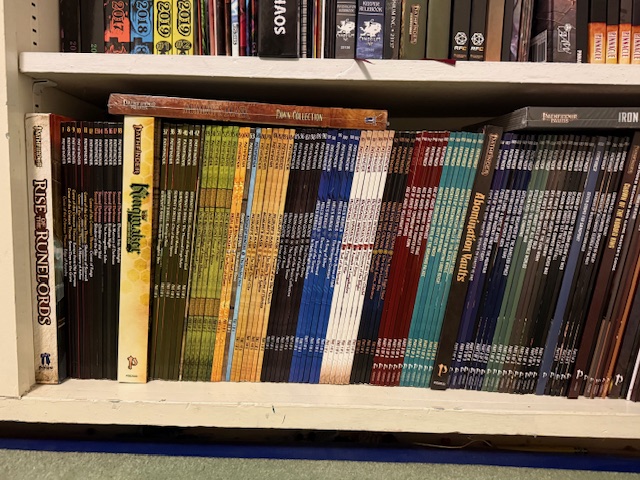
It’s fair to say that, at age fifty-one, I’m in the midst of my Second TTRPG Renaissance. At the same time, the whole TTRPG industry is going through its own Renaissance, with intriguing new games popping up seemingly every week. Not surprisingly, my game shelf has exploded. I now own most of the games listed above, plus a metric ton of others I’ve Kickstarted, found in bargain bins or eBay auctions, or used birthday gift certificates on. I’ve even sold old game books and given my college-age son my D&D 5E collection to make room for them in my house.

There are two major differences between my TTRPG life as a gray-bearded geezer compared to my young, wispy-mustachioed self. The most obvious one is that it’s more difficult to find a group with which to play. Throughout middle school, high school, and college, I rolled dice with my core group of friends. Most of our interests were shared and we spent a ton of time together… easy squeezy. These days, in contrast, the vast majority of my contemporaries have neither the time for, nor interest in, TTRPGs. While online platforms make the pool of potential players wider, these online groups are ephemeral. It’s clear to me that if one of my current group members (all of whom are twenty years younger than me) has kids, takes a new job, or moves, it probably spells the end of the group… that sort of “life event disruption” can happen with any group, but somehow in-person groups feel stickier because the investment feels somehow deeper. Meanwhile, I’ve tried to think of how to conjure another reliable, fun in-person group and failed to come up with a solution.

The second difference is in the type of games I’m playing now versus in my youth. If it’s not obvious from the banner image on this blog, my first love is superheroes and comic books, and at one point in college set my sights on becoming a comic book illustrator. As my TTRPG life deepened as a young person, it skewed heavily–and eventually exclusively–to superhero games. Yet all of my groups in the last six years want to play fantasy or investigative horror games. That’s okay, because I can get excited about those games. But none of the groups I’ve encountered want to play superhero make-believe.

The feeling of being an odd-shaped puzzle piece continued recently as I started to discover the “Old School Renaissance” (or OSR) movement within TTRPGs. These games are built by people who love early Dungeons & Dragons and want to recreate the feel of those games for modern audiences. I’ve looked at OSR-type games like Old School Essentials, Knave, Ironsworn, and have absolutely fallen in love with Dungeon Crawl Classics. I’ve also rescued a bunch of my old D&D modules from my mother’s garage, joined the Ancient Dungeons & Dragons Players Facebook group, and have been bingeing the Vintage RPG podcast. Yet when I tell my online group that I’d love to run them through a DCC beginner adventure to test out the system, I get the same lukewarm response that I received when I tried to get my in-person group to play a superhero game. They’ll probably roll with it because they like and trust me, but there isn’t an itch there they need to scratch.

All of this has me reflecting deeply on the years ahead. I’ll certainly keep seeking out online groups and brainstorming how to form an in-person group, because these are games that are most fun when they’re social and played with friends. Just last week, for example, I jumped online with a bunch of strangers to learn to play Dragonbane, a game I own and have considered running for my regular group. I’ll also keep collecting games, because I find real pleasure in reading the books cover-to-cover and seeing them on my shelf. We truly are living in a glorious period of TTRPG innovation, and the sheer diversity and volume of options is awesome.

But I’m beginning to accept that a) I may never have a long, stable group of gaming friends again, even as an empty nester nearing retirement where my time is beginning to be more spacious, and b) the number of games I own and want to play far outweighs the number of hours I’ll be able to play with friends. I surely won’t ever get a chance to play everything, much less everything beckoning to me.

The final addition to my reflections is the rise of solo play in TTRPGs. Solo play has always been a feature of some TTRPGs dating back to the 1970s, but thanks to the global pandemic it has a lot more support now than ever. Many games, like Ironsworn and Vaesen, have solo play built into the base game as an option. Meanwhile, tools like the Mythic GM Emulator allow for being able to play any game solo, without the need for a gaming group. Indeed, one of my recent podcast obsessions is Tale of the Manticore, a great audio production of a guy solo-playing an old-school D&D system.  

Maybe the answer is to begin solo play on the games no one but me wants to play? Would I enjoy that, or is the fun of TTRPGs really tied to a group? I’ll probably dip my toe into these strange, solo-play waters soon, while continuing my epic quest to find more time with awesome groups like my current online one. My enthusiasm for TTRPGs is as high as that ten-year-old kid pretending to swing his overpowered sword around. How best to channel that enthusiasm, though, is something I’m still contemplating.

If you have any thoughts about the TTRPG hobby these days, or ways you’ve tackled the hurdles I’ve outlined, I’d love to hear it. Comment below or shoot me an email at jaycms@yahoo.com.

Enthusiastically adventuring,

-jms