ToC14: Battle of the Watchflame [with game notes]

[prose-only version here]

XIV.

Duskmarch 17, Goldday, Year 731.

The village’s shrine to The Watcher—also called The High Listener, The Fourth Sister, and She Who Watches the Bay, among many other titles—sat in the heart of Vastren Hollow, at the center of a cobblestone square. Alric supposed that, since the village had been founded by rangers long ago, they had built the shrine and its flame to signal safety to travelers or passing caravans, much as Skywarden Tower served for Oakton. Yet Vastren Hollow established no trade routes currently in use and had never proven to be of strategic advantage for the city. As a result, the village had maintained the Watchflame but grown around it, sitting comfortably within the rampart wall and defensive structures, unseen by passerbys. It was now, he guessed, primarily a symbol of safety for Vastren Hollow’s residents, a sign that Oakton’s gods still sheltered them from the wild world beyond.

Today, however, safety was under siege.

As Maelen and Vessa led Alric and the ragged militia through the village, they saw the true devastation of the skratt swarm. Every home gaped open, doors torn, windows bloodstained. Fires guttered across the square. One house, fully ablaze, stained the twilight orange. Black-furred bodies of skratts lay everywhere, some curled on their sides, some with backs arched and white eyes staring lifelessly at the clouds above, and others face down in the mud. Indeed, it seemed that the skratt corpses outnumbered the others by four to one, though everywhere Alric looked there were dead villagers and animals, all shredded by claws and with faces ravaged. The smell of blood, offal, and smoke filled Alric’s nose, making him gag several times.

The shrine itself was a waist-high, octagonal structure made of pale granite, atop which sat a bronze brazier in the shape of an eye. Alric could see immediately that the flame within that brazier was magical, its fires burning both white and blue. A few desperate soldiers stood in a tight ring above a mass of writhing, snarling black fur. Even as they approached, one of the women fell shrieking under the skratt horde. In moments, the others would follow.

With a shout, Maelen charged.

I’m going to run this combat in two parts. Last time I rolled that the PCs would be facing 7 skratts, so that’s going to be the “main” combat, essentially the enemies who pay attention to the party. But I’m picturing the scene more chaotic and cinematic than that, so in the background I’m going to be rolling on how the militia band is doing against the rest of the horde.

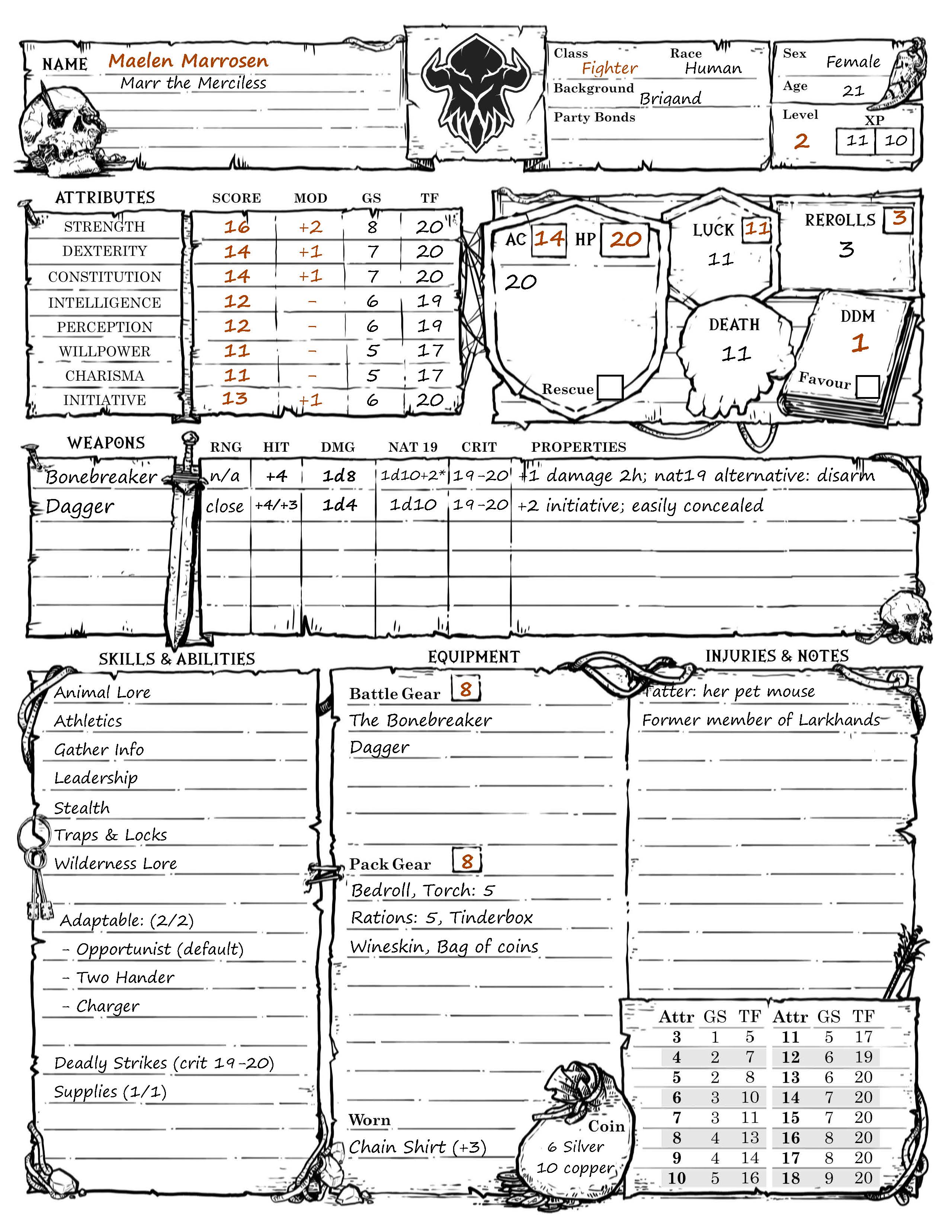
First, I’ll have Maelen roll initiative, against her 13 attribute score. She rolls a 7 and succeeds, so the PCs go first. She’s going to Charge (I’ll say the group is currently Far from the shrine), but should she use a class ability right out of the gate and take advantage of Charger? I’m going to say no, because I think Opportunist will help more in a fight against a pack of 1 HD creatures. It’s a normal Charge, then, which not only lets her get into melee but gives her (and the skratts) a +2 bonus to hit. With the Bonebreaker, that’s a whopping +6 to hit an AC 11 creature. But she rolls a 4! Oh dear.

Vessa, meanwhile, will move to Close range and fire with her bow. She has a +4 and rolls an 8+4=12, which is a hit. The shortbow’s damage is 1d6 and I’ll simultaneously roll 1d8 hit points for “Skratt 1.” 2 damage versus 5 hp, reducing it to 3. Something I didn’t do throughout all of Level 1—maaaaybe because I’m still learning the rules and forgot they existed—are Exploits, which are minor (or major) effects combatants can have on opponents. The requirement for a Minor Exploit (which Vessa will now attempt) is to hit and damage an opponent, which she’s done. She’ll hope the arrow will distract the skratt, taking its +2 to hit Maelen away. To do so she rolls an opposed Dex check and rolls a 9 (succeeding by 7) versus a 9 by the skratt (succeeding by 4), which works! Had she failed, she wouldn’t have been able to do another Exploit this combat. Exploits are an amazing way to give flavor and minor advantages, and I’m glad to remember them!

Has Alric received more combat abilities now that he’s level 2? Not really. He’ll move to Vessa’s side and grip his staff, ready next turn to help either Maelen or Vessa as best he can.

Now it’s the 7 skratts’ turns. I won’t roll whether they stay focused on the Watchflame, as these are the skratts who I’ve already determined will attack the PCs. Assume a mass of the creatures continuing to swarm around the shrine and dash all over the village. I’ll say 3 focus on Maelen, and I’ll roll what the other four do.

Skratt 1 (who no longer has a +2 to hit thanks to Vessa’s Minor Exploit) has a +1 to hit, then +1 because of outnumbering her 3:1, versus Maelen’s 14 AC and rolls a 9, missing. Skratt 2 has the bonus and rolls 18+4=22, hitting for 3 damage (on 1d6). Skratt 3 rolls 15+4=19, also hitting and doing 2 damage. Ouch. Maelen is down to 15 hp.

I’ll roll even chances for the other 4. Three of the four will rush Vessa and Alric, but one remains to swarm Maelen. It rolls 13+4=17, and also hits for a max 6 damage. Dangit! She’s down 9 hp, less than half in a single turn.

For the abstracted battle outside the PCs, there are terrific Mass Battle rules in Tales of Argosa, but they don’t quite fit this situation (they’re more for sieges and warfare). Instead, I’m going to do simple opposed rolls between the militia and skratt swarm. The militia rolls 8 to the skratts 17, losing. They take 1d6 “losses” of members and I roll 5. They’ve gone from 8 “strength of force” to 3!

That first round was brutal. Let’s roll Round 2 before I narrate. Vessa rolls 11 against her 13 Initiative, succeeding. Maelen will strike out at one of the four skratts surrounding her with Bonebreaker, rolling 16+4=20 and hitting. She then rolls 5+2=7 damage versus 4 hp and Skratt 2 is dead. She’ll then use Opportunist (which triggers when she reduces an opponent to 0 hp) to attack a second skratt, rolling a nat-19! For a Fighter, that’s max damage plus half her level, plus a Blunt Trauma roll. The 11 damage alone absolutely crushes Skratt 3, so no need for the Trauma. That’s better!

Vessa’s now in melee with 3 skratts herself, so she’ll drop the shortbow, use her Move action to draw her shortsword, and then attack. She rolls a 9+2=11 and hits, doing 1+1=2 damage to Skratt 5’s 6 hp, dropping it to 4. Does she attempt another Minor Exploit? Sure. She’ll try and trip the creature with an opposed Dex check. She rolls 13, succeeding by 3 versus the skratt’s failed roll of 14. Skratt 5 is prone.

Alric will try and bash the prone opponent, which gives him an additional +2. He rolls 9+3=12 and hits! His staff does 2 (on 1d6) damage, bringing it to 2 hp.

It’s now the skratts’ turn. The two versus Maelen no longer have the Charge bonus and don’t outnumber her 3:1, so it’s just a +1 for them to hit. They roll 6 and 7, both missing her 14 AC.

Skratt 5 stands up and launches at Alric, rolling 9+1=10, exactly hitting his AC. I roll only 1 damage, though, bringing him to 13 hp.

Skratts 6 & 7 attack Vessa (rolled randomly) and roll 11+1=12 and 2+1=3, both missing her 13 AC.

Will the militia fare better? Their opposed roll is 19 versus the skratts’ 4, so yes! The Stonekin soldier and his remaining villagers battle back the horde for another turn, whittling away its numbers.

Well, that was a better round for the PCs. No morale checks to make on the skratts, as they’ve only lost 2 of 7 combatants. Here’s the current battle status:

  • Maelen faces Skratt 1 (3 hp) and 4 (unrolled). Skratts 2 & 3 are dead at her feet.
  • Alric and Vessa face Skratt 5 (2 hp) and Skratts 6 & 7 (unrolled).
  • The militia has 3 “strength” remaining before it’s defeated.

Alric had seen her fight before, stumbling uphill at Greenwood Rise, but this was different. She flew across the square, all power and precision. The Vastren Hollow militia, with a whoop, raised their makeshift weapons and followed her towards the besieged shrine. The humans at the shrine let up an answering call, rallying against the enemies around them. Now Alric watched, mouth agape, as Maelen’s spiked mace swung to catch a startled skratt in the chest, sending it arcing into the air. Right behind her, the Stonekin soldier’s glaive flashed out, shining in the bright light of the Watchflame.

Then the skratt mob swarmed them. The whispering chitter of rats mingled with the cries of pain from the militia, and the group disappeared amidst a mass of black fur. Alric gasped.

“Stay sharp!” Vessa loosed an arrow into the swarm, cursed, and dropped her bow. “Here they come!”

Vessa stepped past Alric and slashed with the short blade of her sword, intercepting a skratt that had run at him. It fell to the square awkwardly, scrabbling for purchase with its claws on the stones. Alric swung his staff, cracking into its body with a crunch. Then it launched itself at him, black hands outstretched and white eyes wide. He sidestepped on instinct but felt the hot flash of a claw across his cheek. It had gone for his eyes.

The creatures were everywhere. Vessa pivoted and swung her blade as Alric held out his staff defensively. Magic whirled in his mind, unable to form into anything coherent amidst the battle.

Round 3! It’s Alric’s turn to roll for initiative, against his attribute score of 11. He rolls 18 and fails, so the skratts go first.

All the skratts currently have only their +1 bonus to hit, thankfully. The two facing Maelen roll 15 & 11, hitting once for 2 damage and bringing the warrior to 7 hp.

Meanwhile, I’ll have the injured Skratt 5 continue to attack Alric, rolling 10 and hitting. Thankfully, he takes only 1 damage again (!) and is now down to 12 hp.

The remaining two skratts will focus on Vessa. They both roll 4, which means she easily avoids their claws. Not too bad, all things considered.

Can Maelen take out her two opponents in one turn? She rolls 9+4=13 and hits Skratt 1, and 6 damage kills it. She’ll attempt an exploit to knock the crushed body of the skratt into its companion, knocking it prone. They roll opposed Strength checks, and Maelen rolls a 2 versus the skratt failing. It’s prone, and so she now has a +6 for her Opportunist attack. She rolls a 17, though, so I guess it didn’t matter… Six total damage versus 2 hp, and Skratt 4 is gone. She takes a beating, but she can dish it out too!

Alric tries to fend off the skratt attacking him and rolls a 14! He’ll wield the staff two-handed, which gives him +1 to damage. Since the skratt only has 2 hp, it’s dead.

Vessa will stab at one of the two skratts facing her, rolling a 12+2=14 and hitting for 6 damage versus its 3 hp. Only one skratt is left!

How does the militia do? They roll 16 versus the skratt horde’s 3, keeping their three members alive and further diminishing the mob.

Now is a good time for a morale check. The skratts’ Will score is only 7, but I roll a 3 and succeed. They want that flame out!

All around him, violence raged. Yet for several heartbeats, Alric faced off against the skratt Vessa had injured. It crouched on the cobblestones, feet set wide and clawed hands flexing as it sniffed the air loudly. Then its milky eyes fixed on his position, the oil-slicked, ropy tail lashing. The thing chittered and jumped again at his face.

This time, Alric was ready for it. He interposed the staff between them, though a frantic claw still nicked his neck as he pushed it away.

He swung the heavy wood of his staff in a desperate, wide arc. The blow struck the skratt where its head met its scrawny shoulder and the creature crumpled. Then Alric struck again, and again.

He hadn’t realized he was shouting until another skratt, slashed by Vessa’s blade, rolled into his leg.

Alric whirled, wide-eyed, to take in the scene. The dead lay everywhere, skratt and villager alike, though a cluster of both still battled around the Watchflame. Maelen was there, batting furred bodies left and right with her weapon, a fierce smile on a face spattered in dark blood.

Two skratts leapt out of the crowd at the shrine simultaneously. Their bodies fell atop the Watchflame deliberately, as if trying to smother the fires with their lives. More followed. The scattered soldiers on the granite pedestal cried out in dismay, striking at the smoking bodies. Alric watched the blue-and-white flame gutter, and then he couldn’t see it at all amidst the writhing, black-furred mass.

As we’re nearing the end of the fight, it was time to implement what I’d already rolled last time: That the skratts had successfully doused the Watchflame. It seemed more dramatic to have Alric witness it being snuffed out than to show up and have it already be out.

Anyway, Round 4 is surely the last round of combat. We’re back around to Maelen rolling initiative, and she succeeds with a 7. Can she make a second Charge in one battle? I don’t see why not, so here goes: She rolls a 13+6=19, hitting easily. She then rolls max damage of 10, fully crushing the last skratt. Combat done!

Let’s see if the militia survives the last skratt push. I roll a nat-20 versus the enemies’ 2, so absolutely yes. In fact, I’ll say they are the real reason the battle is over, making the skratt horde flee after they’ve extinguished the Watchflame.

“No!” the stocky soldier roared, his glaive carving a desperate path through the skratt swarm. The last few villagers closed ranks around him, driving toward the shrine. Alric watched, almost transfixed by the scene: A last push of bravery amidst carnage.

The whispery chattering of a skratt near his ear jerked him into the battle. There, one of the creatures bared its long front teeth and spread its clawed hands wide, pale eyes fixed on his face as it readied to leap. He froze, surprised.

Maelen’s spiked mace crushed the skratt into the cobbles with a wet crack. Alric hadn’t even seen her cross the square. The warrior was bloodstained, panting, her hair and eyes wild, as she gripped her black weapon and spun, looking for another opponent. Vessa finished slicing the throat of another creature, then positioned her back to Maelen’s, a move that looked almost instinctual for the two mercenaries.

But it was unnecessary. Any skratts that had broken from the horde at the shrine were dead or gone. For a long moment, only panting and the crackle of fire filled the square.

Alric’s eyes scanned the scene, his gaze passing over countless corpses that his mind refused to register. He focused instead on the shrine. The Stonekin soldier had retaken the granite pedestal. Black-furred bodies lay everywhere around him, the stack of them fully to his waist. Three other humans—all covered in gore—yelled and moved to chase the last of the skratts as they fled. They had been fighting all night and day, however, and had no hope of catching the rat-like creatures. Dozens of skratts scurried from the village square, flowing like a river towards some exit Alric couldn’t see.

The soldier sank to his knees at the brazier’s base. His glaive clattered against the stone dais. The Watchflame was gone, buried beneath smoldering skratt corpses. Only the burning houses lit the square now, flickering orange, warped by smoke.

“White eyes, oily tails, and whispers,” Maelen rasped beside him. “You’re right, lad. Orthuun’s work.” She coughed, blood on her lip, and dropped to one knee.

“Maelen!” Vessa called out, but Alric was already kneeling beside her.

Alric has a new spell! It’s time to Mend Flesh (hopefully), expending 1 of his 2 magic spells for the adventure. To do so, first Alric must succeed at an Int(Arcane Lore) roll, which for him means rolling 16 or under. He rolls 16! Whew.

Next, his Dark & Dangerous Magic score was 2 at the end of last adventure, so Alric must roll a d8 (at 2nd level) and roll over a 2. He rolls a 5 and doesn’t trigger anything nasty. His DDM score, however, increases to 3. It’s… coming!

Finally, how much healing does Alric provide? His spell allows Maelen to recover 1d6+2 hit points, and rolls 4+2=6! Nice. Maelen is now at 13 hp.

Speaking of which, the PCs can now take a Short Rest, a few minutes to let them catch their breath. Doing so allows each PC to make two Willpower checks. Maelen will go first and rolls 10 & 12, either side of her 11 Will. With one success, she recovers half her missing hit points (3 of 7) and is now at a respectable 16 hp.

Alric, meanwhile, rolls 14 & 10, also one success versus his 13 Will. He’ll leave his hit points at 12 of 14, but will instead recover his lost spell slot.

Vessa neither took damage nor used any class abilities, so the recovery doesn’t matter to her. It’s a good reminder to use some of her Rogue abilities in the future, though.

Finally, some housekeeping: I’ll increase the Chaos Factor from 6 to 7 for obvious reasons. Since the Stonekin soldier survived, I’ll give him a name, Sergeant Brodan Flinthewer, and add him to the Character List. I think that’s it for now.

As soon as he’d entered the village, Alric had begun to hear a low, whispered murmur at the edge of his awareness. He’d convinced himself it was nothing.

But as he reached for Maelen’s face, the mumurs rose, coiling around his mind. Words he couldn’t understand, half-heard and hissing. They filled his ears, drowning out everything else. Lone cries from anguished villagers, blazing house fires, and even a question that Maelen asked him as she looked into his eyes—Alric could hear none of it. Only the whispers remained, and his lips moved with the alien rhythm of them.

A familiar numbness spread throughout his body, as if he were separating from the world and becoming apart from it. His skin tingled as it passed from his head, down his neck and spreading throughout his torso and limbs, moving down to his legs and feet. Once the sensation had passed, he felt nothing, no pain or emotions. Dispassionately, Alric said words he and his companions would not remember later.

Maelen’s eyes went wide, then relaxed. She blinked at him, a sense of wonder across her face as he released her head with his long fingers and ceased the spell. It would take, he knew, several heartbeats for his senses to fully return, and the tingling as the numbness retreated was awfully distracting. But he could still speak through deadened lips, and asked, “Are you better?”

“Lad,” Maelen mouthed. “How?”

“Shh,” Alric shook his head, pursing lips. He hadn’t heard her through the diminishing whispers in his ears, but he saw her lips make the words. “Later. Let’s help the others.”

As he stood on shaky legs and surveyed Vastren Hollow, though, he wasn’t sure who there was to help.

The village was gone, its Watchflame cold. Orthuun had wiped it from the world like ink from a wet page.

Next: Make Sure I Do It [with game notes]

ToC: Level 2

What’s this? A midweek Tales of Calvenor post? Today is our first level-up day! I’m setting the prose aside momentarily to do the nerdy (but, arguably most fun) game-notes stuff for an entire post. This Saturday will return to our regularly scheduled narrative.

I’ve decided to change how I’m approaching level advancement for this campaign. Thus far, as you’ve seen from the game notes, I’ve been tracking individual xp by character. I haven’t enjoyed the xp bookkeeping, though, and it’s made me paranoid about putting each PC in situations where they can keep up with their peers. Instead, I’m switching to another option for advancement offered by the Tales of Argosa rulebook. Downtime Level Up says, “Using this method, adventurers who meaningfully participated in the last adventure advance one level during Downtime.” However, I want to make sure that levels get increasingly more difficult to attain, per the xp rules. Since it took me 10 posts for the PCs to reach Level 2 (and yes, all three will advance today), I’ll be looking for Level 3 around post 30, whenever a natural Downtime there makes sense. If I’m still writing these characters around post 60 (and wouldn’t that be great?!), they’ll achieve Level 4. Etcetera. If a character dies, I’ll decide whether to press on with two PCs or introduce a new one, and that character will start at Level 1 unless the story dictates otherwise, leveling up after 10 or so posts. That’s my current plan, subject to change through more play!

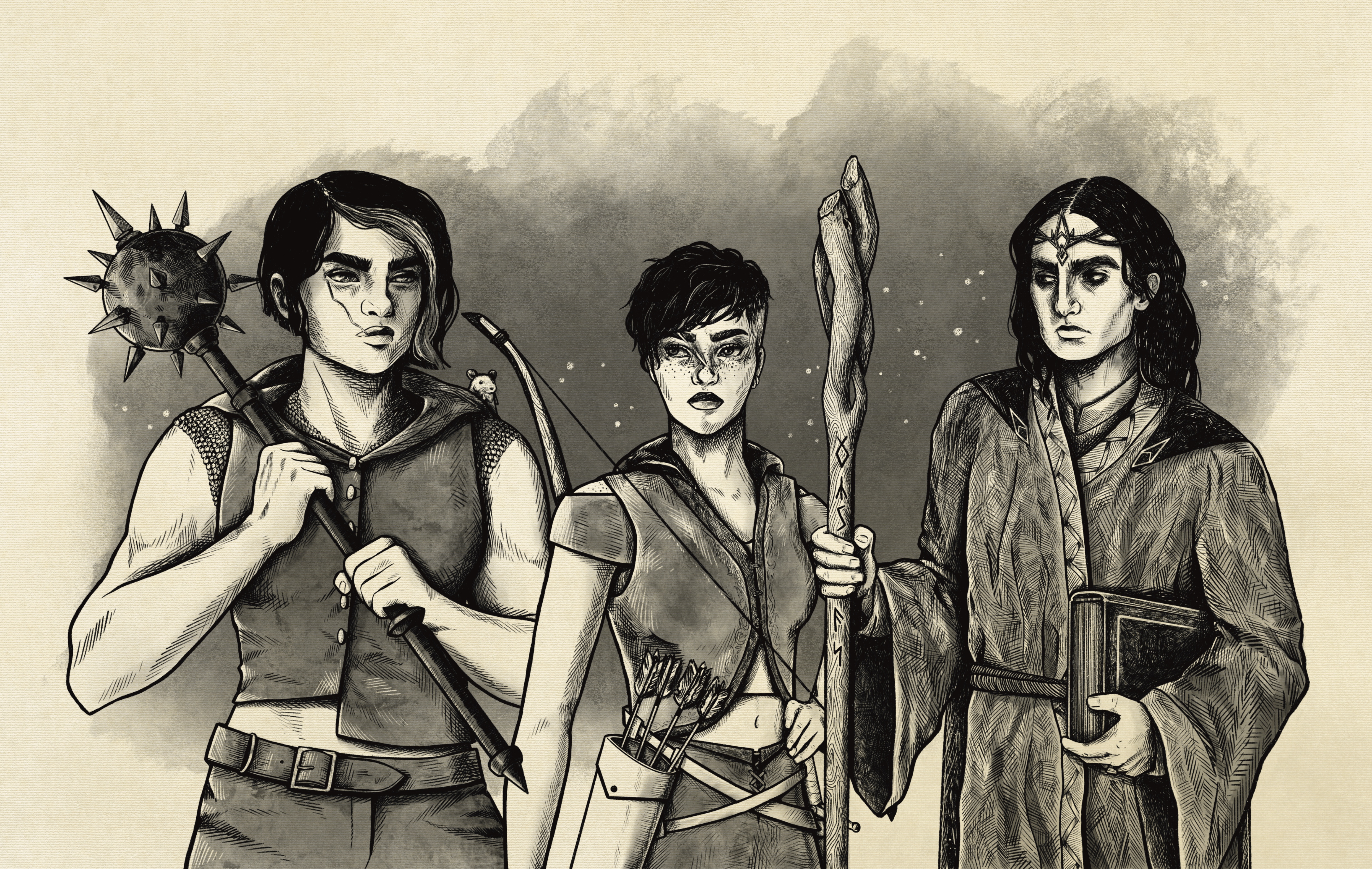
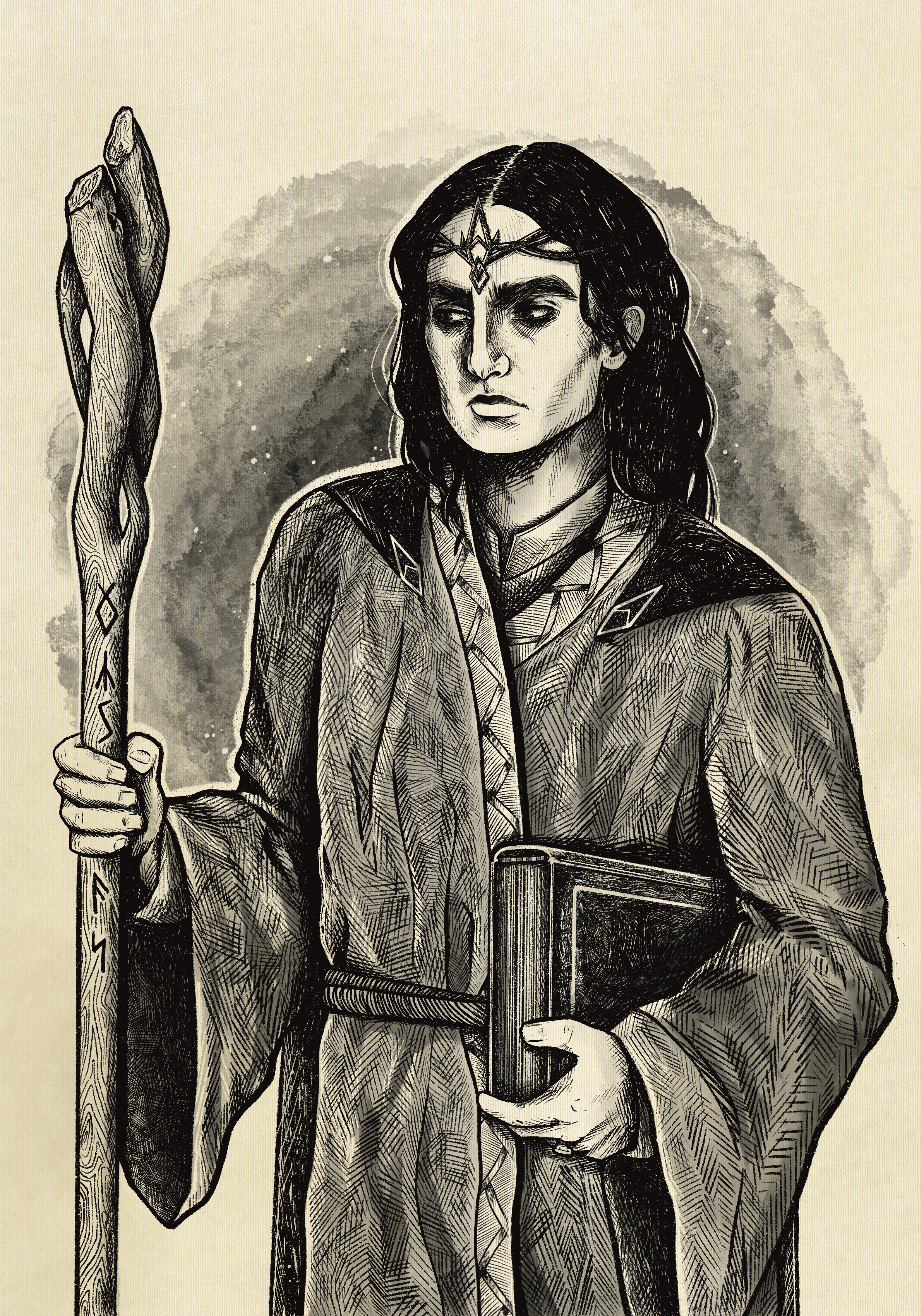
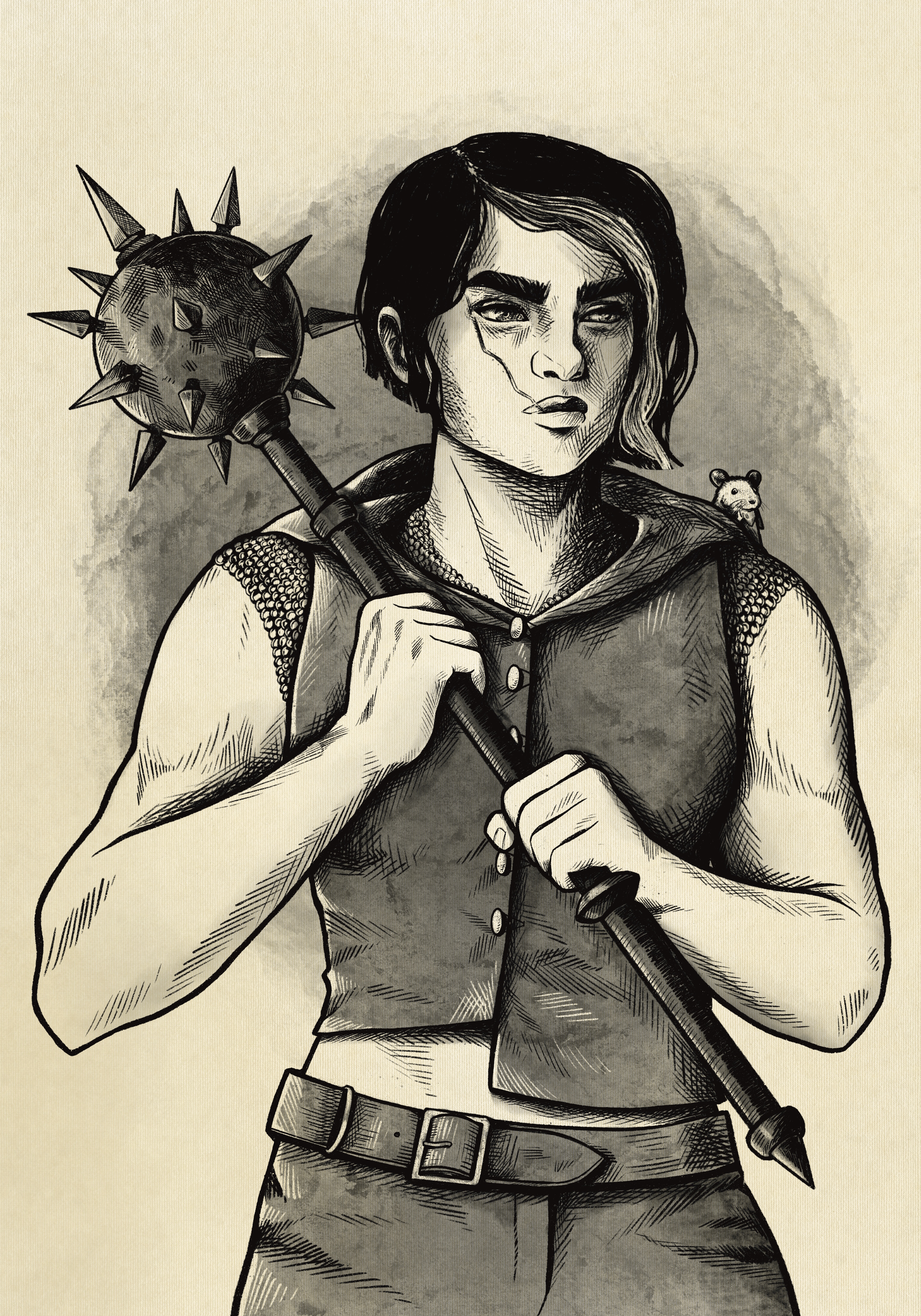
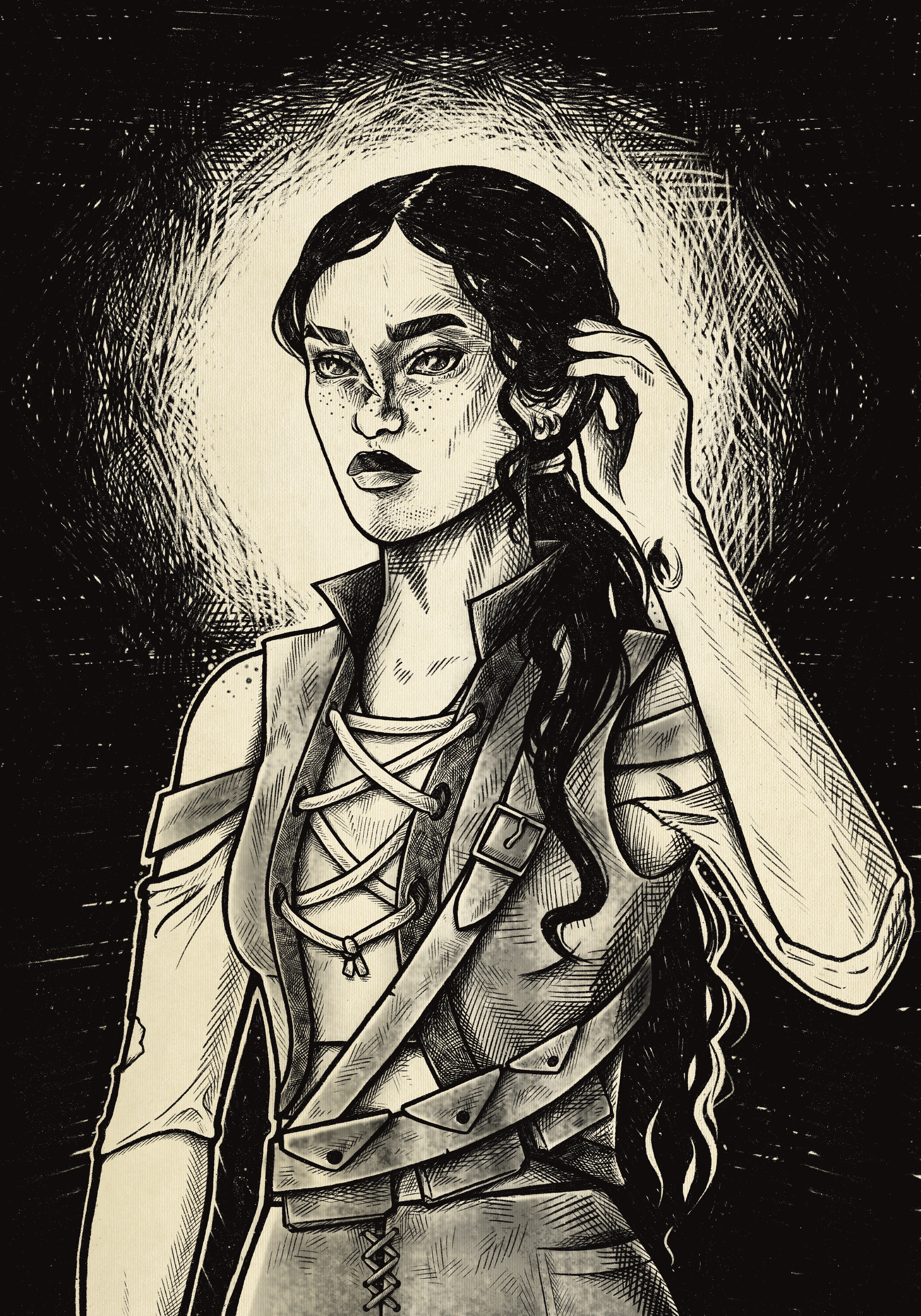
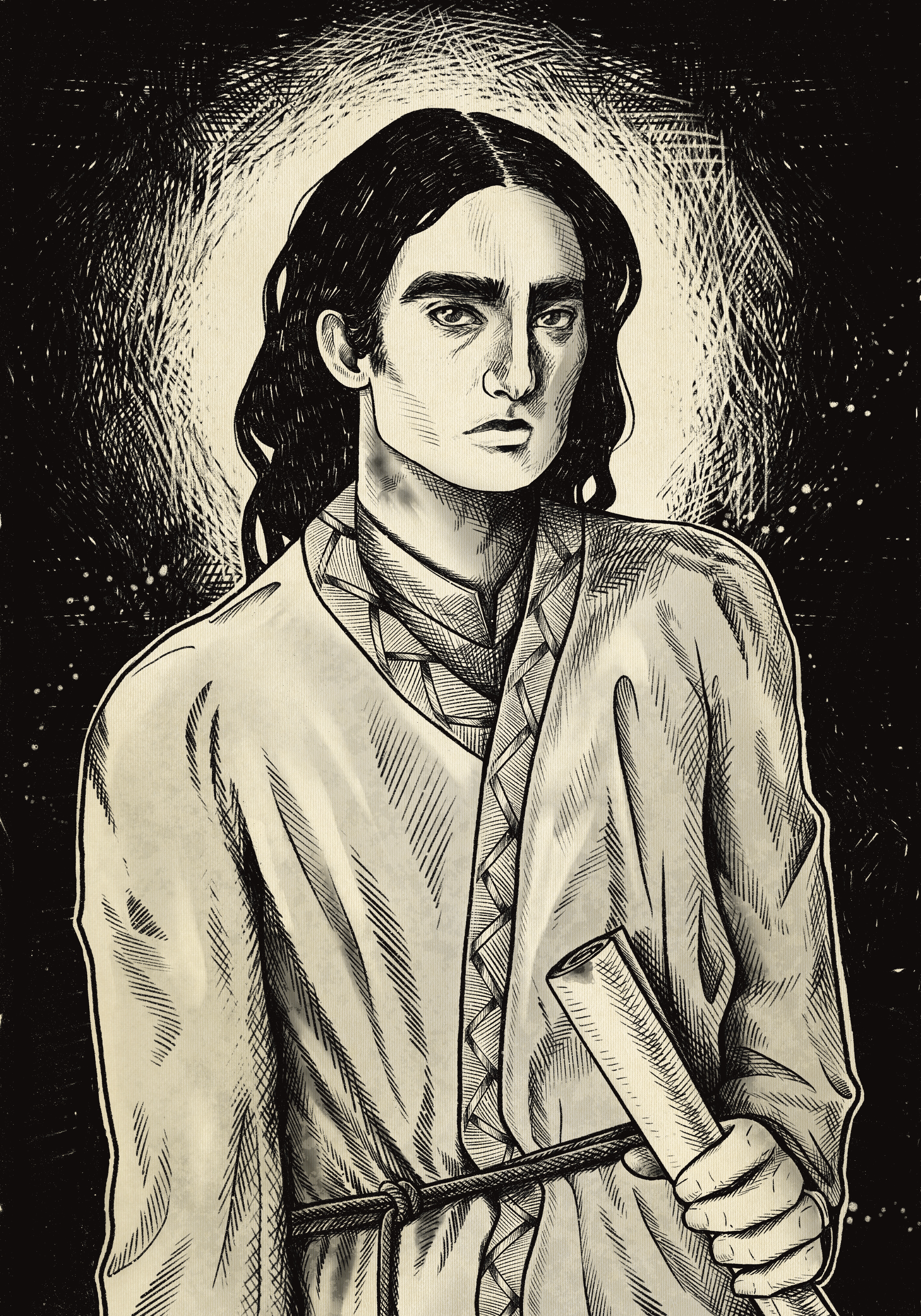
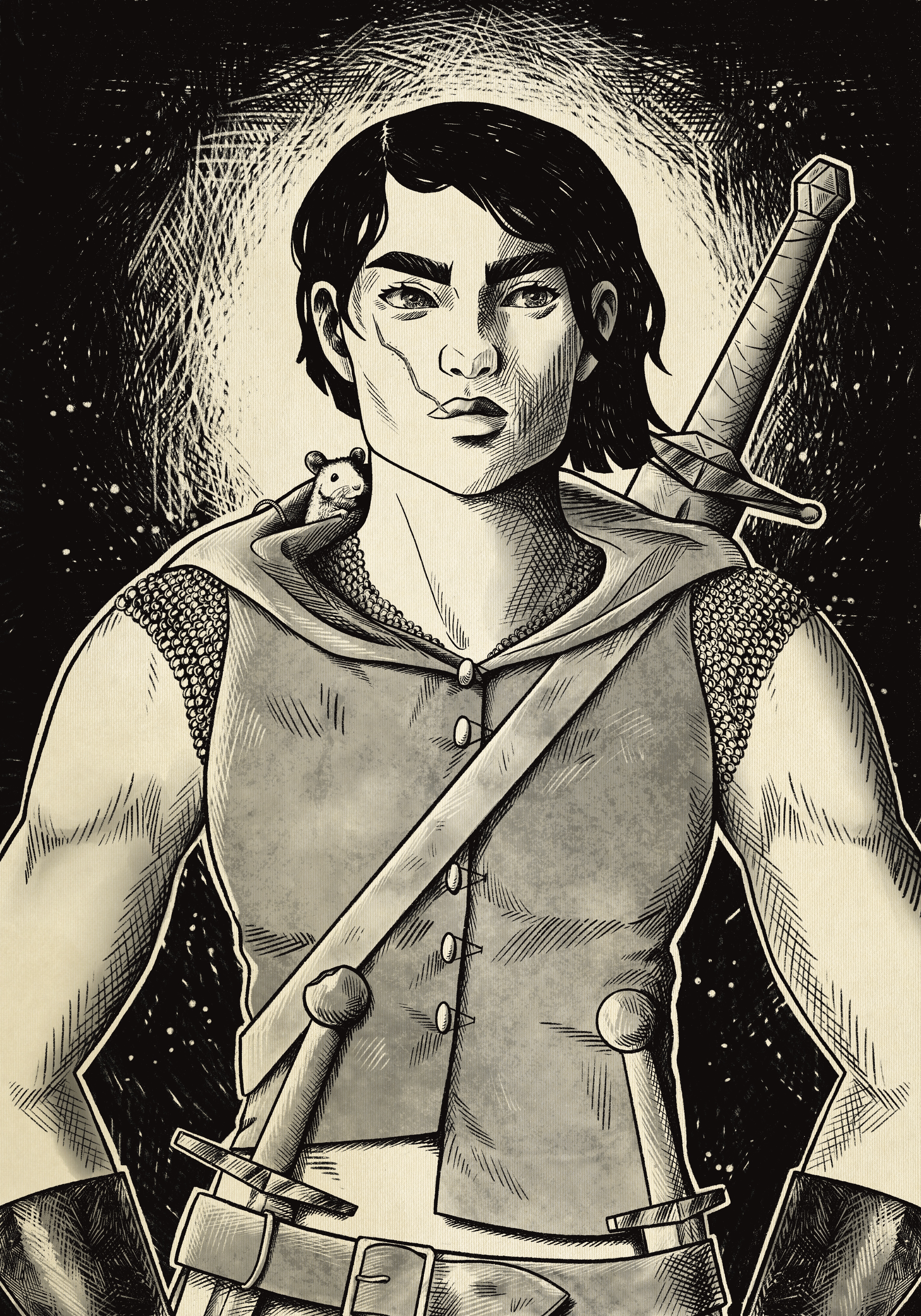
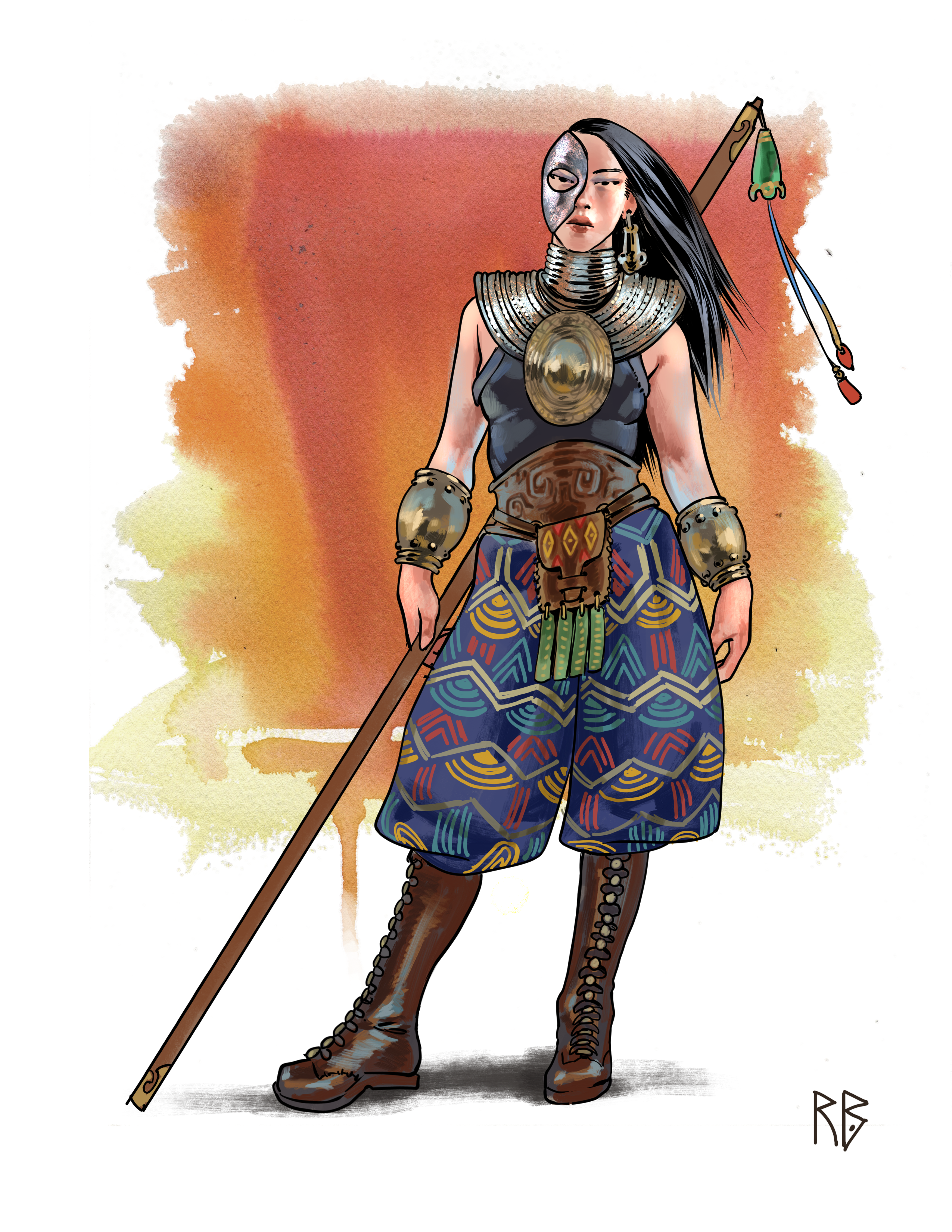
Before we jump into it, you may have noticed some new art from the extremely talented Anaislalovi. She has generously agreed to contribute once again to character portraits now that the three PCs are into their second level (and story). As you can see, she’s amazing. All of the artwork in these Calvenor posts is © anaislalovi, used with permission, all rights reserved.

Vessa Velthorn

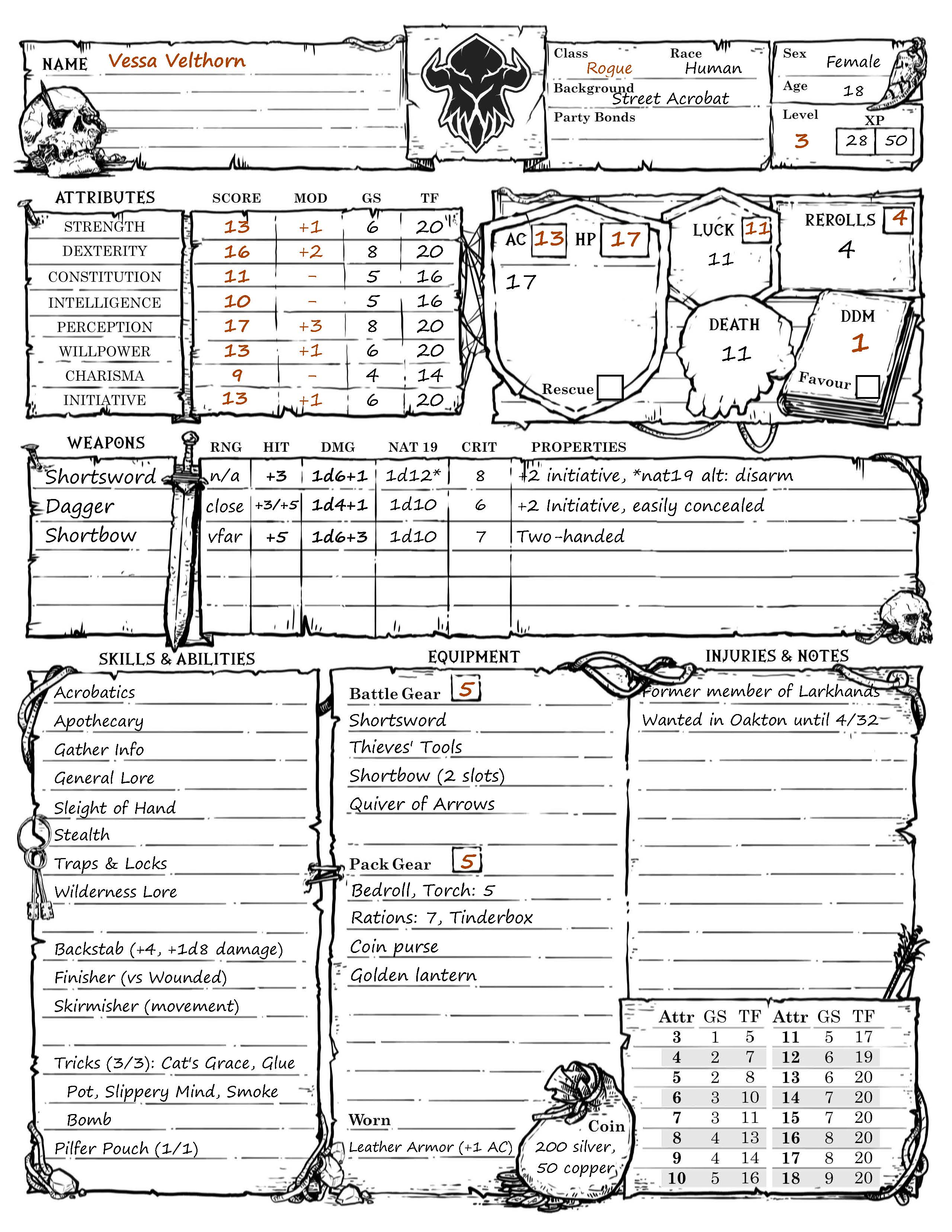
Let’s get to that juicy advancement and Downtime, tackling Vessa first. What happens at level-up? First, the PC gets +1 to an attribute of their choice, excluding Luck and Initiative, up to max 16. I’m going to say that the experience in Thornmere Hold increased Vessa’s self-confidence and mental fortitude, bringing her Willpower to 13. Doing so also increases her Death Save to 11. Next, Vessa’s hit points increase from 12 to 14 (yes, Tales is a brutal, deadly game). She also gains an extra Reroll.

Finally, Vessa’s class skills increase. Her Attack Bonus goes up by 1 (she now has a +4 to hit with her shortbow!). She gains a new skill, and Wilderness Lore makes the most sense given her romp in the woods. At Level 2, she also gains the ability Skirmisher, giving opponents’ free attacks due to movement disadvantage. She also now can use her Tricks 2 times / level and gains a new one: Smoke Bomb, which I’ll explain in play. I really need to use these Tricks more.

Now let’s talk Downtime. I love the Tales Downtime rules, which are designed around “activities for PCs to spend their silver on, to keep them hungry for coin.” First, I roll how much time passes before “something interesting” happens, which will constitute this Downtime period. I roll nine weeks.

Seven days of predominantly low-key activity in a safe location is called a Long Rest, and Vessa thus regains all hit points, class abilities, Rerolls, and attribute loss (minus Luck), plus recovers 1 Luck point. That leaves her at full strength, but at 10 of 11 possible Luck. “Wait a gosh-darned minute!” you might be saying, “but Downtime is nine weeks! Wouldn’t she be able to recover that other point in eight extra weeks?” Maybe. But she’s doing other things during that time, having her own mini adventures and peril. The sum total is that she’ll be down 1 Luck when the next adventure begins. Unless something happens during Downtime to diminish it further.

Speaking of which, for Vessa a big question is how much of the party’s gold she can pay back to the Latchkey Circle versus how much she spends on carousing and gambling. First, let’s decide how much she and Maelen need to pay off their debts. I’m going to roll 2d6x100 gold, an impossibly big sum for people in Oakton. I roll 80 gold of debt. Whew. Combining gold and silver from Thornmere Hold, they have 105 total gold, so theoretically they have enough. But while Maelen is in a coma, Vessa may be getting herself into trouble…

Let’s combine these two subsystems and see how it goes. Vessa will use 100 sp (or 10 gp) on gambling/carousing. How does the weeks worth of gambling go? Vessa must make a Luck save. She rolls a 14 and fails, losing the money. The only “good” news is that Vessa won’t lose a Luck point for failing.

Now, the fateful Carousing roll, the same roll that last time had Vessa lose her hair, a tooth, and create a complication that has yet to rear its head (but is on the Mythic Threads list!). Here goes the d100 roll… 04, which is Crime, “Your drunken endeavors lead you to commit a crime, roll 1d6.” Vessa rolls affray, a word I had to look up and means “an instance of fighting in a public place that disturbs the peace.” She is wanted for questioning for the next 4 (rolled on 1d6) months after Downtime ends for questioning. Well, this all fits perfectly into Vessa’s character flaws so far. The big question: How much money does she spend? Carousing from levels 1-3 can take anywhere from 20-100 silver. I’ll roll and get 80 silver. Dangit, Vessa!

Subtracting the 70 silver that Alric took with him, that’s 80 gold exactly left. Sometimes the dice just tell the story, don’t they? Vessa and Maelen will be dead broke after this downtime.

Here is Vessa’s Level 2 character sheet:

Alric Mistsong

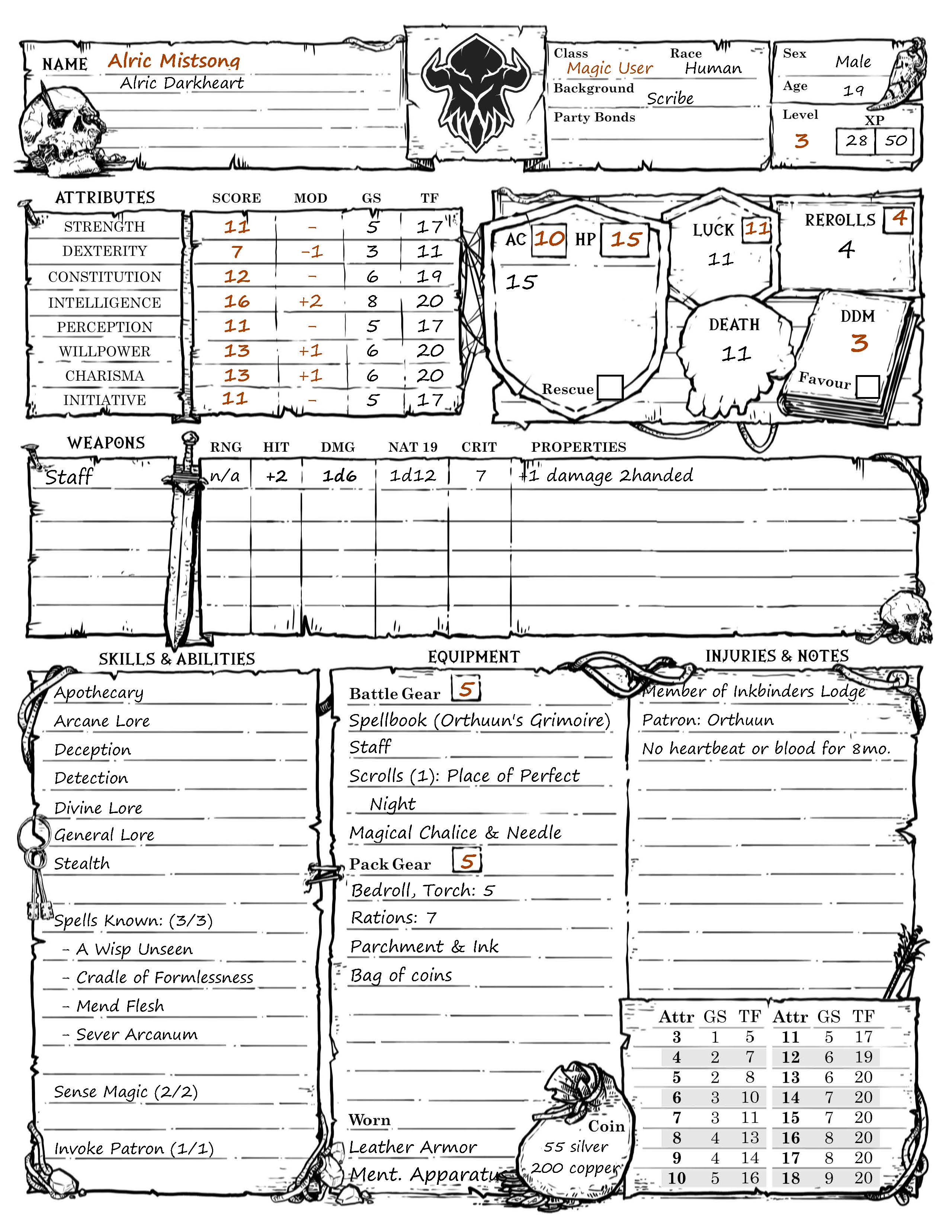
Next up is Alric. He fully heals, and his Luck is now 10 of 11. Like Vessa, he will use his +1 attribute increase on Willpower, increasing it also to 13, giving him a +1 modifier and increasing his Death Save to 11. His hit points increase by a whopping 1, to 14 (brutal!). He gains a Reroll.

Next are his class bonuses. His Attack Bonus becomes +1 (all that staff-bashing he’s been doing paying off). He gains a new skill, and already has both Arcane Lore and Divine Lore. Hm. As squeamish as it makes me, I’ll give him Deception since he’s dabbling in dark forces, and it’s a skill he showed some aptitude for at the Root Gate in Chapter 2. As a Magic User, he also can construct a Mental Apparatus, which is “a circlet, cap, high rimmed collar, or other headgear that strengthens your mind against mental attacks.” He’ll gain advantage when resisting things like charm, fear, etc. But lo, it costs 50 silver to create, which means he can’t pay back his family! Again, this all feels very in-character.

Of course, the most exciting thing is Alric’s spellcraft. He can now cast 2 spells / level (regained with rest). Interestingly, Tales is the first game I’ve played that doesn’t just let spellcasters learn random new spells for free when they level up. Instead, Alric is allowed to learn one new spell this level, but only based on scrolls, spellbooks, etc. he’s acquired as loot. Thankfully, the vault in Thornmere Hold provided two scrolls. Though the idea of flying is cool, by far the most useful of the two is Mend Flesh, which Alric will spend a good chunk of his Downtime learning. He’s dabbling in dark magics, but at least the party now has a healer.

Studying his magic, learning new spells, and creating his Mental Apparatus seem like more than enough for Alric to be doing during his nine weeks of Downtime. That said, he’s likely the most transformed of the party, and will start the next adventure as much less a scribe and much more a full-blown magic user. Here is his Level 2 character sheet:

Maelen Marroson

Last but not least, let’s turn to the fallen Maelen. Most importantly, her Long Rest will allow her to recover from Sarin’s draining touch. If the party had gold left, I might say that the recovery took some of their money. Since I was harsh on Vessa’s Downtime and the party is starting effectively poor, I’ll handwave the healing this time. Again, one of the main goals of these nine weeks is to make the trio desperate enough to risk their lives for more wealth, and it’s “mission accomplished” there.

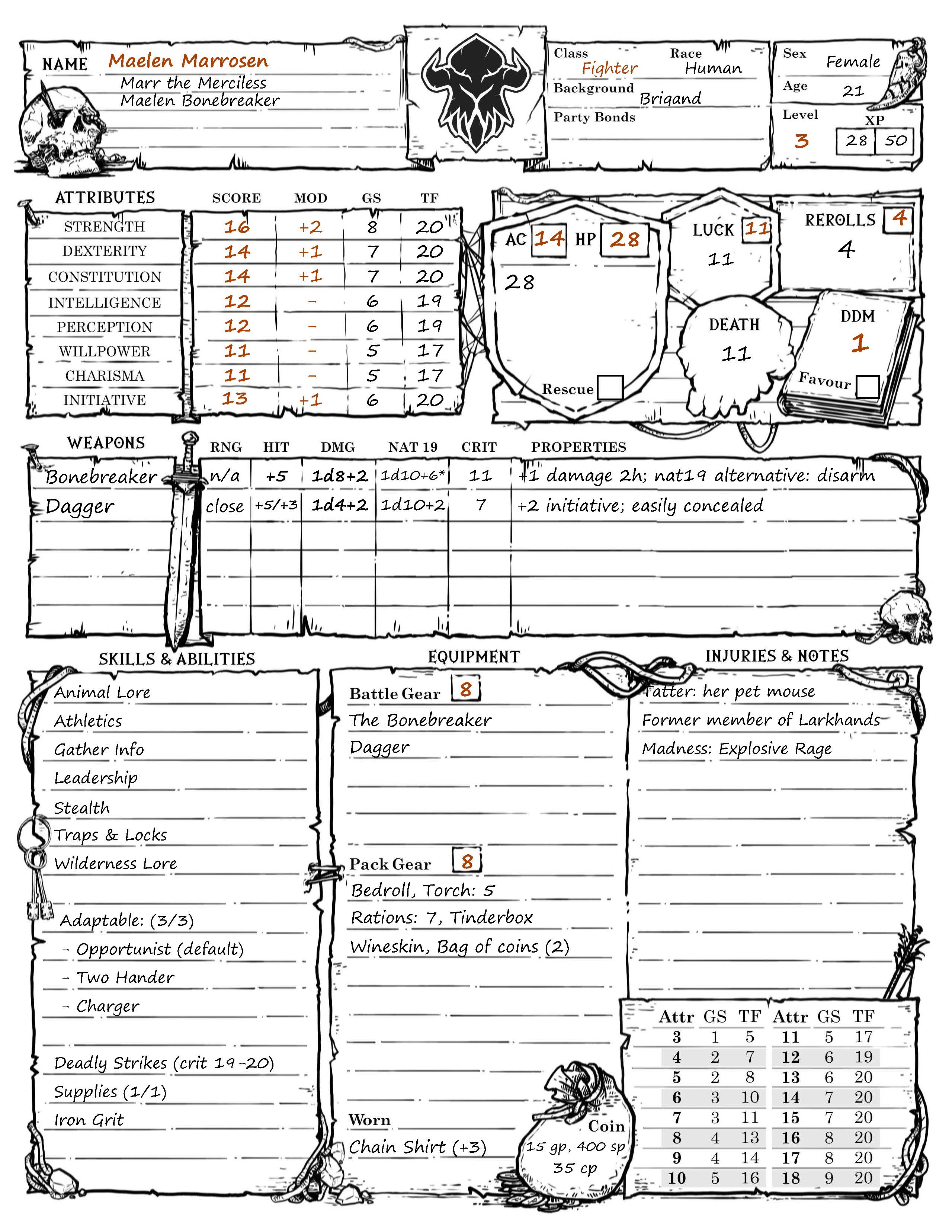
For Level 2, Maelen will use her attribute increase on Constitution, increasing it to 14 (which doesn’t change the modifier but will do so next increase). As a Fighter, her hit points increase from 16 to 20. She also gains an additional Reroll.

Class-wise, her attack bonus increases to +2. For her new skill, it’s a little boring but I do think Wilderness Lore makes sense, especially since she and Vessa are intent on going after Sarin’s treasure at some point. As a Level 2 Fighter, Maelen also gains Supplies, which means at any time during an adventure she can add 1d4 mundane items that she retroactively decided to pack. Pretty cool! Her Adaptable uses also go up to 2 uses / level. I misunderstood this ability last level… her default is Opportunist (which she used twice), and she has access to this ability as a default. The uses of Adaptable, then, are to switch to a different style (Two-Hander). Maelen also gains a new potential style: Charger, which allows her to knock foes prone with a successful Charge.

Here is her Level 2 sheet:

How does Maelen spend her Downtime? Recovering and getting her strength back, mostly, leaving Vessa to pay off the Circle, and then flit away their remaining wealth. I will say, just for fun, that Maelen is with her towards the end, maybe even starting the brawl that Vessa is now wanted for.

Level up complete! When we pick up the story this weekend, it will be nine weeks from the end of the Thornmere Hold story and kicking off the party’s next adventure (which will again be determined by random rolls… yeehaw!). See you then and there!

As always, if you have comments on either the story or game notes, feel free to post a comment below or email me at jaycms@yahoo.com.

Next: A Message For Alric [with game notes]

Tales of Calvenor: Three Oakton Adventurers

Welcome to the second post of my new project, Tales of Calvenor, an amalgam of solo-roleplaying in the background and fantasy fiction in the foreground. If you went on holiday and wonder what the hell happened to Age of Wonders, check out last week’s installment, which gives a broad outline of what I’m doing here and introduces you to the core game system: Tales of Argosa. We have a lot to do today so let’s dive in.

Disclaimer: If you’re only interested in the story and would rather skip the tabletop roleplaying stuff, today is not for you. Check back next week for the first chapter and you can ignore everything below. Today I’m tackling all the juicy game stuff that took many posts in Age of Wonders: I’m rolling up three characters (teaching the system as we go) and discussing any rules tweaks that I’m contemplating.

Welcome, anaislalovi!

Before we jump into the game stuff, I’d like to warmly welcome anaislalovi, the artist who will bring the characters from today to life. Isn’t the cover art on these posts amazing? That’s a stock image I purchased from her DriveThruRPG shop, and is by © anaislalovi, used with permission, all rights reserved (I’ll be adding this same language to the custom photos she’s done of our three protagonists… don’t be a jerk and steal her stuff). Custom artwork, you say? Yes indeedy! See below for more. Thank you, Ana, and I’m thrilled to be working with you!

Artwork by © anaislalovi. All rights reserved

A Brief Note on the World

Learning from my last project, I picked up the astounding Tome of Worldbuilding from Mythmere Games. Highly recommended. It’s an amazing tool, and really, really helped me nail down what I hope are primary ways this world will come to life for you as a reader and me as a storyteller. Rest assured that I have… um, many pages of deep exploration across various parts of this world that will help ground me as I play and write. Rather than reveal the results of working with the Tome, I’m going to let these details come out in the fiction, starting next week.

Suffice it to say, this is a low-magic fantasy setting. Our story will take place on the continent of Nomun, which translates to “The Known Lands,” and is made up of dozens of principalities sparring along uneasy borders. We’re starting in the Princehold of Calvenor, one of those principalities, on the eastern edge of the continent. More specifically, our story begins in The Redwood Marches, a broad set of settlements around a bay along Calvenor’s coast. Our protagonists all hail from Oakton, a large coastal city in the Marches. That’s a lot of names, but gives you at least the main hierarchy of locations. Each boldface entry above sits within the entry before it.

Introducing Vessa

There are seventeen listed steps in the Tales rulebook for character creation, which sounds like a lot but many of them are simple and quick. Plus, again, it’s a system that’s easy to puzzle out if you’ve played any traditional role-playing game. Let’s dive into our first protagonist…

Step 1 is to roll for Race. I’m going to slant the rolls here, since my setting is dominated by humans. I’ll roll a d10 to begin, with 1-9 being Human. If I roll a 10, I’ll then roll the table as suggested, a d12. I roll a 1. Human it is! Humans are great in ways that will become clear throughout this process.

Next, I roll d66 for Background. What’s a d66? It means rolling 2d6 but instead of adding them, you use one number as a tens integer and the other as a ones integer. I roll 52, which is Street Acrobat! Cool. That grants her (I’m sticking with at least two of the three characters being female) a +1 Dexterity (max 16), the Acrobatics skill (which grants a +1 bonus to relevant checks and allows for using a precious Reroll on failed checks), and a 10’ pole. Okay that last one is my least favorite old-school item because of how immersion-breaking it is for me, but we’ll make it work.

Step 3 is generating Attributes by “rolling 3d6 seven times and allocate the results in order to Str, Dex, Con, Int, Perc, Will, and Cha. You must have at least one attribute of 13 or higher and another of 15 or higher. If not, increase one attribute of your choosing to 13, and/or one to 15, as required. You may then also swap any two Attribute scores, if desired.”

Here we go! Strength 13, Dexterity 12, Constitution 9, Intelligence 10, Perception 17 (!), Willpower 16 (!), Charisma 9. Wow, those are some amazing rolls. From the rulebook, high Perception means “your character has excellent aim, a sixth sense for danger, and notices subtle details.” I’ll keep that high, but swap my Dex and Will scores, giving her a Dexterity of 16 and Willpower of 12. Because she’s Human, she gets an additional +1 to a single score, not to exceed 16. I’ll give it to Constitution, slightly increasing her hit points. She’ll now have a +3 modifier to Perception, +2 to Dexterity checks, a +1 for Strength, and no negative modifiers. Wheee!

Step 4, based on the rolls so far, I choose my Class. The two that make the most sense are Ranger, which relies on Perception and is a ranged specialist, and Rogue, which relies on Dexterity and backstabbing. Given her Background, Rogue feels like the obvious choice. That gives me a bunch of class abilities, equipment, skills, and such as detailed below.

As with all first level characters, her Luck is 11 and Dark & Dangerous Magic (DDM) score is 1 (more on what this score means if she ever tries to cast a spell or interact with a magic item). Because she’s Human, she gains 2 Rerolls. What are Rerolls? Exactly as you’d expect, though we’ll get into these more during play.

The next three steps are calculated scores. Her Initiative is the average of her Int and Dex scores, rounded down, so 13. Her Hit Points, as a Rogue, are her Con score + Levelx2, which is 12. And her Death Save score is 10 + either her Con or Will modifier, whichever is greater. Both are zero, so she has a score of 10.

Step 9 involves tallying her Skills. She already has Acrobatics, and being a Rogue automatically adds Stealth, Sleight of Hand, and Traps & Locks, all of which are self-explanatory. In addition, she rolls d10 for three additional skills and I roll: General Lore, Gather Info, and Apothecary. Those first two make sense: She’s streetwise and good at rumormongering. I’ll have to think about why she’s also a decent healer.

Probably the most fun step is Class Abilities. As a Rogue, she’ll gain a) Backstab, which helps her ambush and assassinate her foes, b) Finisher, which helps her pick off injured foes, and c) two Tricks: Glue Pot and Cat’s Grace, each of which can be used once at 1st level (she can regain these uses on rests).  

In terms of Gear, Tales of Argosa uses a modern system of Gear slots. She gains half her Str (5) each in Battle Gear (things that can be accessed in combat) and Pack Gear (things that can be accessed outside of combat) slots. All characters begin with a bedroll, torch, tinderbox, and rations, all in Pack Gear. She also has that 10’ pole, plus thieves’ tools, leather armor, a shortsword, and dagger thanks to her Background and Class. That takes up all her Pack Gear slots and 3/5 Battle Gear ones. I’d like to get her a ranged weapon because of that sweet Perception bonus, but with only 10 starting silver coins, she’ll have to wait.

We’re in the final stretch of character creation! Her Armor Class is 10 +1 for leather armor and +2 for her Dex modifier, for a total of 13. Her Attack bonus is 0 as a Rogue, +1 for melee and +3 for ranged thanks to Str and Perc, respectively. Meanwhile, her Age is 1d20+16 years. I roll 2, so she’s 18 years old. So young for this life of danger!

I have a custom name generator for this land, and her name is Vessa Velthorn. Some nice alliteration there. Per the rulebook’s suggestion, I’ll roll on the Tales of Argosa hireling personality and traits tables for inspiration. Oh my! She’s a “lotus addict” (hello explanation for Apothecary!) and has a broken nose. A true rogue through and through, I’d say.

The final, seventeenth step of character creation is Party Bonds, which we can’t do until we have a party.

See? Easy stuff. Even having never made a single Tales of Argosa character before, the game is elegant and the rulebook easy to follow. Here’s how her character sheet looks after this process, plus anaislalovi’s awesome depiction:

Artwork by © anaislalovi. All rights reserved

Welcome to the team, Vessa! Let’s see who she’s facing danger alongside…

Introducing Alric

For our second character, let’s return to Step 1. I roll a d10 for Race and get 8, another Human. A d66 for Background gets me 55: Scribe! That’s a +1 to Int (16 max), the General Lore skill, and a parchment & ink in gear. Already very different from Vessa! Love it. I’ll also make this a man to shake things up a bit.

General Attributes do a lot to define the character, of course. I roll 11 Strength, 7 Dexterity, 12 Constitution, 11 Intelligence, 14 Perception, 11 Willpower, and 13 Charisma. Excellent. I’ll swap Perception and Intelligence, which with his +1 makes 15 Int. I’ll also add the +1 from being Human to Willpower. That means his only positive modifiers are +2 Intelligence and +1 Charisma, with -1 Dexterity. Not impressive by any means but he meets the minimum standards. What’s up with that Dex? My son was born with club feet, so that’s the first explanation that popped into my head, and that’s how I’ll explain his Dex score.

Next is Class, and I believe we’ve found our Magic User for the party. Or maybe… Just kidding. We love spellcasters, so if there’s a chance for a Magic User, a Magic User he shall be.

His Luck, Rerolls, and DDM are the same as Vessa (11, 2, 1). His Death Save is 10, also the same. His Initiative is a nice, average 11. He has an impressive (for a Magic User) 13 Hit Points.

Skills-wise, he gains Arcane Lore and Apothecary, and he gets three more determined randomly: Detection, Divine Lore, and Stealth. Interesting. This guy certainly fits as a scholar: So much Lore. What’s up with the Stealth, though? Sneaking through the scroll stacks to steal forbidden knowledge, perhaps?

In Class Abilities, a Magic User gets… spells! At first level, he’ll know two spells based on d100 rolls: Sever Arcanum (basically Dispel Magic) and Cradle of Formlessness (basically Gaseous Form). Weird! He can cast one spell per rest at first level, whichever one he wants each time. He also can, twice per adventure, use Sense Magic (basically Detect Magic).

Next is Gear, and thanks to 11 Str our Magic User has the same gear slots as our Rogue. Two of those five Battle Gear slots go to a spellbook and a longsword (I see you, Tales!). Meanwhile, all the Pack Gear slots are taken thanks to the same bedroll, torch, rations, tinderbox, and parchment & ink. Like Vessa, he’ll have leather armor.

…Which is good, because his Armor Class is 10 +1 for the armor and -1 for Dex. That 10 AC is scary. No Attack Bonuses, but he does have a few languages: Calvenor (i.e. common) and two others that I’ll figure out later. Age-wise, he is 3+16… 19! A young crew. I was picturing him as significantly older up until that roll.

In fact, now that I know that he’s a teenage scribe just finding his way into magic, his longsword makes less sense. I love the idea of a mage with a real weapon, but I’m going to give him the silver for the sword and then spend 1sp on a boring old, stereotypical Gandalf staff.

Who is this magical dabbler? His name is Alric Mistsong, a club-footed young man who is, according to random tables, quite blunt (that will be fun to write!). I’m curious how he and Vessa know one another, but we’ll get to Pact Bonds after our final protagonist.

Here are Alric’s character sheet and portrait:

Artwork by © anaislalovi. All rights reserved

Introducing Maelen

Let’s meet our final PC! Once again, we begin with a roll for Race and get another 8. Easy Squeezy… even without my tilted, homebrewed odds, all three protagonists are Human.

For Background I roll a 24, which is Brigand! That will give her (yes, back to a female character) +1 to Strength (max 16), the skill Stealth, and, hilariously, a wine flask. The dice have created a really balanced party if this one can handle fighting.

To that end, here come the Attribute rolls: 12 Strength, 14 Dexterity, 11 Constitution, 12 Intelligence, 12 Perception, 11 Willpower, 11 Charisma. That’s about the most average, even rolling I’ve ever done in a “roll down the line” set of scores. Funnily enough, it also doesn’t meet the minimum requirements of at least one 15 or higher. The rulebook allows me to then bump one of my choice to 15, which will obviously be Str. With the Background bonus, that makes her Strength 16. I then have a +1 from being Human, which I’ll add to Constitution. Great.

Class feels obvious. It’s a Fighter, right? I suppose she could have also been a Barbarian, or even a Monk. But yeah… she’s a Fighter, and can definitely “handle fighting.”

Once again, Luck, Rerolls, and DDM are 11, 2, and 1. Her Initiative is a respectable 13. Thanks to her Class, her Hit Points are a more-than-respectable 16. Her Death Save is 11.

Next, we turn to Skills. She already has Stealth (something all three characters have… maybe I’ll build in some infiltration somehow into their adventures), and being a Fighter adds Leadership, Athletics, and three rolled randomly: Gather Info (also there for all three!), Animal Lore, and Traps and Locks. Yep, she’s definitely a scoundrel.

What Class Abilities do Fighters receive? First, she’s Adaptable, able to access multiple fighting styles. She begins with two (her Str modifier) styles: Two-Hander (gains “advantage” when rolling damage) and Opportunist (can get a second attack when a foe drops to zero HP). Like spells, she can use one of these abilities per rest. Her second ability is Deadly Strikes, expanding her crit range to 19-20. Cool!

Her starting Gear as a Fighter is, of course, slanted towards bloodshed. She has a whopping 8 slots each for Battle Gear and Pack Gear. In terms of Battle Gear, she begins with a longsword and shield, but I’m not loving a shield for a brigand who wields a sword two-handed, so I’m going to eschew it and give her the 20 silver pieces instead. She also gains a chain shirt. For Pack Gear, she has the standard array of bedroll, torch, rations, and tinderbox, plus that wine flask. Might she buy something else? For now, I’ll give her a dagger for 1sp. After that, I’ll have to think about whether she would buy a bow and arrows or not.

Even without the shield, her Armor Class is a sweet 14 (10 +3 for the chain shirt +1 Dex). Her Attack Bonus as a Fighter plus her Attribute modifiers are an equally sweet +3 for melee and +2 for ranged. How about age? I roll 5+16… 21. She’s still young, but the eldest of our trio. I really thought we’d have more age diversity, but I rolled 2, 3, and 5 on three d20 rolls!

Consulting my own charts and the hireling ones in the book, her name is Maelen Marrosen, a callous, hardscrabble mercenary with a “lucky pet.” Heh… let’s give an ode to Age of Wonders and make her pet a mouse named Tatter. I also love how this detail ties into her Animal Lore skill.

Well, it’s certainly a scruffier crew of characters than my last story, and perfect for a Sword & Sorcery tale. Let’s roll some Pact Bonds to see if we can puzzle out how and why these three find themselves adventuring with one another. For my first bond, I roll a 42 on d66 and get “Joint debt to someone/thing.” That sounds like our Rogue and Fighter’s bond. I rolled a second bond to see how Alric fits in, but I didn’t like the result and have another idea that… can kick off our story next time!

Artwork by © anaislalovi. All rights reserved

I don’t know if I was simply lucky or if the system is just that good, but I’ve ended up with a balanced party of interesting characters and am thrilled. I’m tempted to force a cleric (in Tales, called a Cultist) into the mix for a classic old-school band of PCs, but I’ll let the dice tell the story for now. Maybe they’ll find a cultist along the way.

Any Rule Tweaks?

As I’ve mentioned many times in this blog, as I read through Crusaders as the backbone of my Age of Wonders story, I made a metric ton of homebrewed rules changes. As I’ve also said many times, I consider the ability to make these sorts of changes a strength of a rules-light system, and these tweaks enhanced my experience with the game. Imagine, then, my enthusiasm when Tales of Argosa explicitly states, “The GM is the final authority of all rules, which are expected to be tweaked to fit table preferences.”

That said, I find myself ready to embrace Tales right out of the proverbial box, without any need to mess with anything yet. I’ll likely lean more heavily on the Mythic GM Emulator for solo play than what’s directly in the suggested solo play rules, and I’m sure to find little ways (like the Race rolls above) to tilt the game slightly towards my setting. Other than that, I’m happy with what I’m reading so far.

The only rule that I considered changing is that attack rolls are the only place in the game where you want to roll high on a d20, whereas all other rolls you want to roll low. That strikes me as odd. I’m no lover of THAC0, but just for the sheer elegance of it, I wondered about essentially making AC a low number (so, Maelen’s 14 AC would become 6), rolling low to hit. It’s an easy change, though it does mean that any “nat19” mentions become “nat2” and probably a few other conventions that would need me to flip-flop my brain. In the end, I decided it was a cosmetic change that forced me into more thinking than I needed for something that ultimately would function the same way. All of that said, it’s still in the back of my brain in case the inconsistency bothers me.

Oh, and I should also say that my intention heading into this project is not only to play Tales of Argosa as it’s written out of the box, but to do the same with Mythic GM Emulator. I only started dabbling with Mythic towards the end of Age of Wonders, but this time I’m going to try and follow it as Tana Pigeon and the book suggest, using as many of the tools as possible. The result will likely be lengthier “game notes” versions of each weekly installment, and more reliance on random rolls.

As always, if you’re enjoying these posts or have suggestions, drop me a comment below or feel free to email me at jaycms@yahoo.com.

Next: Our story begins [with game notes]

Age of Wonders, Issue 2c: The Bronze Armor [with game notes]

art by Roland Brown (drawhaus.com)

Kami hesitated. Beyond the open steel door lay a rectangular, windowless chamber that must have taken half the floor. The room’s only furniture was a wooden stool, and a worktable topped with various alembics, crucibles, glass tubing, and esoteric objects. A brick chimney lacking a hearth protruded from the east wall, while on the west wall hung some sort of scaled creature on display.

Standing motionless in front of her was a large suit of plate armor, seemingly made of bronze, with dead ratfolk littered at its feet. Kami didn’t know much about weapons- or armor-craft, but even still it was clearly a rare and valuable artifact, looking wholly unlike anything made in Kalee, Kaizuka, Mesca, or the Stone Isles. The metal figure was complete, from domed helmet to gauntleted hands to bronze boots. Its burnished metal was ornate with filigree, yet the details did not take away from the impressive, imposing bulk of the thing. Whoever this armor had been made for must have been a giant of a person.

The bronze helmet was a sphere with breathing holes and two menacing eye slits, which glared darkly at Kami. Yet when she stepped into the room, the eyes flared with pale blue light in the gloom. As they did, the armor shifted, regarding her, and a wave of apprehension and malicious, predatory intent washed over her. The armor stepped forward with a heavy thunk. Not an empty suit, after all!

First villain combat! Last time I figured out the stats for this imposing animated suit of bronze armor. Because of its Aura of Fear, I won’t need to make stats for Sergeant Mewa or his two City Watch thugs—they simply can’t attack the Bronze Armor in melee and they have no missile weapons (I mean, technically they could throw their spears, but then they’d be unarmed and I think they’re more likely to just freeze and allow the PCs to engage).

For the first turn, once again that Aura of Fear is doing work. The PCs hesitate, which means that only the Bronze Armor gets to attack. They won’t be surprised, however.

Kami is the one facing off against it, so that’s where it will deliver its first blow. She’s still conscious of using her powers in front of the City Watch, so won’t use Elasticity to dodge. That means, with its Prowess of 16 and her Alertness of 13, Kami has a 35% chance to dodge. But wait! I said last time that the PCs would get -20% in all melee rolls because of the aura, so that drops her chances of avoiding a blow to 15%.

Kami rolls 82, which means even if she used her lone Hero Point this Issue she wouldn’t be able to avoid the attack. The Bronze Armor has a whopping Strength score of 38. Thankfully, Kami subtracts 10 from all bashing damage due to her Elasticity. She takes 28 damage and is down to 2 (!) Vitality with a single blow. I, uh… don’t think she’ll hesitate to use her powers now.

Let’s talk Knockback in Crusaders. Knockback occurs when a character takes bashing damage greater than their Physique score, unless that character has Super Strength, which Kami does. What’s unclear in the rules is whether the damage is before or after resistances. I think it’s more cinematic and comics-accurate if knockback occurs even when a person is partially immune to damage. So I’ll say that Kami is hurled backwards but, because did not take damage greater than her Strength level, she won’t be stunned.

Again, because it’s cool and comic book-like, I’m going to say that Kami hurtles backwards and through the wall behind her, rolling to a stop before she would break through the outer wall and fall three stories below. Because of Elasticity, I won’t inflict any damage to her from this effect. But I think the Bronze Armor has everyone’s attention now!

Kami’s bowels clenched as the figure advanced on her, unable to will herself to move out of the way. Her assailant raised a bronze gauntlet faster than she would have expected and slapped her with the back of its hand.

Before she could register what had happened, she was flying backwards, out of the steel door through the air. There was a tremendous crashing sound and Kami found herself rolling on a dusty floor. She blinked, trying to get her bearings, just as the pain of the blow began blossoming in her battered chest where the warrior had struck her. All around her were shards of shattered wood. He had backhanded her through the wall!

She was in an entirely different room, this one devoid of ratfolk corpses and full of cobwebs. Like the room with the bronze figure, it had a long, narrow table and stool, though this one was adorned by a brass cage and a small box encrusted with gold and jewels.

Kami grimaced and watched through the broken wall as she struggled to stand. Her companions faced the towering figure in bronze armor with its witch-lit eyes, clearly someone as god-touched as her. If she didn’t get back into the combat, they would all die.

Round 2! Now we’re using our regular Alertness to determine order. Maly will go first with a 15, then Emah and Kami with 13, and finally the Bronze Armor. Sergeant Mewa and his guards will effectively just stare slack-jawed and cower thanks to the Aura of Fear.

What can Maly do to a suit of animated plate armor? She’ll call out to her panther friend, for one, and then draw a dagger and strike. With her Prowess of 13 and its Alertness of 10, she would normally have a 65% chance to hit. With the Aura of Fear, however, that drops to 45%. She rolls a 16! That’s 15 damage, reduced by 10. It takes 5 damage, bringing its Vitality to 49. Not much, but it’s a start.

Emah draws her sword and charges. With her sword she would have a 100% chance of hitting, but that’s dropped to 80% with the aura. She rolls a 93, and I don’t think it’s worth using a Hero Point just yet. I’ll say the blow deflects off the armor.

Kami has been sent into the battle’s Perimeter (all distance in Crusaders is abstracted into three zones: Center, Perimeter, and Environs), and she doesn’t have any ranged attacks. As a result, she uses her turn to stand and make her way back into the room.

Now it’s the Bronze Armor’s turn. Who will it attack? I can make a case for any of our PCs, so will roll randomly to determine. I go in order of turn and roll a 3 on a d3, which means Kami. If it hits, she’s out of the combat.

This time Kami has no hesitation to her Elasticity to dodge. Now the Bronze Armor’s 16 Prowess is against a score of 25. That would normally give Kami a 95% chance to dodge, which is now 75%. Here we go… I roll 02!

Beyond the breach, the pale-skinned Maly showed incredible courage. She dove past Emah, shouting something Kami couldn’t hear over her ringing ears. As she danced around the warrior in armor, a dagger flashed past in the dim light of the room, scoring a line across its shoulder plate.

Her friend’s attack seemed to jolt Emah out of her hesitation. With obvious training the Kalee warrior stepped forward to engage the figure.

But Kami didn’t wait to see the result of the confrontation. The armored warrior had hit her harder than she would have thought possible. If it struck any of the people in her party, it would simply kill them in a single blow, she was sure of it. The warrior’s strength was greater, even, than Kami’s own, something she wouldn’t have believed. Any worry about displaying her newfound abilities in front of her companions was gone. She needed to end this fight, and quickly, before anyone died.

Though her stomach lurched, chest ached, and head pounded from the blow she’d received, Kami pushed herself up. The landing beyond the break in the wall was clogged with the City Watch members, all of whom stared frozen at the battle before them. Even Hakau, despite his strong sense of duty, appeared unable to will himself into the fray.

The house was a simple square, which meant it was only this room and the one with the battle, each wrapping part-way around the central staircase. She moved left and through the dusty room, past the long table with its birdcage and gilded box, around a bend and to a closed door. Kami practically ripped the door open and stumbled forward, still clearing her head.

Beyond the door was the armored figure, pale glowing eyes illuminating the darkened room. Almost immediately upon seeing the bronze warrior, a wave of apprehension again filled her. It seemed that he or she radiated some sort of unnatural aura, causing her heart to race and weakening her limbs.

Those glowing eyes locked onto her, ignoring Maly and Emah futile attempts to damage the thick plate armor. It charged her and swung its gauntleted fist down, the blow meant to crush her into the floor.

Instinctively, Kami’s body simply… flowed. She didn’t know how else to describe it. She relaxed into allowing her torso and limbs to loosen, like taking a deep breath. The bronze figure would have punched her where her neck met the shoulder, a blow that may have crippled  or outright killed her if it had landed. But instead, she dove left and around the bronze fist with her body while her legs moved right, almost as if the two halves of her were splitting up and darting in different directions. The armored warrior’s gauntlet struck only air, and Kami’s own arms simultaneously stretched out, ready to strike.

Hakau and his guards yelled out of sight from the landing.

Kami saw Emah flick a glance at the doorway and grimace. “Rats!” she announced. “They’re here!”

Yes indeed. A troupe of ratfolk have been waiting to make their attack, and Round 3 is the time. There are a fair number of them, as well. I’ll say it’s three “bunch of thugs” groups, each with a Fight score of 10. They’re led by a lieutenant with the same stats as the one that tackled Maly out in the street: Physique 12 Prowess 12 Alertness 14 Psyche 10.

This addition to the combat means that the City Watch members also need stats. I’ll say the two guards are a group with Fight score of 11. Sergeant Hakau Mewa will have 12 across all his stats.

So here is Round 3 in initiative order (I’ll also list current health & location):

  1. Maly (30 Vitality, room)
  2. Ratfolk lieutenant (12, landing)
  3. Kami (2 of 30, room)
  4. Emah (39, room)
  5. Sergeant Mewa (12, landing)
  6. City Watch guards (11,11, landing)
  7. Ratfolk mob 1 (10,10,10, landing)
  8. Ratfolk mob 2 (10,10,10, landing)
  9. Ratfolk mob 3 (10,10,10, landing)
  10. Bronze Armor (49 of 54, room)

Let’s get crazy! Maly can see that she won’t be much use against the Bronze Armor, so will return to the landing in order to help the City Watch. In fact, she’ll take on the lieutenant. She has a 45% chance of hitting and rolls an 18, doing 15 damage and killing it. Nice, Maly!

With the lieutenant out of the way, Kami and Emah are up next and will continue focusing on the Bronze Armor. With the Aura of Fear, Kami has a 30% of hitting and rolls a 56. Dang, that would have been cool. Emah, meanwhile, has an 80% chance and rolls 64, doing 10 damage after the thing’s Armor is applied.   

Meanwhile, Sergeant Mewa turns and lays into the first ratfolk mob. He has a 60% chance of hitting and rolls a 73. Nope. He’s surprised and still affected by the Bronze Armor’s aura.

The City Watch guards also defend themselves against the rat horde. They have a 55% chance of hitting and roll 88… Amazingly, through four combats that is our first ever critical fumble! I’ll say that with the Aura of Fear and sheer number of rats, they panic. They’ll be Passive Targets for the ratfolk mobs, meaning they defend with an Alertness score of 5. Yeesh.

Let’s see if they survive the onslaught of rats. With an Alertness of 5, they only have a 25% chance of avoiding damage from each mob. Against the first they roll 37, which does 10 damage. Against the second they roll 99, another critical fumble! No wonder Inspector Calenta recruited our PCs! With that result, I’ll say the second mob tears through them, doing enough extra damage to kill both guards. That leaves the third mob to attack Mewa, who is not as stupefied as his guards. He has a 60% chance of defending and rolls 19. He can’t kill any rats, but he does fend them off (and more importantly, delays them from entering the room).

Finally, it is the Bronze Armor’s turn. Will it attack Kami or Emah? I’ll roll odds/evens… 4. That makes sense. Kami isn’t doing any damage to it, so Emah is the bigger threat. With Emah’s Parry ability, she would normally have a 70% chance to avoid damage. With the Aura, that drops to 50%. She rolls… 95. Ouch, that’s not even a roll that a Hero Point will help. The Bronze Armor does a whopping 38 damage, leaving Emah with a single point of Vitality. But let’s also remember Knockback. Emah goes flying against the wall. I’ll make a Luck roll to see if she bursts out of the wall to fall three stories or not. The outer walls are stronger than the inner ones, I’ll say, giving her a 60% chance of staying indoors. I roll a 24. Whew. She is Stunned (unable to act next turn), but at least she didn’t fall three stories to her… death? I don’t know how I would have handled that.

Kami heard combat unseen around the bend of the room, the chittering of large rats, the shouts of the City Watch. Then she heard screams, awful and anguished, and they sounded like human screams.

Emah circled the armored warrior and barked over her shoulder. “Maly! Help the others!”

“On it,” Maly said, and darted out of the room, a dagger in each hand. Oddly, she then shouted. “Yes now! We need you!”

Kami didn’t have time to ponder the young woman’s words or the battle raging on the landing, however. The glowing eyes within the bronze helmet pivoted away from her flowing form as the warrior turned to face Emah.

“Watch out!” Kami warned.

Emah was waiting, sword in front of her, but perhaps did not anticipate the speed or power of her heavily armored opponent. With the same backhanded swing that had surprised Kami earlier, the warrior batted Emah back. For her part, Emah seemed to move her blade to parry, but the warrior’s strength was immense. The blow knocked the sword from Emah’s grip and the woman went flying, crunching against the wall and landing in a heap.

“No!” Kami yelled.

As the bronze helm turned back to face Kami, a feral roar filled the third floor of the building, causing everyone to pause.

It’s Round 4, and Maly’s companion Destiny the panther has finally entered the story! Let’s take stock of our combatants in this crazy battle:

  1. Maly (30 Vitality, landing)
  2. Kami (2 of 30, room)
  3. Emah (1 of 39… stunned, room)
  4. Destiny (30, stairs)
  5. Sergeant Mewa (12, landing)
  6. Ratfolk mob 1 (10,10,10, landing)
  7. Ratfolk mob 2 (10,10,10, landing)
  8. Ratfolk mob 3 (10,10,10, landing)
  9. Bronze Armor (39 of 54, room)

Maly will attack the first ratfolk mob and has a 65% chance to hit. She rolls an 82, however. I think the chaos of the landing is tough for her to navigate.

Kami will try and hit the Bronze Armor again and again has a 30% chance to do so. She rolls a 94. Emah, meanwhile, is stunned. She shakily returns to her senses and will need to spend next round regaining her sword (am I being overly punitive? Given the strength of the blow she took, I don’t think so).  

Destiny the panther is coming up the stairs below the rat mobs and will attack the third mob with his claws and teeth. He has a 60% chance of hitting and rolls a 96. For now, he’s just snarling and gaining ground. Besides, those rats are slippery.

Sergeant Mewa, meanwhile, is fighting the first mob. He also has a 60% to hit and rolls a 79. Wow, bad turn for our heroes.

None of the ratfolk mobs will attack Destiny. They want Mewa out of the way so they can swarm into the room (I’ve decided that once the City Watch are down, they can do so… Maly isn’t enough to stem the tide on her own). Mewa has three 60% rolls to beat them back. He rolls an 84 on the first one, taking 10 damage and dropping to 2 health. He rolls a 90 on the second one and dies, overwhelmed by the flood of combatants. The third mob moves through the hole Kami made when struck. They don’t want to fight, really… they’re here for what’s in the next room! It will take them the next turn to get what they want.

Finally, it’s the Bronze Armor’s turn and there is no doubt it will attack Kami. Once again, she has a 75% chance to dodge with her Elasticity. She rolls a 31, literally the only successful roll by the heroes this round.

Well, my first villain battle (adding thugs and lieutenants now that I have a feel for them), is quite the tense one!

What was happening? Kami could hear what sounded like a horde of ratfolk chittering and squeaking, heard Hakau shouting in surprise and defiance, a mighty “Yes!” from Maly, and some sort of enormous beast’s echoed roars. Then there was hissing, rats screeching, and Hakau screaming in pain. Kami realized that she couldn’t hear the other City Watch members, and feared what Maly and Hakau might be facing upon the third-floor landing.

Emah lay sprawled against the wall. Given the armored warrior’s strength, she assumed that the woman was dead.

And then Kami could think of nothing beyond extending her body left and right, her body flowing unnaturally to avoid the bronze, gauntleted fists of her assailant. Whoever was within the plate armor, they seemed unconcerned with the battle raging upon the landing. The entire glowing-eyed, malicious intent of the warrior was focused on her and her alone.

Next: Issue 2 Reflections!

Age of Wonders, Issue 1b: Jail Rats [with game notes]

art by Roland Brown (drawhaus.com)

Emah spun, glaring. She had heard rats chittering and something padding through the shadows.

“Maly,” she growled. “They’re here.”

The warrior tested the grip on her sword, once her mother’s. It was a weapon without flourish, with an iron crossbar, the blade long and wide. Its leather-wrapped handle fit her palm like a natural extension of her body. She swung it out in front of her, air whistling, as she took in their assailants.

The flickering torchlight showed many sets of round, beady eyes, and small furred bodies wrapped in rags. Emah counted half a dozen in all. Each creature was the same size—that of a human child—as the corpses she’d seen upstairs, and each possessed the head of a large, brown rat, with furred arms and standing upright on legs. Their four-fingered hands and feet were tipped by black claws, and some held crudely sharpened sticks. Nothing like these rat-people existed in any tale or story she’d ever read or heard, and she was in her heart a scholar. Yet here they were… inside the inner keep walls of Oakton!

“No,” her friend Maly whispered, almost inaudibly. “No, no, no, no.”

Our first Crusaders combat! Woo!

First things first, these little rat guys are considered (and yes, this is a technical game term) a “bunch of thugs.” There are two groups of three ratfolk, and each has a single stat, called Fight, that they’ll use for everything combat-related. Each ratfolk mob has a Fight score of 10.  

Combat scenes in Crusaders are handled in rounds, and characters act in descending order of Alertness (or Fight, in the case of thugs). To keep things simple for this first combat as I’m learning the system, I’m going to say there is no surprise round for the rats… they’ve snuck up on the PCs but alerted them with their chittering immediately prior to any action. Besides, Emah has Psychic Sense, which prevents her from being surprised, and she has time to warn her companions.

Maly’s Alertness is 15, followed by Emah and Kami, each with 13. The ratfolk mobs will each then act with a Fight score of 10. Where is Destiny the panther? Not part of the story yet!

There are no tactical battle maps in Crusaders, and space and movement are both abstracted. Again, to keep things simple, for the purposes of this scene, everyone is considered in melee at the Center of the action (there are two other distances in the game, but we won’t worry about those right now).

All rolls are a) player-facing, meaning that the PCs roll to both attack and defend, and b) percentile, based on the formula [(Active – Opposing) x 5% + 50%] – which sounds confusing but is easy once you get the hang of it, and there’s also a handy table in the rulebook. For Maly, her Prowess score is 13 against the rats’ Fight score of 10, which means she has a 65% chance of hitting with her dagger.

Maly rolls a 63… hit! She does her Physique (10) in damage, plus 5 for the dagger, for a total of 15 lethal damage. With a Fight score of 10, one rat dies, and in mobs the excess damage carries over to the next rat, bringing it to half health (5).

So we have one mob at full strength, and another with 2 ratfolk at 10 & 5 vitality. You can see where the combat here is fast and light… Maly only gets one action, but it’s easy to describe it as multiple maneuvers.

Emah saw shock and disbelief flicker across her friend’s pale face and quickly settle on determination.  

Maly dodged to her right, dipping low, as the first rat-thing rushed by her. She extended her dagger as it passed, cutting it from armpit to belly in a shower of dark blood. The thing screamed as it fell, rolling past. A second creature stabbed out with a stick and Maly kicked it in the face. Two things Emah knew of Maly from the training yard… she was quick and she fought dirty, to win.

With a roar, Emah stepped forward, swinging her broadsword wide and effortlessly. The blade tore through two of the leaping rat-folk, and they squealed briefly before dropping lifeless to the stone floor.

Emah can use her Prowess +5 with her sword and does Prowess +5 damage if she hits. With her score of 20 and the rats’ Fight score of 10, she will automatically hit and deal 20 damage. That kills 2 of the rats exactly.

Mob 1: One rat at 10 health (represented by Fight).

Mob 2: One rat at 10, one at 5.

Now it’s Kami’s turn. Does she reveal her powers to these relative strangers? She’s furious (for reasons we’ll learn later) so is not thinking straight. She is not, however, a trained fighter. Her Prowess score is only 10, which means she has a 50% chance of hitting. She rolls an 83 and misses. I could use her sole Hero Point this issue (the length of a usual gaming session, which I’m judging to be three of these blog posts) to flip-flop the roll and hit, but I’ll hold off since these thugs don’t seem particularly dangerous.

Both ratfolk mobs, then, have the opportunity to attack. I’ll say that the two rats head for Kami and the single rat will attempt to avenge its brethren against Emah. Once again, all rolls are player-facing, so Kami will roll with a score of 25 thanks to her Elasticity instead of Alertness. She has a 100% of success and dodges easily out of the way.

Emah has an Alertness of 13, but can add +5 because of her Parry ability. She then has a 90% chance of avoiding the attack from the remaining creature. She rolls a 62 and does so.

Kami seemed to shake herself out of her distraction as the combat raged. She turned, face furious, and swung one of her bare fists. Her arm seemed to elongate, extending much further than it should have done. The rat creature in front of her ducked below the clumsy blow, but as her fist struck the iron bars of a cell there was a tremendous CLANG!, leaving the bars bent.

As if Kami’s swing was not remarkable enough, what happened next caused both Emah and Maly to gape. The rat continued its charge, stabbing forward with its sharpened stake. It was a clever strike and should have impaled her between her breasts, but Kami’s body… bent, flowing like a ribbon in a breeze around the stab. The creature squeaked and chittered in surprise.

Maly is going to try and take out the one attacking Kami, and does so by rolling a 37. Her 15 damage is more than enough to kill it, while Emah slashes with her sword and kills the remaining two ratfolk.

And just like that… we’re done! Crusaders combat is as advertised… fast, clean, and easy. Also, even at street level and my neutering of the PC’s stats, these bunch-of-thugs mobs are no match for them. All of which does indeed feel superheroic. Yay! Soon I’ll feel more comfortable going hard on our party, either by upping the Fight scores or adding more baddies, but I’m thankful to have today’s warm-up.

Maly, clearly running on fear and instinct, had followed the rat creature and stabbed it between the shoulder blades from behind. It dropped, her dagger’s blade slick with blood, and she looked Kami in the face. Where Maly was wide-eyed and disbelieving, Kami’s face was etched in danger, eyes narrowed. Emah swung her sword left and right, snick-snack, killing the final two creatures. Their dying squeals drew the other two women’s attention.

“What is going ON!?” Maly shrieked, her voice shrill. “What are these things? What is this!?” she gestured from the bodies to the bent bars of the cell behind her and then to Kami.

“We go,” their employer said decisively, face glowering. When the others didn’t immediately comply, she rounded on Emah. “You said we must leave, yes? Let us leave, then, and quickly. We should not be here when the Watch arrives.”

Emah looked at the bent bars and then to their employer, a scowl as her mind raced. Impossible creatures followed by impossible acts from Kami. For weeks Oakton had been buzzing about seeming fable-tales occurring across the town, and now she would be adding to those accounts. She had so many questions but now was not the time. The job was to bring this woman to the jail and escort her home, that was it. They needed to get out of here, especially if more of those creatures could bubble out of the cesspit at any time.

“We go,” she confirmed with a short nod, and turned towards the staircase.

“Wait!” Maly cried. “We’re just going to leave? What are these things, Emah? What happened just now?” She was arguing to an empty hallway, however. Emah had already ascended out of view, with Kami quickly on her heels.

Emah heard Maly growled in frustration and the clatter of a sharpened stick that she must have kicked in frustration. Then Maly’s blonde head was bobbing up from the darkness in the torchlight, following them.

The three women scaled the spiral stairs, through the guard room and into the entryway. Nothing there had changed; two dead guards and an equally dead rat-thing lay upon the stone floor in pools of dark, sticky blood. Emah’s mind calculated. One of the creatures dead here, one on the stairs. That made eight total. Was that enough to kill three armed guards? It seemed unlikely, especially without more of the rat-things’ deaths. They must have surprised the guards, but the rats seemed to her like poor fighters. They would have to rely on overwhelming numbers.

“Do… do you think we were seen entering?” Maly panted, interrupting Emah’s thoughts. She blinked, frowning. Kami moved past them both towards the exit.

“I don’t believe so,” Emah frowned. “But when we leave, are we going straight to the Watch or disappearing into the crowds?”

The question was directed at their employer. Kami paused, her hand on the door latch. Emah examined the woman’s hand, thinking that moments before that same hand had extended impossibly long and bent iron bars with a single blow. Kami’s skin was as unblemished and perfect as before, the fingers long and graceful.

“We disappear into the crowd,” Kami nodded, and seemed to remember her hat and walking stick. She bent to retrieve them both, securing the hat firmly on her head. “Best to not let them detain us. I do not think the Watch will assume innocence of a madame of the Rose District and two new mercenaries with, ah, questionable reputations.”

Emah’s frown deepened. The woman had clearly done some investigating into who she hired. She liked that not at all, especially for such a simple job.

“Alright,” Emah exhaled, sheathing her sword. “Maly, come here. You have blood on your shoulder and arm.”

For the next moments, they looked each other over and cleaned themselves the best they could manage with water and the yellow cloaks of the Watch. The parts not spattered with gore, that is.

“Where are we going?” Maly asked when they were done, her voice pitched like that of a frightened child.

Kami looked back, her expressionless face made more so by the wooden mask covering half of it. “Back to the Golden Heron. Are we ready?”

Emah met her eyes and nodded.

Kami opened the door.

Now is a good time to use the Mythic GM Emulator for the first time. It’s an amazing tool for solo gaming, though I don’t often use it religiously or strictly exactly as outlined in the book. Indeed, when playing through published adventures in Dungeon Crawl Classics, ripe with random tables, I found that I didn’t need it at all. Here, when the game is homebrewed and the system lighter, I suspect I’ll lean on it more heavily.

The first question I’ll ask is: Do the trio meet any problems outside the jail? If the answer is no, I’ll just cut to the next scene. If yes, we’ll see where that takes us. The last scene sent the story further out of the PC’s control, so I’ll increase the Chaos Factor from 5 (which is the baseline) to 6. I’ll also say that the chance of them encountering trouble is Unlikely – after all, this is a little-visited jail, away from most of the foot traffic within the inner keep. These decisions give me a 50/50 chance of a Yes. Here’s the roll…

44, which would have been a “No” if the Chaos Factor had been 5 but is a “Yes” now. The PCs do indeed encounter trouble, which means now I need to ask what sort of trouble. First, I’ll roll on the Event Focus table: 11, a new NPC. Second, I’ll roll for the Event Meaning, and use the Descriptor tables first: 16 & 39, which is Combatively Glorious. What sort of character or creature would be outside, between the jail and the brothel, that might be described in that way? Let me ponder…

I’ve got it. Let’s keep the action flowing. It’s not something waiting for them outside. Instead, it’s something that followed them out into the light from the jail. There’s about to be another combat with ratfolk, and this one will be in full view of the city.

This is as good a time to introduce the other sort of Minor Foe in Crusaders, the Lieutenant. I’ll say that there was a leader of the ratfolk minions that were down in the cesspit, and when his pack didn’t return it went to investigate. The creature has tracked the PCs to the upper level and attacks just as the door opens.

Lieutenants, unlike thugs and like PCs, have four distinct attributes, with an average of 12 across scores, and can take damage equal to their Physique. Before I fill out the stats, let me roll on a few more Mythic tables: Character Description (99, Wild), Character Personality (01, Active), and Character Motivations (77, Plan). Alright, it’s a hyperactive super-rat who had planned this jail infiltration into the city and is now furious and crazed that its plan went awry. I’ll give it Physique 12 Prowess 12 Alertness 14 Psyche 10. Fun fun!

The Kaizukan woman walked outside, her hat lowered over her face. The clouds had given way to light rain, which had only begun to wet the cobblestone streets around the keep under the reaching branches of the Great Oak. Emah followed close at her heels, hand twitching towards the hilt of her sword. The mahogany skin of her shoulders, arms, and face glistened with sweat in the sudden light.

“Let’s go,” she whispered sharply to Maly.

The young Stone Islander woman swallowed and moved to follow, but something behind her shuffled, causing her to pause. Emah had just enough time to call out a warning as, out of the shadows, a savage, furred thing snarled and tackled Maly.

Back to Initiative we go, but this time the ratfolk lieutenant will indeed have a surprise round against Maly since Emah isn’t the one being attacked. Surprise means that the lieutenant will get to act first in the round, but thankfully, because its Alertness is not greater than Maly’s (12 vs 13), Maly will not be a “passive target” (i.e. ridiculously easy to hit). Still, because she’s surprised, I’ll say that Maly can’t add her bonus to Alertness from Acrobatics, which means that she has only a 55% chance to dodge – I’ve already said that the attack hit, but this will determine whether she rolls with the attack and thus doesn’t take damage.

Maly rolls a 65, failing. She takes the blow hard, and the lieutenant deals its 12 Physique damage to her. Maly’s Vitality started at 30, which is now down to 18. Ouch.

She is next in initiative order, and in her shock (and my effort to test out different combat maneuvers) will try to Grapple the lieutenant, which is an opposed roll of Physique against Physique. Maly’s not the strongest, so she has a 40% chance of succeeding. She rolls a 96 and fails miserably.

Emah will act next and can end this tussle with an expert sword strike. Thanks to her Weapon Master skill, she has a whopping 20 against the ratfolk’s Alertness of 14. That means she has an 80% chance of success and rolls a 40. She does 20 lethal damage to the lieutenant, killing it.

Lieutenants usually act in concert with gangs of thugs, and I knew a single lieutenant would lose quickly against three PCs. But the consequences for this fight were not the threat of death, but instead a) the public nature of the fight, and b) seeing a different, stronger version of the rats. I’m also feeling my way into the Crusaders system. In those regards, mission accomplished!

These ratfolk also spread disease. Let’s roll Maly’s Physique against a “disease potency” (totally making this up) of 12. That’s a 40% chance of success with her, and I roll a 51. Yikes! Here is an excellent use of Maly’s lone Hero Point for the issue, so I’ll flip-flop that roll into a 15, allowing her to stay disease free for now.

Maly and something large and furred rolled in a bundle out of the jail door and onto the street. Emah drew her sword, moving close. Her friend was screaming and beating at the thing vainly with her bare hands, but this rat-creature was larger and stronger than the others they had fought. Indeed, it was the size of Emah, with muscled shoulders and black claws each the length of her last knuckle. It snarled and chittered, tearing and ripping with those claws. Maly cried out in pain.

Emah stepped in, lunging forward with the tip of her sword and through the rat-creature’s neck. This close, it smelled powerfully of animal and sewage. The creature screamed and slumped to the side, and blood splashed across Maly’s neck and face. She scampered to her hands and knees, gaping at the now dead figure she’d escaped. Its tongue lolled from a long snout filled with jagged yellow teeth.

Emah wiped the blade on the creature’s gray rags and pulled at Maly. “Come on! Up, girl, up!”

All around them, people were pointing and exclaiming in shock and horror. Someone in green-and-yellow livery nearer the curtain wall shouted to one of the watchtowers.

Rain was pattering harder now, blurring everything around.

“We can’t run,” Kami said, voice hard and resolute. “They’ve seen us.”

Age of Wonders: Issue 1c

Age of Wonders: Emah Elmhill

I’ve picked the system for my next solo game. I’ve outlined the setting and variant rules. I’ve built enough of the starting settlement to have a feel for it and the wider world. Today, it’s time for the first character to throw into that setting, playing that system, as a resident of that settlement.

I haven’t decided how many PCs I’ll make to begin my game. At least two, probably three. As with almost everything in this project, I’ll feel my way there and decide.

Background Rolls

Before I jump into Crusaders, I absolutely love the Background Generator tables in ICONS Origins. Let’s start there, busting out a pair of d6. I’ll log each table and results, with the roll in parentheses.

Gender (6): Female.

Ethnicity* (12,5,7): Mixed heritage: Kalee and the Stone Isles.

*the city of Oakton has four major peoples, which are rough analogues of broad-African (Kalee), Spanish/Mexican hybrid (Mesca), English (Stone Isles), and Japanese (Kaizuka), roughly in that order from most- to least-common.

Age (7, 4): 24 years old.

Manner (11): Detached and logical.

Who do you value? (3): Family member.

What do you value (4): Knowledge.

Attitude (10): No one will ever hurt me again.

Birthplace (6): Rural. Raised in an isolated household away from civilization.

Status (8): Comfortable upbringing, able to afford a few luxuries.

Tragedy (4): No childhood tragedy.

1st Past Experience (1,2,2): Has a friend that is a current or past romantic interest.

2nd Past Experience (5,6): Suffered a personal loss, such as the death of a loved one, a serious financial setback, or personal tragedy.

3rd Past Experience (6,1): Framed or falsely accused of something she didn’t do.

4th Past Experience (4,2): Met someone willing to teach and mentor her.

5th Past Experience (4,1): Made a connection, contact, or earned a favor from someone.

(According to the Background Generator, you roll 2d6 for the total number of past experiences, but I find this volume of results overwhelming. Instead, I’m going to stop when I think that I’ve “found the character,” which is right about now.)

Let’s put all of those rolls together into a brief bio:

Emah Elmhill was the product of an illicit marriage between a scholar from one of Oakton’s several schools and a Kalee warrior from the castellan’s personal guard (who are not allowed to marry or bear children). To raise their daughter without recrimination, they moved north to the foothills of a distant mountain. Emah’s father’s wits and her mother’s sword kept the family safe, despite the ever-present danger of the wilds, and it was an upbringing upon which she still thinks fondly.

She was nineteen years old when her mother died to a beast threatening their home. Though she had trained every day with a blade, Emah and her father could not survive alone, and so moved back to Oakton. Her father reacquainted himself with a university there, and Emah joined him as a scribe. Indeed, she quickly became a favored pupil of the school’s head, much to her father’s pride.

…at least until another scribe, jealous of Emah’s reputation, framed her for stealing a precious and ancient scroll. Though few thought Emah capable of the crime—most especially her father—the evidence was conclusive, and she was expelled.

Desperate and without prospects, Emah joined the Adventurer’s Guild, and…

Well, I suppose we’ll see what happens next. In terms of the Background Generator results, I haven’t yet worked out who her romantic interest is, and I combined both the mentor and a contact who can benefit her later (both are the school’s head). As I said, though, I’ve got a good picture in my mind’s eye of Emah. Thank you, d6s. Now it’s time for your cousins, the d10s, to take a turn.

Origin

Right now, Emah is merely a fantasy character. We’ve established that she can swing a sword, is learned, and has a variety of contacts and rivals in Oakton. But is she a newly bestowed super in this world or something else? I’ll be relying primarily on the tables from my variant rules post to find out!

My first roll is an important one: Emah’s origin (or, if you prefer, what sort of “class” she is in this story). I roll an 89 (Spy/Assassin/Thief/Guide), which can also be a 98 (Warrior). Ooo! So she’s non-powered, but hanging out with folks who are affected by the Wyrding. How interesting!

I’m seeing Emah as a noble soul, which means that Spy, Assassin, and Thief don’t really work. She could be a “Guide,” except that she’s relatively new to Oakton, where our story begins. Instead, I like the idea that she’s a scholarly Warrior, someone there to protect her friends with martial force. Warrior it is.

Powers and Attributes

As a Rank 1 character, Emah received 3 rolls on the Powers table plus 10 Attribute points to spend. Because she’s a Warrior, she can trade one of these rolls for either Armor or Weapon Master, and must trade one for the Intensive Training option (4 extra Attribute points). In other words, she instead has only 2 Powers rolls and 14 Attribute points to spend.

For the first Powers roll, I will absolutely trade it for Weapon Master. I’ve already said that her mother trained her to help defend their homestead in the wilds north of Oakton, and what’s a warrior without weapon badassery? I’ve pictured it as a sword, which is basic but cool. This Super Skill will give her three combat maneuvers when wielding her blade: Superior Strike (+5 to Prowess with her weapon, and can use Prowess instead of Physique to calculate damage), Parry (+5 to Prowess, which she can use instead of Alertness when defending melee attacks), and Disarm (she can try to disarm one-handed weapons instead of deal damage).

That leaves me one Power roll remaining: I roll 49, which can also be a 94, and yields these options: Leaping, Vigor, Psychic Sense, Telepathy, Fire Mastery, Weather Control, Gadgetry/Tech Whiz, or Weapon Master. I’ve crossed out the ones that don’t make sense for a non-powered PC with her background, but there are still four juicy options. In reading through them, Leaping and Vigor are difficult to explain without superpowers, so they’re out, and taking Weapon Master a second time would make her too skilled compared to my vision for her. So that leaves Psychic Sense, which means effectively that she can sense danger and never be surprised. Cool! That’s one of those abilities that is easy to explain in a superhuman way or a “cool action hero” way, and I like thinking of Emah as always vigilant against danger. Heck, I even rolled that her attitude was “No one will ever hurt me again.”

I then turn to Attributes, which in Crusaders are Physique, Prowess, Alertness, and Psyche. Each begins with an average score of 9, and I have 14 points to distribute among them. As a swordswoman, Prowess seems like the key stat, so I’ll spend almost half there to give her a score of 15. I’ll also give her a Physique and Alertness of 13, leaving her Psyche alone. Emah is one of Oakton’s best swordfighters and is both fit and alert. She is, however, unprepared for any sort of mental attacks.

There is one derived stat, Vitality (i.e. hit points), which is 3x Physique. Emah’s Vitality is 39.

Final Touches

In terms of Motivation, I have a sneaky system in mind that’s grounded in what each PC’s powers are and how the forces behind their abilities are prodding them to act. Since Emah isn’t one of those directly transformed by the Wyrding, however, I’m free to figure out a motivation on my own that fits the character. The central question for her is: Why would someone without powers band together with people transformed, especially when it puts her in incredible danger, against otherworldly forces?

I’ll revisit my Background rolls above: Emah values her father, knowledge, and has vowed to never be hurt like she was when expelled from the Oakton school. I take that to mean she’s guarded with others, often seeing them as threats, so Survivor works. Another option is Analyst, as she’s driven to understand why these changes in the world are happening, perhaps even to prove herself to the head of school. Put another way, do I want Emah to be a survivor, pulled along in the eddies of fate, clinging desperately, or do I want her to be the Lois Lane of the story, tagging along despite impossible danger to find The Truth.

I’m leery of damsel-in-distress narratives (note that almost all my DCC characters were women) and Emah is more warrior than scholar, so that makes my decision easier. Emah will be a Survivor, a fighter who refuses to be put down by the forces arrayed against her. Not Lois Lane so much as John McClane, then. That motivation doesn’t explain why she’s with the superpowered PCs, but I’ll rely on bonds or relationships there once I’ve made those characters. In many ways, she’ll be our story’s less comedic Sokka.

One of the things I like about using Crusaders for my system is that it doesn’t get fiddly with equipment. Indeed, the Crusaders Companion lays out how I’ll use it in game, with slight renaming on my part: There are three types of gear: 1) Tools, which are equipment necessary for the use of a Super Skill. Emah’s sword is a Tool, for example, and she receives it for free. 2) Artifacts, which are equipment that simulate superpowers, like a ring of invisibility or a flying carpet. These are going to be exceedingly rare in the world of Age of Wonders, and will be either the result of Powers rolls or will add a Power to a character. Finally, 3) Crafted Items, which are equipment that simulate powers, but do so at about half the value of a power. If Emah goes to an armorer to get kitted out, this will be a Crafted Item (and will likely involve a Luck roll to see if she can obtain it). Crafted Items could go down a long and twisting rabbit hole, but I’m going to handwave most of it. If the PCs need torches, rope, or a backpack, I’m likely just going to let them have it if it makes sense in the story. I won’t be tracking rations, arrows, and the like in this game. I can have fun with resource-management games, but Crusaders is built to be focused on action.

So Emma has a sword, and that’s pretty much it in terms of equipment. In my mind’s eye, she’s wearing what most games would call leather armor, but I’ll say that mechanically it isn’t enough protection to warrant a Crafted Item, and essentially mimics what other adventurers would wear. Her Vitality is an abstract value that, in this case, includes whatever armor she’s wearing. Everything else she’s carrying I can puzzle out as needed once I’m in the game.

The character sheet I’ve created for my game is in Microsoft Excel, because I’m a nerd. Here’s a screenshot to show what I’ll be looking at when playing:

I am a big fan of rendering my main characters so that they spring to life in my mind’s eye during writing. I feel very fortunate to have met Roland Brown to commission some artwork. Find more at his website drawhaus.com. I’ll post the original sketch as well because both are awesome. Thank you, Roland!

Stepping back, I’m psyched that my first PC is someone unchanged by the Wyrding, a witness to the changing world around her. I also like that, no matter what happens, I have a character who can jump into melee and scrap it up. It means almost certainly that I’ll have three starting characters, since I want at least a pair of “supers” at the outset (one of the nice things about solo gaming is that I can expand or reduce the roster without any real consequences). I suppose now there’s a danger that I’ll roll another non-powered character in the next two attempts, but I’ll cross that bridge if I come to it.

For now, let’s do what I started in DCC, write a small warm-up fiction scene to get a feel for her.


“Emah? Emah!”

“I can hear you, Matra,” she grumbled, hunching her shoulders. “I’m just ignoring you.”

Matra tsked rubbing furiously at a wooden bowl with a gray rag. The proprietor of the Dagger and Heart always dressed somewhere between a noblewoman and a prostitute, all fine fabrics, lace, and a tightly cinched corset, showing ample bosom. Today, the bodice was black, highlighted by crimson. Her ebon hair, streaked with gray, was pulled up elaborately, with artful braids, red ribbons, and two delicate curls falling across her rosy cheeks. She was a striking woman, yet those gray streaks, the crow’s feet at her eyes, the waddle of her neck—all spoke of someone who could be Emah’s mother.

“For three days you sit there,” the barkeep scolded, her words thick and clipped with her Mesca accent. “Barely touching my fine ale, shooting anyone a needle eye if they come near. Three days I let you frown at me and darken the mood of my tavern. This is no way to live, Emah. I thought you had found a new trade? Tell to me what is so wrong.”

Emah sighed through her nose. Resting elbows fully on the bar, she straightened her back and fixed Matra with a glare. Leather armor and straps creaked with the movement.

“I…” she cleared her throat. “I don’t like waiting,” Emah grumbled, reluctantly. “It’s been a week since I joined the Adventurer’s Guild, after, well…”

“Yes, yes. No need to speak of that,” Matra said, and made a warding sign with her hand, a quick motion as if picking a leaf from her shoulder, kissing it, touching it to forehead, then throwing it away, all done in a blink.

“Right. Anyway, a full week and no assignments posted for someone new. How am I supposed to eat if I can’t work?”

“The work will come. For now,” Matra shrugged. “Be with friends. Have fun while you are young, no?”

Emah grunted. “I find myself short on friends, right now. But just sitting around is driving me…”

“Well, well, well!” a gravelly voice carried from the front door, across the slanting beams of sunlight and empty tables. “If it isn’t my favorite sight in all of Oakton, Matra Cuencela! An ale for me and the boys, eh?”

Emah’s mouth snapped shut. She returned her face to its unhappy countenance, staring glumly at her full mug. She noticed that Matra’s face flickered with worry and something like disgust, only a fraction of a moment before she smiled widely with her too-red lips and white teeth.

“Welcome, Osen. A little early for you, no? The bard will not be here for several bells.”

“Fah,” the voice behind Emah answered. “Just wetting our lips. We’ll be back later, when… Oh! And what’s this?”

Emah flicked her eyes to the right. A thin Kaizukan man, his face shining with sweat, stood near her shoulder, looking her up and down with a smile of uneven and missing teeth. His black hair was thin and stringy, touching his shoulders. She flicked eyes to the left, where two other men crowded the bar, one from Kaizuka, the other a pale-skinned Stone Islander. All three of the newcomers wore sweat-stained, simple-spun shirts and pants, with long knives on their leather belts. They reeked strongly of fish and alcohol.

“You leave my other customers alone, Osen Haro,” Matra admonished. “I will bring your ales to your table. Go on, now.”

Osen guffawed. “I haven’t done anything wrong. Have I, lass? Just being friendly. Give us your name, sweetness.”

Emah frowned and flicked her eyes to the man.

“Oh, ho! Not so friendly! No need to drink alone, I think. Come join us, eh? We’ll get to know each other.”

“To your table, all of you,” Matra said, a tinge of desperation and forced humor in her voice.

“She doesn’t like ‘em scrawny,” one of the men on the left grunted, the Islander, a thickset brute with a bald head. “Step aside, Osen, and let me get to know her.”

“We all know you’re only big up top!” Osen cackled, and the other Kaizukan man chuckled. “Let her choose after getting to know us, eh? Come, come join us, lass, and tell us of yourself. Especially since no one else is here, ha! Come, come.” Osen waved an arm grandly to the empty tavern, then put a grubby hand on her leather-clad shoulder. Emah shrugged it off, throwing him a glare.

“Stop, Osen,” Matra said sternly, her smile gone. “If you want your ale, you’ll behave.”

“What have I done?” Osen responded, but his leering eyes never left Emah’s face. The alcohol already on his breath almost made her eyes water. “She hasn’t said no. Hasn’t said a damned thing. Come on, then, lass. Too good for an honest fisherman?”

“Go away,” Emah sighed. Her muscles loosened and she found the stillness that always preceded violence. Her mother’s words echoed like reflex in her mind: Fear narrows your vision and makes you stupid. Find your peace. Stay sharp. One hand dropped to her knee nonchalantly, keeping the hilt of her broadsword within easy reach.

“You heard her!” Matra gasped, pleadingly.

“Now listen, bitch,” Osen spat. “I was being nice before.”

Mikán anitó niwé, má nyásho wékon némát,” Emah said, slowly and clearly, the clicks of her tongue on the ancient words pronounced, as she turned to the man to regard him with half-lidded eyes. She could feel the two others tense, ready to grab her.

“What’s that?” Osen scowled. “What did you say to me?”

“Stop this! Get out!” Matra yelled. “Osen Haro, get out of my bar!”

“It’s Old Kalee,” Emah shrugged. “Very old. From the Age of Immortals. It means ‘Walk your own path; do not chase all trails.’ First attributed to the poet Nijlel, I believe, but there’s some debate.”

“The age of–? What the fuck does–” he sputtered. “Screw this and screw you!” Osen’s hand reached for his knife.

Matra screamed.

Emah’s sword had left its scabbard and cut a red line across the man’s throat before his fingers had even touched the dagger’s hilt, making a wide arc of blood as she leapt from her chair. The warrior spun on the wood-planked floor and set her balance, even as Osen Haro clutched at the fountain of gore at his throat and collapsed.

Age of Wonders: Character 2!

art by Roland Brown (drawhaus.com)

Choosing a Supers System, Part 4: ICONS

Another post, another quest for my soulmate game.

By now you’re aware that I’m envisioning a new solo-play venture, one that involves a genre mash-up and thus a particular set of requirements for choosing my next game. These requirements are:

  • A superhero game that can be played in a fantasy setting, plus allow for anachronistic weapons and technology. Basically, the superpowers and fantasy elements need to be satisfying, but allow for other genre shenanigans.
  • Is neither too crunchy (if I’m consulting forums or rulebooks more often than writing, that’s bad) nor too lightweight (I need to feel like the dice are guiding the story and enhancing the narrative). I want to feel like the mechanics support the story.
  • Level-up jumps in power. My idea is that the PCs start as “street level” heroes and become demigods as the story progresses. Something will be pushing them closer to godhood, which is a core part of the story. The game should not only allow for those different levels, but be fun to play at all of them.
  • No hard-wired comics tropes (like secret identities, costumes, etc.). The story will be a genre mash-up, so I can’t hew too closely to any overly specific formulas.

I have another “lighter weight” game system on my pile, so I figured it would make sense to tackle it next in direct comparison to Supers! RED andProwlers & Paragons. It’s also the most popular of the three systems: It’s time for ICONS!

ICONS

ICONS (yes, it seems to be always capitalized, though it’s not an acronym… yell it with me now) is the brainchild of Steve Kenson, longtime TTRPG veteran and original designer of Mutants & Masterminds, probably the most popular and played superhero game of all time. In listening to interviews with Steve, it sounds like he was trying, with ICONS, to create a more accessible game than M&M, something that gamers of all ages could jump into with minimal start-up costs. This goal is further emphasized by the presentation of the core book (the “Assembled Edition” is the 2014 revised book, and seems to be the definitive ruleset), which features Saturday Morning Cartoon-like artwork from Dan Houser and is pocket-sized. Everything about ICONS is non-threatening and kiddie, which I’ll admit for me at first was a turn-off.

The bones of the game are steeped in Fate Core, a rules-light, narrative-focused system. Every opposed test includes rolling a single d6, adding the value of the Attribute or Power you’re using (always on a scale of 1 to 10), and comparing the result to another single d6 plus the opposing ability. Dead easy. Results of these tests have a narrative range (seven possible outcomes, from “Massive Success” to “Massive Failure”). Each character also has descriptive, non-numerical Qualities (e.g. “I can do this all day” or “All-American hero” might be on Captain America’s sheet), and players or the GM can invoke (using Determination points, the game’s metacurrency) these Qualities either for or against the PC. Stamina is the “hit points” stat, a combination of a character’s Strength and Willpower. Range and time in combat are both abstracted. All these points are like the previous two games I’ve explored and seem characteristic of many narrative games. I’ve read some reviews annoyed that ICONS uses many of the same mechanics as Fate Core but changes the terms unnecessarily. Since I’ve not played any Fate proper games, I’m blissfully unaware of these issues.

Sitting on top of these relatively basic mechanics are a metric ton of wrinkles and optional rules that make ICONS deceptively deep. Characters can combine effort to overcome otherwise-impossible opposing numbers, or the GM can set up “pyramid tests,” which are multistep challenges that simulate things like stopping trains from colliding. Players can retcon the fiction and use their powers for creative stunts. The game’s lethality is a choice, as are things like sustaining injuries. The list goes on and on, and that’s just from the 2014 rulebook. Over the past ten years, a metric ton of splatbooks, supplements, and additions have piled up, much like my bae Dungeon Crawl Classics. Unlike DCC, Steve Kenson has managed to collect many supplements into a few “greatest hits” books. For me, the best are Great Power, which adds a bunch of new powers to the base game, Origins, which expands the character creation process and introduces Knacks and Specialties, and ICONS Presents!, a 2019 summary of all sorts of variant rules and additions to the game. Included in this last book is a whole section on playing ICONS in a fantasy setting!

Character creation in ICONS is meant to be random (though there’s an optional point-buy way of making characters, the reverse situation from the last two games I explored) and is supposed to go quickly. So… let’s try it out!

To simulate what I want to do in my game, I’m dipping into ICONS Presents! for the alternate “fantasy hero” tables. I’m also going to roll on the very fun Background tables in Origins to flesh out the character. And, to fully stretch all the supplements I own, I’ll also use the expanded Powers tables in Great Power.

My first table is Origin, and I roll a 1 on a d6: My character is Arcane, with an innate gift for magical power. I also receive an additional arcane Knack.

I next roll on Archetype, a get a 5 on a d6: Stealth, adding +2 to my Coordination and Awareness. Cool. It’s an arcane trickster or thief of some kind.

Now it’s time to roll up my Attributes on 2d6, consulting a slightly modified table for Fantasy. Here is what I roll:

Prowess (ability to fight): 3 (Average)

Coordination: 6+2 from my Origin: 8 (Amazing)

Strength: 6 (Great)

Intellect: 6 (Great)

Awareness: 5+2: 7 (Incredible)

Willpower: 2 (Poor)

I then get to swap two Attributes, and I’ll swap Strength and Willpower. Whoever this person is, they’ll be a slight, agile, headstrong person, but not particularly musclebound.

Next I would roll for powers, but the Fantasy rules say to pick a few Knacks instead. I’m actually going to do a bit of both, selecting 2 each of Knacks and Specialties (their “fantasy” profession and skills), then rolling for a single Power.

For our magician-thief, I’ll pick Vanish and Escape Artist as Knacks, plus Stealth and Occult as Specialties. My character was, I’ve decided (at least until rolling up the background information), an Indiana Jones-like relic hunter before acquiring otherworldly abilities.

What was that Power? I roll “Offensive” and then “Dazzle.” My character can overwhelm an opponent’s senses somehow. Cool, and mighty handy given a PC who wants to mostly get out of combat instead of fight.

Now I turn to rolling up my character’s Background. After a whole bunch of rolls, I come up with a female, pale-skinned, seventeen-year-old who is a fun-loving and playful person. She values a mentor/teacher and yearns for love. She believes that people need leadership and guidance. She grew up in a rural community and was well-treated, at least until her entire family was betrayed by a loved one and lost everything. She then found a mentor and a windfall. Excellent stuff, random tables! I’ve got her in my mind, and as such writing her origin and Qualities is simple.

Here’s where I ended up:

The character creation process took me quite a bit longer than, say, Prowlers & Paragons, but that’s partly because I was flipping through four separate books. I have no doubt that it would become a fast process with practice. More importantly, it was fun, and generated a character that I could immediately drop into the story I’m wanting to tell.

Why ICONS Works For Me

It’s clear that Steve Kenson has put a lot of love over the past dozen years into ICONS, and it’s built on a Fate Core system that’s tried and true. As a result, ICONS is an intuitive system that is not only easy to understand but easy to tweak. I made a judgment call on what to use between standard superhero random character generation and the fantasy alternate tables without feeling self-conscious about the decision, even though Meri was my first character. Because the game always comes down to a single d6 role plus a single value, there’s not a lot to bog down speed of play. I love that the timekeeping system out of combat is divided into chapters, issues, and series, which sounds perfect for serial fiction. Which is all to say that ICONS’ core mechanics are easy to digest, easy to use, and I can easily see it working in my homebrewed world. With the four books I already own, I’m ready to play.

Although I didn’t think of it as a requirement when I began this process, I’m finding that random character generation is foundational to me being interested in the character creation process. Recall that I’m coming off six full months of Dungeon Crawl Classics, which is likely the most random-table heavy game in any genre. So much of solo play is combating my paranoia about overly railroading the story, and the randomness of rolls is what generates my surprise and delight. I’m already more interested in the character I made above than either of the Evlyn Towers I made with point-buy systems.

The level of support for ICONS is also heartening. There are tons of books, from both Ad Infinitum Adventures (Steve’s company) and third parties. I found no less than a dozen form-fillable PDF character sheets online, for example. There are Wiki and Facebook pages and a Discord server. The community feels dormant, but there’s still a faint heartbeat there. And hey… there’s even VTT support! I haven’t used Fantasy Grounds VTT before and have heard that it’s an expensive endeavor, but it’s nice to know that it’s there if I need it.

My ICONS Hesitations

My two hesitations on ICONS are related. First, because everything in the game is based on a 10-point power scale and every roll is a single d6, the power spread in the game doesn’t feel huge. As a result, I’ve read some forum comments that it might be a better game for low- and mid-level play instead of cosmic-threat level. It’s not a game that has particular rules for “street level” or “superheroic” play, because I don’t think those distinctions really exist in ICONS.

…Which means that it’s difficult to envision what “leveling up” looks like, when what I’m seeking are clear jumps in power once the character hit story milestones. There’s a section in the rulebook that discusses how to give Minor, Moderate, and Major Achievements, and Major Achievements (increasing Determination, adding Powers, etc.) might be enough, especially if I ignore the other two. It’s an open question, though, and one I probably wouldn’t sort out until I was already deeply invested timewise into my campaign. It would be a shame to get six months into a solo campaign, only to realize that I’m going to have to switch systems to fully realize the higher levels of play I had intended when I began.

I also don’t love juggling so many books to play, which is the same complaint I had with DCC. But I can’t really ding other systems for not having enough supplemental material and then complain that ICONS has too much material that I want to use. Consider this a minor irritant, not a reason to play another system.

One Game to Rule Them All

Of the three lightweight systems I’ve explored these past few weeks, it’s clear to me that ICONS is the best fit for what I want to do. The question is: Does moving it into first position on my list mean that I absolutely won’t come back to Supers! RED? For now, no. Yes, ICONS has the better character creation system, and far better support and materials. Supers! RED is different enough mechanically, though, that I may end up deciding that I want its narrative flexibility (particularly how it handles multiple Resistances) and the clear ladder of power levels. Heck, I could even see using the random tables in ICONS to generate the concepts for Supers! RED. So for now, I’ll keep both on the list:

Top Contender: ICONS

Second: Supers! RED

Not currently in consideration:

Choosing a Supers System, Part 5

Portal Under the Stars, Chapter 2

Introduction: Portal Under the Stars Playthrough

Portal Under the Stars, Chapter 1

Art by Antal Keninger

Councilwoman Leda Astford stared through the open door in wonder. She could feel the other Graymoor residents pressed beside and behind her in the cramped corridor, but her full attention was fixed ahead.

Old Bert Teahill had claimed that beyond the magical portal lay “jewels and fine steel spears.” There were crystals on the now-open door, dotting the wooden surface in star-like patterns, which she supposed could be mistaken for jewels. And spears?

Yes, there were certainly spears.

In a rectangular room, perhaps ten feet from the open doorway, straight ahead, was another stout, wooden door banded in iron, no crystals upon its surface. Four armored iron statues, two on each side, flanked that door. Each statue depicted a person–human men and women, judging by the physiques, ears, and roughly carved faces–in enameled armor holding a black spear, arm cocked back as if ready to throw. All four deadly spear-tips aimed directly at the open doorway in which Leda stood.

It was Bern Erswood, the herbalist, who pulled her aside forcefully.

“Leda! If those things loose those spears, you’re as dead as Mythey, that’s for sure,” he whispered fiercely, admonishing.

“If it were a trap,” sniffed Egerth Mayhurst, the unpleasant jeweler, panting, flattened himself on the opposite side of the hallway as Leda and Bern. His bald pate gleamed with sweat in the pale blue light. “It would have triggered, yes? Perhaps it was meant for someone who forced the door open before it was unlocked.”

“Well then, by alla’ means,” the dwarf, Umur Pearlhammer, grumbled from behind them. “Go on in and try the next door, yeah?”

“Absolutely not!” Egert blanched.

“I’ll- I’ll do it,” stammered Little Gyles, Bert’s grandson. He planted his pitchfork and pushed forward.

“No, son,” Umur and Bern said almost simultaneously, then chuckled at one another.

“Bravest one here is the wee lad,” Umur shook his head. “Step aside, step aside. We’re here. Might as well see what’s behind that next door since we’ve come alla’ this way.”

“I’ll join you, Master Pearlhammer,” Bern smiled, and the two men stepped into the room, shoulder to shoulder. Undaunted, Little Gyles was right on their heels.

Nothing happened.

Leda exhaled loudly at the same time as several others, not realizing she had been holding her breath.

The adventure text says that the statues “wait for an opportune moment, then suddenly hurl their spears at the characters.” Since I’m controlling the actions of both the traps and the PCs, it seems unfair to choose when that moment occurs. Instead, I’ll leave it up to chance.

I’ll roll a d4 to see how many cohorts of three individuals enter the room before the spears fly. I already have their marching order down on a piece of paper.

I roll a 1. Dang. I like all three of those characters in the lead!

Each statue attacks with a +2 against the PC’s Armor Class of 10 (12 for Bern, who is wearing Mythey’s leather armor), but poor Gyles is in the doorway, so any that target him get a whopping +4. They do 1d8 damage each. I’ll say one spear flies at each PCs, and two at Gyles unless the first one kills him. If so, the fourth spear will fly through the doorway at either Leda or Egerth at a +2 (what? You thought the point-of-view character Leda had plot armor? The dice decide the story, and everyone here is as fragile as a… well, as a villager thrown into a magical, alien portal.). Here goes…

The first spear flies at Umur: (19+2) 21, and hits for 2 damage. Umur has 3 hp… whew!

The next at Bern: (6+2) 8, sails wide of Bern. Whew again!

Now at Gyles: (8+4) 12, which hits for 3 damage. The boy only has 1 hp, sadly. Brutal.

That means the fourth spear targets either Leda (1-3 on a d6) or Egerth (4-6): A 4 is Egerth. It rolls a (7+2) 9 and barely misses.

Suddenly, with a coordinated, metallic THUNK! and a quick whirring noise, the four statues released their spears in unison. Before Leda and the others could even gasp, one had buried itself in Umur’s broad shoulder, another had clattered against the wall behind Bern, and a third had sailed through the doorway, narrowly missing Egerth’s leg and skittering across the stone floor amidst the others. The dwarf cried out in pain and stagged just as the jeweler clawed at the wall backwards, into the pressed crowd.

“No!” Bern yelled, much to Leda’s confusion. And then Little Gyles Teahill, the boy with the strength of a grown man, asked specifically to be there by his grandfather, fell back into her arms. A spear shaft protruded from the middle of his chest.

Gyles didn’t mutter last words or even make a single sound. The sleek, black spear must have killed him instantly. A bright bloom of red blossomed on the front of his homespun shirt, his eyes wide, surprised, and glassy. The pitchfork the boy had been clutching clattered to the floor.

For a long while, there was screaming, crying, consoling, and grief. Leda herself carried Gyles’ body to the end of the corridor and outside, placing him gently on the open ground in the nighttime air. She closed his eyes and said a prayer that Justicia, goddess of justice and mercy, watch over him. She had promised Bert that she would keep the boy safe and had utterly failed. The weight of that failure threatened to crush her into a ball on the cold dirt. Instead, she stood and planted fists on hips, staring at Little Gyles to memorize his every feature. Something cold and hard formed along her spine, keeping the tears at bay.

Bern, meanwhile, tried his best to tend to Umur’s shoulder wound, and managed at least to get the bleeding staunched. The dwarf looked pale and weak now, his voice strained. The others tried to convince the dwarf to turn back and head back to Graymoor, but he set his jaw stubbornly.

“You say me, but we should alla’ go back,” he grumbled. “We’ve found only death here.”

“We keep on,” Leda said decisively, joining them after her time outside. “They’ve taken Little Gyles, these bastards. We go in, we take what we can, and we ensure his death was not in vain.”

The group quickly realized that the black, sleek spears were better weapons than any of them wielded. Bern and Egerth were the first to take theirs, and after some discussion the Haffoot siblings, Ethys and Giliam, gripped the other two. The halfling pair, who made their living trading tea leaves in a small boat up and down the Teawood River, looked particularly small carrying the long, wicked weapons. When offered one, Finasaer Doladris explained that, as an elf, he could not touch the iron of the spears for long, but he did pick up Little Gyles’ wood-shafted pitchfork. Even the scholar, it seemed, had recognized the danger of their situation.

It was Erin Wywood, the sharp-witted minstrel and councilman’s granddaughter, who recognized that the armor on each statue was not part of the sculptures and could be removed. It took what felt like ages, but together they puzzled out how to unstrap the pieces from the unmoving iron and help others don them. Umur looked the most natural in the black metal, even though his dwarven physique forced him to exclude some of the original pieces. Hilda Breadon, the stocky baker, followed Umur’s lead and made hers fit in much the same way. Erin donned a full, scaled suit, which the others thought only fair since she had discovered it in the first place. And, thanks to the particular urging of Umur and Bern, Leda took the final suit of armor herself. She was unaccustomed to wearing anything but simple cloth, though she found the weight somehow comforting.

When everything was sorted, only the haberdasher Veric Cayfield found himself armor- and weapon-less. He smiled brightly and said that he didn’t mind… it was fun to help get the others fitted into armor, and he would feel ridiculous holding a spear.

“I have my scissors if it comes to fighting,” the halfling announced with cheer, patting a pouch at his hip. “But I don’t think it will. This strange place beyond the portal is full of traps, not monsters. What do you think the traps are protecting, do you figure?”

“And who was the principal architect of this demesne?” Finasaer wondered aloud, tapping his lip. “Fascinating.”

At that, the group grew quiet and looked warily at the closed, iron-banded door. After the experience of the last two doors and the talk of traps and mysterious builders, no one seemed especially eager to go first.

Filled with visions of Little Gyles’ glassy-eyed stare, Leda sighed and told the others to stand aside. “From now on, I’ll go first,” she announced. “Everyone keep sharp and have your eyes open. If you see something, speak up.” The others murmured assent, even bitter-faced Egerth. The smell of sour, nervous sweat filled the room. Leda’s gauntleted hand reached out to the door, she exhaled sharply, and tried the latch.

It clicked and the door swung open. Leda winced, expecting pain. Nothing happened.

Beyond the door was a large, square room with marble flooring and polished walls. At the far end of the space was a towering granite statue of a man. It was a detailed work of artistry Leda could hardly fathom, and must have been thirty feet tall. The statue’s eyes looked somehow intelligent, and his barrel-chested body was carved to show him wearing animal hides and necklaces from which dangled numerous amulets and charms. A heavy, stone sword was carved to hang at the man’s hip. Leda thought he looked both like a barbarian warrior and shaman, though from where or when she could not begin to guess.

One arm of the statue was outstretched, its index finger pointed accusingly at the doorway in which Leda stood. After the room with the spear-throwing statues, it was a nerve-wracking pose. She quickly stepped into the spacious room and aside.

“Come on,” she said to the others. “There are more doors here.”

Indeed, the square room had three additional doors, all identical to the one she’d just opened, at each wall’s midpoint. Four sides, four doors, one enormous statue. Otherwise, the room was empty.

Time to see if anyone notices some other features of the room with an Intelligence check, at DC 12. I’ll give the three high-Int PCs and Leda, as the first one in, a chance.

Erin for once misses an Intelligence check at (2+1) 3.  Ethys also rolls a (2+1) 3. Leda rolls a (12-1) 11. Thankfully Umur rolls a (15+1) 16, which makes sense since he’s the stonemason of the town.

As everyone slowly filed in, boots echoing on the marble floor, Umur peered up and around, studying the statue and room’s construction.

“Careful,” he growled. “See those scorch marks on the floor and walls? And look here, this statue weighs tons but there’s grease here on the base where it meets the foundation.”

“What does that mean, master stonemason?” Bern asked nervously.

“It means, methinks, that the statue rotates and shoots fire, is my guess,” he rubbed thick fingers in his beard, frowning. “Though the masonry involved in such a thing, well… it boggles the mind.”

“Traps, not monsters,” Veric said from the back of the group.

At that, everyone froze and looked wide-eyed up at the enormous barbarian shaman, its finger outstretched accusingly at the empty, open doorway.

“What– what do you think activates it?” Erin Wywood whispered. Still no one moved.

Umur continued rubbing at his beard, eyes searching. “Could be pressure plates on the floor, s’pose, but I donna’ see any. Could be openin’ the doors, but it didn’t scorch us when we came in, did it?”

“Eyes open, everyone,” Leda tried to keep her voice from trembling as she called out. This enameled black armor would not help her at all when engulfed in flame. “And let’s not clump together.”

For the next several minutes, the ten Graymoor residents carefully, carefully spread out and searched the room. Other than discovering more evidence of fire to support Umur’s theory, they found nothing.

“Maybe… it’s broken?” Giliam Haffoot, the brother, asked, rubbing sweat from his brow with a sleeve. It was well known that his sister Ethys was the brains of their boating operation and he was there for the labor. “Been here for years, innit?”

“We have no idea how long,” Bern mused. “We could be standing in another plane of existence, outside of time, even on the surface of that distant Empty Star. That statue could be of the god who created everything, ever, all the stars and worlds. Who knows? This place is a wonder.”

“A miracle,” Erin the minstrel breathed, eyes wide.

“Let’s assume,” Umur murmured through teeth still clenched in pain. “That it will roast anyone who tries to open a door. What do we do?”

They all contemplated.

“We could open all three doors at the same time,” Ethys Haffoot tried, planting the tall spear on the stone to lean on it. “Maybe the statue will get confused, then.”

“Or only cooks one of you, at the least, while the others escape,” Egerth mused. Leda frowned that he said “you” and not “us.”

“And then what? The rest of us run to a door where it ain’t pointin’?” Giliam asked, his scrubby face scrunched in thought. “Sort of a shit plan, though, innit?”

“Do you have a better one, Master Haffoot?” Bern asked. The halfling seemed surprised to be asked and looked absolutely dumbfounded how to respond. Neither he nor the others could come up with an alternate suggestion on how to proceed.

With much apprehension, then, they assembled themselves. Leda would open the western door (none of them knew if it were truly west, but it helped to have a description, so they pretended that the door from which they’d come was south), Umur the northern one, and Giliam surprisingly volunteered for the eastern door. The others of them stood near one of the doors, Bern and Finasaer with Leda, Erin and Hilda with Umur, and finally Egerth and the two other halflings joining Giliam.

“Ready?” Leda called out, placing her hand on the handle of the western door. As she did so, a whirring noise began building within the room. “Now!”

I tried to puzzle out who would go with whom here. Bern the herbalist has been protective of Leda, and the elf Finasaer has seemed to gravitate to her side as well. Erin, one of the smartest of the group, will follow one of the other smarties in Umur, and Hilda is a fellow craftsperson (as much as bakers and stonemasons are similar) so would feel some kinship with the dwarf. Ethys would clearly stick near her brother, and it makes sense that Veric would want to be near the other halflings. Egerth, meanwhile, calculates that a group of four means he is less likely to be targeted by the statue than if he were in a group of three.

Egerth’s logic, it turns out, dooms his group. The statue targets the largest group first, and whoever is opening the door. It shoots out a gout of flame, and rolls a whopping (19+6) 25, for 5 damage. Giliam only has 2 hp, so he’s dead.

Into combat initiative we go… The PCs are lucky and most rolled higher than the barbarian-shaman statue.

In surprising synchronicity, the three figures at the door clasped the latches and opened their respective doors. As Umur had predicted, the immense stone figure rotated on its base with a sound of grinding rock so deep that they all felt it in their bellies more than heard it. Ethys and Veric shouted warnings, but too late. A fountain of fire erupted from the statue’s fingertip, engulfing poor Giliam Haffoot. The man shrieked and rolled on the stone as he died.

Veric, the haberdasher with neither weapon nor armor, did not pause. Quicker than Leda knew the man could move, he sprinted on short legs away from the flaming Giliam and towards Umur, diving through the open northern door. Umur, wide-eyed, followed the halfling, with Hilda right on his heels.

“In! In!” Bern shouted over the screams, and he pushed himself and Leda through the western doorway.

Egerth Mayhust, Graymoor’s jeweler, stumbled past the burning, shrieking Giliam Haffoot and into the eastern opening. Then, much to Ethys Haffoot’s utter astonishment, slammed the door closed behind him, right in her face.

There are now three villagers remaining when it is the statue’s turn: Finasaer the elf at the west, Erin Wywood the minstrel at the north, and Ethys Haffoot (facing a closed door) to the east. Since there is no group larger than the rest, we’ll roll randomly who the statue targets next. I’ll roll a d6 (1-2, 3-4, 5-6) and get a 2.

The statue rolls a (14+6) 20, which easily hits the elf. He takes 3 fire damage, leaving him with 1 hp. He is also burning, though, and will take an additional 1d6 of damage, killing him, unless he can succeed at a DC10 Reflex save. I’ll roll that now: Finasaer gets a 6.

The room seemed to shudder as the thirty-foot stone figure pivoted in its base, finger swiveling to the sage Finasaer Doladris, the only elf in Graymoor’s memory.

“No, wait!” he held up his hands, dropping Little Gyles’ pitchfork, before the WHOOSH! of fire jetted from the fingertip to surround him.

Through the open doorway, Leda could see the elf rolling around in his once-sparkling robes, frantically trying to extinguish the flames. Yet within moments he was nothing more than a burning pile, like Giliam Haffoot across the room.

A Haffoot family trait, the siblings had long told the Graymoor residents, was a single club foot. Both Giliam and Ethys had one, lending credence to the claim. Across the wide room, Leda and Ethys locked eyes and the councilwoman could almost feel her mind working out whether she could, on one lame foot, make the distance between them. The quick-witted halfling apparently decided she couldn’t, and ran in a galloping trot to the north using the spear as a makeshift crutch, out of Leda’s view.

“Miss Astford!” a small voice called out clearly from the direction in which Ethys had run. It was Veric, the haberdasher.

“Yes! I’m here! Me and Bern!”

“Quick! Run to us! So we’re not split!”

She turned to Bern at her side and the two shared a quick nod. As one they threw themselves out, leaping over the charred, flaming lump of Finasaer and towards the north. The room shuddered and rumbled as the statue began tracking their movement. She did not even pause to take in the surroundings behind the western door before exiting it.

Damn this armor! Leda thought wildly. Bern, in Mythey’s leathers, sprinted past her, around the statue’s base and into the northern opening. Leda stumbled, feeling clumsy with the weight of the enameled, black metal strapped everywhere. Ahead she could see a group of huddled faces, urging her on. Veric and Umur and Erin, all reaching out to her from the doorway as she panted towards them, each step heavy.

The scale mail that Leda (and Umur, Erin, and Hilda) is wearing decreases her movement by 5’ per round. So while Bern can dash from the eastern hallway to the northern in one turn, Leda cannot. She gets right to the north entrance, and the statue gets to make a strike against her. The only hope is that Leda’s AC is higher than everyone else’s, +4 for the armor and +2 for her high Agility. So her AC is 16, meaning the statue has just over a 50% chance of hitting. Oh boy.

The statue rolls a (13+6) 19, hitting. I literally winced when I rolled the damage, but it’s only 2! That’s half of Leda’s hit points, and now she needs to pass a DC 10 Reflex save. Now, scale mail also provides a “Check Penalty” for a variety of activities involving dexterity. I can’t find in the rulebook if this pertains to Reflex saves, though. A quick web search tells me that, while slightly disputed, no. Leda’s +2 Reflex save bonus is intact. So she has to only roll an 8 or better…

She rolls a 12. Yes! Whew.

Joseph Goodman, author of Dungeon Crawl Classics and the adventure The Portal Under the Stars has said that the statue room is incredibly deadly, able to wipe out whole parties of Level-0 characters if they aren’t careful. He’s not kidding.

“Come on!” Umur growled from mere feet away. “Run, lass!”

The others dove for cover as the sound of the flames fountained from behind her. Her back and legs seared with heat and she jumped with her last bit of strength towards the now-empty doorway. Leda landed painfully, with a clatter of armor, and suddenly multiple hands were all over her, rolling her and helping to extinguish the flames. Someone slammed the door shut, leaving only the sound of several people panting and the smell of burnt hair hanging in the air.

 For several moments, Leda gasped for breath and lay her cheek on the stone floor beneath her. Her father’s longsword, never used once in her life, jammed painfully beneath her hip. Indeed, everything hurt, especially her back and legs. But she was alive, thank the gods. She squeezed both eyes shut and thought of Little Gyles.

Eventually, she rolled to her knees and, grimacing, stood. Umur sat gasping, his back against the door. She could see the dwarf’s bandaged shoulder through the gaps in his armor and it was soaked in fresh blood. Bern, Erin, Hilda, Ethys, and Veric all sat or stood nearby, looking stunned and out of breath. Seven of them, where they had once been twelve.

It was only in glancing at her companions that she first became aware of the shimmering, ethereal light in the room. She gasped as she looked beyond their group.

“What– what is this place?” she whispered.

Portal Under the Stars, Chapter 3

Gaming at Fifty One

Today is a (rather long) State of the Union address on my gaming life.

As best as I can remember, I started playing tabletop role-playing games (or TTRPGs) in Fifth Grade, in 1983, which would make me ten years old. It was one of those phenomena where a friend–though I can’t remember who Gamer Zero was–received a boxed set as a Christmas gift and we all dove in. Soon we all asked our parents to supply us with books, dice, graph paper, and pencils. Throughout the Spring, we played a mix of Basic Dungeons & Dragons and Advanced Dungeons & Dragons, not understanding that they were two largely different games. It didn’t really matter, though… what we actually played was some rules-light, make-it-up-as-you-go game that didn’t even try to involve the many complex tables in the books we didn’t understand. Usually our first-level characters wielded something like a +5 Sword of Dragon Slaying that could cut through anything.

As we transitioned to middle school, a subset of that original group began playing anything we could get our hands on. The biggest boon to our fledgling group was my buddy Russell’s older brother Jim, who was happy to run our games for us. I’m not sure this is an exhaustive list, but I remember playing a lot of Tunnels & Trolls, Gamma World, Car Wars, Top Secret, Marvel Superheroes, Villains & Vigilantes, Teenage Mutant Ninja Turtles (TMNT), Heroes Unlimited, Superworld, Champions, GURPS, and, yes, a good helping of D&D (this time using the rules and their published modules). Just seeing the covers of those games triggers a flood of nostalgic make-believe happiness. Those were fun times.

I had a new group of friends in high school and quickly introduced them to the hobby. We almost exclusively played superhero games, primarily Villains & Vigilantes and Champions, though we sprinkled in some TMNT, Golden Heroes, DC Heroes, and Super Villains as well. My good friend Ted ran us through a particularly memorable V&V campaign, which clued me into how cool a longform set of adventures with the same characters can be.

We all scattered to different colleges, and I met new TTRPG enthusiasts. Throughout my time at Occidental College, I ran a monthly Champions campaign, even drawing the “comic covers” for each session we played as keepsakes. At that point, Champions was my only game, and I was deep into the HERO System and its math-heavy fun.

Then it was off to graduate school, where I met both my wife and a little game called Magic: the Gathering, which would be the object of my obsession for years. Then my working career started to take off, I had kids, we moved around, and, as these things do, TTRPGs faded into the background of my life for nearly two decades. I remember trying to organize a D&D adventure with my wife and some friends once or twice during that time, but it never stuck. During that time, I bought-and-sold the D&D 3E and 3.5 rulebooks without really doing anything with them.

In 2018, I took a year off work to recoup, then in 2019 started a job in San Francisco that, unlike most of my previous roles, didn’t require heavy travel. Around that time, I started listening to a ton of podcasts, including the Glass Cannon Podcast. The TTRPG bug started inching its way into my brain, and I began to seek out my local game stores to see if there were people with whom I could play. After some false starts with Dungeons & Dragons 5th Edition and Pathfinder at local stores, I found a group that was playing D&D 5E and were happy to have me join. They were interested in switching to Pathfinder 2nd Edition once it was released, and eventually I GMed us through the game’s first 1-20 Adventure Path, Age of Ashes over three years. During those years we took occasional detours, experimenting with Blades in the Dark, Symbaroum, Call of Cthulhu, Savage Worlds, and, at my urging, even returned to supers for a Sentinel Comics RPG one-shot.

That gaming group was my first experience with serious personality clashes in TTRPG groups. I ended up feeling picked on by a person there who was close friends with two other members, and after trying-and-failing multiple times to talk it out, my best recourse was to leave. Suffice it to say, it was the only real negative chapter I’ve had with TTRPGs, which have otherwise been a source of unqualified joy in my life.

For months I was genuinely wounded by my abandoned group. Thankfully the global pandemic had introduced me to virtual tabletops and online games. Eventually I found a couple fun virtual tables, including a delightful online group of Europeans that has met weekly now for almost two years. We mostly play PF2E, but have rotated GMs and done several sessions of Call of Cthulhu, Warhammer Fantasy, and most recently Mörk Borg. On our “really want to play list” are Vaesen, Dragonbane, Traveller, Forbidden Lands, Dungeon World, Lancer, Savage Worlds, and countless others.

It’s fair to say that, at age fifty-one, I’m in the midst of my Second TTRPG Renaissance. At the same time, the whole TTRPG industry is going through its own Renaissance, with intriguing new games popping up seemingly every week. Not surprisingly, my game shelf has exploded. I now own most of the games listed above, plus a metric ton of others I’ve Kickstarted, found in bargain bins or eBay auctions, or used birthday gift certificates on. I’ve even sold old game books and given my college-age son my D&D 5E collection to make room for them in my house.

There are two major differences between my TTRPG life as a gray-bearded geezer compared to my young, wispy-mustachioed self. The most obvious one is that it’s more difficult to find a group with which to play. Throughout middle school, high school, and college, I rolled dice with my core group of friends. Most of our interests were shared and we spent a ton of time together… easy squeezy. These days, in contrast, the vast majority of my contemporaries have neither the time for, nor interest in, TTRPGs. While online platforms make the pool of potential players wider, these online groups are ephemeral. It’s clear to me that if one of my current group members (all of whom are twenty years younger than me) has kids, takes a new job, or moves, it probably spells the end of the group… that sort of “life event disruption” can happen with any group, but somehow in-person groups feel stickier because the investment feels somehow deeper. Meanwhile, I’ve tried to think of how to conjure another reliable, fun in-person group and failed to come up with a solution.

The second difference is in the type of games I’m playing now versus in my youth. If it’s not obvious from the banner image on this blog, my first love is superheroes and comic books, and at one point in college set my sights on becoming a comic book illustrator. As my TTRPG life deepened as a young person, it skewed heavily–and eventually exclusively–to superhero games. Yet all of my groups in the last six years want to play fantasy or investigative horror games. That’s okay, because I can get excited about those games. But none of the groups I’ve encountered want to play superhero make-believe.

The feeling of being an odd-shaped puzzle piece continued recently as I started to discover the “Old School Renaissance” (or OSR) movement within TTRPGs. These games are built by people who love early Dungeons & Dragons and want to recreate the feel of those games for modern audiences. I’ve looked at OSR-type games like Old School Essentials, Knave, Ironsworn, and have absolutely fallen in love with Dungeon Crawl Classics. I’ve also rescued a bunch of my old D&D modules from my mother’s garage, joined the Ancient Dungeons & Dragons Players Facebook group, and have been bingeing the Vintage RPG podcast. Yet when I tell my online group that I’d love to run them through a DCC beginner adventure to test out the system, I get the same lukewarm response that I received when I tried to get my in-person group to play a superhero game. They’ll probably roll with it because they like and trust me, but there isn’t an itch there they need to scratch.

All of this has me reflecting deeply on the years ahead. I’ll certainly keep seeking out online groups and brainstorming how to form an in-person group, because these are games that are most fun when they’re social and played with friends. Just last week, for example, I jumped online with a bunch of strangers to learn to play Dragonbane, a game I own and have considered running for my regular group. I’ll also keep collecting games, because I find real pleasure in reading the books cover-to-cover and seeing them on my shelf. We truly are living in a glorious period of TTRPG innovation, and the sheer diversity and volume of options is awesome.

But I’m beginning to accept that a) I may never have a long, stable group of gaming friends again, even as an empty nester nearing retirement where my time is beginning to be more spacious, and b) the number of games I own and want to play far outweighs the number of hours I’ll be able to play with friends. I surely won’t ever get a chance to play everything, much less everything beckoning to me.

The final addition to my reflections is the rise of solo play in TTRPGs. Solo play has always been a feature of some TTRPGs dating back to the 1970s, but thanks to the global pandemic it has a lot more support now than ever. Many games, like Ironsworn and Vaesen, have solo play built into the base game as an option. Meanwhile, tools like the Mythic GM Emulator allow for being able to play any game solo, without the need for a gaming group. Indeed, one of my recent podcast obsessions is Tale of the Manticore, a great audio production of a guy solo-playing an old-school D&D system.  

Maybe the answer is to begin solo play on the games no one but me wants to play? Would I enjoy that, or is the fun of TTRPGs really tied to a group? I’ll probably dip my toe into these strange, solo-play waters soon, while continuing my epic quest to find more time with awesome groups like my current online one. My enthusiasm for TTRPGs is as high as that ten-year-old kid pretending to swing his overpowered sword around. How best to channel that enthusiasm, though, is something I’m still contemplating.

If you have any thoughts about the TTRPG hobby these days, or ways you’ve tackled the hurdles I’ve outlined, I’d love to hear it. Comment below or shoot me an email at jaycms@yahoo.com.

Enthusiastically adventuring,

-jms