
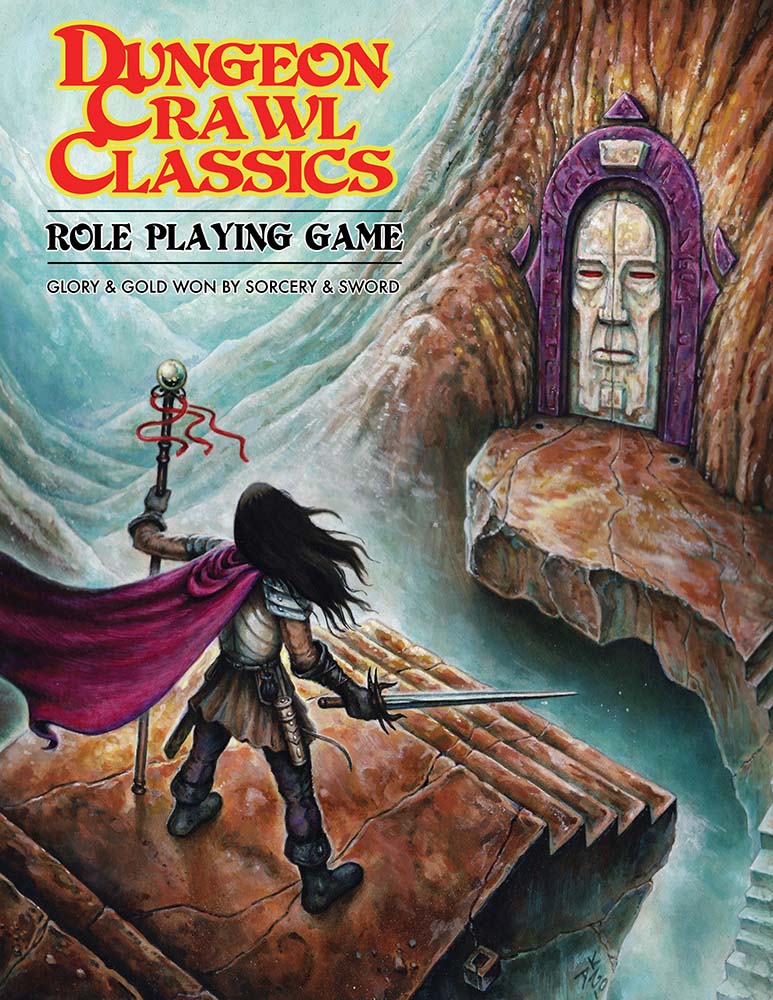
As I mentioned in my last entry, I have recently been pouring over the Dungeon Crawl Classics rulebook by Goodman Games. Each of its 500+ pages is a delight. DCC is a game that a) I really, desperately want to try out, and b) for a variety of reasons (time, number of games already in the queue, my group’s interests, etc.) is unlikely something I can play soon with my weekly online group of players. I also mentioned solo play, and not-coincidentally received the Mythic GM Emulator as a Christmas gift (thanks mom!) last year. So, although superhero games are my first love, right now, in this moment in time, I’m going to try my hand at playing my way through an introductory DCC adventure.
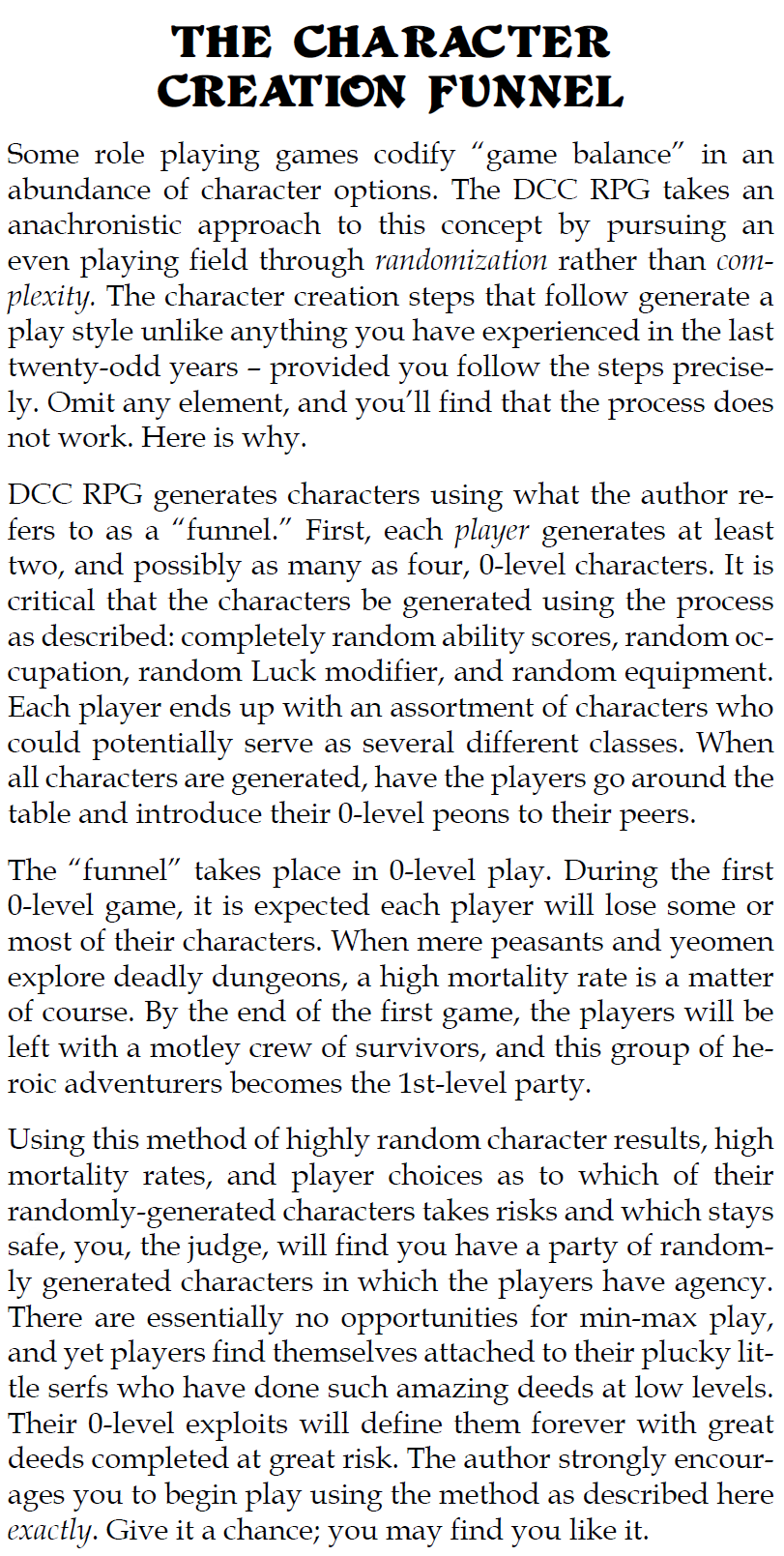
One of the quirks of DCC as a system is “The Funnel,” which is a way of describing how players form new adventuring parties. The basic idea is this: Each player rolls up multiple pre-adventurers, called Level 0 characters. These are normal townsfolk living in a dangerous and mysterious world, ready to defend their livelihood but without the equipment or skills to do so effectively. Then, The Funnel puts these poor 10-15 souls in a brief, deadly scenario. Whoever survives the scenario creates the pool of potential Level 1 adventurers, and off you go.
From what I can gather, The Funnel is a barrier for many “modern” players to jump into DCC. Yet there are also countless testimonials for why a Level-0 Funnel is vital for a new group; The Funnel not only introduces beginners to the rules in a digestible way, but it also emphasizes the tone and tenets of the game world, helps players fall in love with their characters, and creates memorable stories the group will forever remember. Besides, it’s such a different way to start adventuring than most modern games, I am fascinated to try it out. I was immediately sold when reading the rulebook:
Woo! Sounds awesome.
There are a lot of DCC Level 0 adventures, and by far the most popular and highly-touted one is Sailors on the Starless Sea. I own SotSS and initially decided that I wanted it to be the object of my playthrough. What I concluded, however, is that I’d rather not have a public playthrough of such a beloved Funnel, which might ruin it for others (including my own group, if I convince them to try out DCC). Instead, I decided to focus on the Funnel provided in the core rulebook, The Portal Under the Stars.
The Cast of Characters
Before I can dive into my first Funnel, however, I need a large party of townspeople. Simulating four players with three characters each, I rolled up an ambitious TWELVE townsfolk. Below is a quick sketch of each, which is all of the backstory I want right now. There’s no need to create elaborate backstories for characters that might die in the first session, plus the spirit of DCC is to find the characters through playing them. It’s fun to wonder which of these poor saps might eventually become honest-to-goodness adventurers.
I’ll also provide the “stats block” for each character. Right now, don’t worry about understanding the gobbledygook of abbreviations and numbers… I’ll briefly explain mechanics as I go. Suffice it to say, if you’ve played any edition of Dungeons & Dragons, Pathfinder, or another d20-based roleplaying game, DCC will be pretty easy to figure out.
Bern Erswood. Graymoor’s herbalist is well-liked and seen as a kind man eager to help his neighbors, even if his remedies rarely have any medicinal benefits. Bern lives on the village’s outskirts, where he has the most access to nature and can cultivate his gardens.
Bern Erswood. Level 0 Herbalist. STR 9, AGL 11, STA 13, PER 16, INT 12, LCK 11. Init +0; Atk club +0 melee (1d4); AC 10; HP 5; MV 30′; Act 1d20; SV Fort +1, Ref +0, Will +2; LNG Common; AL Neutral; Equipment: small hammer, herbs, 19cp.
Councilwoman Leda Astford. Leda is one of four councilmembers elected by Graymoor’s populace, and the most recent addition to the Town Council (taking her mother’s seat when she perished from illness). She is young, popular with town residents, and perhaps a touch naïve. Her three councilmember peers—all old, grizzled men who’ve held their seats for years—push Leda to do any and all hard work.
Councilwoman Leda Astford. Level 0 Noble. STR 8, AGL 16, STA 12, PER 15, INT 8, LCK 7. Init +2; Atk longsword -1 melee (1d8-1); AC 10; HP 4; MV 30′; Act 1d20; SV Fort +0; Ref +2; Will +1; LNG Common; AL Lawful; Equipment: 10′ pole, gold ring, 41cp. Note: Born with a clover-shaped birthmark. (-1 to find secret doors)
Egerth Mayhurst. The town’s only jeweler, Egerth has lived in Graymoor since he was a youth and yet still considers himself better than other locals, who he calls “backwater fools.” Selfish and ambitious, he has remained single well into his middle age and is more than a little bitter about it.
Egerth Mayhurst. Level 0 Jeweler. STR 13, AGL 10, STA 10, PER 9, INT 8, LCK 9. Init +0; Atk dagger +1 melee (1d4+1); AC 10; HP 2; MV 30′; Act 1d20; SV Fort +0, Ref +0, Will -1; LNG Common; AL Chaotic; Equipment: holy water (1 vial), gem, 24cp.
Erin Wywood. The granddaughter of Councilmen Wywood, Erin is the closest thing Graymoor has to a bard. She spends her time in the town’s tavern playing her ukelele. Erin should be more popular than she is, due mostly to her devout religiosity and fervor, which creeps into all of her interactions and songs.
Erin Wywood. Level 0 Minstrel. STR 13, AGL 11, STA 13, PER 8, INT 14, LCK 10. Init +0; Atk dagger +1 melee (1d4+1); AC 10; HP 5; MV 30′; Act 1d20; SV Fort +1, Ref +0, Will -1; LNG Common, Halfling; AL Lawful; Equipment: holy symbol, ukelele, 32cp.
Ethys Haffoot. Ethys and her younger brother Giliam are responsible for the trading barge up and down the Teawood River, which connects Graymoor to the neighboring settlements (one of which is the halfling village of Teatown, Ethys and Giliam’s birthplace). She has the family affliction of a club foot, but is otherwise hardy and unquestionably the brains of her family business.
Ethys Haffoot. Level 0 Halfling Mariner. STR 11, AGL 6, STA 12, PER 9, INT 15, LCK 12. Init -1; Atk knife +0 melee (1d4); AC 10; HP 2; MV 20′; Act 1d20; SV Fort +0, Ref -1, Will +0; LNG Common, Halfling, Elven; AL Lawful; Equipment: 10′ pole, sailcloth, 36cp. Infravision.
Finasaer Doladris. Master Finasaer arrived in Graymoor ten years ago from the woods, explaining to the Town Council that he was writing a book on provincial towns in the region. He is the only elf in Graymoor, and a town curiosity in every way. For his part, “Fin” (as the locals call him) is friendly but aloof, and his elevated vocabulary often alienates him from others.
Finasaer Doladris. Level 0 Elven Sage. STR 13, AGL 10, STA 14, PER 9, INT 11, LCK 14. Init +0; Atk dagger +1 melee (1d4+2); AC 10; HP 4; MV 30′; Act 1d20; SV Fort +1, Ref +0, Will +0; LNG Common, Elven; AL Neutral; Equipment: backpack, parchment and quill pen, 14cp. Note: Born on a full moon as a pack of wolves howled. (+1 to attack and damage for starting weapon). Sensitive to iron. Infravision.
Giliam Haffoot. Giliam and his older sister Ethys are responsible for the trading barge up and down the Teawood River, which connects Graymoor to the neighboring settlements (one of which is the halfling village of Teatown, Ethys and Giliam’s birthplace). He has the family affliction of a club foot, but is otherwise hardy and hard-working.
Giliam Haffoot. Level 0 Halfling Mariner. STR 12, AGL 7, STA 13, PER 12, INT 8, LCK 9. Init -1; Atk knife +0 melee (1d4); AC 10; HP 2; MV 20′; Act 1d20; SV Fort +1, Ref -1, Will +0; LNG Common, Halfling; AL Lawful; Equipment: grappling hook, sailcloth, 25cp. Infravision.
Gyles Teahill. “Little” Gyles Teahill is the son of Ephes Teahill, Graymoor’s most prominent rutabaga farmer. Ephes recently had an accident that has left him bedridden, so Gyles has taken up the majority of his father’s work. He is small, but strong for his size and everyone in the town is either overtly or secretly rooting for the Teahills to have a successful year because of Little Gyles’ heart.
Gyles Teahill. Level 0 Farmer (rutabaga). STR 12, AGL 6, STA 5, PER 12, INT 9, LCK 9. Init -1; Atk pitchfork +0 melee (1d8); AC 10; HP 1; MV 30′; Act 1d20; SV Fort -2, Ref -1, Will +0; LNG Common; AL Lawful; Equipment: hen, rations, 25cp.
Hilda Breadon. Graymoor’s only commercial baker, Hilda is famous for her pies, cakes, and cookies of remarkable variety. She would be more successful if she didn’t eat twice as much of her wares as she sells, but she is a woman of great passions and appetites.
Hilda Breadon. Level 0 Baker. STR 9, AGL 11, STA 18, PER 9, INT 11, LCK 11. Init +0; Atk rolling pin +0 melee (1d4); AC 10; HP 7; MV 30′; Act 1d20; SV Fort +3, Ref +0, Will +0; LNG Common; AL Lawful; Equipment: chain, flour, 26cp.
Mythey Wyebury. Mythey grew up in Graymoor as a ne’er do well, always in trouble and running from his bad choices. Unbeknownst to most of the town, he and a couple of his friends have recently been plaguing the roads as outlaws, stealing from travelers to fuel their tavern revelry. His most closely guarded secret, however, is that he has a sickness that he believes will kill him any day now.
Mythey Wyebury. Level 0 Outlaw. STR 15, AGL 11, STA 6, PER 13, INT 9, LCK 7. Init +0; Atk shortsword +1 melee (1d6); AC 12 (leather armor); HP 1; MV 30′; Act 1d20; SV Fort -1, Ref +0, Will +1; LNG Common; AL Chaotic; Equipment: small sack, 29cp. Note: Born as a bear visited the village. (-1 to Melee damage rolls)
Umur Pearlhammer. No one in Graymoor knows how old Umur is, but they know he’s outlived anyone else’s memory. He’s still hearty enough to be the town’s primary stonemason, though, and despite his dwarven gruffness he is one of Graymoor’s most well-liked residents.
Umur Pearlhammer. Level 0 Dwarven Stonesmith. STR 9, AGL 9, STA 9, PER 14, INT 13, LCK 9. Init +0; Atk hammer +0 melee (1d3); AC 10; HP 3; MV 20′; Act 1d20; SV Fort +0, Ref +0, Will +1; LNG Common, Dwarven, Giantish; AL Lawful; Equipment: fine stone, lantern, 26cp. Infravision.
Veric Cayfield. Like the Haffoot siblings, Veric grew up in the halfling village of Teatown, but moved to Graymoor several years ago to begin his life as a haberdasher. No one loves clothes as much as Veric, and what he loves about humans is how much more fabric he gets to use to make them.
Veric Cayfield. Level 0 Halfling Haberdasher. STR 13, AGL 16, STA 12, PER 9, INT 11, LCK 12. Init +2; Atk scissors +1 melee (1d4+1); AC 10; HP 1; MV 20′; Act 1d20; SV Fort +0, Ref +2, Will +0; LNG Common, Halfling; AL Lawful; Equipment: fine suits (3), flask, 19cp. Infravision.
And there we go. Have any bets on survivors or early deaths? And yes… several of them have 1 or 2 hit points. Yikes.
Next time… the adventure begins!
-jms


 My Hero Brain