Hilda peered over her shoulder to make sure that no one was approaching. In the early morning light, Hirot seemed practically empty except for the occasional emaciated dog skulking near walls and looking for scraps. Smoke from chimneys gathered overhead, making the sky hazy and gray. This was a dreary place, Hilda decided. Though she wasn’t as prone to the black-and-white views of Erin, Hilda couldn’t deny that it felt as if a taint of Chaos sat upon the village of Hirot. For the moment, however, she was thankful for the village’s emptiness. There was no sign that the Jarl or any of his minions had trailed her from the Wolf-Spear Inn.
A crow cawed suddenly above, momentarily startling her. Hilda sighed and pounded once again, harder this time, on the rickety door of the hut before her.
“Ymae!” Hilda hissed, trying to both yell and be quiet at the same time. “Are you there?”
After a third try, something moved within the hut. Hilda gripped her staff with both hands, leaning her weight on it while she waited. It seemed to take forever, but eventually the door cracked open.
A face peered up at her with one wide eye, the other drooping below folds of flesh on an ancient, craggy face. “By the balls of Bobugbubilz, child, can’t you let a woman sleep before you go rattling her door? What is it?”
“Ymae,” Hilda breathed, letting go of some tension. “Good. I’ve brought the hair and the Hound comes tonight.”
“Ah. I see,” the old woman nodded, smacking her lips. She receded into shadow and left the door open. “Come in, then.”
As before, the interior of the hut seemed somehow larger than the outside, though still cramped by numerous shelves filled with jars and curios. Beneath the thatched roof, the wide, round hut was dark, with its central fire pit unlit. The mottled cat, which had been eyeing her from atop a shelf in her previous visit, lay stretched out and asleep on the straw mat near the stone wash basin.
“Give it to me,” Ymae said, extending a gnarled hand. Hilda rummaged through the satchel at her hip and produced a folded cloth. The old woman took the cloth and brought it close to her wide eye, examining it closely. With a grunt, she carefully unfolded the cloth with shaking fingers.
“Lots of hair,” she commented. “All from corpses?”
“Yes,” Hilda nodded.
“Hm,” she sniffed the locks. “And all fresh, even the ones that look ancient. Death follows you, child.” As she said the words, Ymae raised her gaze to take in Hilda’s robed figure. For several heartbeats, she looked at the young wizard from head to toe, eventually grunting again. “You’ve been using his power again, this shadowed man in the orb, hm?”
“How– how do you know?” Hilda asked, smoothing her robe self-consciously.
“You’re weaker. Not frail, exactly, but diminished. You’ve given too much of yourself, or he’s taken it,” the crone tsked. “Dangerous. Very dangerous. You should rest before you call on the magics again, and be wary of letting it sap your own strength. Another day like today without recovery, and you may be the corpse offering the hair, hm?”
Beneath her hood, Hilda stared at the old woman, unsure how to respond.
Ymae chuckled darkly. “But you’ll do what you do, it seems. Take my words or not, makes no difference. As long as you bring your aura of death to the Hound and me a husband. He’s still coming at the end of this, yes? The dwarf?”
“He is,” Hilda nodded, swallowing. She was confident that Umur would fulfill Hilda’s promise to the old woman. Or, at least, reasonably confident.
Ymae watched her carefully, then half-grinned. “Good enough. Let’s get to work, shall we? Help me get this fire started.”
Hilda had seen it done two days ago, so she moved to gather sticks from the nearby basket as the old woman retrieved her flint and steel.
“We’ll bind the fire to the hair of the dead.” As they worked, Ymae spoke almost casually. “The Hound is from beyond the grave, you see. A spirit of Chaos from the time of the Savage Kings. It’s picking fights because it wants to be killed, to rest. But whoever summoned it or whatever force released it hasn’t made that easy.”
“The Savage Kings,” Hilda repeated, stacking sticks carefully. “Like Ulfheonar.”
“Mmm. He was the one they called the Serpent King, yes. The Savage Kings littered this side of the Trollteeth long ago, each seeking power to conquer the others, doing anything and everything to get the upper hand. Too many played with fell powers they didn’t understand, and we’re all paying for it still.”
“In Ulfheonar’s tomb, there were images of snakes battling wolves. Might the Hound have been summoned by another king to kill Ulfheonar and his snake tribe long ago?” Even as she said it, Hilda felt she was fumbling the history, not knowing nearly enough even to ask questions.
“You’ve been to his tomb, then? Did you find the spear?”
Hilda looked up at Ymae’s tone. The crone had stopped what she was doing and watched her pointedly. The former baker felt like she was seeing in Ymae a child from Graymoor as she removed a pie from the oven, hungry and eager. The old woman even licked her lips.
“Y-yes. It almost cost us our lives, but we have it.”
Ymae cackled and slapped her knee. “Good! Good. Well done, child. We’ll make you a net of flame and undeath, something to bind the Hound. Denying its freedom is like denying its essence, yes? Then your warrior friends can stab its heart with the Serpent King’s Spear. Oh, delicious, delicious. I wish that I could be there to see it. Ha ha!” She cackled again, shrill and dry.
“I don’t understand,” Hilda sighed.
Ymae tsked, almost mockingly. “Don’t you mind, child. You have enough to worry about with this patron of yours. The important bits are this: Find the Hound’s lair, for it can only truly be killed there. Bind it. Land the final blow while it’s bound.” She extended three knobby fingers as she ticked off the steps. “Let the otherworldly forces sort out the rest, mm? Now, get comfortable. While the fire burns, we must weave these hairs into a single thread, and your fingers are far younger than mine.”
“You’re sure she’s in there?” the Jarl growled, rubbing at his chin and examining the heavy, iron-banded door of the Wolf-Spear Inn.
“She was there when the sky topped its zenith,” Sylle Ru said in his high-pitched, whispery voice. “I watched her with my scrying.” The thin man rubbed at his hands as if they itched whenever he spoke of using his magics. “The outsiders as well, and the pretty pretty girl from the church.”
The Jarl grunted, ignoring the seer’s lascivious licking of lips, and regarded Claus. Sensing the attention, the lieutenant turned so his one good eye could see him. Claus raised a thick, black eyebrow.
“We do it fast,” the Jarl said. “They’re warriors of some skill, but we outnumber them two to one. Get one of them alive. That’s all we need.”
“It’s risky,” Claus said, his voice deep and harsh.
“We need a sacrifice,” the Jarl sighed. “And the town is close to revolt as it is. If it’s not the girl or one of these outsiders, it could get ugly. Everyone knows what they’ve been doing. We need to bring them down and show our strength. And their weakness.”
“Hirot folk we can cow,” Claus said. “If they truly beat the Hound as easy as…”
“Enough,” the Jarl barked.
Claus snapped his stubbled jaw shut and nodded. He turned to the others and began organizing them for the assault. All around were rough men and women in armor, grim-faced and quiet. None of them seemed to like this plan–or to be outside the relative safety of the manor, truth be told, as their eyes darted to every corner constantly–but they were trained warriors and would follow orders. Heavily calloused hands gripped swords and spears and axes, while gauntleted boots found purchase in the dirt, ready to charge.
“I’ll get that door down,” the Jarl growled, stretching his neck and flexing broad shoulders covered in iron and steel. The giant bear of a man stomped over to the door and grabbed the front latch.
It clicked open.
With furious confusion, he looked back at the seer. Sylle Ru shrugged, clearly not anticipating an unlocked, unbarred door.
“Careful,” Claus rumbled low.
“Bah!” the Jarl snarled and threw open the door. Recklessly, he charged inside. Behind him, men scrambled to follow.
The common room tavern of the Wolf-Spear was as it would be any night after closing. Dark. Quiet. Tidy. Chairs upturned on tables. But it was not the wee hours now; the late afternoon summer sun slanted in through the doorway.
By the time Sylle Ru entered, the room was flooded with armored forms, panting and wary. He gently slid his way around them, made easier by those who saw him coming and wanted to avoid even grazing the strange, oily communer of otherworldly powers.
He found the Jarl holding a single sheet of parchment. The burly man thrust it at his seer.
“It was on the bar. Read it,” he bellowed. The Jarl was all power and strength and had never learned his letters, one of the many ways he relied upon his advisor.
Sylle Ru accepted the document and unrolled it with knobby, long fingers. It was a clumsy, blocky script but written in the common tongue. The ink strokes said, simply: “We will handle the Hound. Stay away.”
Now is as good a time as any to do a bit of housekeeping on the party’s status after a long night’s rest.
Per the Dungeon Crawl Classics core rulebook: “A character who actively adventures and gets a good night’s rest heals 1 hit point. If the character gets a day of bed rest, they heal 2 hit points per night. …Ability score loss, except for Luck, heals at the same rate: 1 point with a good night’s rest, and 2 points with a day of bed rest. A character may heal both ability score loss and hit point loss on the same night’s rest. Luck, however, does not heal. Repeat: lost Luck does not heal. Except for the special abilities of halflings and thieves, a character who burns Luck does so permanently. Luck can be restored in the same way that a man normally gains good or bad luck – by appealing to the gods.”
After a day traveling into Ulfheonar’s tomb and battling Iraco and his huntsmen, Erin Wywood was fully healed by the Horn of Kings and suffered no ability score loss. What Erin gains from a night of rest and prayer is a reset of her “Disfavor” rating. Whereas before she would have lost favor with Shul on a d20 spell check roll of 1 or 2, that risk is back down to natural 1s only.
Joane Cayhurst, our new Warrior, is now a Level 1 PC and ready to fight with her 10 hit points. Similarly, Briene Byley is up to 9 hp, though still currently class-less until (likely) the end of Doom of the Savage Kings.
Umur Pearlhammer took a single point of damage from an arrow after the Horn had healed him from the tomb’s awfulness. He’ll heal that minor wound with rest and be back up to 10 hp as well.
Hilda Breadon took no damage from the day but did Spellburn her way to losing 4 Stamina, plus 1 Luck. Her night’s rest will give her back 1 Stamina point, bringing her to 15 of 18. As per the above rules, her Luck score is now permanently 10, unless the gods intervene in some way.
Finally, we have our Halfling, Ethys Haffoot. She also took an arrow hit for 1 damage, and burned a total of 4 Luck to help her companions. Since the party (other than Hilda, per the narrative above) spent their day holing up in the Wolf-Spear Inn, I’ll give Haffoot a day of bed rest, which means she will be back up to 6 hp (her max), and regain 2 Luck points, bringing her ability to score to 10 out of 12. As a sidenote, I’m still worried that Haffoot is the most vulnerable of the party members, though as we saw from the Iraco fight pretty much any critical hit from an enemy can kill you in DCC.
One more housekeeping note: Last time we outfitted Joane in leather armor and squared away her weapons. She’ll also have standard adventuring equipment that I suspect she could obtain from her family’s inn: A backpack, rope, torches, and a waterskin. Even though Briene doesn’t have a proper class, I’ve given her padded armor (+1 AC) and the same standard equipment. Recall too that Briene has a grappling hook and holy symbol of Justicia from her Level 0 days, as well as a shortbow and arrows from the huntsmen.
Okay, with the housekeeping out of the way… Let’s throw our party back into the action!
“Do you think they’ll actually leave us alone?” Haffoot whispered from the bushes. The group had gathered on the opposite side of the clearing surrounding the standing stones as before, the logic being that, if the Hound was expecting a similar ambush, perhaps originating in a different location would give them an edge.
The clearing itself was the same as they’d left it, minus the snow, which meant it was much changed by Hilda’s magic. All around the clearing, the trees and low shrubs appeared overgrown and wilder than the surrounding forest, because in the moments of Hilda’s spell the vegetation had burst out frantically, reaching for anything nearby. The grass in the clearing was noticeably longer than the pathway leading here, except where the black scar of a lightning strike marred an area near the standing stones. The stones themselves were cracked in places, the rope threaded through holes in them appearing frayed and ancient. All around were unsettling reminders of the powers that their hooded magic user could call forth.
Umur shrugged. “I hope the Jarl sees that for him it’s a win-win. Either we kill the Hound or it gets its sacrifice. But he’s a vicious bastard and has no reason to listen to us, so he may wait until after the battle to kill whoever’s left.”
“We have Briene watching the path,” Erin whispered, touching the silver crescent moon dangling from her neck. “She’s smart and will come running if someone approaches.”
“That’s the hope,” Umur sighed. “For now, let’s just worry about the Hound. It should be here soon, yeah?”
“The sun has set,” Erin nodded. “And this is the third night.” She looked skyward, frowning at the darkening sky.
“What’s wrong?” Haffoot nudged her.
“It’s nothing…” Erin said, uncharacteristic uncertainty in her voice. “It’s only that the moon tonight will be but a sliver. Shul’s gaze is less upon us now than when we first arrived.”
“Does that means you have less power?” the halfling’s eyes were wide.
“I– I don’t know. Perhaps. But Shul feels more distant. Or perhaps it’s merely a test of my faith, a chance to be his emissary even beneath a darkened night sky.”
With that thought, silence settled over the group. They watched the clearing warily as shadows overtook the twilight. Each of them remembered their previous time in this place vividly, and their eyes darted this way and that, waiting for movement.
They were still unprepared for the menace of the Hound of Hirot when it appeared.
Emerging from the darkness was the same hybrid wolf and bat creature from before, as large as a pony. It stepped cautiously with its padded feet prickling with oversized claws, head low and black fur bristling upon its back. The Hound’s bat-like nose sniffed in deep, powerful huffs as its sharp ears twitched. The companions held their breath, staying silent and still while gripping weapons tightly as the Hound came fully into view.
Unlike before, the beast didn’t immediately approach the standing stones. Instead, it moved to the center of the clearing and circled, its head near the grass and scanning the surrounding forest with red eyes. As they’d hoped, the creature began its inspection where they’d hidden in the previous encounter, putting its back to the companions.
“Ready,” Umur said in a low, quiet whisper.
Initiative time! First let’s see if the companions have successfully hidden from the Hound to gain themselves a surprise round. The DC was 10 before, but this time I’ll increase it to 15 since the Hound has been ambushed in this place before and is on guard. Last time, I mistakenly said that Haffoot had the lowest Agility modifier of the group, which is technically true but she also receives a +3 to Sneak and Hide checks. So this time I’ll have Umur do the roll, as he and Hilda both have a +0.
Umur rolls a 19, so the group will indeed get a surprise round. Amazing.
Joane wins initiative and charges forward eagerly with the Wolf-Spear of Ulfheonar. She rolls a… oh no… a natural 1! Joane then rolls on the fumble table, which reveals that she tripped. She needs to make a DC 10 Reflex save or fall prone, losing her next round to standing up. Thankfully, she rolls a [11+2] 13. So it’s an embarrassing beginning, but no real harm done.
Since it worked so well on the tomb-ghouls (though in hindsight, there is an argument that they should have been immune to the spell), Erin will try a prayer to Shul and attempt to cast Paralysis. She rolls a [17+1] 18, which is awesome. Her result says, “The cleric’s melee and missile weapons are charged with Paralysis. The charge remains for d4+caster level (CL) rounds. Any attack delivered by the cleric during this period delivers the normal damage plus paralysis if the target fails a Will save (DC 18, the spell check). The paralyzed creature will be unable to move or take any physical actions for d6+CL rounds.” Erin then rolls a [4+1] 5 rounds, which should be the entire combat. Amazing.
Hilda is next. She only barely suspects the great cost of her Chill Touch while also knowing that her companions fear her Invoke Patron spell. So she’ll attempt to cast Chill Touch, the first time casting a spell without additional modifiers or Spellburn. She rolls a [5+1] 6, which is a failure and the spell is lost for the day. Perhaps Hilda now realizes that she must start every combat by calling upon her patron?
Haffoot charges in, swinging both swords. But she rolls terribly, scoring a [6+1] 7 and [2+1] 3. Needless to say, both miss the Hound’s 15 AC.
That leaves only Umur, who rolls a 1 on his Deed Die as he approaches. He rolls a paltry [2+1+1] 4 with his longsword, but for maybe the first time his d14 Shield Bash strike hits home, rolling a [13+1+1] 15. He does [2+1] 3 damage.
All in all, I’d say that was a decidedly mixed turn, and very different from the first time they surprised the Hound!
Almost inaudibly, Erin, acolyte of Shul, began a prayer. Her companions could not hear the words, but the long, curved blade of her dagger began to glow a soft white.
“NOW!” Umur bellowed. He, Haffoot, and Joane burst from the bushes, charging the black-furred back of the Hound.
Joane, however, was neither used to the leather armor she’d obtained from her late father’s rooms nor the long wolf-spear. She stumbled in the wild vegetation, nearly losing her balance. Haffoot sidestepped the young woman’s fumbling form, but it cost her momentum. Only Umur’s charge was unaffected.
The Hound turned lightning-fast, its top lip curled above jagged teeth as long as the dwarf’s hand. Roaring, Umur hurtled into the beast’s head with his wooden shield.
Within the cover of the forest, Hilda stood and removed her hood. As she began to reach for her patron’s power, Ymae’s words from the morning echoed in her mind: “You should rest before you call on the magics again, and be wary of letting it sap your own strength. Another day like today without recovery, and you may be the corpse offering the hair, hm?”
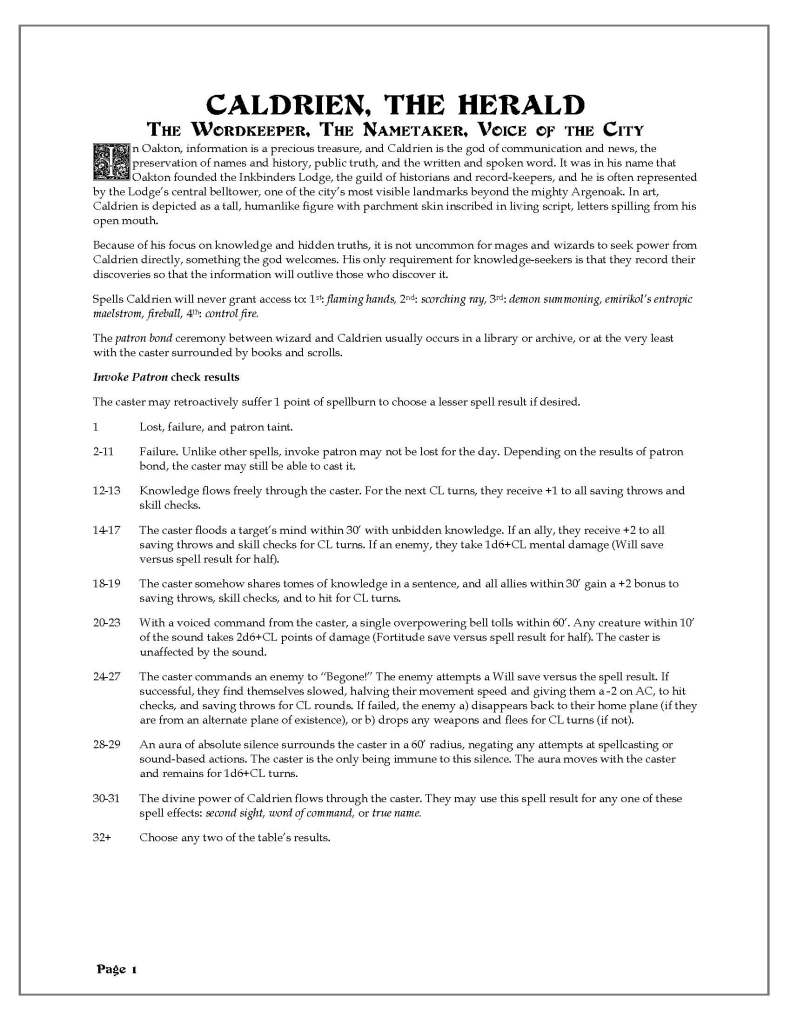
The black rectangle on her forehead flared briefly blue and then went dormant. Hands outstretched, Hilda found herself reluctant to embrace the forces swirling just beyond reach. Through wide-open eyes, she briefly glimpsed the umbral form of a bald, inhuman man, staring at her and frowning from within an orb glowing like a star.
Round 1 begins!
Joane recovers from her stumble and strikes out with the ancient wolf-spear, rolling a 3 on her Deed Die, and then… another natural 1! You can’t make this stuff up. The fumble table says that the weapon is damaged in some way, but I’m going to GM fiat and instead say that Joane gets the weapon knocked out of her hands. It will take a full round to recover it. It’s fair to say that our new Warrior is not off to an awesome start.
Thankfully, Erin steps in with her newly enchanted dagger and hits with a [17+1] 18. She rolls minimum [1+1] 2 damage, but now the Hound must make a Will save against her initial spell roll of 18. It rolls an 8, so is Paralyzed for [6+1] 7 rounds. Holy crap. I think this fight is suddenly over?
It would have been the Hound’s turn, but it doesn’t get to act. Hilda is next but given the Hound’s paralysis, I don’t want to risk another spell failure here. I’ll say she is stunned by the disconnection with her Patron and doesn’t act this turn either.
Finishing the Round are Haffoot and Umur, both of whom get a larger die size for their attacks because of the paralysis. Haffoot rolls a [12+1] 13 and [10+1] 11. I’ll say that she hits, but the Hounds hide is too tough to penetrate. Umur, meanwhile, rolls another 1 on his Deed Die, and then a [5+1] 6 (on a d24 roll!) with his longsword and an [11+1] 12 with his shield.
Round 2, Joane retrieves her spear. Let’s get the three other melee combatants’ attacks in: Erin rolls a [13+1] 14. Haffoot rolls a [16+1] 17 and deals a whopping 6 points of damage with her first shortsword, but then rolls a natural 1 on her second (thankfully, with Halfling two-weapon fighting, she needs to fumble on both attack rolls to officially fumble). Umur then rolls a 2 on his Deed Die, a [18+2] 20 with his longsword, doing 2 damage, and a [14+2] with his shield bash, doing 1 damage. All told, that’s 9 more damage to the Hound, leaving it with 6 hit points.
Finally, at the top of Round 3, Joane Cayhurst retrieves the weapon designed to kill this thing, rolls a 3 on her Deed Die, and a [22+1+3] 26 on her d24 to hit. She rolls enough damage to kill the Hound, [6+1+3] 10 total.
Whew. Paralysis for the win! The Hound fights feel stressful, although both have been absolute romps.
The Hound snarled savagely, throwing its impressive weight in a thrash meant to knock its enemies prone. Joane cried out in shock at the wolf-spear was torn from her grip and tumbled into the long grass. Umur hunkered behind his shield, absorbing the Hound’s frenzy but unable to strike back. Haffoot danced back and out of the way, but her short blades and arms prevented her from touching the aggressive creature. For breathless, frantic moments, the combat seemed a stalemate.
Shouting her defiance, Erin Wywood stepped forward with her glowing blade. Clad in her white armor, with eyes and dagger shining like a full moon, she appeared to be the perfect foil for the black-furred creature of darkness. Erin plunged her weapon into the Hound’s side. It shrieked, more like a squealing bat than a canine, and fell sideways into the clearing. Its red eyes rolled up to the sky, even as its limbs jerked spasmodically and stilled.
“Quickly!” the cleric yelled. “It is paralyzed! End it now!”
Her dwarf and halfling companions complied, stepping forward with their swords and hacking at the beast again and again.
“Step back!” Joane snarled. She had retrieved Ulfheonar’s wolf-spear and held it overhead with both hands. The young woman’s eyes narrowed as she bore the broad-headed blade down and into the Hound’s side. The spear first met resistance, and then the creature was dissolving into oily smoke. Panting, weapon buried into the long grass in front of her, Joane screamed her father’s name.
Umur immediately brought his sword up and turned to face the path, waiting for an ambush from the Jarl and his thegns. Haffoot, taking his cue, stood back-to-back with Umur, swords raised.
No ambush came. The companions’ breaths calmed. The wild, magic-touched clearing was empty and still in the night air.
Doom of the Savage Kings, Chapter 11




 My Hero Brain