Choosing a Supers System, Part 5: Cortex Prime

Game number four of my deep-dive exploration of superhero games that can be played in a fantasy setting. Sometimes I wonder what’s wrong with me, that this is how my brain works.

By now you’re aware that I’m envisioning a new solo-play venture, one that involves a genre mash-up and thus a particular set of requirements for choosing my next game. These by-now-familiar requirements are:

  • A superhero game that can be played in a fantasy setting, plus allow for anachronistic weapons and technology. Basically, the superpowers and fantasy elements need to be satisfying, but allow for other genre shenanigans.
  • Is neither too crunchy (if I’m consulting forums or rulebooks more often than writing, that’s bad) nor too lightweight (I need to feel like the dice are guiding the story and enhancing the narrative). I want to feel like the mechanics support the story.
  • Level-up jumps in power. My idea is that the PCs start as “street level” heroes and become demigods as the story progresses. Something will be pushing them closer to godhood, which is a core part of the story. The game should not only allow for those different levels, but be fun to play at all of them.
  • No hard-wired comics tropes (like secret identities, costumes, etc.). The story will be a genre mash-up, so I can’t hew too closely to any overly specific formulas.

After three narrative-light systems in a row, it’s time to turn to something different. Today is my first (and only, at least for this series) dive into a true “setting agnostic” game, not built for any one genre, but meant for games in any of them.

Cortex Prime

Truth be told, I didn’t know that Cortex Prime existed until recently. Instead, I knew Marvel Heroic Roleplaying, a 2012 game by Margaret Weiss Productions and by far my favorite (out of five!) TTRPGs made under the Marvel banner. Marvel Heroic Roleplaying received rave reviews and introduced several innovative mechanics well-suited to the superhero genre. Sadly, the company lost its Marvel license within a year of launching the game and thus disappeared as quickly as it appeared. My sense is that if Margaret Weiss had retained the license, MHR would be talked about today as much as FASERIP, and likely would have spawned Cortex Prime—a generic system using the same engine as MHR—sooner. Instead, designer Cam Banks took the guts of that original game to a 2017 Kickstarter, and Cortex Prime released three years later. It may have sat dimly in my awareness the past few years alongside systems like Genesys and Cypher, but I had mostly steered away from generic systems towards more specific and unique game experiences. At some point this year, I made the connection between Cortex Prime and Marvel Heroic Roleplaying, rubbed by eyes in disbelief, and promptly ordered the core rulebook.

The first thing to say about Cortex Prime is that it is beautifully produced. The cover, the interior art, the graphics used to explain game concepts, the layout… it’s all stunning. If the Supers! RED rulebook sits on one end of a sensory-stimulation spectrum, Cortex Prime is on the other.

It’s also a relatively unique rulebook in two ways: First, it reads like a “Game Design 101” textbook as much as a game instruction manual. Everything beyond the core mechanics in Cortex Prime is modular, and optional rules (called, in fact, “mods”) take up more room than the base rules, each painstakingly considered and guiding when you might use or not use that option. Because it’s a generic system, everything has a specific and technical term abstracted away from any one genre, and it’s a game that requires you to think beyond those technical terms to their application. Second, and relatedly, the book is targeted at Game Masters, not players. Because of its modular, design-the-game-to-your-world nature, Cam writes the book to bring GMs into the game design tent, letting them choose what sort of game they want to play. Cortex Prime is the single most earnest attempt I’ve seen to allow GMs to run the very specific game they want to play.

A number of great reviews of the system exist, and I’ll link to a few here by Mephit James, Gnome Stew, and Jeff’s Game Box. The best summary of the core mechanics are from a terrifically-written review by Cannibal Halfling, which I’ll quote here:

“Cortex is at its core a ‘roll and keep’ dice mechanic. For any challenge the player assembles a dice pool of around three dice, rolls them, and keeps the highest two results. Depending on which of your character’s traits are relevant to the roll, you could be rolling d4s, d6s, d8s, d10s, or d12s, with d6 being average, larger dice being better, and d4 being much less good, especially considering the high probability of rolling a 1. All dice rolls are opposed rolls; the base dice pool that the GM rolls is two dice whose size vary depending on the difficulty of the task.

There are two other mechanics which depend on the die results. First is the Effect Die. Once a player chooses the two dice they wish to keep, they choose the largest remaining die to be an Effect Die. The Effect Die determines the impact of certain dice rolls, and is dependent on the size (rather than result) of the chosen die. This does mean that it might sometimes be advantageous to choose a lower absolute result (provided it still meets the threshold for success) if it produces a larger Effect Die. Second result-based mechanic is the Hitch. A Hitch occurs when a player rolls a 1 on one of their dice. A die showing a one cannot be chosen for results or for the Effect Die. While there are no direct consequences beyond that for rolling a one (only rolling all 1s is considered a critical failure and is called a Botch), the GM may choose to spend that 1 on the roll to create a Complication. Complications, and their positive counterparts Assets, represent circumstances or items that exist in a scene, much like Aspects in Fate. A GM can add the die value of a relevant Complication to the dice pool that opposes a character’s roll, while the player can do the opposite with a relevant Asset. When a character creates an Asset, they may use the Effect Die to determine its die size and therefore its impact on the scene. The other core mechanic of note is the Plot Point System. Each player starts play with a Plot Point, and when the GM activates a Complication from a player rolling a 1, they also give that player a Plot Point. Plot Points can be spent on activating abilities, counting more dice in rolls, and preventing a character from being Taken Out of a Conflict. As more options are defined, so too are more ways to earn and spend Plot Points.”

For the previous games, I made a sample character to test out the system. I can’t do that here, because to make a character in Cortex Prime means first making a dizzying number of choices about what mods exist in a particular world. Are we defining characters by Attributes, Skills, Roles, Powers, Relationships, Affiliations, Values, or something else? What do the superpowers do in this world? What factions exist that characters can join? Etcetera etcetera etcetera. Every character sheet in Cortex Prime is unique to that GM’s vision for the world. Take, for example, the same character sheet on the game’s website, for their sample Hammerheads (sci-fi) setting:
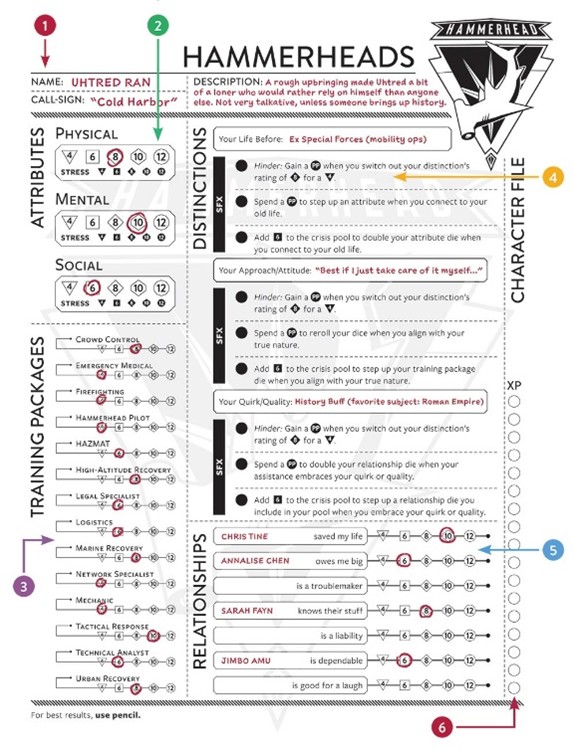
Everything on the sheet above—the three Attributes, the Training Packages, how Relationships work, what Distinctions matter—it’s all a setting-driven choice that the GM made before a player ever got involved. The possibilities are dizzying, and means that, once a GM has done the work of designing the world, everything in it bends towards the specific setting and stories in that setting.

Why Cortex Prme Works For Me

In a lot of ways, Cortex Prime is my wildest dream come true. It is a system designed for genre mashups, to allow GMs to feel unconstrained by any pre-existing setting. This is exactly what I’ve been searching for in this exploration. Reading through my criteria at the top of this post, it’s hard to see how any of the next game systems are ever going to address my criteria better than Cortex Prime. I get the strong sense that I could spend months worldbuilding and turning all the modular knobs to create exactly, EXACTLY what I want to do. Heck, once I’d done this work, I would have a game sourcebook in my hands that I could use far beyond my own solo play adventures. I would be tempted to consider writing adventures for my world and publishing them, surely reaching out to my regular game group to start a campaign. It’s kind of like a dream come true for homebrew worldbuilders.

What about jumps in character leveling, something that I’ve been using as a primary screen against other systems? You guessed it: There are mods for that too. Character advancement is its own section in the Cortex Prime rulebook, and I could make leveling up as milestone-driven or dramatic as I want.

Finally, once the world and game are built and all that knob-fiddling is done, the game has exactly the balance between crunch and narrative that I’ve been seeking. The mechanics are clear and easy to execute, and the decisions lead to exciting story moments. Even though the book often reads like a dense technical manual, it’s obvious that the density of mechanics is meant to allow the GM to make choices before players get involved, but that gameplay is meant to be fluid and fun. Look back to the game that launched the system in the first place, Marvel Heroic Roleplaying. In a lot of ways, MHR is an example of what Cortex Prime looks like once the GM choices are done.

The cherry on top: Because it’s a new game with such a wide scope and elegant presentation, the community around Cortex Prime is still vibrant. Unlike some other games I’m considering, I have no doubt that there would be plenty of people with which to bounce ideas or to lend inspiration. Moreover, I expect more and more setting books will be released over time, providing a whole ecosystem of Cortex Prime ideas to mine.

So, am I done? Did I find my perfect system? It sounds like it, right?

My Cortex Prime Hesitations

On average, I think each page of the ~250-page Cortex Prime rulebook took me more time to consume than any other game book I own. I had to reread sections multiple times to grok it and connect what I was learning with other sections, taking breaks between sections to allow my mind to breathe. It’s the only rpg book in memory that I’ve brought on an international business trip so that I could have the long plane rides to read it without distraction. To be clear: I’m not criticizing the book’s presentation or layout. For me, learning Cortex Prime is akin to learning a new language. Cam Banks has invited me to become a game designer and given me tools to do so. It’s as if I started the process of finding the perfect car for myself and stumbled upon a custom-kit dealership, where I can have any unique car I want if I’m willing to learn how to build it.

What I’ve come to realize, though, is that I’m not fundamentally a game designer. At best, I’m a competent GM who is comfortable homebrewing certain rules and tweaking settings to my taste. I’m a writer first, game player second. I don’t aspire to publish my own game system. Jumping back to my analogy, I’m a car enthusiast, not a mechanic—I want to buy a car and have someone give me the keys, complete with a maintenance plan if I run into trouble later. It’s clear to me that Cortex Prime offers the exact game experience I want for my project, as long as I’m willing to put in the significant work to assemble it from parts. Is that the work I want to do? I don’t think so. Everything about Cortex Prime feels tantalizingly full of possibilities but frustratingly far away.

I have two additional quibbles, but they are minor compared to the daunting, steep learning curve of building the system to my homebrewed world. First, as I’ve said throughout this series, Dungeon Crawl Classics titillated me with the story possibilities inherent in random tables. The more randomness I can insert into my process, the more that I surprise myself in my storytelling. Unless I want to build the tables myself, nothing about character creation in Cortex Prime is random. I’m sure that Cam Banks would encourage me to build those tables, but it’s just another step to a long process before I get to play and write. Woof.

Second, it sounds like there is some collective handwringing in the Cortex Prime community about how licensing works with the system (another article on this topic is here). In other words, once I’d put in the months of fiddling with the system to have it exactly represent my homebrewed, mashup setting, how public could I be with the choices I’d made? If I wanted to start releasing bits on this blog that became my own specific character sheets, powers lists, etc. – who owns those? It makes sense that there are legal questions there, because as I said, the Cortex Prime book feels uniquely like a game design toolbox more than a typical game rulebook. I don’t have specific goals or an endpoint in mind for this project (and honestly am not particularly ambitious about it), but I’d hate to regret choosing it as a system without fully educating myself on how licensing works. Add this step to the long lists of things I’d have to understand before beginning to play, which just all makes me want to sigh heavily.

One Game to Rule Them All

If it’s not obvious, I’m incredibly impressed by Cortex Prime as a system. It’s brilliant and unlike anything else I have on my TTRPG shelves. Kudos all around to Cam Banks and anyone else who created it.

It’s also a sobering game to explore. On the one hand, Cortex Prime delivers exactly what I want, as long as I’m willing to put in upfront work to create it. My resistance to doing that work is palpable, however, and makes me realize that I want a game that satisfies my requirements without needing to design the game myself. Back to my car analogy, I’d rather spend more time test-driving cars, finding the best one of the options available that I can drive right off the lot, than learning the skills necessary to build my own from a kit. There’s a reason that I spend time playing games and writing fiction and don’t spend that same time designing games. I hadn’t been forced to confront my missing game-designer gene until Cortex Prime.

As a result, I’ll keep it as an option, but distantly behind the others. If I truly can’t find something that works for me—or if I find myself with tons of free time and a willingness to crack my designer knuckles—it’s cool to know that Cortex Prime is there waiting for me.

Top Contender: ICONS

Second: Supers! RED

Third: Cortex Prime

Not currently in consideration:
Choosing a Supers System, Part 6

Choosing a Supers System, Part 4: ICONS

Another post, another quest for my soulmate game.

By now you’re aware that I’m envisioning a new solo-play venture, one that involves a genre mash-up and thus a particular set of requirements for choosing my next game. These requirements are:

  • A superhero game that can be played in a fantasy setting, plus allow for anachronistic weapons and technology. Basically, the superpowers and fantasy elements need to be satisfying, but allow for other genre shenanigans.
  • Is neither too crunchy (if I’m consulting forums or rulebooks more often than writing, that’s bad) nor too lightweight (I need to feel like the dice are guiding the story and enhancing the narrative). I want to feel like the mechanics support the story.
  • Level-up jumps in power. My idea is that the PCs start as “street level” heroes and become demigods as the story progresses. Something will be pushing them closer to godhood, which is a core part of the story. The game should not only allow for those different levels, but be fun to play at all of them.
  • No hard-wired comics tropes (like secret identities, costumes, etc.). The story will be a genre mash-up, so I can’t hew too closely to any overly specific formulas.

I have another “lighter weight” game system on my pile, so I figured it would make sense to tackle it next in direct comparison to Supers! RED andProwlers & Paragons. It’s also the most popular of the three systems: It’s time for ICONS!

ICONS

ICONS (yes, it seems to be always capitalized, though it’s not an acronym… yell it with me now) is the brainchild of Steve Kenson, longtime TTRPG veteran and original designer of Mutants & Masterminds, probably the most popular and played superhero game of all time. In listening to interviews with Steve, it sounds like he was trying, with ICONS, to create a more accessible game than M&M, something that gamers of all ages could jump into with minimal start-up costs. This goal is further emphasized by the presentation of the core book (the “Assembled Edition” is the 2014 revised book, and seems to be the definitive ruleset), which features Saturday Morning Cartoon-like artwork from Dan Houser and is pocket-sized. Everything about ICONS is non-threatening and kiddie, which I’ll admit for me at first was a turn-off.

The bones of the game are steeped in Fate Core, a rules-light, narrative-focused system. Every opposed test includes rolling a single d6, adding the value of the Attribute or Power you’re using (always on a scale of 1 to 10), and comparing the result to another single d6 plus the opposing ability. Dead easy. Results of these tests have a narrative range (seven possible outcomes, from “Massive Success” to “Massive Failure”). Each character also has descriptive, non-numerical Qualities (e.g. “I can do this all day” or “All-American hero” might be on Captain America’s sheet), and players or the GM can invoke (using Determination points, the game’s metacurrency) these Qualities either for or against the PC. Stamina is the “hit points” stat, a combination of a character’s Strength and Willpower. Range and time in combat are both abstracted. All these points are like the previous two games I’ve explored and seem characteristic of many narrative games. I’ve read some reviews annoyed that ICONS uses many of the same mechanics as Fate Core but changes the terms unnecessarily. Since I’ve not played any Fate proper games, I’m blissfully unaware of these issues.

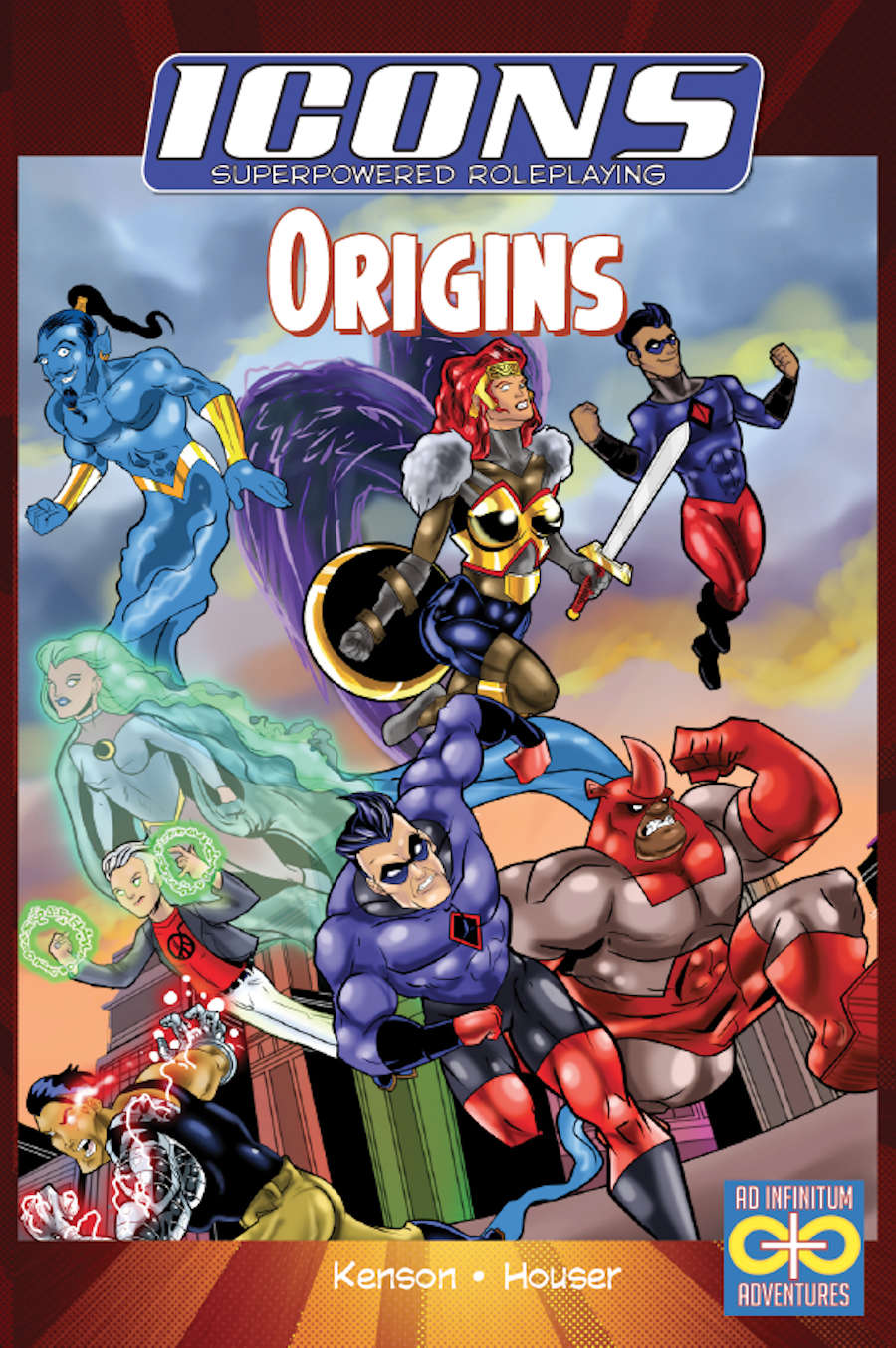
Sitting on top of these relatively basic mechanics are a metric ton of wrinkles and optional rules that make ICONS deceptively deep. Characters can combine effort to overcome otherwise-impossible opposing numbers, or the GM can set up “pyramid tests,” which are multistep challenges that simulate things like stopping trains from colliding. Players can retcon the fiction and use their powers for creative stunts. The game’s lethality is a choice, as are things like sustaining injuries. The list goes on and on, and that’s just from the 2014 rulebook. Over the past ten years, a metric ton of splatbooks, supplements, and additions have piled up, much like my bae Dungeon Crawl Classics. Unlike DCC, Steve Kenson has managed to collect many supplements into a few “greatest hits” books. For me, the best are Great Power, which adds a bunch of new powers to the base game, Origins, which expands the character creation process and introduces Knacks and Specialties, and ICONS Presents!, a 2019 summary of all sorts of variant rules and additions to the game. Included in this last book is a whole section on playing ICONS in a fantasy setting!

Character creation in ICONS is meant to be random (though there’s an optional point-buy way of making characters, the reverse situation from the last two games I explored) and is supposed to go quickly. So… let’s try it out!

To simulate what I want to do in my game, I’m dipping into ICONS Presents! for the alternate “fantasy hero” tables. I’m also going to roll on the very fun Background tables in Origins to flesh out the character. And, to fully stretch all the supplements I own, I’ll also use the expanded Powers tables in Great Power.

My first table is Origin, and I roll a 1 on a d6: My character is Arcane, with an innate gift for magical power. I also receive an additional arcane Knack.

I next roll on Archetype, a get a 5 on a d6: Stealth, adding +2 to my Coordination and Awareness. Cool. It’s an arcane trickster or thief of some kind.

Now it’s time to roll up my Attributes on 2d6, consulting a slightly modified table for Fantasy. Here is what I roll:

Prowess (ability to fight): 3 (Average)

Coordination: 6+2 from my Origin: 8 (Amazing)

Strength: 6 (Great)

Intellect: 6 (Great)

Awareness: 5+2: 7 (Incredible)

Willpower: 2 (Poor)

I then get to swap two Attributes, and I’ll swap Strength and Willpower. Whoever this person is, they’ll be a slight, agile, headstrong person, but not particularly musclebound.

Next I would roll for powers, but the Fantasy rules say to pick a few Knacks instead. I’m actually going to do a bit of both, selecting 2 each of Knacks and Specialties (their “fantasy” profession and skills), then rolling for a single Power.

For our magician-thief, I’ll pick Vanish and Escape Artist as Knacks, plus Stealth and Occult as Specialties. My character was, I’ve decided (at least until rolling up the background information), an Indiana Jones-like relic hunter before acquiring otherworldly abilities.

What was that Power? I roll “Offensive” and then “Dazzle.” My character can overwhelm an opponent’s senses somehow. Cool, and mighty handy given a PC who wants to mostly get out of combat instead of fight.

Now I turn to rolling up my character’s Background. After a whole bunch of rolls, I come up with a female, pale-skinned, seventeen-year-old who is a fun-loving and playful person. She values a mentor/teacher and yearns for love. She believes that people need leadership and guidance. She grew up in a rural community and was well-treated, at least until her entire family was betrayed by a loved one and lost everything. She then found a mentor and a windfall. Excellent stuff, random tables! I’ve got her in my mind, and as such writing her origin and Qualities is simple.

Here’s where I ended up:

The character creation process took me quite a bit longer than, say, Prowlers & Paragons, but that’s partly because I was flipping through four separate books. I have no doubt that it would become a fast process with practice. More importantly, it was fun, and generated a character that I could immediately drop into the story I’m wanting to tell.

Why ICONS Works For Me

It’s clear that Steve Kenson has put a lot of love over the past dozen years into ICONS, and it’s built on a Fate Core system that’s tried and true. As a result, ICONS is an intuitive system that is not only easy to understand but easy to tweak. I made a judgment call on what to use between standard superhero random character generation and the fantasy alternate tables without feeling self-conscious about the decision, even though Meri was my first character. Because the game always comes down to a single d6 role plus a single value, there’s not a lot to bog down speed of play. I love that the timekeeping system out of combat is divided into chapters, issues, and series, which sounds perfect for serial fiction. Which is all to say that ICONS’ core mechanics are easy to digest, easy to use, and I can easily see it working in my homebrewed world. With the four books I already own, I’m ready to play.

Although I didn’t think of it as a requirement when I began this process, I’m finding that random character generation is foundational to me being interested in the character creation process. Recall that I’m coming off six full months of Dungeon Crawl Classics, which is likely the most random-table heavy game in any genre. So much of solo play is combating my paranoia about overly railroading the story, and the randomness of rolls is what generates my surprise and delight. I’m already more interested in the character I made above than either of the Evlyn Towers I made with point-buy systems.

The level of support for ICONS is also heartening. There are tons of books, from both Ad Infinitum Adventures (Steve’s company) and third parties. I found no less than a dozen form-fillable PDF character sheets online, for example. There are Wiki and Facebook pages and a Discord server. The community feels dormant, but there’s still a faint heartbeat there. And hey… there’s even VTT support! I haven’t used Fantasy Grounds VTT before and have heard that it’s an expensive endeavor, but it’s nice to know that it’s there if I need it.

My ICONS Hesitations

My two hesitations on ICONS are related. First, because everything in the game is based on a 10-point power scale and every roll is a single d6, the power spread in the game doesn’t feel huge. As a result, I’ve read some forum comments that it might be a better game for low- and mid-level play instead of cosmic-threat level. It’s not a game that has particular rules for “street level” or “superheroic” play, because I don’t think those distinctions really exist in ICONS.

…Which means that it’s difficult to envision what “leveling up” looks like, when what I’m seeking are clear jumps in power once the character hit story milestones. There’s a section in the rulebook that discusses how to give Minor, Moderate, and Major Achievements, and Major Achievements (increasing Determination, adding Powers, etc.) might be enough, especially if I ignore the other two. It’s an open question, though, and one I probably wouldn’t sort out until I was already deeply invested timewise into my campaign. It would be a shame to get six months into a solo campaign, only to realize that I’m going to have to switch systems to fully realize the higher levels of play I had intended when I began.

I also don’t love juggling so many books to play, which is the same complaint I had with DCC. But I can’t really ding other systems for not having enough supplemental material and then complain that ICONS has too much material that I want to use. Consider this a minor irritant, not a reason to play another system.

One Game to Rule Them All

Of the three lightweight systems I’ve explored these past few weeks, it’s clear to me that ICONS is the best fit for what I want to do. The question is: Does moving it into first position on my list mean that I absolutely won’t come back to Supers! RED? For now, no. Yes, ICONS has the better character creation system, and far better support and materials. Supers! RED is different enough mechanically, though, that I may end up deciding that I want its narrative flexibility (particularly how it handles multiple Resistances) and the clear ladder of power levels. Heck, I could even see using the random tables in ICONS to generate the concepts for Supers! RED. So for now, I’ll keep both on the list:

Top Contender: ICONS

Second: Supers! RED

Not currently in consideration:

Choosing a Supers System, Part 5

Choosing a Supers System, Part 3: Prowlers & Paragons

It’s my second of many superhero TTRPG deep dives (links at the end of each installment to the others)!

Why am I suddenly diving into so many games? I’m planning to continue my solo gaming experience, but this time using a homebrewed world, story, and characters. The setting I’m envisioning is a genre mash-up, basically superpowers layered onto traditional fantasy, with a sprinkling of technology. Could I have started with something simpler? Heck yes, and maybe I should have done so. But I’m enjoying the specific requirements for a project like this one, and using it as an excuse to pour over some games on my shelf that I’ve either never read or have wanted to take for a test spin. Choosing the system has become a time-consuming tangle, but it’s been fun so far.

Speaking of requirements, I’ve articulated them as:

  • A superhero game that can be played in a fantasy setting, plus allow for anachronistic weapons and technology. Basically, the superpowers and fantasy elements need to be satisfying, but allow for other genre shenanigans.
  • Is neither too crunchy (if I’m consulting forums or rulebooks more often than writing, that’s bad) nor too lightweight (I need to feel like the dice are guiding the story and enhancing the narrative). I want to feel like the mechanics support the story.
  • Level-up jumps in power. My idea is that the PCs start as “street level” heroes and become demigods as the story progresses. Something will be pushing them closer to godhood, which is a core part of the story. The game should not only allow for those different levels, but be fun to play at all of them.
  • No hard-wired comics tropes (like secret identities, costumes, etc.). The story will be a genre mash-up, so I can’t hew too closely to any overly specific formulas.

My previous exploration tackled Supers! RED, a game that I’d bought after reading its glowing reviews but that I’d never sat down to read cover to cover. The other game in this vein is Prowlers & Paragons, also bought when I was in a superhero TTRPG buying frenzy because of how many people said they love it. What’s different about P&P is how many folks declare loudly that it’s their favorite supers system. When I added it to my “to be explored” pile, it was in large part to give me an excuse to understand what everyone was raving about. Let’s jump in!

Prowlers & Paragons

Prowlers & Paragons was first released in 2013, with the “Ultimate Edition” launched via a 2019 Kickstarter. Before I sit down to read a rulebook for the first time, I often search through easy-to-find game reviews to orient my brain. What’s fascinating (and exciting) about P&P is how many old-school lovers of Champions swear by it, and it seems to be a haven for people who, for whatever reason, bounced off Mutants & Masterminds. Hey, I’m a lover of Champions! I bounced off M&M (at least gameplay… I still love making characters)!

Check out this comment, from Richard in the above DMs Guild forum: “I would recommend this game for players of games like Champions or Mutants & Masterminds who find the math oriented nature of combat to feel very clunky and not very comic book like. Likewise I feel that fans of other narrative games, such as Cortex Prime, could look at this and have a good alternative game to use if their players want more crunch in the character creation. Alternatively I could see this game being used to create a really good fantasy game as well. I have often used super hero rpgs to run Dungeons & Dragons games. I feel character creation is much more fun in such situations and combat tends to work better.”

Squeee!!

In terms of how the core mechanics work, I’m going to use another quotation, this time from a 2022 review from Timothy S. Brannan: “The game mechanic is very basic and very easy to use. Every trait, ability, power, or what have you has a score. Figure out what you want to do, find the right combination, add those numbers up, minus any negative modifiers, and then roll that number of d6s.  “2s” and “4s” are one success, “6s” are two successes.  Compare that to the Thresholds table and you will know by how much you succeed, or fail.”

In a lot of ways, then, Prowlers & Paragaons shares its base DNA with Supers! RED. Everything has a d6 value, and gameplay involves rolling pools of dice. The difference here is that you aren’t adding the dice values in a pool, but instead counting the number of successes. As a result, dice pools in P&P can get large, since the game doesn’t care about your ability to do much math. The book routinely uses pools of 12d6 or more. If you like fistfuls of dice, this is a great game for you.

Combat is the crunchiest part of P&P, with specific terms like “active and passive defense” and “subdual damage,” but everything is theater of the mind and based on the basic mechanics from the review quoted above. Range and movement are abstracted to provide narrative flexibility, and a GM can decide how much things like size and cover matter to combat (or not). There are multiple pages of combat maneuvers, including rules for grappling, stunts, ambushes, defending others, etc. My general sense in reading the rulebook is that the non-combat parts of P&P are about who the narrator is, with a lot of open space to describe what’s happening. Combat, on the other hand, becomes more scripted, with clear initiative order and Health tracking. I’m not sure how I feel about the balance here without playing it.

Also like Supers! RED, character creation in P&P is a point-buy system with an optional random generator if you need a launching pad for ideas. The main differences between the two are a) the overall pool of points is larger (for street-level heroes, I used 12 for Supers! RED and 75 for P&P), b) P&P has more Attributes and Talents, which is what soaks up a lot of those extra points, and c) Flaws serve a different purpose. In Supers! RED, the equivalent of Flaws give you extra points to spend. In Prowlers & Paragons, though, Flaws create roleplaying situations in which you can receive Resolve points, the metacurrency that allows players to add dice, reroll dice, or add narrative features to a scene.

Because there are so many parallels between the two, I thought it might be fun to try and recreate my character Evlyn from the last post to see how it might differ here:

Comparing the two Evlyns from Supers! RED and P&P, you can see that, even with a street level hero, there is more detail here. Indeed, I’ve heard new players sometimes feel intimidated by the sheer number of Attributes, Talents, and Powers, especially if they’ve entered expecting a “light mechanics” system. That said, most of that sheet is fluff (though I like the many ways to add flavor), and since everything is expressed in a simple Xd format, once you’ve stared at a few characters sheets it’s all easy to grasp. Making my first PC took a little more time than Supers! RED, but not much. Like any points-buy system, the biggest trick was the “add one point here, take away two there” fiddling at the end to make sure I used exactly 75 points. Overall, I felt that I had plenty of points and options to make the character from my mind’s eye.

Why Prowlers & Paragons Works For Me

I worry that Supers! RED is too light mechanically, and Prowlers & Paragons is a definite step up in complexity. Combats can get crunchy, and things like chases and hazards are handled in “goals,” or multiple steps to resolve the situation. Because the “who gets to narrate” question is a core focus of the game, it’s a little odd to think about it in solo play. Thankfully there’s a “traditional results” variant rule that creates a table reminiscent of Blades in the Dark, changing the narrate-and-respond structure of resolving actions into “failure,” “success,” or “failure/success with a twist” which the GM can dictate. I love those mechanics, and it’s something I often find myself weaving into other TTRPGs. Also, like Supers! RED, we have tiering of enemies into Villains (full stats), Foes (same stats, half health), and Minions (one xd6 value), which creates encounters where PCs can feel especially super. Which is all to say, Prowlers & Paragons seems to have a lot of things I want out of my next game.

The system also has easy, clear jumps in power level built into the system since everything is based on point-buy character creation. Check out this glorious table from the core rulebook:

Perfect! I can easily see, instead of allowing PCs to spend the incremental Hero Points they receive at the end of each successful adventure, forcing them to save up until reaching a certain threshold. This sort of sudden jump in ability is, mechanically, what I’m hoping to create, and P&P makes this part of the storytelling easy and straightforward.

Finally, I want to say it’s a minor thing, but the more superhero game books I read, the more it matters to me: The Prowlers & Paragons book is gorgeous. Some of the art makes me wish it was a full comic book, and the layout is clean and easy to follow. Bouncing around chapters to find information is easy. The writing is clever and often delivered with a wink. After half a year with Dungeon Crawls Classics’ absolute monster of a rulebook and its scattered supplements, it’s delightful to have such a well-assembled book.

My Prowlers & Paragons Hesitations

Despite the quotation earlier in this exploration, I think the base P&P game requires some work to make it fit cleanly into a fantasy setting. Several of the Talents–Professional, Science, Technology, and Vehicles–are aimed at a decidedly modern comic book experience, and missing are things like Lore and Magic/Arcana. Similarly, several of the descriptions for Motivations, Flaws, etc. lean heavily into modern comic book tropes. None of these problems are crippling to my ability to play it in a fantasy setting, but it’s not out-of-the-box ready. As I’ve said before, I’m leery of homebrewing a system before I’ve even had a chance to play it as intended, and though the core game here is simple to grasp, it’s unlike most other TTRPGs I’ve played.

The biggest stumbling block for a fantasy setting is Gear. For me, equipment in P&P is caught in a weird limbo between narrative and crunchy. Characters can basically have whatever mundane gear they want, but these items often have mechanical boosts or effects. At some point, equipment is good enough to justify becoming its own Power, but that point isn’t obvious to me. Armor and weapons have tags that have defined mechanical impacts as well, some of which mimic Perks or Flaws that would normally cost or give you Hero Points. When thinking about a fantasy world where the PCs have superpowers but others don’t, the whole thing feels like a mess to sort through. I wish there was a P&P supplement that fully explored alternate settings like sword-and-sorcery or cyberpunk, which would help me feel more confident in how to navigate the many issues I see ahead.

I have a few other minor gripes about the system that already make me want to fiddle with it. For example, why doesn’t a character’s Motivation, which is given more than a full page in the book, somehow provide ways to generate Resolve? Another example: when making Evlyn, the only distinction between Blink and Teleport seems to be about combat, and so buying both felt overly taxing on my points build. I read in some reviews that P&P is easy to “break” from a balance perspective, and I’m just beginning to sniff at the edges of this problem even from a single read through the book. There is a way that a highly crunchy system like GURPS Supers or a highly abstracted system like Supers! RED works better for me, which is a surprise to discover.

Finally, I’m bummed to see that Prowlers & Paragons neither has a vibrant, active community nor even a creator website where I can find discussions, alternate rules, sample builds, etc. for inspiration (though I do believe a small Discord server exists). There’s no VTT support that I can find. These absences aren’t an enormous barrier, but they are discouraging to my confidence for committing to it for more than a one-shot foray.

One Game to Rule Them All

When I began my exploration into Prowlers & Paragons and reading reviews, I was sure that it would rank ahead of Supers! RED. Much to my surprise, I can more easily see committing to Supers! RED, and, while writing this post, often found myself thinking “this would be easier to figure out in Supers! RED than here.” My worries about Supers! RED being too lightweight and thus not keeping my interest remain, but P&P simply didn’t pull me in, despite its flashy presentation. In fact, if Supers! RED had the same art and layout, I’m pretty sure that the decision would have been ridiculously easy to make.

To be clear: I don’t want to yuck anyone’s yum; if P&P is your favorite supers system, that’s great. Feel free to argue with me in the comments. For me and for this particular project, however, I see too many ways it doesn’t quite match my hopes for it, despite the ridiculously-lovely rulebook.

As a result, our top contender hasn’t changed…

Top Contender: Supers! RED

Not currently in consideration:
Choosing a Supers System, Part 4

Choosing a Supers System, Part 2: Supers! RED

Last time, I outlined my dreams for my next project: Continuing the solo-play, serial writing I’ve done the past year with Dungeon Crawl Classics, but in a fantasy-superhero mash-up story of my own creation. Because DCC doesn’t do superheroes, I’ve opened the door to another TTRPG as the underlying system I’m playing. My general instinct has been that it’s easier to adapt a superhero game to a fantasy setting than taking a fantasy game and adding superpowers. I’m also open to more setting-agnostic games, especially ones that have both fantasy and superhero supplements.

The special requirements for the game I choose are:

  • A superhero game that can be played in a fantasy setting, plus allow for anachronistic weapons and technology. Basically, the superpowers and fantasy elements need to be satisfying, but allow for other genre shenanigans.
  • Is neither too crunchy (if I’m consulting forums or rulebooks more often than writing, that’s bad) nor too lightweight (I need to feel like the dice are guiding the story and enhancing the narrative). I want to feel like the mechanics support the story.
  • Level-up jumps in power. My idea is that the PCs start as “street level” heroes and become demigods as the story progresses. Something will be pushing them closer to godhood, which is a core part of the story. The game should not only allow for those different levels, but be fun to play at all of them.
  • No hard-wired comics tropes (like secret identities, costumes, etc.). The story will be a genre mash-up, so I can’t hew too closely to any overly specific formulas.

I’ve discussed the dozens of popular games that I’ve already discarded from consideration, including all the behemoths in the genre and some of my personal favorites. Today I begin my dive into the eight (yes, last time I said seven… but comments on the last post here, plus Facebook and Reddit discussion, convinced me to add one) games I’m still actively pondering. Truly, I still have no idea which one I’ll choose, but I’m hoping this series will untangle my brain. Each post is meant to be a full dive and exploration, to really pressure-test each system against my needs and wants.

Let’s kick things off! First off is one of the games on the pile I know the least…

Supers! RED

Probably the most annoying thing about Supers! RED is its name, which is just generic enough to make web searches difficult. It’s an abbreviation for Supers! Revised Edition, a 2014 revamp of a game originally published in 2010 by a different author. Any reviews and play-throughs I can find on the game use the “RED” nomenclature, though, so Supers! RED it is. Also, sometimes SUPERS! is all caps, but inconsistently, so shhh.

The original Supers! is a lightweight game system, using handfuls of d6s in a way that I think originated from the West End Games Star Wars system. I don’t own the original Supers! book, but here’s a nice interview with the RED authors describing why they decided to revise it and what improvements they made. Suffice it to say, they clarified rules, filled in gaps not covered (like how you break things or grappling rules), improved the presentation, and added examples and optional rules—so the game is essentially the same, but polished up and with more options. In other words, if you want to buy the game, get Supers! RED by Hazard Studios, not the original.

The core mechanic is that each attribute, skill, and power have an xd6 value, which you roll whenever you want to do something. In combat, opponents also roll abilities or powers to defend themselves, setting the DC to succeed. Each character has four resistances (Composure, Fortitude, Reaction, and Will), and PCs (not the GM) choose when taking damage which resistances to lower, so each character effectively has four distinct “hit point” pools. Indeed, one of the strengths of the system is that the PCs have a good amount of control over how to interpret what happens and why, while still grounding these decisions in dice rolls. For a tutorial on the basic system, check out this short video. Watching that video alone, it’s apparent that Supers! RED is easy to figure out, has a lot of narrative wiggle room, and adapts easily to multiple genres (there’s no functional difference between, for example, an arrow and a laser).

On top of that basic system are several tweaks that give the game some depth. There are combat maneuvers, Competency dice (the game’s meta-currency to give players an edge), power boosts and complications, PC advantages and disadvantages, plus optional rules for dice caps, pushing actions, wild dice, and alternate damage. Even without the options (the one I like best is adding a “wild die” to each dice pool that explodes, making actions have the potential for more dramatic effects, since the level of success matters when determining results of an action), there are interesting trade-offs in playing Supers! RED that hopefully keep the game fun to play despite its seeming simplicity.

One more thing I love (which is similar to my favorite supers game Sentinel Comics RPG): Enemies have different levels of complexity based on how important they are to the story. Major villains are built like PCs, with all the same Resistances and access to abilities. Major lieutenants are “henchmen,” and have an xD value, scaled to the threat they represent and what they use for all attacks and defense. “Mooks,” meanwhile, are groups of nameless enemies with a single xD value. Mechanically, henchmen and mooks are identical but get interpreted differently, one as an individual and one as a mob. This system allows PCs to feel like real superheroes, tackling piles of low-level enemies at a time and making bigger threats feel like final bosses.

To wrap my head more fully around the system, I made a starter character, keeping it a low-powered PC with a more classic fantasy base. Here she is:

I’m not going to go into all the ins and outs of what’s on the sheet, but a few quick notes: You can see that from all the white space that the system does not contain a lot of detail (although admittedly this is a low-level “pulp hero,” about as basic as it gets). It was easy for me to grasp the character creation process, what trade-off choices I was making, and how to build what was in my mind’s eye, even only reading through the book once. Start to finish, Evlyn took me about fifteen minutes to make.

Interestingly, there isn’t anything particularly “fantasy” about Evlyn when looking at the sheet, though I had a fantasy trope in mind when building her—namely, the bookish scholar pulled unwittingly into danger. What’s heartening is that, although she’s meant to be a scholarly and investigative character, Evlyn is still useful in combat. As far as I can tell, in fact, there’s no such thing as a “useless in combat” Supers! RED character because of the open-to-interpretation nature of the Aptitudes and Powers, and the flexibility to attack or defend with anything on your sheet that has a d6 value as long as you can explain it.

Why Supers! RED Works For Me

As the above section illustrates, Supers! RED is an incredibly flexible system, grounded in creatively explaining how the few words and dice-value on a character sheet interact. Falling off a building? I’ll use my Ice Powers as a defense, creating a frozen slide to keep me safe. Someone’s throwing knives at me and hits? The damage is to my Composure, because they didn’t physically hit me but now I’m freaking out. I’m attacking a group of 2D mooks, doing 1D damage? I land on one of them, then spin a kick, sending a second one into a third, cutting my number of foes in half before they can blink. All the rules in Supers! RED are ways of increasing or decreasing the number of d6 used, and the effect adds or subtracts from the available d6s next time. It’s elegant and open to whatever interpretation works in your game. As a result, it’s a system that can basically work in any genre, all with a 168-page rulebook and nothing else. For a genre mash-up game, that’s a boon. In fact, I took glee in a Reddit comment from a player that said they’d played a multi-year Supers! RED fantasy, sword-and-sorcery campaign without superheroes.

Speaking of campaigns, I love the game’s clear scaling of power levels. Pulp heroes are 10-15D total in value, all the way up to cosmic legends of 50D value. I can imagine starting my PCs at 12D characters like Evlyn, awarding them Competency Dice each milestone or adventure, and letting them spend those Dice to improve their Resistances/Aptitudes/Powers, purchase Boosts/Advantages/Powers, or reduce Complications once they’d hit 15D, and then every 5D after that. After only eight “level” jumps, the PCs would have moved from barely enhanced humans like Evlyn above to a true cosmic demigod. This is exactly the sort of power jump that I consider a core part of the game I run next.

Because of the sparse, easy-to-understand system, making NPCs on the fly or improvising situations appears absurdly easy. The deeper I went into the rulebook, the more I thought that I could convert any adventure in any game system into Supers! RED without hassle. For a GM, the game is silly-easy to prep and requires simply the ability to translate situations into appropriately sized d6 pools. Oh, there’s a wildfire? That’s a 3D hazard. Twenty lizard men come pouring out of a fissure in the earth? Let’s call those two 2D groups of mooks, oh and let’s say they have a leader who’s a bruising 3D henchman leader. The simplicity of Supers! RED keeps the focus on vivid description and away from rules lawyering.

My Supers! RED Hesitations

I have one big worry about Supers! RED and three smaller ones. My largest hesitation is probably obvious: The system may be too lightweight to be satisfying. Making Evlyn’s character sheet was easy. Staring at it, though, it’s difficult to find inspiration for creativity. She has four Aptitudes and one Power… those five values must literally explain every single action she makes, adventure after adventure, until she levels up and adds 1-2 more (and that assumes that I add Aptitudes or Powers instead of solely increasing the value of those she already has). Will I get bored describing enemy after enemy in similarly restrained ways? Is a 3D fire elemental going to feel different enough from a 3D gang of skeletons to be interesting? The strength of Supers! RED is its open-to-interpretation, narrative focus, but I’m looking for something that gives me a feeling of tension and exhilaration when I roll the dice. I’m worried that I may not be giving myself enough narrative tools to enhance my writing versus simply, you know… writing.

I’ll cover my other three gripes quickly because they’re all minor. First, Supers! RED has very little support as a game system. There are no player or GM forums, there’s no module on Foundry VTT or any other virtual tabletop, and few supplemental books exist by Hazard Studios or other third parties. That’s fine, but I often mine forums and supplements for inspiration, ask questions of fellow GMs, and use the VTT to immerse myself in the game experience. None of that is possible here.

Second, I’m surprised to find that the lack of randomness–both in character creation and game play–is an unwelcome shock after playing so much Dungeon Crawl Classics (which is famous for how laden it is with random tables). There’s a random character creation variant process at the back of the rulebook, but it doesn’t really work for me and honestly feels a little half-baked. Thinking about it, I would probably make random characters in a different system, then quickly translate them into Supers! RED. That’s a fine workaround, I suppose, but strikes me as pretty silly if I’m going through all of this trouble to pick my game system of choice.

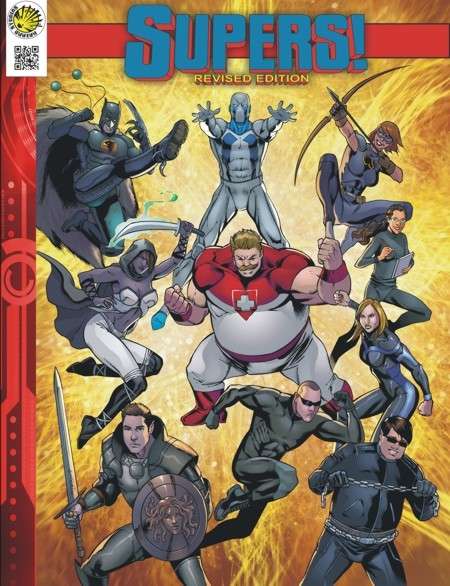
Finally, as someone who almost became a comic book artist after college, I’m utterly uninspired by the artwork in Supers! RED. I feel terrible saying it out loud, because I know how difficult good artwork is. A real joy about PF2E, however, is the rampant Wayne Reynolds art. DCC is famous for its old-school approach, led by Doug Kovacs. Heck, Johan Egerkranz is almost the entire reason that I bought physical copies of Dragonbane and Vaesen. For me, the art in a game is best when it sets my mind on fire with possibilities, wanting to lose myself in the world. Any superhero game is trying to attract comic books fans, which is a visual medium defined by its artists, so I’m a little baffled when supers TTRPGs get this wrong. With Supers! RED, I’m distracted by how little I enjoy looking at the book. Add to “the art problem” the lower quality paper and print from my print-on-demand copy of the rulebook, and I find the sensory experience of the game frustratingly poor. I am looking past a lot of blech to see the possibilities in this game.

Are any of these last three reasons enough to ditch Supers! RED as my chosen game? Absolutely not. It’s the lightweight gameplay that’s the primary worry. But since I have seven more systems (unless I continue to find more… lord help me) to consider, I suppose that everything is a factor. Speaking of which…

One Game to Rule Them All

I have a feeling that, at the end of this assessment process, I will have a pile of games that weren’t exactly right for my current project but that I desperately want to take for a test spin. In future installments, I’ll take the time to rank each system here. The game at the top will be the one I choose to solo-play next, but a handy ranked list will help kickstart me next time, if there is a next time. For now, though, I’ve only done one full exploration, so this section is as sparse as it gets:

Top Contender: Supers! RED

Next time: The exploration continues! If you have thoughts about this system or others I should add to my pile, I’m all ears!

Choosing a Supers System, Part 3

Choosing a Supers System, Part 1: What I’m Not Playing

It has been great fun over the past six months playing Dungeon Crawl Classics solo, documenting my sessions as both a game log and fantasy fiction (if somehow this sentence is news to you, start the dozens of installments here!). I’ve learned a ton from this experience, not only about DCC and solo play, but how I might relaunch a similar series using a superhero TTRPG (which, as I’ve said, is my first love) in an entirely weird homebrewed setting, operating without the safety net of published material. That’s right: Today I officially switch gears.

I’m not done with DCC, not by a long shot. But I’ve had a story idea niggling in my head since before the pandemic, and the past year’s posts have provided clarity on how I might explore it. What I had originally conceived as a series of science-fantasy/superhero mash-up novellas works better, I think, as serial fiction, and solo play keeps the project energizing for me. So, at least for now, I’m planning to move my DCC love into GMing an online campaign for a group of players while simultaneously turning my solo-play/fiction energy towards my brain-worm of an idea.

I, uh… own a lot of games, superhero and otherwise. Indeed, collecting superhero TTRPGs has been a hobby of mine, and I’ve even tried to document every superhero game ever published (this list is neither current nor comprehensive… I get bursts of energy to update it a couple of times a year). For me, then, one of the most profound questions to answer is: What the heck game system do I use for my solo play?!

This decision is a weighty one. At any point in time, of course, I can switch game systems in the background without messing up the story (and might even want to do so from time to time). What I believe deeply, though, is that the underlying system fuels the narrative, and will either work with or against me when I’m writing. Besides, I’m choosing which game I’m going to dedicate months, if not years, of my life to playing. Do I pick something already familiar to me or something brand new? Do I go rules heavy or rules light? Do I reskin a game built with a strong setting or choose a system that’s inherently setting agnostic? Etc. etc. etc. These questions feel almost overwhelming. Scanning my bookshelves and PDF libraries, I’m paralyzed by choice.

As a result, I’m going to dedicate multiple posts to sorting out my thinking on this topic. Settle in, boys and girls, because the next several weeks are going to entail a lot of TTRPG navel-gazing. By the end of this first series, though, I’ll have selected a game system and be ready to dive into the setting and character creation.

First, a note about the story I want to tell: It’s a post-apocalyptic Earth that has become, with the fall of modern civilization, a feudal, fantasy-like setting where humans face off against monsters. No one remembers the world as it was. Suddenly a set of superpowered people—think comic book powers layered onto fantasy archetypes—emerge. What is the origin of these strange abilities? What do these powerful beings herald for the world? Can they save humanity? You get the idea.

My oddball requirements for this project are:

  • A superhero game that can be played in a fantasy setting, plus allow for anachronistic weapons and technology. Basically, the superpowers and fantasy elements need to be satisfying, but allow for other genre shenanigans.
  • Is neither too crunchy (if I’m consulting forums or rulebooks more often than writing, that’s bad) nor too lightweight (I need to feel like the dice are guiding the story and enhancing the narrative). I want to feel like the mechanics support the story.
  • Level-up jumps in power. My idea is that the PCs start as “street level” heroes and become demigods as the story progresses. Something will be pushing them closer to godhood, which is a core part of the story. The game should not only allow for those different levels but be fun to play at all of them.
  • No hard-wired comics tropes (like secret identities, costumes, etc.). The story will be a genre mash-up, so I can’t hew too closely to any overly specific formulas.

To help bring my unique story to life, today let’s talk about the systems that I am not considering, even though this list represents many of the most popular games in the superhero TTRPG genre, past and present. Heck, a lot of these games are true favorites of mine, and some represent literal years of memories. For one reason or another, however, each doesn’t sound quite right for this specific project.

The OGs

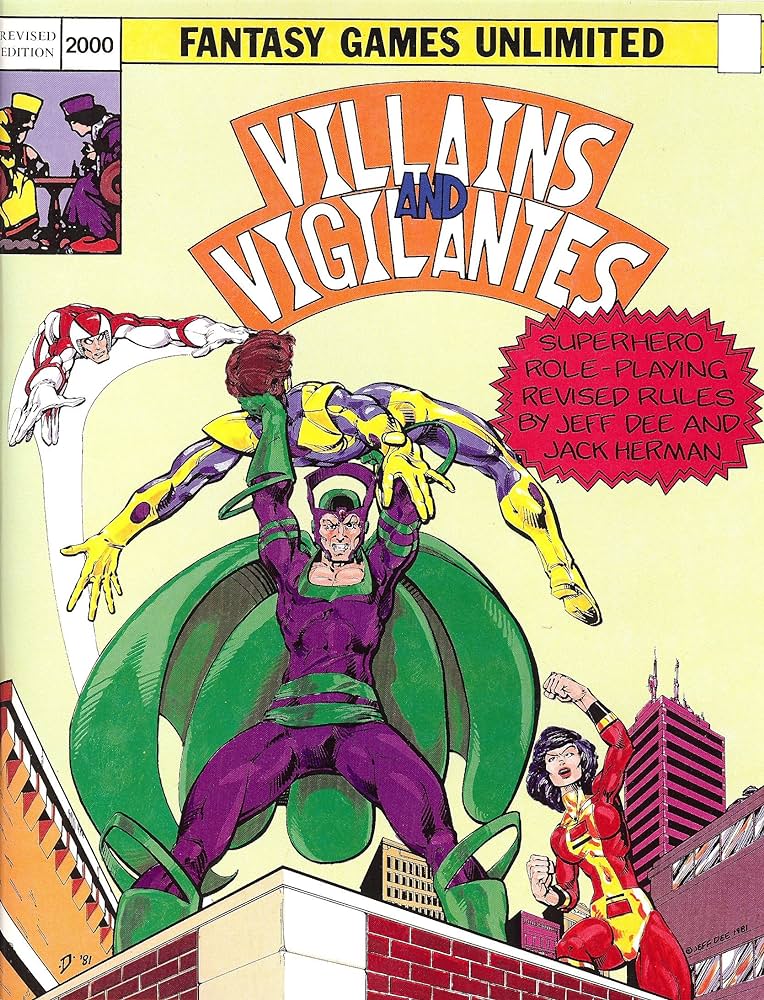
Villains & Vigilantes was my first superhero game, and something I played through middle school and high school. I was immediately enthralled by the art of Jeff Dee and Bill Willingham, which would become constant inspirations for my own drawing. My first time playing in a long campaign of any kind was a wild V&V series of adventures GMed by dear friend Ted. At one point in that campaign, our group of heroes entered an alternate dimension, and, upon exiting, each PC’s power set and appearance completely changed, permanently altering our heroic identities. It blew my mind how satisfying sticking with the same character over long story arcs could be, and how gonzo wild superhero tales can become.

Why not take V&V for a nostalgic spin, then? The revised edition of the original rules, which is what I played during those years, is a product of the early 1980’s and, truly, does not hold up well in terms of creating satisfying characters, simulating comics action, or telling deeply narrative stories. On the other hand, after a lengthy legal battle, Jeff Dee and Jack Herman finally released a more modern, updated game in 2017, called Mighty Protectors. This third-edition of the game, which I own but have never played, has an old-school vibe but seems to, based on many positive reviews, hold up well under today’s modern scrutiny. Which is all to say that I’m tempted. For this project, however, I worry about all three of my requirements above. It seems like work to make the system into a fantasy world, character creation is gradual and incremental, and some Disadvantages are hardwired into tropes. As a result, I’ll save Mighty Protectors for a future project.

A special, side-note shout-out to Longshot City, a delightful superhero hack of the very-weird Troika! system. Longshot City, to me, has an even better V&V vibe than Mighty Protectors, and is something I would immediately be comfortable playing solo. It also, however, suffers from all the same issues in terms of fit for this project. Making characters is a hoot, though. I recommend checking out this game.

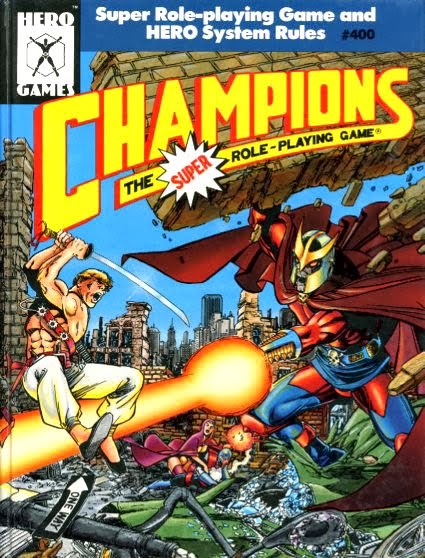
The single superhero game I played for the most years of my life, the one that unseated V&V and became my obsession through college, graduate school, and beyond, was Champions. Indeed, the first long campaign I ever GMed was with Champions 4th edition, with the sweet George Perez cover. I also still own the 3rd, 5th, and 6th editions of the game, the latter of which is the current edition and has its own fantasy supplements. Champions introduced “point buy” systems for superhero character creation. The rulebook is an absolute tome, with a mathematical, balanced answer to creating any superpower or character concept possible, and it’s a system I know back to front. In addition, because it’s all based on points budget, my “level up requirement” is easy to handle in Champions; if I want a jump in power, I just need to, for example, add 50 points at story milestones.

It is equally tempting to dip back into the nostalgia lake of Champions. But, and I say this with great affection, the HERO System is work, man. Creating characters—heroes or NPCs—can take hours of tinkering, and combat can be equally persnickety. I’d like the system to be in the background for this project, not the primary time commitment. I’ve loved putting in the math-miles in the past, but not this time. For all of these same reasons, I am also not considering GURPS Supers, which is a point-buy generic system that I’m sure at least one person thinks I’m stupid for not using. GURPS is really, really, really flexible as a system, but if I wanted to use something generic here that’s based on balanced, simulationist math, it would be the HERO System, which I know far better.

One of the original superhero games that still has a surprisingly cult-like following is the original Marvel Superheroes, which pioneered the famous FASERIP system. I own the original yellow boxed set in 1984, and the advanced set released a year later. Marvel Superheroes has a terrifically narrative approach (especially for its time) and can be a lot of fun to play. The game never really captured my imagination for creating new heroes, though, and I find it’s better suited to a “I want to play Wolverine and fight Deadpool” sort of game experience than a homebrewed world with novel characters. It’s important to nod my cap at FASERIP, but it’s not my system of choice.

I’m more tempted by the most recent Marvel game, the Marvel Multiverse RPG. I like that it’s actively supported by Marvel and still pumping out sourcebooks. I also know that the Glass Cannon Podcast crew love it. The more I’ve read about Marvel Multiverse, though, the more detractors I find, suggesting it has some real balance issues, that some character concepts are currently impossible to realize, and that there is less of a focus on character advancement. Even more, the game and setting are deeply interwoven, so it seems difficult to use for a non-Marvel game, and, especially, a fantasy setting. I’ll also not be delving into the other Marvel (or DC, for that matter) games from over the years.

Another nostalgic favorite of mine that is oh-so-tempting is Golden Heroes. I’ve written a deep dive look at Golden Heroes, so I won’t rehash it here. Suffice it to say, I’ve spent a long time thumbing through my copy of Squadron UK (its more modern successor), wondering if this project might be the time to bust it out. Good sense tells me, though, that the fun of Golden Heroes has always been rolling up characters, not so much the gameplay.

The People’s Favorites

The game many, many people consider the granddaddy of superhero TTRPGs is Mutants & Masterminds. With over twenty years of updates, supplements, and support, the M&M community and resources are vast. At its core, Mutants & Masterminds is a d20 system recognizable to fans of Dungeons & Dragons, but it is a game uniquely its own, and specifically designed to tell superhero stories. For years and years, I had a Hero Lab account for the sole purpose of making M&M characters in my spare time, even when I never had a group with which to play them. Character creation here is also a point-buy system, and it has so many options that pretty much any idea is possible.

Although making characters (PCs or NPCs) in M&M is not quite as time-consuming and intense as in Champions, it’s still significant, tinkering work. It also has d20 baggage from D&D 3E that I don’t love, including the restrictive action economy that doesn’t, in my opinion, simulate the cinematic, superpowered battles that are the stuff of my daydreams. For all these reasons, I enjoy making characters in M&M more than playing it. The staying power and popularity are nothing to sneeze at, though. Mutants & Masterminds deserves its flowers and would be easy, because of its adjacency to D&D, to use in my homebrewed setting.

The only game I hear talked about more than M&M is Masks, a Powered by the Apocalypse game meant to simulate and capture the spirit of teen superhero drama. Gone are the fiddly, crunchy bits in all the games above in favor of pure, thematic, storytelling gusto. Masks was somewhat of a revelation for many people, able to tell stories that superhero games to that point had struggled to tell. Unfortunately, like most PbtA games, Masks fits a very specific niche in terms of genre and is thus mostly unable to tell stories other than teen superhero drama. Since I want my tale to be broader than that, I’m skipping this system.

A quick sidenote that Worlds in Peril attempts to broaden PbtA into more general superhero tales, but I haven’t been super interested in that game. The creators eventually adapted it into a game I really like, though. Speaking of which…

Close, But No Cigar

So, Worlds of Peril begat a really intriguing game in a different system, Galaxies in Peril. I absolutely love Blades in the Dark’s mechanics, but (and I know these are both controversial statements) the setting of Doskvol turns me off, and I have zero interest in playing scoundrels. As a result, I often keep an eye on Forged in the Dark games that have different settings or flavor. The idea of a supers FotD game was immediately appealing, and I’ve devoured the Galaxies in Peril book cover to cover twice. There is a procedural element to the mechanics that would make for excellent serial storytelling, and it’s fundamentally a system that focuses on the meatiest part of adventure tales, with a fun narrative way of interpreting die rolls. For a long time, when I envisioned playing games in my homebrewed setting, I assumed that I would use Galaxies in Peril.

Unfortunately, the more I’ve considered the reality of using this game, the more I realize that the city that replaced Doskvol in Galaxies in Peril is highly specific, and not at all conducive to classic fantasy. To make it work, I would essentially have to create my own city, with my own factions. I ultimately might end up doing exactly that, but having to do it all as prework is daunting. I’d still love to play Galaxies in a longform campaign, but like many games in today’s post, I get the sense that it’s most fun right out of the box, embracing the baked-in setting.

When people ask me for my favorite superhero game, my current answer is Sentinel Comics RPG. Sentinel Comics does so many cool things that other games don’t that it blew my mind when I first played it. Character creation is semi-random and yet creates wholly satisfying PCs. Combat, with its innovative, timed Green-Yellow-Red mechanic, is epic and fast-paced. The environment is an actual NPC in combat, with its own moves that change any scene cinematically. Game sessions are called “Issues,” and there are story milestones once you’ve created a “Trade Paperback” worth. So cool! Running it as a GM is a joy. Everything about Sentinel Comics is just so fun. And yes, the game takes place in its own “Sentinel Comics” universe, which is four-color, bright-and-shiny in theme. But there’s nothing about the setting that is hardwired into the mechanics, and it’s an easy system to reskin.

The fatal flaw of Sentinel Comics, at least for my purposes, is that it has basically no level-up advancement at all. This omission makes some sense, since comic book characters over time rarely get more powerful… they just change. Sentinel Comics assumes that the fun is seeing those changes in characters without obvious jumps in power, sort of like my high school game with Ted. It’s a system that very much mimics the experience of comic books at every turn.

I’ve thought long and hard about whether I could make Sentinel Comics RPG work for this project, and I just don’t think it’s fit for this particular purpose. Alas. If you haven’t heard of the game and love superhero stories, though, I can’t recommend buying it highly enough.

Another modern system that has sorely tempted me is City of Mist. The basic conceit of City of Mist is that each PC is an avatar of mythos that sits just beyond human perception. PCs can be embodiments of Thor, or Little Red Riding Hood, or the Stay-Puft Marshmallow Man, or whatever. Pretty much anything goes in City of Mist, both in terms of character concept and powers. Thanks to its Fate-like system, playing the game is less about measurable stats and more about thematic “tags,” qualitative descriptions attached to characters. If you can argue for why a tag works in a situation, you get a bonus to your 2d6 roll (and, like PbtA, every roll is a 2d6 roll and considered a “move”).

Thematically, there is a lot about the game that works well with my homebrewed concept. If I replace the modern city with a fantasy world, the same toggling between “Logos” and “Mythos” is not only possible, but something that I want to actively explore in my story. The lack of crunchy mechanics means that fighting with swords or eyebeams is irrelevant, and though City of Mist, like Sentinel Comics RPG, doesn’t have an “advancement” mechanic per se, changing the thematic tags does fundamentally shift characters in ways that can feel like growth. A lot fits here.

I’ve consumed a ton of City of Mist reviews, listened to interviews of the creator and actual-play podcasts, and read the books cover-to-cover. What I’ve come to understand is that a) the system is extremely narrative, open-ended, and feels unlike most other TTRPGs, and b) the quality of gameplay is highly dependent upon (as with many narrative games) the skill of the GM and trust of the players. What I cannot for the life of me figure out is whether City of Mist would be terrible for solo play. It seems like much of the richness of the game lies in the collaborative storytelling mojo between people, so my fear is that during solo play it would feel sort of, I don’t know… rule-less. Which is all to say that City of Mist intrigues the heck out of me, but I want to play it with a group before committing to it solo. Champions is too much crunch. City of Mist, I’m afraid, might be too little.

Speaking of too little crunch, I like that we have so many “rules light” superhero games like Tiny Supers and BASH, but I likely need more heft. I’ll be trying out some light-rules systems in upcoming installments, but these feel a bit too light.

A game that I originally placed into Part 2 of this exploration is Scion. On the surface, Scion has a ton of features that feel exactly like what I need for this project: Like City of Mist, it’s a game about humans becoming inhabited by myths. There are clear jumps in power levels that are both story-driven and tied to mechanics, and each power level has its own book associated with it: Origin, Hero, Demigod, and God. The Storypath System seems cool and a huge improvement on the first edition of the game, with the right balance of dice-rolling and narrative focus. From everything I’ve read, combat is fast-paced and fun.

I ultimately decided to shelve Scion for two reasons. First, like City of Mist, the idea of urban fantasy feels hardwired into the game. The specific gods in Scion are tweak-able, but the game expects that you’re playing off the major pantheons and mythos, whereas I’m planning to create my own divine forces. Would it be possible to replace their detailed explanation of cosmology with something homebrewed, and replace the modern aspects of the setting with traditional fantasy? Maybe, but I feel a little lost at the full scope of implications. Which leads me to my second reason for not using Scion: I don’t know if it’s the way Onyx Path writes its books, but I’ve read through Scion: Origin a handful of times, and I just don’t “get” it. I’ve read tons of TTRPG rulesets and supplements, and there is something oddly impenetrable to me about the way the game is showcased. It’s a beautiful book and I absolutely love the concept (American Gods is one of my all-time favorite novels), but my eyes glaze over every time. If I’m not grokking the rules the first several reads, tweaking it right out of the box feels nigh impossible. Like City of Mist, I need to play Scion with a group before going solo.

Finally, it’s worth briefly touching on other popular systems that I’m not considering for this project:

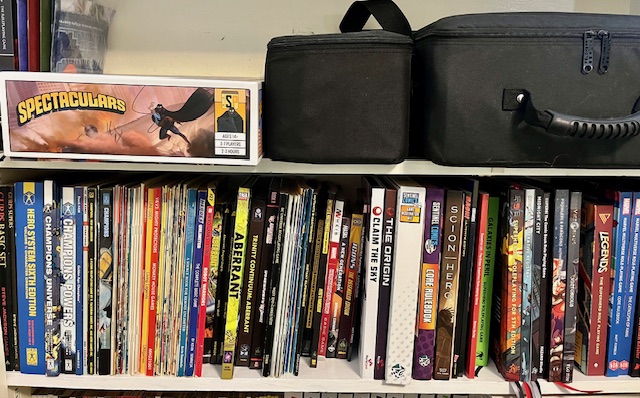
  • There isn’t another game like Spectaculars, and I would looooove to play with a regular in-person group. At its heart, Spectaculars is a journaling game that invites a group to spontaneously and organically create the world as you go. Innovative. Cool. I really hope they release digital journals at some point so I can drag my online group into trying it out someday. For this project, however, the assumptions the game makes about embracing superhero tropes doesn’t fit my goals.
  • I’ve written a deep dive into Aberrant, but wow does it seem like a lot of work to fit into a custom, fantasy setting. The world of Aberrant, and by extension the whole Trinity Continuum, feels fundamental to the game design. Could I force-fit something like Trinity: Aegis to make my concept work? Like Scion and City of Mist, with a system I don’t know well, it’s too much effort.
  • Savage Worlds Super Powers Companion takes the very cool SWADE system into the world of superheroes. I like Savage Worlds, in general, and find it fun to play. It can also easily toggle between fantasy and superpowers. From everything I know about it, though, and everything I’ve read, it is far better for “pulp” stories than epic ones involving demigods. I’m going to start small in my tale, but eventually want to get big.
  • I’m intrigued by Claim the Sky, the superpowers expansion for the Cypher System. However, in reading through reviews of the Cypher System, it seems to not so much have fans and detractors as a lot of… middling. It’s a solid generic system that some people think is slightly too fiddly and others think is slightly too narrative. It’s unclear how the vastly different role the system expects GMs to take versus players would work in a solo game. Basically, I don’t have any good reason to break the seal on these books and pilot them through such a complex project as this one.
  • Just for the sake of completeness, I don’t have any interest in dusting off my old copies of Superworld, Heroes Unlimited, or Silver Age Sentinels. I didn’t really love these games when they were new (okay, I had some fun with HU), so they’re not really in the running here.

Alright, alright, enough about the pile of games that I won’t consider for this project. Next time, let’s begin a much deeper look at the SEVEN (yes, really) games that I’m currently exploring as my game system of choice. I truly don’t know which one I’ll choose at the end, but fingers crossed that all this navel gazing will help clarify my muddled thoughts.

If you have thoughts about any of the games above—including any you think I’ve prematurely ejected—please comment below. You can also feel free to guess as to what systems I am considering, if you’re a superhero game afficionado.

Until then!

Choosing a Supers System, Part 2!

Gaming at Fifty One

Today is a (rather long) State of the Union address on my gaming life.

As best as I can remember, I started playing tabletop role-playing games (or TTRPGs) in Fifth Grade, in 1983, which would make me ten years old. It was one of those phenomena where a friend–though I can’t remember who Gamer Zero was–received a boxed set as a Christmas gift and we all dove in. Soon we all asked our parents to supply us with books, dice, graph paper, and pencils. Throughout the Spring, we played a mix of Basic Dungeons & Dragons and Advanced Dungeons & Dragons, not understanding that they were two largely different games. It didn’t really matter, though… what we actually played was some rules-light, make-it-up-as-you-go game that didn’t even try to involve the many complex tables in the books we didn’t understand. Usually our first-level characters wielded something like a +5 Sword of Dragon Slaying that could cut through anything.

As we transitioned to middle school, a subset of that original group began playing anything we could get our hands on. The biggest boon to our fledgling group was my buddy Russell’s older brother Jim, who was happy to run our games for us. I’m not sure this is an exhaustive list, but I remember playing a lot of Tunnels & Trolls, Gamma World, Car Wars, Top Secret, Marvel Superheroes, Villains & Vigilantes, Teenage Mutant Ninja Turtles (TMNT), Heroes Unlimited, Superworld, Champions, GURPS, and, yes, a good helping of D&D (this time using the rules and their published modules). Just seeing the covers of those games triggers a flood of nostalgic make-believe happiness. Those were fun times.

I had a new group of friends in high school and quickly introduced them to the hobby. We almost exclusively played superhero games, primarily Villains & Vigilantes and Champions, though we sprinkled in some TMNT, Golden Heroes, DC Heroes, and Super Villains as well. My good friend Ted ran us through a particularly memorable V&V campaign, which clued me into how cool a longform set of adventures with the same characters can be.

We all scattered to different colleges, and I met new TTRPG enthusiasts. Throughout my time at Occidental College, I ran a monthly Champions campaign, even drawing the “comic covers” for each session we played as keepsakes. At that point, Champions was my only game, and I was deep into the HERO System and its math-heavy fun.

Then it was off to graduate school, where I met both my wife and a little game called Magic: the Gathering, which would be the object of my obsession for years. Then my working career started to take off, I had kids, we moved around, and, as these things do, TTRPGs faded into the background of my life for nearly two decades. I remember trying to organize a D&D adventure with my wife and some friends once or twice during that time, but it never stuck. During that time, I bought-and-sold the D&D 3E and 3.5 rulebooks without really doing anything with them.

In 2018, I took a year off work to recoup, then in 2019 started a job in San Francisco that, unlike most of my previous roles, didn’t require heavy travel. Around that time, I started listening to a ton of podcasts, including the Glass Cannon Podcast. The TTRPG bug started inching its way into my brain, and I began to seek out my local game stores to see if there were people with whom I could play. After some false starts with Dungeons & Dragons 5th Edition and Pathfinder at local stores, I found a group that was playing D&D 5E and were happy to have me join. They were interested in switching to Pathfinder 2nd Edition once it was released, and eventually I GMed us through the game’s first 1-20 Adventure Path, Age of Ashes over three years. During those years we took occasional detours, experimenting with Blades in the Dark, Symbaroum, Call of Cthulhu, Savage Worlds, and, at my urging, even returned to supers for a Sentinel Comics RPG one-shot.

That gaming group was my first experience with serious personality clashes in TTRPG groups. I ended up feeling picked on by a person there who was close friends with two other members, and after trying-and-failing multiple times to talk it out, my best recourse was to leave. Suffice it to say, it was the only real negative chapter I’ve had with TTRPGs, which have otherwise been a source of unqualified joy in my life.

For months I was genuinely wounded by my abandoned group. Thankfully the global pandemic had introduced me to virtual tabletops and online games. Eventually I found a couple fun virtual tables, including a delightful online group of Europeans that has met weekly now for almost two years. We mostly play PF2E, but have rotated GMs and done several sessions of Call of Cthulhu, Warhammer Fantasy, and most recently Mörk Borg. On our “really want to play list” are Vaesen, Dragonbane, Traveller, Forbidden Lands, Dungeon World, Lancer, Savage Worlds, and countless others.

It’s fair to say that, at age fifty-one, I’m in the midst of my Second TTRPG Renaissance. At the same time, the whole TTRPG industry is going through its own Renaissance, with intriguing new games popping up seemingly every week. Not surprisingly, my game shelf has exploded. I now own most of the games listed above, plus a metric ton of others I’ve Kickstarted, found in bargain bins or eBay auctions, or used birthday gift certificates on. I’ve even sold old game books and given my college-age son my D&D 5E collection to make room for them in my house.

There are two major differences between my TTRPG life as a gray-bearded geezer compared to my young, wispy-mustachioed self. The most obvious one is that it’s more difficult to find a group with which to play. Throughout middle school, high school, and college, I rolled dice with my core group of friends. Most of our interests were shared and we spent a ton of time together… easy squeezy. These days, in contrast, the vast majority of my contemporaries have neither the time for, nor interest in, TTRPGs. While online platforms make the pool of potential players wider, these online groups are ephemeral. It’s clear to me that if one of my current group members (all of whom are twenty years younger than me) has kids, takes a new job, or moves, it probably spells the end of the group… that sort of “life event disruption” can happen with any group, but somehow in-person groups feel stickier because the investment feels somehow deeper. Meanwhile, I’ve tried to think of how to conjure another reliable, fun in-person group and failed to come up with a solution.

The second difference is in the type of games I’m playing now versus in my youth. If it’s not obvious from the banner image on this blog, my first love is superheroes and comic books, and at one point in college set my sights on becoming a comic book illustrator. As my TTRPG life deepened as a young person, it skewed heavily–and eventually exclusively–to superhero games. Yet all of my groups in the last six years want to play fantasy or investigative horror games. That’s okay, because I can get excited about those games. But none of the groups I’ve encountered want to play superhero make-believe.

The feeling of being an odd-shaped puzzle piece continued recently as I started to discover the “Old School Renaissance” (or OSR) movement within TTRPGs. These games are built by people who love early Dungeons & Dragons and want to recreate the feel of those games for modern audiences. I’ve looked at OSR-type games like Old School Essentials, Knave, Ironsworn, and have absolutely fallen in love with Dungeon Crawl Classics. I’ve also rescued a bunch of my old D&D modules from my mother’s garage, joined the Ancient Dungeons & Dragons Players Facebook group, and have been bingeing the Vintage RPG podcast. Yet when I tell my online group that I’d love to run them through a DCC beginner adventure to test out the system, I get the same lukewarm response that I received when I tried to get my in-person group to play a superhero game. They’ll probably roll with it because they like and trust me, but there isn’t an itch there they need to scratch.

All of this has me reflecting deeply on the years ahead. I’ll certainly keep seeking out online groups and brainstorming how to form an in-person group, because these are games that are most fun when they’re social and played with friends. Just last week, for example, I jumped online with a bunch of strangers to learn to play Dragonbane, a game I own and have considered running for my regular group. I’ll also keep collecting games, because I find real pleasure in reading the books cover-to-cover and seeing them on my shelf. We truly are living in a glorious period of TTRPG innovation, and the sheer diversity and volume of options is awesome.

But I’m beginning to accept that a) I may never have a long, stable group of gaming friends again, even as an empty nester nearing retirement where my time is beginning to be more spacious, and b) the number of games I own and want to play far outweighs the number of hours I’ll be able to play with friends. I surely won’t ever get a chance to play everything, much less everything beckoning to me.

The final addition to my reflections is the rise of solo play in TTRPGs. Solo play has always been a feature of some TTRPGs dating back to the 1970s, but thanks to the global pandemic it has a lot more support now than ever. Many games, like Ironsworn and Vaesen, have solo play built into the base game as an option. Meanwhile, tools like the Mythic GM Emulator allow for being able to play any game solo, without the need for a gaming group. Indeed, one of my recent podcast obsessions is Tale of the Manticore, a great audio production of a guy solo-playing an old-school D&D system.  

Maybe the answer is to begin solo play on the games no one but me wants to play? Would I enjoy that, or is the fun of TTRPGs really tied to a group? I’ll probably dip my toe into these strange, solo-play waters soon, while continuing my epic quest to find more time with awesome groups like my current online one. My enthusiasm for TTRPGs is as high as that ten-year-old kid pretending to swing his overpowered sword around. How best to channel that enthusiasm, though, is something I’m still contemplating.

If you have any thoughts about the TTRPG hobby these days, or ways you’ve tackled the hurdles I’ve outlined, I’d love to hear it. Comment below or shoot me an email at jaycms@yahoo.com.

Enthusiastically adventuring,

-jms

An Aberrant Brain

Oh my goodness, I did not intend to have so much time pass between posts. A big work development plus two major trips (a third next week!) plus my first bout of Covid have all kept me away from my laptop.

And yet I had a lot of fun pouring over one of my favorite games of my childhood, Golden Heroes. It was a nice validation of what I want to write about these days: the long list of superhero tabletop roleplaying games (hereafter TTRPGs) that rarely get enough attention. I’m going to continue jumping around the list of games, spotlighting ones I either love or that intrigue me.

Since I started in the 1980s, let’s fast forward a decade. Honestly, the 1990s isn’t a particularly interesting span of superhero games. It’s the time when Champions and, to a lesser extent, GURPS Supers, took up most of the oxygen in the room. Goodness knows I spent my TTRPG time in the ‘90s running two different Champions campaigns and loving the crunchiness that would become the HERO System.

But right at the end of the decade entered a game that I’ve owned for more than twenty years yet barely played: Aberrant. My curiosity in this game abounds. I picked it up at a time in my life when I had just moved to the San Francisco Bay Area, was deep, deeeeeeeep into Magic: the Gathering, and without a dedicated roleplaying group. By the time I was back into TTRPGs there were newer, fresher games to play. As a result, it’s one of those handful of games I own that I’ve played only in a couple of one-shots.

The more I’ve explored Aberrant as part of this blog, though, the more curious I’ve become (and also slightly poorer, since I bought the next two versions to compare them). Let’s see why…

A few weeks ago, I only had three books. Hm…

A Brief History of Aberrant

I couldn’t find a rich, narrative history of Aberrant like I did Golden Heroes, so here is the story as I understand it. Apologies in advance for anything I’m somehow misinterpreting or not seeing clearly.

White Wolf Publishing was a new and powerhouse European game publisher in the 1990s. White Wolf was most successful and famous with its World of Darkness games, but it also produced some fantasy TTRPGs and, right at the end of the decade, the trio of games now known as the Trinity Continuum.

The Trinity Continuum was ambitious because it was essentially three different games interconnected by the same basic mechanics and fundamental lore: Adventure! was an action-pulp, alternate-1920’s game. Aberrant was a near-future superhero game. And Æon was a far-future sci-fi game. All three shared, essentially, one universe with each taking place on a different part of that universe’s timeline. It’s a cool idea, and one that has followed each game through various editions. Although this post is focused on Aberrant, each time the game appeared it has been joined by Adventure!, Æon, and a variety of Trinity-spanning books.

This is speculation on my part, but in looking at White Wolf’s projects I suspect that they saw the success of their World of Darkness games and thought the future was in taking these properties into videogames. They merged with an Icelandic videogame company in 2006 and were acquired by another in 2015. Shortly after that, a scandal led to the dissolution of White Wolf as an independent entity.  

Whatever the case, after three years and quite a few supplements, Trinity generally and Aberrant specifically in 2002 ceased publication. The games tried a d20 reboot in 2004 (because pretty much everyone at the time was seeing if they could make d20 work, sort of like 5E now), but they never found their footing. There is shockingly little content I could find on this d20 foray.

Then, for fifteen years, Aberrant faded into the background as a cool setting with a sometimes-unwieldy game behind it. Eventually Onyx Path Publishing, founded by a White Wolf alum, obtained the tabletop publishing rights to a lot of White Wolf’s old games, including Aberrant. After a recently successful Kickstarter, a new version of Aberrant was born using Onyx’s Storypath System. For these reasons, sometimes this new Aberrant is called “Second Edition” and sometimes “Storypath Edition.” Almost everyone calls the 1999 game “First Edition.” (And again, no one refers to the d20 version as anything, really.)

I was able to find this 2019 interview with the most recent version’s core authors, Steve Kenson and Ian Watson. There isn’t much history-telling to fill in the blanks above, but it’s a great introduction to the broad brushstrokes of the Trinity Continuum generally and a deep look at what excited the authors about this newest incarnation of Aberrant. Check it out!

It’s amazing to think that the original game only lasted three years. As far as I know, people are still playing Aberrant campaigns from First Edition, and it’s still some people’s favorite “crunchy” superhero game. And hey, it spawned a reboot twenty years later that is already seeing a ton of new supplements. What makes it so intriguing, you ask?

What’s Great About Aberrant

The single best thing about Aberrant is the one thing that has endured across three distinct game systems: the setting.

It occurs to me that superhero TTRPGs fundamentally need to decide how much to invest in worldbuilding a setting that explains – and potentially sets the boundaries for – superpowers. Most games just assume that it’s a comic book reality, in which radioactive insects, mystical artifacts, aliens, time travel, interdimensional demons, and giant robots just exist, and that people with amazing powers (often bestowed by some combination of the above) choose sides and battle with their fists and eye lasers.

Aberrant does deep worldbuilding. Indeed, the first HUNDRED pages of their 285-page core book in 1999 are dedicated to fleshing out how superpowers came to be and how “novas” – the people with these powers – exist within society. Those pages are also the only ones in color, full of rich, creative entries detailing news reports, science journals, celebrity interviews and, yes, comic book pages. The art throughout is consistently excellent and evocative of the “Iron Age” of comics, clearly a core inspiration for the tone and flavor of Aberrant. In the newest version, the setting takes up even more space (over half of the roughly 300 pages) and is still the centerpiece of drawing you into the game.

I won’t try and do a full review of the setting here. Suffice it to say, Aberrant takes place about ten years in the future after an international space station blew up and irradiated the globe, spawning the rise of novas. The authors have created a richly textured story as to how the world embraced these thousands of superpowered individuals, full of factions, internet celebrity, private companies, and varied government interventions. Playing Aberrant means becoming facile in terms like quantum flux (and quantum tech and, honestly, quantum everything), The Utopia Society, eufiber, the Æon Society, The Teragen, OpNet, the XWF, Mazarin-Rashoud Coils, and yes… Aberrants (both a slur term for novas and a formal organization).

Getting steeped in Aberrant’s setting is as daunting as learning the game’s mechanics, and in fact creates a sort of dual barrier to entry for new players. The First Edition book didn’t help matters by making the setting a series of wildly creative but unorganized snapshots, something very cool when you spend time with it but incredibly difficult to skim or reference later. The newest edition, thankfully, does a bit of indexing and exposition, but it’s still dense stuff.

But just like any deep worldbuilding, the density and depth of the setting are also the things that fans of the game are most passionate about. The world of Aberrant is evocative and full of intrigue. Reading those first hundred pages of the original book or the setting chapters of the new one, it’s impossible not to have your mind explode with campaign and character ideas, very much like modern Blades in the Dark or Symbaroum, but even more globally expansive.

Aberrant’s setting strives to take a realistic view of how the world would react to superpowers. It’s also, as I said, steeped in the Iron Age of comic books, full of the gray morality and grittiness of the 1990s. There is a very real sense that power corrupts. It’s even baked into the mechanics, as the thing most likely to take your character out of a campaign isn’t death – it’s the tainted transformation from modern god to monster. There are rules in the most recent edition for adapting Aberrant to different tones, but I’m a big believer in playing to a system or setting’s strengths. Aberrant is about the costs and perils of having superpowers as much or more as the glory. It’s a game about tough choices in a complicated world.

Here’s a terrific summary from a very good 2019 review of the original game:

“You are placed as central figures participating in a tragedy played out in slow motion. All Novas are doomed to be tainted by their powers in time, despite any good intentions. No matter how hard they try, they will lose that which makes them human. It’s inevitable. It’s a devastating bit of storytelling, and creates a setting rife with narrative rabbit holes to fall down. I haven’t found a superpowered RPG that comes close to this level of depth in its world building.”

For a detailed look at all things Aberrant, check out the OpCast podcast – a podcast completely dedicated to the Trinity Continuum. There is an episode specifically looking at the First Edition of the game, and a five-episode breakdown of the new Storypath book. Not surprisingly, these episodes slant heavily towards the setting.

Let’s Talk Mechanics (And Lots and Lots of Dice)

The strength and richness of Aberrant’s setting are, I believe, what has engendered so much nostalgic love for the game and the reason why it’s respawned into a new edition. It’s certainly the reason I kept cracking open the original 1999 rulebook over the years. But I’ve made it almost to the end of this write-up without mentioning the mechanics. So how does Aberrant actually play?

The 1999 edition was based on White Wolf’s Storyteller system, which uses d10s exclusively. At its core the system is elegant: You create a dice pool when trying something, and every 7 or better on a d10 is a success. The more successes, the better the result. Aberrant built on this core idea by adding “Mega” (or superpowered) attributes and abilities, which count two successes for a 7-9 and THREE for a 10, resulting in much splashier results.

Although elegant, the original Aberrant broke down in how big the dice pools became. It wasn’t uncommon to have twenty or even thirty d10s in a pool. Although rolling dice is fun, it’s apparently possible to have too much of a good thing. Add in that a 1 on a d10 is a “Botch” and those big dice pools start getting weird. Most longtime players of the First Edition shake their head at how out-of-control silly the game experience could be, especially as the power level increased. As one player commented in a Reddit forum: “The idea [of Aberrant] is fantastic, but you will need to houserule the crap out of it.”

Unlike Golden Heroes, character creation is time consuming and complicated, using a point-buy system that isn’t hard to grasp but does involve a lot of steps. It’s nowhere near as crunchy as Champions (which, as I said, was the dominant superhero game when the first edition of Aberrant came out), but it’s not easy either. The good news is that the system allows for pretty much any superpowered concept, but it’s also a process that a GM is going to have to supervise.

I mentioned earlier the inevitable decline from god to monster inherent in Aberrant’s system. This mechanically in the 1999 game is called “Taint” (which, yes, everyone made fun of then and still do today) – basically, the more Taint your character accrues the less human they become. I really like the idea of this system, but in practice it was a little clunky and surprisingly easy to avoid, a better concept than execution.

So along comes the Storypath system from Onyx Path Publishing, an updated version of White Wolf’s Storyteller system. It’s still d10 based, still with Mega attributes and a point-buy system to create any and all powers. Dice pools are less unwieldy. Taint becomes “Flux” and is more flexible (and less narratively inevitable). And the rulebook is definitely, definitely better organized and thus easier to navigate than the First Edition one. For a good overall review of the new Aberrant compared the original, check out this write-up.

Alas, though: I haven’t yet been able to play the newest edition of Aberrant. It remains on my “super interested to try it out” pile. So consider today’s post a nostalgic reminiscence of the 1999 game more than an analysis of the update. Still, my interest is piqued. Here’s hoping the power of my nostalgia and the strength of the overall Trinity setting is one that pulls you into checking it out. And if you do… drop me a line and let me know how it goes!

Next time I’ll jump forward another decade into the 2000s and pluck some fun-but-lesser-known game out of the pile. Until then, uh… may your Summer be Taint-free and all of your experiences Mega? I don’t know, man. I didn’t really have a closing in mind.

My Golden Heroes Brain

Starting in early adolescence and continuing through college, I mostly played Villains & Vigilantes and Champions (shhh… yes, I’m old), and someday soon I’m sure to have a lot to say about these two beauties. They are two of my all-time favorite games in any genre.

Amidst epic, mask-clad campaigns with friends, my broader exploration of superhero tabletop role-playing games took root. Of the “other” (meaning, not V&V or Champions) superhero games from my teens and twenties, my favorite is a little-known British game called Golden Heroes.

A Quick Golden Heroes History Lesson

The year is 1984. The original Apple Macintosh computer runs its first television commercial. Los Angeles hosts the Summer Olympics. Cyndi Lauper and Wham! are dominating the radio. And a skinny Jay Salazar, just starting middle school, convinces his grandmother during a regular visit to their local gaming store to buy him a new superhero game just hitting the shelves.

It’s amazing that Golden Heroes and I found each other that 1984 day, back at Wargames West in Albuquerque. The game didn’t stay in print long, particularly in the United States. I’m the only person I know across my many gaming groups who ever owned it. Heck, I probably bought one of the few copies in the state of New Mexico.

Why was its tenure so short? Years earlier and across the pond, authors Simon Burley and Peter Haines were university students and friends in England, inspired by Chris Claremont and John Byrne at the height of their powers. They self-published copies of their game and sent it to major publishers hoping for a deal. Check out how the original looked!

The original Golden Heroes, pre-Games Workshop

It was Games Workshop, a London-based publisher now famous for the Warhammer miniatures game, that showed interest. Although few people associate the two, Golden Heroes became GH’s first-ever homegrown game.

Unfortunately, Games Workshop lost access to the Marvel Comics license they had intended to use for Golden Heroes, a license that would instead get used for TSR’s famous FASERIP-system Marvel Superheroes game. Marvel Superheroes beat Golden Heroes’ release by weeks and soaked up consumers’ attention, even though many people – me included – thought Golden Heroes was the superior game. A year later, having published two adventures (Legacy of Eagles and Queen Victoria and The Holy Grail), a Supervisor’s (GM) kit, and some embarrassingly bad miniatures, Games Workshop quietly closed the doors on Golden Heroes.  

For a lovely look into Simon Burley’s stories of the game’s founding and rules, check out the Grognard RPG Files podcast (Part 1 and Part 2). There are a ton of fun stories there, including Simon and Peter going to conventions with their new game, stirring interest by simulating famous battles from the comic books like the X-Men vs. Shi’ar Imperial Guard fight in Claremont/Byrne’s Dark Phoenix saga.

Despite its lack of commercial success, I love this game. My good fortune to discover Golden Heroes led to countless hours of joy for me during those painfully awkward middle school years. I’ve carried the books with me for forty years and counting even though I have yet to play it for more than a single session with friends.

Well-traveled and well-loved

What’s Great About Golden Heroes

Before I get into the game, I want to say something about the art. Art matters in any TTRPG, but for me it matters even more in a genre meant to simulate a visual medium like comic books. Golden Heroes showcases art from several different artists, and the quality varies. But the good far outweighs the bad, and I am nostalgically giddy about the stuff from Alan Davis, Mike Collins, Brett Ewins, and Jon Glentoran.

As I’ve spent the last week reading reviews of Golden Heroes (for two stand-outs, check out here and here), I’m relieved to see that what everyone loves most about the game is character creation. Those reviews make me feel significantly less self-conscious about the memories of me and my friend Ted rolling up character after character after character, then drawing them into our sketchbooks and going back for more. I sort-of-almost-remember actually playing the game, but not in any way that stands out. What I vividly remember is the joy of making characters… all told, probably more than a hundred of them over the years.

Character creation is fully random in Golden Heroes, which on the surface sounds like a nightmare. You roll on four Attributes: Ego, Strength, Dexterity, and Vigour (yay for British spelling!). You roll on how much damage your character can take and dish out. You of course roll up your superpowers. Finally, you roll on the character’s Background, or life before becoming a hero.

That series of random rolls can potentially lead to a mess, but there’s a safeguard built into the system. Golden Heroes gets around the goofiness of rolling up someone with incredible Strength, low Vigour, a Chameleon Ability, Replication, Teleport, and a Vehicle by making a player rationalize how these particular powers hang together. From the Players Book:

“This is where you must use your skill and imagination as a comic-book writer. You must concoct, possibly with the help of the [GM}, a plausible background for your character which explains how they got their Superpowers. You should attempt to explain as many of your character’s powers as possible, for which the [GM] deems are inconsistent are forfeited.”

p.9

You can trade off power rolls as you go for upgrades to already-rolled powers or for an Advantageous Background (like being a Bruce Wayne / Tony Stark billionaire). So while character creation is indeed random, it gives the player a ton of latitude to sculpt those initial rolls into something that’s fun to play.

Simply put, character creation in Golden Heroes is quick and easy, full of flavor and guided by narrative. At the end of this post I’ll roll one up to demonstrate.

Golden Heroes’ “let’s remember that we’re all comic-book writers” vibe permeates the rules of play as well. There’s a heavy focus on combat and set pieces, dividing combat actions into Frames. Different activities cost different amounts of Frames per round (very similar to the modern Pathfinder Second Edition, actually), giving the action a delightfully comic book feel.

Combat can get overly crunchy, unfortunately. For example, there are different rules to resolve a Parry versus a Dodge, and they use different dice (and to be honest, Parry rules are just bonkers). Tables rule everything, as was common in the 1980s. My guess is that, if I ever got into a regular campaign, I’d eventually simplify some of the mechanics to keep everything moving and as fluid as character creation. Even amidst the crunch, though, there are some cool ideas. In addition to Frames-as-actions, you have two hit-point pools: Hit-to-Coma (HTC) and Hit-to-Kill (HTK), and this distinction helps simulate the fact that comic books can toggle between characters beating each other to a pulp but never dying and life-or-death stakes.

Between combats, characters get a certain amount of downtime phases, which is also easy to picture making their way into comics books. And in a truly narrative RPG innovation, every campaign in Golden Heroes has a set of Campaign Ratings that are built collaboratively between players and Supervisor (the GM) that fluctuate based on the adventures the characters undertake and their role-playing. Campaign Ratings also get awfully crunchy, but it’s clear that despite the complexity the goal here is to have a dynamic world and story built off individual character backstories. Supervisors reward players for being heroes instead of murder hobos or powermongers, and these rewards help them achieve more success in the campaign world. It’s a cool rewards system that veers away from individual level-progression and, again, mimics what superheroes experience within comic books.

If you’re intrigued by the game but either don’t want to track down expensive, hard-to-find books or play outdated crunchy tables of the ‘80s, Simon Burley has gone on to update the system as Squadron UK. It’s easy enough to pick up on DriveThruRPG. Because I can’t help myself, I’ve ordered a copy and may dive into it in a future blog post.

Let’s Roll Some Dice!

As I’ve said, the glory of Golden Heroes is the character creation. In fact, there is an absolutely wonderful section in the Players Book that dedicates three full pages to showing the “now you interpret your powers” system in action – using one set of powers rolls to flesh out eight (!) in-depth character ideas. Let’s walk through the steps and see what happens.

For the four core attributes, it’s old school D&D style: Roll 3d6 and that’s your score. Alright [rattles dice in hand]. Here we go.

Ego is a measure of my character’s willpower. I roll 5,4,3: 12.

Strength is, um… how strong my character is. I roll, 3,5,1: 9.

Dexterity measures manual dexterity rather than physical agility. I roll 5,4,3 again: 12.

Vigour (ha!) is a measure of how fit and healthy my character is. I roll 6,2,2: 10.

Wow. My character is pretty much the definition of average.

Hits to Coma (HTC) is the amount of damage my character can take before passing out. I roll 1d6 for each point of Vigour, or 10d6. Fun! I roll 1,1,2,3,4,1,5,2,6,5: 30. Blech. My character will be Staggered at 1/5 of my HTC, or 6, and will be Stunned at 1/10, or 3.

Hits to Kill (HTK) is the amount of damage my character can take before dying. 10d6 again yields 6,6,4,1,3,2,3,6,3,1: 34. My character will be Hospitalized at 3 HTK.

Movement is how far my character can move in a Frame, measured in metres (ha!). The calculation here is (Strength + Dexterity + Vigour) / 6. My character’s movement is 5.

Now comes the fun part.

I get a number of power rolls equal to 2d6 halved + 4 (why not 1d6+4? I don’t know, man. I suppose the idea is that rounding up gives you slightly more rolls on average). Since I’m rolling mediocre today, of course I roll 7, rounded up is EIGHT power roles. Wheeee!

Each Power Roll can be used to either:

  • Determine an Advantageous Background
  • Roll on the Superpower Generation table
  • Upgrade a Superpower already rolled
  • Enhance Superpowers and skills (used for campaigns)

Roll 1-2: 55 = Psi Powers, which the table tells me immediately costs an additional power roll. Psi Powers are COOL and makes a ton of sense for someone with decidedly average stats.

Roll 3: 56 = Psi Powers! This automatically bumps me from Grade 1 Psi Powers to Grade 2, something I would have probably done anyway. Neat.

There’s a subsystem in Psi Powers to determine my powers. I get 15 + 1d10 Psi Points and I roll a 9. 24 Psi Points, which is a resource pool for using my psychic powers. What psychic powers? Let’s roll four d10s and find out:

  • Psi roll 1: 6. Telekinesis. This is my Specialty Power (meaning it costs less Psi Points to use than the others).
  • Psi roll 2: 4. Precognition
  • Psi roll 3: 5. Psi Blast
  • Psi roll 4: 8. Telepathy

Roll 4: 02 = Agility, which as I said is different from Dexterity. This means my character can leap 4 metres in a Frame, swing at 2-4 times my Movement, gain a bonus to dodge, and can do extra damage by swinging or leaping into combat.

Roll 5: 33 = Health. Another table here, which I roll 5 on a d6: Toxin Immunity. My character will be immune to poison.

Roll 6: 20 = Energy Attack. Another table, which I roll 6 on a d10: Vibration. My character can emit destructive vibrations.

Roll 7: 24 = Flight, which is what it says it is and doesn’t require another roll.

Roll 8 is my Advantageous Background roll (which the rules allow me to pick, but I’m embracing full randomness): Previous Training, which allows me to add 2 to any Attribute or 1 to two Attributes and should represent some sort of elite training.

My character’s Superpower rolls:

  1. Psi Powers (Grade 2 – Telekinesis, Precognition, Psi Blast, Telepathy)
  2. Agility
  3. Health (Toxin Immunity)
  4. Energy Attack (Vibration)
  5. Flight
  6. Background: Previous Training

Now comes the time to rationalize and make sense of these rolls. As the Players Guide says, I need to come up with an origin story and narrative that ties everything I’ve rolled together, forfeiting what doesn’t make sense.

Can I get eight distinct concepts out of this list? Gauntlet thrown!

Concept 1: Hand of Gaia

Maasa Abebe is a young, talented archeologist (Previous Training, +2 Ego). At a dig she discovers the literal heart of the world, an artifact linked to the primordial goddess Gaia. Thereafter she is a living avatar of the goddess, able to tap into the ancient soul of the Earth itself to move objects, read others’ thoughts, and even unleash localized earthquakes. Her connection to her goddess makes her immune to natural toxins and preternaturally light on her feet.

I can’t really make Flight makes sense here but kept all others.

Concept 2: Psion

Cassidy O’Toole is in the prime of her life and a doctoral student of cognitive psychology (Previous Training, +2 Ego) when she discovers her terminal illness. Her wealthy parents sign her up for an experimental set of treatments to find a cure. The bad news is that the treatment facility is destroyed during a super-powered battle, with Cassidy the only survivor. The good news is that the chemicals and supervillain powers combine to cure Cassidy and leave her with superior health and psychic powers. She is adopted by the superhero group responsible, becoming an invaluable member.

I don’t really see a room for Energy Attack here (Flight, I’m saying, is a result of Telekinesis on herself).

Concept 3: Quake

Adam Johnson is a dedicated, albeit mediocre gymnast (Previous Training, +1 Strength, +1 Vigour, also accounts for Agility) and geology student at UC Berkeley. During a particularly humiliating competition, Adam’s mutant powers manifest and his rage causes an earthquake to level the gymnasium. Horrified, he retreats from school and vows to understand these new abilities before returning to society. He is quickly found by a group of mutants who train him in his vibration-themed powers (including flight and a metabolism so high it’s resistant to toxins) and give him purpose.

In this version, I’m dropping the highly valuable Psi Powers and would likely request that the Supervisor allow me to upgrade Energy Attack to at least Grade 2 to compensate.

Concept 4: Nomad

No’madd is the sole survivor of an alien spacecraft that has crashed on Earth. In a desperate gambit to save their species from a dying planet, No’madd’s people rigorously trained countless explorers (Previous Training, +2 Ego) and sent them to the far reaches of the galaxy. Now stranded here and utterly alone, No’madd has vowed to ingratiate themself to the local populace and improve life on Earth as much as possible, always hoping more of their people will find their way here.

Aliens always feel a little like cheating in Golden Heroes because I can basically keep everything and say it’s innate. I’d probably ask the Supervisor to switch from Vibration on my Energy Attack to Cosmic.

Concept 5: Prana

Sunita Singh was born and raised in a monastic order (Previous Training, +2 Ego) where she quickly became a prodigy of the mindfulness and inward-centered teachings. At fifteen years old, she had surpassed all masters of the order. At twenty, she went into a meditation so deep that she did not eat or sleep for years. At twenty-five, finally, she awakens with a glowing third eye on her forehead and manifests a broad array of psychic abilities. She has perfect control of her body, full of grace and immune to toxins. Sunita, without a word, flies up and away from the monastery, full of intent to change the world.

I’m keeping everything here except the Energy Attack.

Concept 6: Noir

Christopher Knight was a hardboiled detective (Previous Training, +2 Ego) in Chicago in the 1920s, killed during a case investigating a crime boss. Now he has reappeared, spectral but solid enough to interact with the world. Why now? What is he here to do? Chris doesn’t know, but he picks up the trail of that cold case, intent on finding out.

The Psi Powers, Flight, and Health are all easy enough to fold into “dead guy powers,” and the Agility is decently noir-style pulp detective. I’d work with the Supervisor to say that his Energy Attack is his spectral pistol, using Vibration as an energy type but saying it’s basically ghost bullets.

Concept 7: ATHENA-5.5

Nine years after Dr. Dara Melamed’s death, the ATHENA prototype artificial intelligence she created finishes building itself a physical shell (stretching here, but I’m saying self-educating itself for years has led to Previous Training, +2 Ego). The smooth, silver globe rises from Dr. Melamed’s secret laboratory and drifts out into the city. (It’s the story of Ultron from Marvel Comics, but a creation that strives for making the world better through collaboration with its fellow populace.)

I don’t think it makes sense to keep Agility, since a floating globe won’t really be leaping or swinging anywhere. Everything else makes sense, though I would talk to the Supervisor about making the Energy Attack Sonic or Laser instead of Vibration, which is more what I picture.

Concept 8: Medusa

Deep-sea diver (Previous Training, +2 Vigour) Sophie Kim discovers a new, bizarre species of jellyfish, an amazing and groundbreaking find. Unfortunately, it stings her and sends her into a coma for nearly two years, and the jellyfish is never seen again. When she awakes in a government science facility, Sophie’s body has turned translucent like a jellyfish, her hair a mass of tentacles and her brain pulses with electricity within her iridescent skull. She has amazing psychic powers, immunity to toxins, and she can swim at astounding speeds. Government officials give her the codename Medusae (which the media mistakenly changes to “Medusa,” a name that sticks) and send her out on aquatic missions.

No Energy Attack here, and I’d say the Agility and Flight are water-based. She can’t technically breathe underwater, so I’d either ask for a device to allow her to do so or to provide a Grade 2 on Health from the Supervisor to compensate for the self-imposed limitations on my powers.

There we go! Eight distinct thumbnail concepts from the same random rolls, all of which I can see being a fun foundation for a series of adventures. So yes, fully random rolls can be a mess. But there’s enough freedom in character creation that somehow solid characters still emerge. It’s fair to say that very few of these ideas would manifest in quite the same ways if I was using a point-buy system and starting with my own concept. That’s the joy of Golden Heroes character creation, and why it’s so addictive.

Holy cow this post became a beast. I’ll set my eyes on another game from my master list of games and see where the next post takes me.

In the meantime, may your Vigour be high and your Movement take you many metres!

A New, Heroic Adventure

For the past couple of years, my posts here have primarily been scenes I’ve written for my longstanding Pathfinder campaign. Because of some dynamics within the gaming group, we’re taking an extended break. Being a Game Master of a deep and complex story has been soaking up my creative energy for almost three years now, and I suddenly find myself with time and space for something new. I’ve learned over the years that a) I only have room in my brain for one creative project at a time, and b) there must always be a project.

What to do with this fresh, blank canvas? Normally I would turn to superhero fiction, either character sketches in preparation for something ambitious or short, contained stories. But I’ve been loving this tabletop role-playing renaissance in my life, and I’m not ready to fully replace my TTRPG creative space with something entirely non-TTRPG related. The switch from traditional fantasy to superheroes is an easy one, but my grip on my dice bag is white-knuckled and fierce.

Alrighty then. It’s time to turn this blog into a blog.

Superhero Tabletop Role-Playing Games

For as long as I’ve played fantasy TTRPGs – which for me started in middle school back in the 1980s – I’ve played superhero TTRPGs. I’m a lifelong comic book reader, and the opportunity to live those stories was and continues to be a siren’s call.

The first superhero tabletop game, Superhero 2044, followed the more popular Dungeons & Dragons by a mere three years (1977 vs 1974). Since then, for forty-five friggin’ years and counting, a handful of superhero games have continued to regularly pepper the broader role-playing game landscape, nowhere close in popularity but ever-present.

The lack of popularity, by the way, confuses me. Even in our modern age of the Marvel Cinematic Universe dominating cinema and television, superhero games take a backseat to elves and dragons, steampunk industrial fantasy, horror, and futuristic sci-fi. I mean, look at the top graphic from this 2021 analysis, where a superhero game doesn’t even crack the top fourteen Google searches (unless you count small slivers of the Powered By The Apocalypse or Blades in the Dark systems). That same article says that the superhero genre makes up a measly 6% of the broader TTRPG market.

Maybe it’s that simulating superhero action – where traditionally anything can and does happen, full of characters with wildly different power levels – is more difficult than other fantasy genres. Maybe it’s that people want to watch adults dress in spandex, imagine it, but ultimately get embarrassed actively pretending it with friends. I don’t know. For now, the important point here is that, okay, these games aren’t incredibly popular with most people.

To me, though, they’re THE BEST.

Neeeeerrrrrrd Alert!

Indeed, I have a full cabinet full of superhero TTRPGs I’ve collected over the years. Many I’ve played with friends over the decades, but just as many I’ve only made some characters and wished that I had a gaming group eager to tell superhero stories with me instead of sword-and-sorcery ones. It’s fair to say at this point that I’ll probably never play all the comic book-inspired games that I own.

At some point in the last year, the collector in me started getting curious as to what percentage of the entire superhero TTRPG market I knew, and if there were any new or major publications I’d missed over the decades.

(This sort of side quest, the need to generate a list or framework, is common for me. Heck, two years ago I started compiling a “Favorite 300 Albums” spreadsheet and hope to finish it before Christmas. My brain is a demanding, dissatisfied master.)

The result of my curiosity is this list. Or perhaps I should say THE LIST. It is beautiful and daunting and full of masks… every superhero role-playing game ever published. I’m not saying it’s perfectly comprehensive because every time I dig through the internet, I miraculously find little gems I never knew existed. But I am saying that this list is the most complete list of superhero TTRPGs around.

Basking in Superheroic Glory: A Blog Pivot

Now that I have this wonderous, sparkling list, what do I do with it?!? On its own, it’s cool but not particularly useful. At one point I fantasized about launching a podcast where I walked through each game, systematically looking at what made it special or fun and taking it for a test spin. But the technical start-up costs of a podcast are daunting and not something I’m particularly excited to take on right now.

But you know what I am excited to do right now? Write, baby.

Welcome to my new creative project. I’m going to take some time to explore these superhero role-playing games, one by one. I’m not going to march in order down the list, because wow does that sound like grappling with a lot of archaic, bad games early on. Instead, my intention is to cherry-pick games I either love or that intrigue me, and just generally see where this series goes. Maybe I’ll only write about a small handful of games and feel ready to jump into more fiction writing. Or maybe this list will be satisfying enough to keep going. I’m excited to find out.

We’ll begin next time with a low-key favorite game of mine from high school, often overlooked but utterly delightful. Here’s a hint: I probably should have said “low-key favourite game.”

Stay tuned!