Don’t worry: This post is not signaling that I’m abandoning my Tales of Calvenor story and forging off in a new direction. Instead, a random happening has spiraled into a pet project (and yes, this in addition to the DCC deity and patron write ups, another pet project!). It’s now consumed enough of my time that I am doing what I always do: Writing about it.
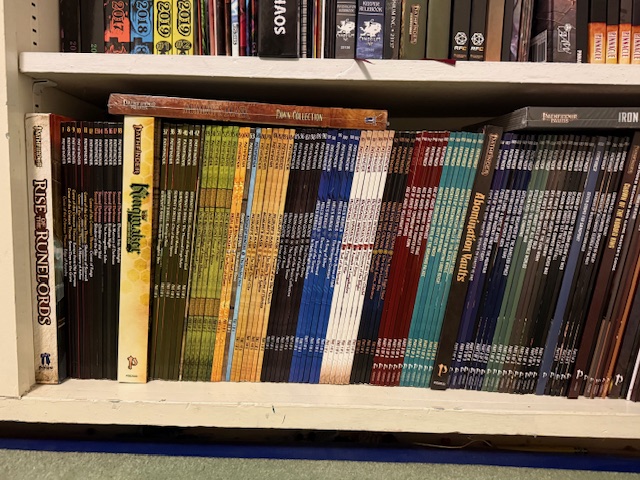
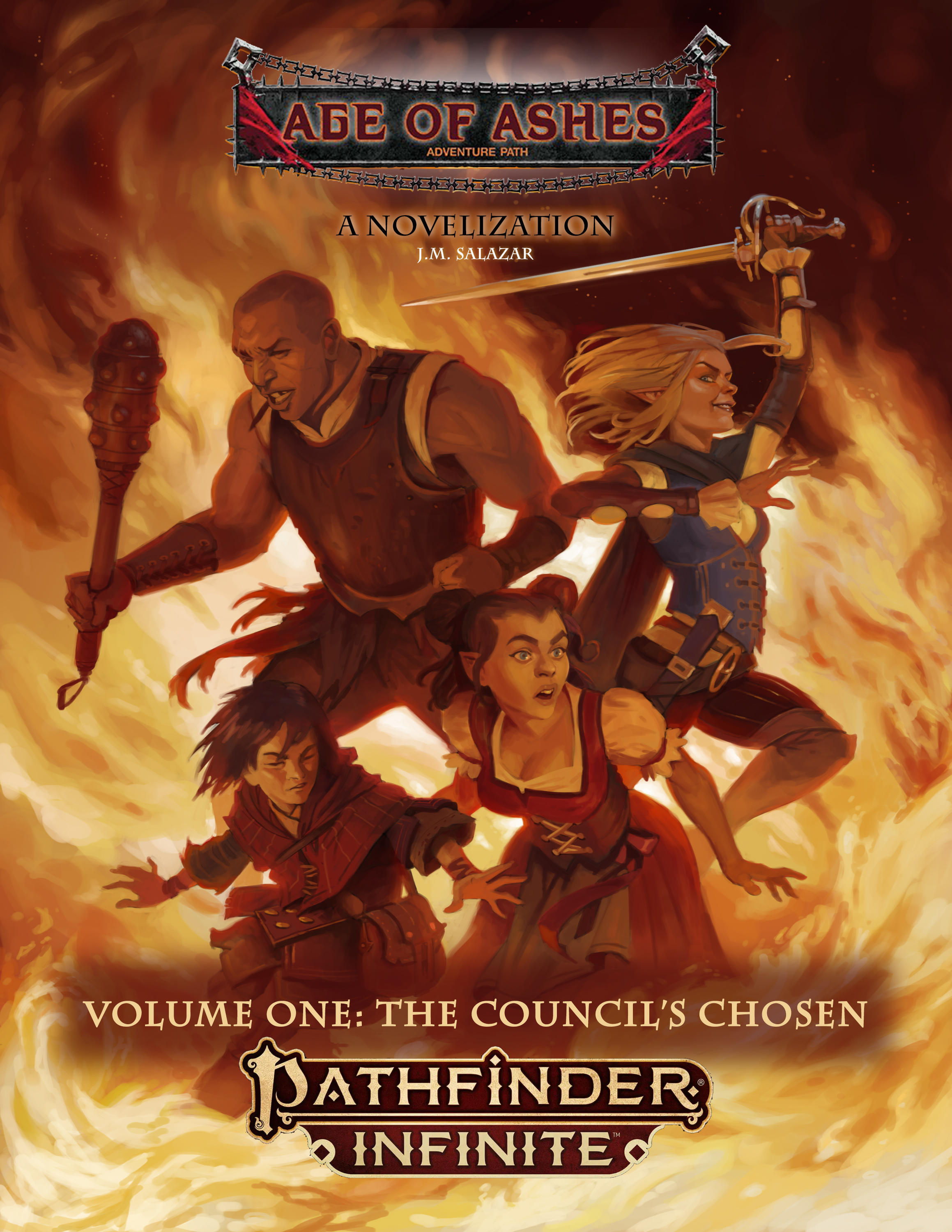
See, just after the new year I stumbled upon an estate sale with amazing deals on TTRPGs (rest in peace, whomever the devout gamer was with the impressive collection). I ended up buying several complete Paizo Adventure Paths from both Pathfinder editions. As I’ve mentioned before, one of my nerdy highlights is GMing the full Age of Ashes AP through six books over three years of play with my in-person group. That experience, then, spawned me writing a couple of Age of Ashes novellas (volume 1 here and volume 2 here). I would happily run another group through the full campaign. It’s great.

Meanwhile, I’ve also been a player in the full Sky King’s Tomb AP (which concludes this Friday! Will my dwarven bard survie the whole thing!?), and have played partial campaigns in Strange Aeons, Abomination Vaults, and Blood Lords. Suffice it to say, I love me some Paizo Adventure Paths, and acquiring several new ones re-sparked my desire to once again run a long campaign through a full, detailed story.
…which may seem at odds with my recent fantasy gaming interests like Dungeon Crawl Classics and Tales of Argosa, two systems that are a) decidedly less (super-)heroic than Pathfinder, and b) focus on shorter, more emergent stories that are strung together over time rather than the epic, long-form “railroads” of APs. Also, haven’t I been enamored with creating my own homebrewed world of Calvenor? Why, then, would I want a fully-baked and exhaustively-detailed setting like Golarion?
It turns out that I can have fun both ways. Yes, I imagine that, for the rest of my gaming life, I’ll be playing some emergent-story games, often in my own setting. Some of these games will be solo, but the whole reason for making the DCC deity and patron entries is to lay the groundwork for a long-form DCC campaign with friends. The thrill of such a campaign would be showing up each week, not knowing where the adventure would twist and turn, even as the GM. I’ll also, if Fates be merciful, enjoy combing through sprawling Adventure Paths for groups of players. At this point, I’ve experienced thousands of hours of fun in Golarion, and I love exploring its various countries and locales. I already own more APs than I can reasonably play in a lifetime, but man… I’d love to try.
(As an aside, if you also love APs and haven’t seen Tarandor’s Guide to the Pathfinder Adventure Paths, do yourself a favor and dive in. I pretty much agree with his entire preamble and this document is an invaluable resource for GMs. I’m thrilled to edit my next AP with his guide by my side, forming a coherent and compelling story from the published material.)
The only wrinkle is that—while I can’t wait to jump into AP after AP—I may be done GMing PF2e. It’s a system that I enjoy playing, but I’m at a stage in life now where the crunch gets in the way of immersion in a way that bothers me. I’d rather us all be storytelling around the table, sharing what’s happening and why, and less discussing the rules so fervently. I’ve played through Sky King’s Tomb with three professional GMs and a devout rules-lawyer. All of us know PF2e’s system inside and out and have internalized vast tomes of Golarion lore. We’re all generous with the spotlight, accomplished storytellers, and solid roleplayers. Yet and still, mostly what we do is strategize about what the rules allow us to do, far more than shared storytelling. I want more of the latter and less of the former.
A few weeks ago, I decided to write a Reddit post asking the wider TTRPG community for suggestions on “lighter” systems I might use to play through Paizo APs. What I outlined was a desire for a game with the following features:
- allows for crazy (super-)heroic stunts without the crunch
- fun to GM and easy to make stuff (like monsters, hazards, etc.)
- suitable for a long campaign (i.e. has some sort of character progression or at least the players won’t get bored with overly simplistic mechanics)
- can’t be tied too deeply into a setting – my intention is to keep the Golarion lore of the APs mostly intact
In other words, I’m looking for a system that is both interesting and complex enough that it can handle long-form storytelling, but light enough that I don’t have to spend hundreds of hours prepping.
The post received over 80 comments, generating excitement for systems I hadn’t considered (and, in some cases, even heard of!). I’ve since narrowed the many suggestions down to four systems to explore, at least for now. Today is the first of these explorations, in much the same way I looked for a very particular kind of superhero game almost two years ago.
Daggerheart
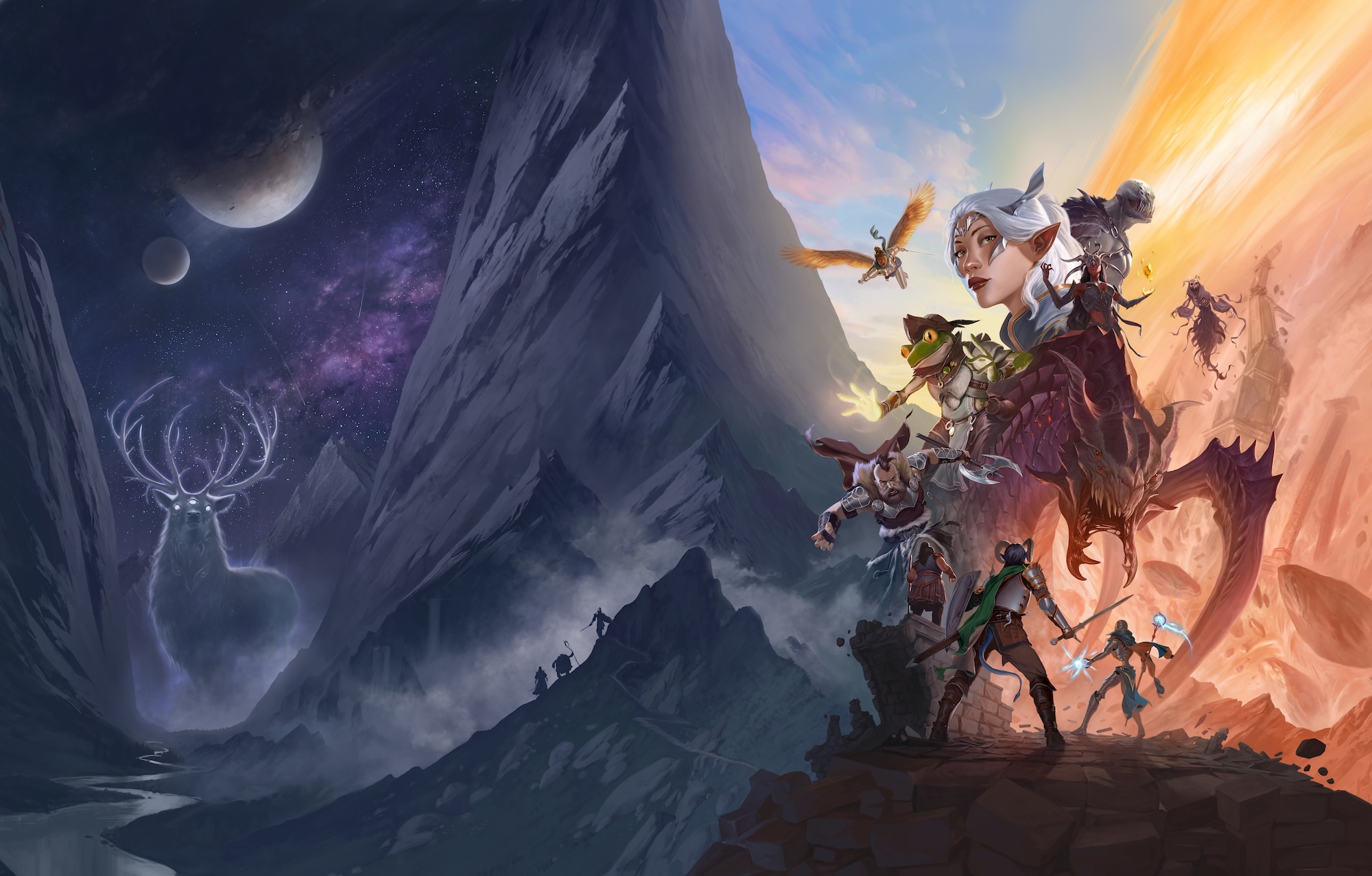
I’m beginning with the system I was least excited to crack open: Daggerheart.
See, as much as I hate to admit it publicly, I’m not a fan of Critical Role. Like, at all. Partly because I think that D&D 5eis one of the least exciting tabletop games around despite being by far the most popular. I’ve played a fair amount of 5e (because, again… most popular!), and I’ve found that a) combat is repetitive and boring, and b) different characters in the same class feel samesy to me. Again, not a fan. I tried to get into Critical Role anyway, but bounced off the storytelling, which felt more like improv theater kids playing pretend than anything that would make me want to roll dice. In fact, I found a lot of Actual Plays using 5e to be similar, fueled by CR’s wild success. It’s so discordant to me that so many great actors flock to a game that’s actually pretty crunchy and grounded in tactical combat, when so many other systems would showcase their talents and enable their stellar improv. But whatever… that’s a side rant. The point is: When I saw that Critical Role had made its own game, I rolled my eyes and had zero interest in checking it out.
Yet I kept seeing fans rave about the system, and it was one of the most recommended when I described my Paizo AP ambitions on Reddit. So, reluctantly, I went online and ordered the Core Set, sending my money to the CR folks. Truth be told, I still expected to hate it.
You know what? Daggerheart is kinda great!
Surprisingly, it takes inspiration from a lot of games I love and uses mechanics that are both easy to grok and fun. The signature mechanic is rolling two differently-colored d12 dice, one called the Hope die and the other the Fear die. You combine both numbers to see if you meet or exceed your DC, but a higher Hope die results in the player gaining Hope, a higher Fear die meaning the GM gains Fear. Both are metacurrencies to do cool narrative things in game and activate abilities. More than this elegant core mechanic, though, is the fact that the game is meant for more storytelling, less tactical combat. It achieves the narrative focus in a myriad of ways, and you can read excellent reviews and mechanics overviews from, among many others, Gamingtrend, The Yawning Portal, and EN World. You can even find more critical reviews, like this one from an OSR-leaning Sablemage on the Tavern. It seems that if you like TTRPGs for its tactical wargaming roots, you’re not going to like Daggerheart (you also won’t like it if a section on “safety tools” offends you, and for that I provide the aforementioned eye-roll). Since pouring over the Core Rules, I’ve read every review I can find, plus listened to several hours of podcast reviews (two highlights are Sly Flourish’s initial reactions to playing the game and the True Strike podcast in general). Suffice it to say, I’m 100% sold that Daggerheart is my kind of game.
Why Daggerheart Works For Me
Amazingly, the various tools from other games are all things I love. Metacurrencies like Hope and Fear for everyone around the table are cool. The ideas of “making moves” as a character in “scenes” from Powered by the Apocalypse games, Countdown Clocks from Forged in the Dark games, abstracted distance and movement, tracking Stress as well as Hit Points, simplified gold and equipment, treating rests like a minigame, making death a narrative option for the player, making leveling up interesting, open invitations to reflavor everything without changing mechanics, “adversary types” like minions that allow for heroic and epic encounters without bogging them down, and on and on—All of it makes me happy, both as a GM and player. Reading through the rulebook, it was immediately clear that I could play the system “out of the box” without an immediate need to pull in rules tweaks from other games (for an extreme example of my tinkering, check out how I hacked Crusaders for my Age of Wonders story).
Even better, all these rules sit atop a core intent of the game that is, like Pathfinder, inherently heroic, in a world that is meant to be made one’s own. PCs are supposed to be superheroes in a fantasy land, slinging impressive spells, vaulting from balconies, and throwing goblins into each other. I love me some classic Sword & Sorcery gaming where death lurks in every alleyway, but I also love heroic escapism straight out of the Marvel Cinematic Universe. It’s easy to see adapting Daggerheart to a setting like Golarion without any difficulty. Yes, I’d probably limit the Ancestry options depending on the Adventure Path. Yes, there’s a slightly different magic system at play. Yes, perhaps some of the Community options or spells would get reflavored. But I didn’t read anything that made me wince as a major setting incongruence. Heck, there’s even a whole section on combat wheelchairs, something that Paizo pioneered!
In another twist of fortune, the other three game books I ordered have been swallowed by inventory shortages and winter storms, and so I asked my Sky King’s Tomb group if they’d be willing to play a Daggerheart one-shot, with me converting the PF2e Beginner Box adventure, Menace Under Otari, into the system. They’ve already made their PCs in Pathbuilder and sent them to me, which I then converted. The whole process has been seamless and fun. We’re T-minus one week until the game, and I can’t wait!
So… am I done? Did I find my dream system on the first try? Will I set aside my distaste for Critical Role and sing their eternal praises for opening the way to my AP collection?
Not so fast, my friend.
My Daggerheart Concerns
Honestly, I’m being hyperbolic above, because the answer might be that I have indeed found my dream system on the first try. That said, there are a few niggling concerns to address before tossing aside my other options and jumping into a Daggerheart Session 0. Those concerns fall into three related domains: Class variety, the newness of the game, and the burden of homebrewing.
My first and biggest concern is around Class variety. I like that the initial rules provide 9 Classes, each with 2 Subclasses, making 18 total different “character options” available. But remember when I said one of my principal dislikes of 5e is the similarity of different characters of the same Class? At least out of the gate, in Daggerheart, if you’re a Druid then you automatically are a shapeshifter. If you’re a Sorcerer, you cast illusions. The are a limited number of abilities (represented by Domain cards), which makes me worried that once you’ve played, for example, a Bard, you’ve kind of done it and don’t need to do it again. My guess is that a) as I and my players got more familiar with the system, we’d be increasingly comfortable adding custom abilities and Class features, and b) Daggerheart will continue to release supplements, with more and more Class, Subclass, and Domain options. This last point leads me to…
Right now, the game is less than a year old. I’m heartened by the many testimonials from GMs who have been running dozens of sessions over months, but I think the jury is still very much out on whether Daggerheart handles higher-level play well, major errata, if there’s anything obvious that makes advancing in a long campaign less fun, etc. I started playing PF2e right as it released, then jumped in to run a full 1-20, six-book campaign. When Paizo decided to Remaster its books because of the OGL debacle, a part of my soul died looking at the money and time I’d already invested in the game. Eventually, annoyed, I sold my pre-Remastered books at a considerable discount (yes, I understand that I could still use them and play “Legacy” PF2e but the whole thing left a bad taste in my mouth). I am now a little gun-shy about investing too many hours in a game before seeing its warts—especially when that game is promising expansion and supplements. It’s one of several reasons why I probably fell in love with DCC so quickly, because it had already been out for a decade when I discovered it, which had me feeling more like an archeologist than a pioneer.
By far my smallest concern involves the burden of converting an entire Adventure Path’s creatures, hazards, environments, and magic items over to Daggerheart. There’s a nice encounter builder in the Core Rules, including how to make custom adversaries and balance them with the party’s size and level. In my limited experience, these tools both work and are dead easy to use, so it’s likely that my worry here would quickly fall away. That said, my instincts tell me that homebrewing content for Daggerheart is slightly more intensive than the other systems that I’m considering, and thus will take more time. If that time and effort is fun (like, say, the extreme example of my DCC deity and patron write-ups), though, I won’t mind.
There are glimmers of hope in the quickly-growing Daggerheart community that will combat all three of my concerns. The Void is a place where the makers of the game preview new content—like Classes, Adversaries, Environments, and Communities, to be released in the first expansion Hope & Fear and beyond. There’s quite a bit of content there already, which suggests that new official books are on the way. In the meantime, there’s purely community-driven content out there, with vibrant sites like Fresh Cut Grass and Heart of Daggers. In fact, I suppose Critical Role’s success is a boon to me here, because they are rapidly spreading the gospel of Daggerheart to a wide swathe of players and GMs, who are in turn generating content at a rate faster than most other new games I’ve seen. So… green chutes!
All of that said, I absolutely don’t have any of the complaints I’ve seen brought up occasionally in other forums. I don’t think the damage-armor system is too complicated for me or the people I play with, nor is juggling the various trackers (HP, Stress, Armor, Hope, etc.). The lack of a traditional initiative system is great, and consistent with other games I love. The “rulings over rules” idea of keeping some rule interactions open to GM interpretation works for me. The menagerie of Ancestries doesn’t push any of my buttons, and I’m perfectly happy to reskin or restrict options based on the AP I’m playing. I understand that these various complaints are frequent in Daggerheart discussions, and they simply don’t phase me.
One Game to Launch My Journey
As I’ve said repeatedly, I’m surprised by how much I like Daggerheart, and I may very well have found my new favorite heroic fantasy game. Before I fully commit, though, I did purchase three additional systems that merit consideration. Stay tuned for my next installment in this series (which will be… um… at least after the next DCC god/patron), where I check out one of these other options. I’m nervous that I’ll end up with more than one system that I’m excited to play …at least until I realize how awesome a problem that would be!
Please comment below or send an email to jaycms@yahoo.com with any feedback.

 My Hero Brain