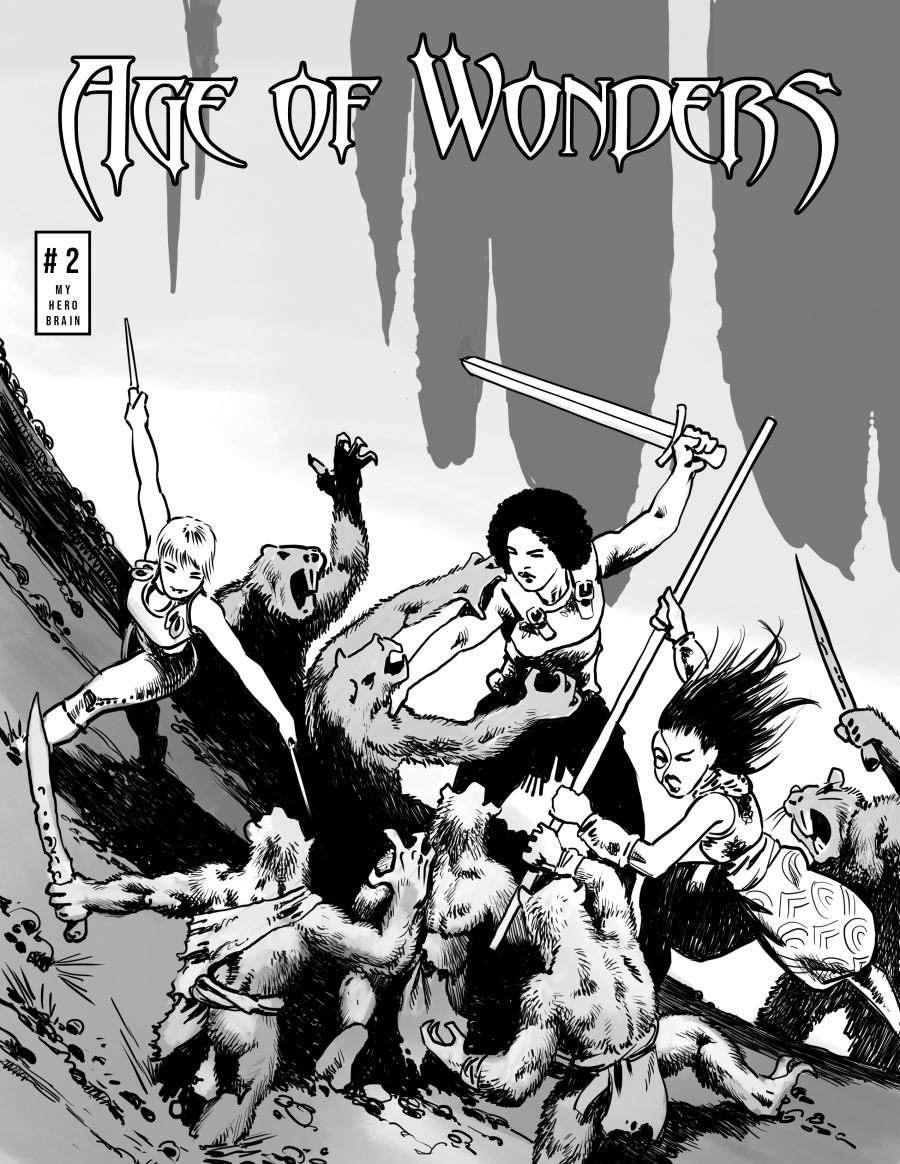
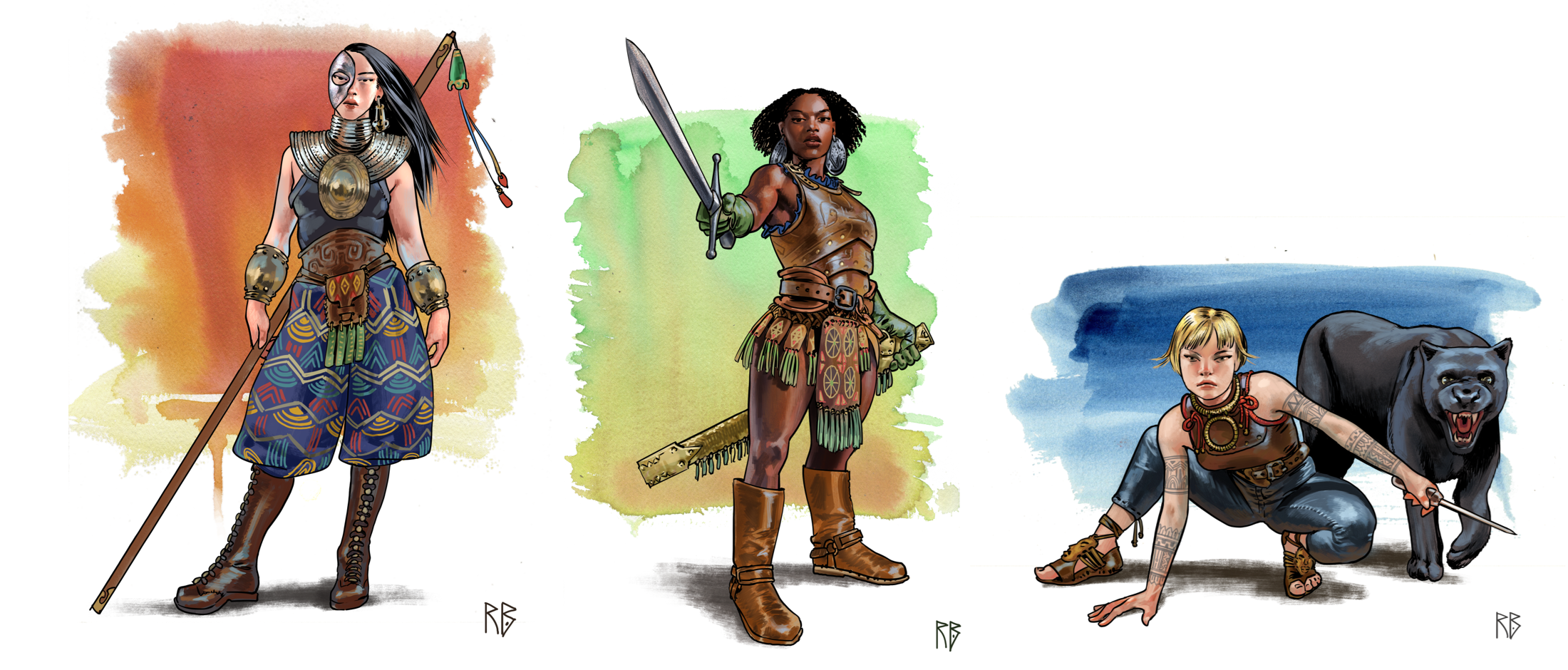
Issue 2 is in the books! Just in case you missed the action-packed installments, here they are:
- Issue 2a: Welcome to the Watch (with game notes)
- Issue 2b: Upstairs (with game notes)
- Issue 2c: The Bronze Armor (with game notes)
My goodness, we left off in the middle of a tense battle where I truly don’t know what’s going to happen, but during which I seriously contemplated killing Emah if the dice rolled a particular way. Yikes!
Before we get back into it and Issue 3, however, it’s time for my monthly pause-and-reflect post. I now have twice as many solo sessions under my belt as the last time I wrote one of these installments. Has anything changed? The short answer is that I’m still enjoying the system and story, though I’m seeing some of the limitations of a simpler mechanical game. I’m also realizing that I need a better way of tracking my various character plot threads, especially given how combat-heavy Crusaders is designed to be. All in all, though, for me it’s going well.
Another Amazing Cover
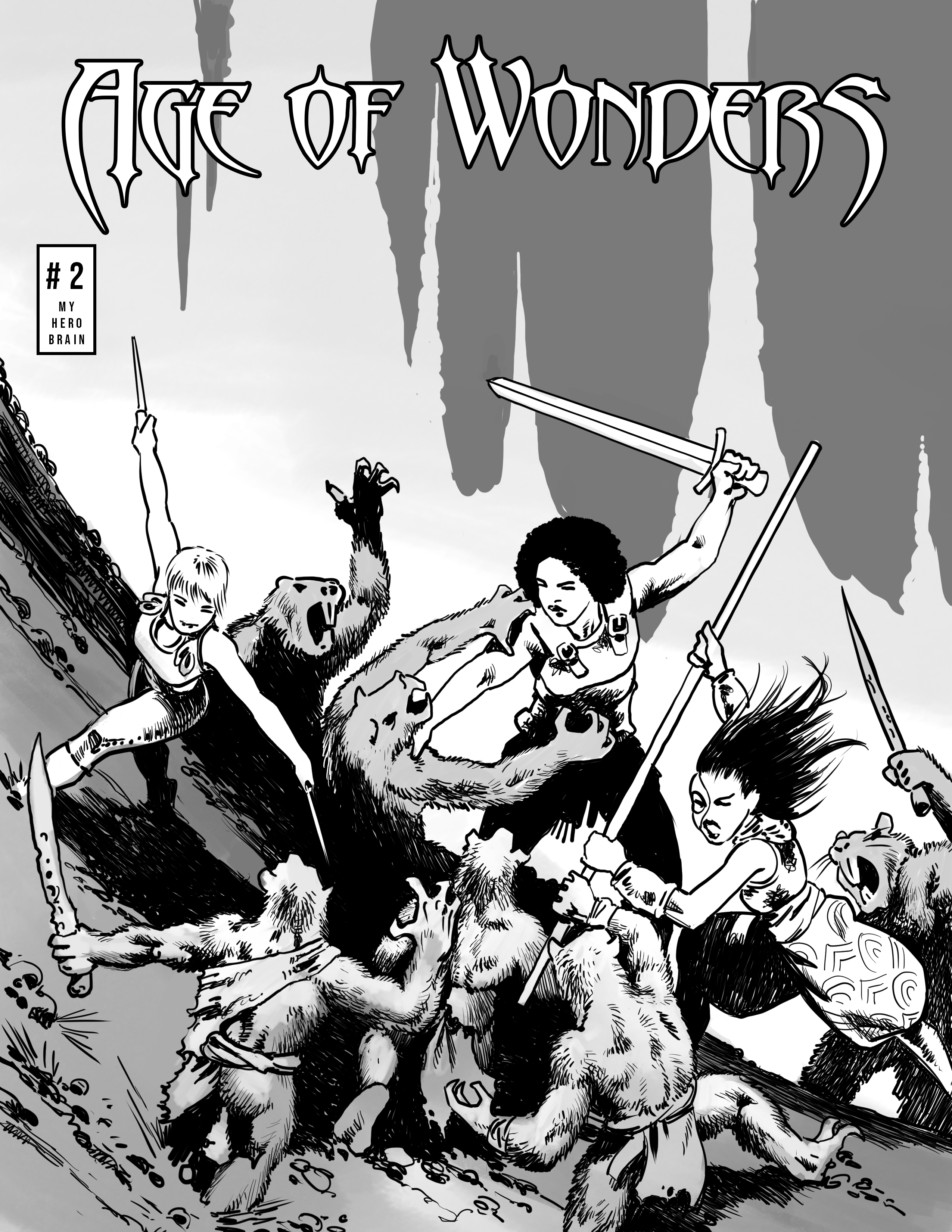
One thing that hasn’t changed is Roland Brown’s awesome artistic ability. It’s been a wonderful partnership seeing him bring my story to life, and I’m looking forward to keeping it going as long as he has time and energy. I originally wanted something like this image (the PCs battling ratfolk) for the first cover, but Roland wisely said we should wait until the rats were more of a known antagonist and instead use a more generic “introduce the team” cover for Issue 1. He was, of course, absolutely correct. Thank you, Roland!
What’s Going Well
I’m still enjoying the story and these characters, and feel absolutely comfortable in my variant-rules-heavy version of Crusaders. Most importantly, I’m getting a better handle on encounter design. My initial few fights (first against the rat mobs, then against a rat lieutenant, then against a City Watch lieutenant and mobs) were good tests of how powerful PCs are relative to mooks, even with me neutering the heroes with my Rank system. I’ve decided that I’ll either need to throw a lot of lower-level foes against the PCs to challenge them, or somehow combine them with environmental hazards, villains, or some other threat in order for the fights to be interesting. The most recent battle with the Bronze Armor has me pushing the upper limits of a fight with a Rank 3 villain plus mobs. Combine all these experiences, and I’m feeling more confident in my ability to judge an encounter’s difficulty and also create situations on the fly.
Speaking of the Bronze Armor, I made my first villain! In any superhero game, creating characters is usually one of the most fun parts of the game, so I’m happy that villains in Crusaders use the same creation process that brought me Kami, Maly, and Emah. I’ll continue to get my dopamine hit of the joy of random tables as long as I’m continuing to throw new villains at our characters, which is absolutely the plan. I hadn’t made this comparison in my mind yet, but I’m expecting this story to read somewhat like an Invincible comic with less gore, or maybe a Savage Dragon comic with less objectified women—lots of action and an ever-growing menagerie of interesting characters. All in an urban fantasy word, of course.
I’m also pleased to have finally introduced the panther Destiny into the story. My decision to start the narrative with Destiny as Maly’s secret turned into quite a different spin on combat than it could have been, but in hindsight I’m happy to initially have fewer characters to juggle and to get a clear sense of Maly’s voice, strengths, and weaknesses before uniting her with her animal companion. I’m hoping that Destiny will shine in the Bronze Armor fight, and then I’ll have to deal with the fact that our party is walking around with a creature foreign to the setting. Should be fun!
Which is all to say that I continue to be invested in these characters, story, and system. I’m also happy to have grounded myself in a published adventure instead of following a fully freeform narrative, which is the major change I discussed last time. I’m overall less anxious that my story is going somewhere concrete, which allows me to enjoy each twist and turn. Any Dungeon Crawl Classics fans know what slim module I’m drawing on for inspiration?
It’s not all sunshine and roses in Oakton, though. Nothing below gives me enough pause to change what I’m doing, but I am noticing a few things mechanically that may, eventually, get tiresome. In addition, given the combat-heavy nature of Crusaders and lack of social mechanics, I’m realizing that some of my plot threads are harder to explore than I expected. Again, the sections below are musings at this point more than problems to be solved.
Crusaders Combat and Noncombat
I don’t think that I’ve ever played a TTRPG that uses flat numbers for damage instead of random rolls. The intention, as Olivier Legrand says in the Crusaders rulebook, is to speed up gameplay. The number of maneuvers and fiddly bits in combat is also small. Olivier says, “You will find no weight charts, range tables, or movement rates…but a system designed to simulate comic book action rather than real world physics.” As I hope that I’ve demonstrated across the first two Issues, Crusaders combat is indeed fast and furious, and once you get a handle on the core concepts, flows easily. I find myself consulting books and charts very little during gameplay, which is a welcome contrast to many other superhero games. I genuinely can’t imagine how long the combats I’ve done already would have taken in some of the more popular game systems.
That said, simplification comes at a cost. It’s not uncommon to achieve either a 0% chance of success or a 100% chance of success on some actions, and flat numbers mean that some attacks will always knock out an opponent without fail. In addition, it occurs to me that the relative lack of randomization means that tweaks to powers or abilities can have dramatic effects on a character’s power. Take, for example, the Aura of Fear from the Bronze Armor. As written, it is basically undefeatable to any melee combatants of lower Rank, which is why I tweaked it. Things like Armor, or Kami’s Elasticity, or Maly’s Acrobatics also mean that many attacks will never, ever touch them. These sorts of absolutes may be somewhat comic book-y (after all, Superman simply can’t be hurt by mooks of any kind, Mr. Fantastic is never hurt by bullets, etc.), but they have the potential to be unfun and uninteresting.
On average, I’m enjoying the speed and ease of gameplay over these problems of Crusaders’ simple mechanics, and I’m clearly not afraid to change a rule if needed. But if I ever get bored of the game, it’s likely going to be because of the lack of variability of outcomes. For this reason, I’m even more happy to have introduced a “critical hits and fumbles” mechanic into my game.
My final wish for Crusaders is for it to have some structure around social mechanics. It’s a very OSR idea to not have such structure, and seems to be a deliberate design choice. “Don’t worry about things like persuasion, influence, bonds, reputation, and other subsystems that soak up time—just roleplay and get back to the punching” seems to be the intent, and for a live group of players this can work fine. Yet I find myself yearning for downtime mechanics like Blades in the Dark or Delta Green, ways to roll dice and experience the implications for my characters. Without them, the game begins to feel too much like a combat simulator where I’m just making stuff up freeform between battles. Ultimately, this is probably where I need to lean most on the Mythic GM Emulator. I just wish I didn’t have to.
Tracking Social Plot Threads
One of the unexpected consequences of a lack of social mechanics is that I get anxious when social scenes take too long. My intent is for Age of Wonders to read like a satisfying serial fiction, with alternate posts that allow you to “play along with me,” or at least see the gameplay that has led to the fiction. In Issue 2b, I got dangerously close to having a fiction-only post and a game-mechanics post be identical, and it low-key stressed me out.
Now, don’t get me wrong: I like keeping the story focused on the action and moving my characters constantly into dangerous encounters. What I’m realizing, however, is that I’m not allowing myself to embrace the interstitial time between encounters, which is where all the juicy character stuff happens. Here is a sample of interpersonal plot threads I’ve opened that are still on my mind:
- Why did Kami go to the jail with bodyguards, really? Why was she so mad when she found Raffin Hothorp dead?
- What are the implications of Kami being away from her employer? How will Elyn Brehill respond? What was said when she said she was leaving?
- Maly needs to get her inheritance back and make the East Bay Dragons pay. How will she do that?
- Where did Destiny come from? What’s his deal?
- We haven’t seen Emah’s father yet… what’s their relationship like and under what circumstances do they see one another? She also has a mentor and a rival at the university. Will they come into the story?
- Who’s Emah’s love interest? (you may have noticed I was angling for it to be Sergeant Mewa… oops he’s dead)
- Is Inspector Calenta a reliable ally like Charlie Townsend or an Amanda Waller-like manipulator?
- There are soon going to be too many strange occurrences for the general public to ignore. What happens in Oakton as the Wyrding’s changes become more known?
Etcetera etcetera… Keep in mind that these are plot threads outside the primary plot involving the ratfolk investigation (what are they? what do they want? can the city get rid of them? etc.). They are personal plots, focused on character exploration and development, any one of which could take an entire series of posts to flesh out. Because I’m leery to spend too much time writing without rolling dice, I’m worried about these threads getting lost in my narrative. Ultimately that’s on me to track and figure out, but I wanted to flag that a) it’s on my mind, and b) with Crusaders as my game system, it’s not obvious to me how best to balance these story elements with the very-fun combat sessions. I’m also in danger of piling up too many threads to track and need a better system for doing so.
That’s it for now! If you’re enjoying the story or have suggestions, drop me a comment below or feel free to email me at jaycms@yahoo.com.
Next time: Back to the Battle! [with game notes]
 My Hero Brain
Pingback: Age of Wonders, Issue 2c: The Bronze Armor – My Hero Brain
Pingback: Age of Wonders, Issue 2c: The Bronze Armor [with game notes] – My Hero Brain
Pingback: Age of Wonders, Issue 3 Reflections – My Hero Brain