
Last time, I outlined my dreams for my next project: Continuing the solo-play, serial writing I’ve done the past year with Dungeon Crawl Classics, but in a fantasy-superhero mash-up story of my own creation. Because DCC doesn’t do superheroes, I’ve opened the door to another TTRPG as the underlying system I’m playing. My general instinct has been that it’s easier to adapt a superhero game to a fantasy setting than taking a fantasy game and adding superpowers. I’m also open to more setting-agnostic games, especially ones that have both fantasy and superhero supplements.
The special requirements for the game I choose are:
- A superhero game that can be played in a fantasy setting, plus allow for anachronistic weapons and technology. Basically, the superpowers and fantasy elements need to be satisfying, but allow for other genre shenanigans.
- Is neither too crunchy (if I’m consulting forums or rulebooks more often than writing, that’s bad) nor too lightweight (I need to feel like the dice are guiding the story and enhancing the narrative). I want to feel like the mechanics support the story.
- Level-up jumps in power. My idea is that the PCs start as “street level” heroes and become demigods as the story progresses. Something will be pushing them closer to godhood, which is a core part of the story. The game should not only allow for those different levels, but be fun to play at all of them.
- No hard-wired comics tropes (like secret identities, costumes, etc.). The story will be a genre mash-up, so I can’t hew too closely to any overly specific formulas.
I’ve discussed the dozens of popular games that I’ve already discarded from consideration, including all the behemoths in the genre and some of my personal favorites. Today I begin my dive into the eight (yes, last time I said seven… but comments on the last post here, plus Facebook and Reddit discussion, convinced me to add one) games I’m still actively pondering. Truly, I still have no idea which one I’ll choose, but I’m hoping this series will untangle my brain. Each post is meant to be a full dive and exploration, to really pressure-test each system against my needs and wants.
Let’s kick things off! First off is one of the games on the pile I know the least…
Supers! RED
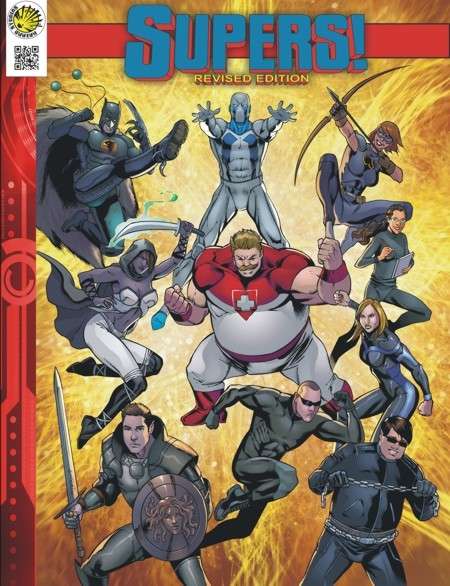
Probably the most annoying thing about Supers! RED is its name, which is just generic enough to make web searches difficult. It’s an abbreviation for Supers! Revised Edition, a 2014 revamp of a game originally published in 2010 by a different author. Any reviews and play-throughs I can find on the game use the “RED” nomenclature, though, so Supers! RED it is. Also, sometimes SUPERS! is all caps, but inconsistently, so shhh.
The original Supers! is a lightweight game system, using handfuls of d6s in a way that I think originated from the West End Games Star Wars system. I don’t own the original Supers! book, but here’s a nice interview with the RED authors describing why they decided to revise it and what improvements they made. Suffice it to say, they clarified rules, filled in gaps not covered (like how you break things or grappling rules), improved the presentation, and added examples and optional rules—so the game is essentially the same, but polished up and with more options. In other words, if you want to buy the game, get Supers! RED by Hazard Studios, not the original.
The core mechanic is that each attribute, skill, and power have an xd6 value, which you roll whenever you want to do something. In combat, opponents also roll abilities or powers to defend themselves, setting the DC to succeed. Each character has four resistances (Composure, Fortitude, Reaction, and Will), and PCs (not the GM) choose when taking damage which resistances to lower, so each character effectively has four distinct “hit point” pools. Indeed, one of the strengths of the system is that the PCs have a good amount of control over how to interpret what happens and why, while still grounding these decisions in dice rolls. For a tutorial on the basic system, check out this short video. Watching that video alone, it’s apparent that Supers! RED is easy to figure out, has a lot of narrative wiggle room, and adapts easily to multiple genres (there’s no functional difference between, for example, an arrow and a laser).
On top of that basic system are several tweaks that give the game some depth. There are combat maneuvers, Competency dice (the game’s meta-currency to give players an edge), power boosts and complications, PC advantages and disadvantages, plus optional rules for dice caps, pushing actions, wild dice, and alternate damage. Even without the options (the one I like best is adding a “wild die” to each dice pool that explodes, making actions have the potential for more dramatic effects, since the level of success matters when determining results of an action), there are interesting trade-offs in playing Supers! RED that hopefully keep the game fun to play despite its seeming simplicity.
One more thing I love (which is similar to my favorite supers game Sentinel Comics RPG): Enemies have different levels of complexity based on how important they are to the story. Major villains are built like PCs, with all the same Resistances and access to abilities. Major lieutenants are “henchmen,” and have an xD value, scaled to the threat they represent and what they use for all attacks and defense. “Mooks,” meanwhile, are groups of nameless enemies with a single xD value. Mechanically, henchmen and mooks are identical but get interpreted differently, one as an individual and one as a mob. This system allows PCs to feel like real superheroes, tackling piles of low-level enemies at a time and making bigger threats feel like final bosses.
To wrap my head more fully around the system, I made a starter character, keeping it a low-powered PC with a more classic fantasy base. Here she is:

I’m not going to go into all the ins and outs of what’s on the sheet, but a few quick notes: You can see that from all the white space that the system does not contain a lot of detail (although admittedly this is a low-level “pulp hero,” about as basic as it gets). It was easy for me to grasp the character creation process, what trade-off choices I was making, and how to build what was in my mind’s eye, even only reading through the book once. Start to finish, Evlyn took me about fifteen minutes to make.
Interestingly, there isn’t anything particularly “fantasy” about Evlyn when looking at the sheet, though I had a fantasy trope in mind when building her—namely, the bookish scholar pulled unwittingly into danger. What’s heartening is that, although she’s meant to be a scholarly and investigative character, Evlyn is still useful in combat. As far as I can tell, in fact, there’s no such thing as a “useless in combat” Supers! RED character because of the open-to-interpretation nature of the Aptitudes and Powers, and the flexibility to attack or defend with anything on your sheet that has a d6 value as long as you can explain it.
Why Supers! RED Works For Me
As the above section illustrates, Supers! RED is an incredibly flexible system, grounded in creatively explaining how the few words and dice-value on a character sheet interact. Falling off a building? I’ll use my Ice Powers as a defense, creating a frozen slide to keep me safe. Someone’s throwing knives at me and hits? The damage is to my Composure, because they didn’t physically hit me but now I’m freaking out. I’m attacking a group of 2D mooks, doing 1D damage? I land on one of them, then spin a kick, sending a second one into a third, cutting my number of foes in half before they can blink. All the rules in Supers! RED are ways of increasing or decreasing the number of d6 used, and the effect adds or subtracts from the available d6s next time. It’s elegant and open to whatever interpretation works in your game. As a result, it’s a system that can basically work in any genre, all with a 168-page rulebook and nothing else. For a genre mash-up game, that’s a boon. In fact, I took glee in a Reddit comment from a player that said they’d played a multi-year Supers! RED fantasy, sword-and-sorcery campaign without superheroes.
Speaking of campaigns, I love the game’s clear scaling of power levels. Pulp heroes are 10-15D total in value, all the way up to cosmic legends of 50D value. I can imagine starting my PCs at 12D characters like Evlyn, awarding them Competency Dice each milestone or adventure, and letting them spend those Dice to improve their Resistances/Aptitudes/Powers, purchase Boosts/Advantages/Powers, or reduce Complications once they’d hit 15D, and then every 5D after that. After only eight “level” jumps, the PCs would have moved from barely enhanced humans like Evlyn above to a true cosmic demigod. This is exactly the sort of power jump that I consider a core part of the game I run next.
Because of the sparse, easy-to-understand system, making NPCs on the fly or improvising situations appears absurdly easy. The deeper I went into the rulebook, the more I thought that I could convert any adventure in any game system into Supers! RED without hassle. For a GM, the game is silly-easy to prep and requires simply the ability to translate situations into appropriately sized d6 pools. Oh, there’s a wildfire? That’s a 3D hazard. Twenty lizard men come pouring out of a fissure in the earth? Let’s call those two 2D groups of mooks, oh and let’s say they have a leader who’s a bruising 3D henchman leader. The simplicity of Supers! RED keeps the focus on vivid description and away from rules lawyering.
My Supers! RED Hesitations
I have one big worry about Supers! RED and three smaller ones. My largest hesitation is probably obvious: The system may be too lightweight to be satisfying. Making Evlyn’s character sheet was easy. Staring at it, though, it’s difficult to find inspiration for creativity. She has four Aptitudes and one Power… those five values must literally explain every single action she makes, adventure after adventure, until she levels up and adds 1-2 more (and that assumes that I add Aptitudes or Powers instead of solely increasing the value of those she already has). Will I get bored describing enemy after enemy in similarly restrained ways? Is a 3D fire elemental going to feel different enough from a 3D gang of skeletons to be interesting? The strength of Supers! RED is its open-to-interpretation, narrative focus, but I’m looking for something that gives me a feeling of tension and exhilaration when I roll the dice. I’m worried that I may not be giving myself enough narrative tools to enhance my writing versus simply, you know… writing.
I’ll cover my other three gripes quickly because they’re all minor. First, Supers! RED has very little support as a game system. There are no player or GM forums, there’s no module on Foundry VTT or any other virtual tabletop, and few supplemental books exist by Hazard Studios or other third parties. That’s fine, but I often mine forums and supplements for inspiration, ask questions of fellow GMs, and use the VTT to immerse myself in the game experience. None of that is possible here.
Second, I’m surprised to find that the lack of randomness–both in character creation and game play–is an unwelcome shock after playing so much Dungeon Crawl Classics (which is famous for how laden it is with random tables). There’s a random character creation variant process at the back of the rulebook, but it doesn’t really work for me and honestly feels a little half-baked. Thinking about it, I would probably make random characters in a different system, then quickly translate them into Supers! RED. That’s a fine workaround, I suppose, but strikes me as pretty silly if I’m going through all of this trouble to pick my game system of choice.
Finally, as someone who almost became a comic book artist after college, I’m utterly uninspired by the artwork in Supers! RED. I feel terrible saying it out loud, because I know how difficult good artwork is. A real joy about PF2E, however, is the rampant Wayne Reynolds art. DCC is famous for its old-school approach, led by Doug Kovacs. Heck, Johan Egerkranz is almost the entire reason that I bought physical copies of Dragonbane and Vaesen. For me, the art in a game is best when it sets my mind on fire with possibilities, wanting to lose myself in the world. Any superhero game is trying to attract comic books fans, which is a visual medium defined by its artists, so I’m a little baffled when supers TTRPGs get this wrong. With Supers! RED, I’m distracted by how little I enjoy looking at the book. Add to “the art problem” the lower quality paper and print from my print-on-demand copy of the rulebook, and I find the sensory experience of the game frustratingly poor. I am looking past a lot of blech to see the possibilities in this game.
Are any of these last three reasons enough to ditch Supers! RED as my chosen game? Absolutely not. It’s the lightweight gameplay that’s the primary worry. But since I have seven more systems (unless I continue to find more… lord help me) to consider, I suppose that everything is a factor. Speaking of which…
One Game to Rule Them All
I have a feeling that, at the end of this assessment process, I will have a pile of games that weren’t exactly right for my current project but that I desperately want to take for a test spin. In future installments, I’ll take the time to rank each system here. The game at the top will be the one I choose to solo-play next, but a handy ranked list will help kickstart me next time, if there is a next time. For now, though, I’ve only done one full exploration, so this section is as sparse as it gets:
Top Contender: Supers! RED
Next time: The exploration continues! If you have thoughts about this system or others I should add to my pile, I’m all ears!
 My Hero Brain
Pingback: Choosing a Supers System, Part 1: What I’m Not Playing – My Hero Brain
Pingback: Choosing a Supers System, Part 3: Prowlers & Paragons – My Hero Brain
Pingback: Choosing a Supers System, Part 4: ICONS – My Hero Brain
Pingback: Choosing a Supers System, Part 5: Cortex Prime – My Hero Brain